Haiti Politic | Analysis | October 28, 2026
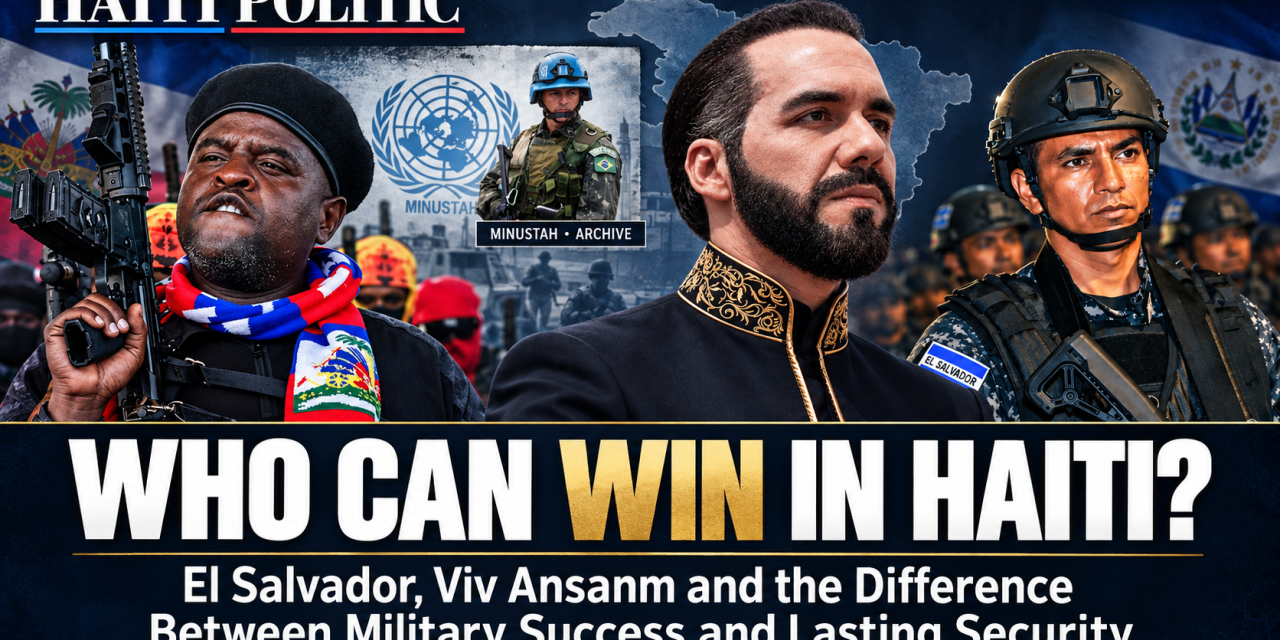
El Salvador’s expanding deployment to Haiti has produced competing predictions: that Nayib Bukele will break the power of Viv Ansanm, or that Haiti will expose the limits of his security model. Neither outcome is established by the arrival of more soldiers.
The more defensible assessment is conditional. Salvadoran forces could gain the advantage in individual engagements and help Haitian forces recover particular areas. But military success would not automatically dismantle the networks that sustain armed power. Viv Ansanm could suffer serious losses and still retain enough influence to obstruct normal life. A prolonged confrontation without a decisive winner is a credible risk, not an inevitable outcome.
For Haitians, the most important definition of victory is whether people can return home, travel, attend school and work safely under institutions that remain accountable after foreign troops leave.
What the deployment establishes
Reuters reported on October 27 that approximately 1,000 Salvadoran soldiers had arrived in recent days, citing a Haitian security official. Its reporting left important questions unresolved, including who would command the new contingent and how long it would remain. Higher figures circulating publicly should be treated as separate reports until independently confirmed. [1]
The reinforcement followed the October 18 ambush after which four Salvadoran aviation technicians went missing. Their reported disappearance helped turn an aviation-support contribution into a much larger security commitment. It does not, by itself, establish a clearly defined long-term mission. [1]
Recovering missing personnel, weakening an armed alliance and building lasting Haitian security are different objectives. Each requires different measures of success. The danger is that political messaging combines them while leaving the public uncertain about the actual undertaking.
Guerrilla warfare is a useful comparison—with limits
Calling the confrontation guerrilla warfare can highlight its uneven character: a foreign military force faces locally embedded armed groups rather than another conventional army. But the term should not substitute for analysis of what those groups do, how they are organized and what sustains their authority.
Using methods associated with irregular warfare does not, by itself, establish that an organization is a liberation movement or enjoys popular consent. Nor does residence in an area controlled by armed groups establish that its civilians support them.
The Global Initiative Against Transnational Organized Crime argues that Haiti’s armed groups must be understood through their connections to political and economic power, rather than simply through an insurgency framework. Its March 2026 research warns that operations aimed only at armed actors can leave the systems sustaining violence intact. [2]
That creates a fundamental challenge for a military response. Soldiers may change the immediate balance of force without changing who finances intimidation, protects illicit activity or benefits from the absence of functioning institutions.
Why Salvadoran forces could gain a military advantage
A professional military contingent can bring organized command, training and access to substantial military capabilities. Whether those advantages translate into success against Viv Ansanm depends on conditions that are not fully established publicly, including the readiness of the deployed units and the opposing force’s organization. Those capabilities could help Salvadoran and Haitian personnel accomplish defined security objectives.
This is an assessment of potential, not a verified comparison of every unit’s readiness. Public information does not establish the full composition, equipment, intelligence support or operational effectiveness of the newly arrived Salvadoran contingent.
International backing also matters. Reuters reported that a U.S. military official confirmed American C-130 transport support for the deployment. Miami Herald reporting described Pentagon airlift provided at the State Department’s request. [1][3]
That assistance helps explain how reinforcements can arrive quickly. It does not establish that Washington commands every operation or pays every associated bill. Nor does an aircraft’s arrival demonstrate that the receiving force has the local knowledge, institutional support or public trust required for sustained security.
Bukele’s domestic reputation is similarly not a transferable guarantee. A foreign deployment operates within another country’s institutions and political conditions. Whatever assessment one makes of his record in El Salvador, Haiti requires an independently defined strategy.
Why Viv Ansanm could remain a threat after setbacks
The two sides face different burdens. A security mission promising stability must help make civilian life reliably safer. An armed alliance can frustrate that promise without defeating every military unit.
Its survival need not mean uninterrupted control everywhere. Continued intimidation, displacement and interference with economic life could be enough to prevent the government from demonstrating durable authority.
This is why casualty counts and temporary territorial gains cannot establish strategic victory. Public safety can remain precarious even after a successful operation.
Viv Ansanm’s current internal cohesion, command relationships and ability to coordinate across its member groups are not independently established in the evidence reviewed for this article. The assessment therefore assumes neither internal divisions nor complete unity. Those uncertainties limit any confident forecast about its response to sustained military pressure.
Military pressure could weaken the alliance, but that remains a possible outcome rather than an established trajectory. The question is whether such a change would produce accountable public authority or merely redistribute armed power.
Command and political purpose remain central
The confrontation is not simply El Salvador versus Viv Ansanm. Haitian police and armed forces, GSF contingents and other security actors also shape the environment.
The GSF’s founding resolution gives participating governments a strategic oversight role while assigning operational command to its force commander. It authorizes targeted counter-gang operations and support for Haitian security institutions, subject to international law. [4]
If additional Salvadoran personnel operate through a separate bilateral arrangement, the relationship between that arrangement and the GSF needs to be explained publicly. The documents reviewed for this analysis do not establish all those terms.
The issue is practical as well as constitutional: who authorizes action, investigates alleged misconduct and answers to Haitians when something goes wrong? Unclear responsibilities can obstruct coordination and make accountability harder.
MINUSTAH makes promises insufficient
Haitians have reason to demand more than assurances that a mission is internationally authorized.
MINUSTAH was a UN peacekeeping operation with obligations to protect civilians and promote human rights. Nevertheless, its deployment included sexual exploitation and abuse. In 2007, the UN announced the repatriation of Sri Lankan personnel on disciplinary grounds following an internal investigation. [5]
MINUSTAH’s legacy also includes the cholera epidemic introduced by peacekeepers. In December 2016, Secretary-General Ban Ki-moon apologized for the UN’s role. The apology acknowledged responsibility; it was not a criminal judgment providing victims with full redress. [6][7]
The GSF has a different institutional structure: it is a UN-authorized multinational force supported by a separate UN office, rather than another MINUSTAH. That distinction explains organization, not moral superiority. [4]
A credible difference would require independent investigations, public findings, prosecution where evidence warrants it, and accessible remedies for victims. These are standards against which the new deployment should be judged—not achievements that can be assumed.
Protecting civilians is part of success
An operation that weakens armed groups while causing unlawful harm, displacement or arbitrary detention can undermine the security it claims to deliver. People living under armed control must not be treated as collectively responsible for it.
An account of violence by Viv Ansanm cannot establish the innocence of foreign forces. Abuses by international personnel cannot excuse violence by armed groups. Responsibility must follow evidence in each case.
This also means distinguishing among actors: harm attributed to a Haitian unit, a private contractor or one international contingent should not automatically be assigned to every other force. Accountability requires identifying who acted and who exercised responsibility.
The possible outcomes
Three broad outcomes are plausible.
First, Salvadoran forces and their partners could achieve limited military successes without a lasting settlement. Particular areas might become safer while insecurity persists elsewhere.
Second, pressure could weaken Viv Ansanm and be followed by sustained gains through Haitian policing, functioning courts, public services and lawful action against financial and political facilitators. This is the pathway most consistent with a meaningful Haitian victory.
Third, operations could expand without clear political objectives or lasting institutional capacity. Mounting costs, civilian harm and distrust could then leave foreign forces unable to deliver security while armed groups remain capable of disrupting it.
There is insufficient public evidence to assign reliable probabilities to those outcomes. Confident claims of Bukele’s inevitable triumph or downfall exceed what is known.
The assessment
Salvadoran forces may have the advantage in particular military engagements. Viv Ansanm may retain the ability to survive setbacks and deny an easy political victory. Neither possibility establishes the final outcome.
What would change the assessment is evidence of durable civilian safety, accountable command, functioning Haitian institutions and disruption of the relationships sustaining armed violence. Independent monitoring should measure those outcomes alongside troop deployments and operations.
A foreign force can help create room for recovery. Lasting security requires Haitian institutions capable of protecting people fairly and maintaining that protection. If they remain dependent on repeated foreign deployments, military success will have fallen short of national recovery.
SOURCE NOTES
[1] Reuters, Sarah Morland, October 27, 2026, “Around 1,000 soldiers from El Salvador have deployed to Haiti, source says”: https://www.investing.com/news/world-news/around-1000-soldiers-from-el-salvador-have-deployed-to-haiti-source-says-4976576
[2] GI-TOC, March 2026, “Brokers and Patrons: Unstitching Gangs from Haiti’s Political Fabric”: https://globalinitiative.net/wp-content/uploads/2026/03/Brokers-and-patrons-Unstitching-gangs-from-Haitis-political-fabric-GI-TOC-March-2026.pdf
[3] Jacqueline Charles/Miami Herald, republished by Aviation Pros, October 26, 2026: https://www.aviationpros.com/aircraft-maintenance-technology/aircraft-technology/defense/news/55414282/salvadoran-troops-land-in-haiti-aboard-pentagon-plane-amid-crisis-over-ambushed-soldiers
[4] UN Security Council Resolution 2793 (2025): https://mandates.un.org/mandate/S/RES/2793(2025)
[5] UN Secretary-General spokesperson, November 2, 2007, statement on MINUSTAH: https://www.un.org/sg/en/content/former-secretary-general/statements/2007-11-02/statement-attributable-the-spokesperson-for-the-secretary-general-the-un-stabilization-mission-haiti-(minustah)
[6] Ban Ki-moon, December 1, 2016, remarks on cholera: https://peacekeeping.un.org/en/node/131687
[7] Harvard Law School, June 24, 2020, “Seeking overdue reparations for U.N.-caused devastation in Haiti”: https://hls.harvard.edu/today/seeking-overdue-reparations-for-u-n-caused-devastation-in-haiti/
EDITORIAL NOTE
This is strategic and political analysis, not a prediction based on access to military plans. Reported troop figures and mission arrangements remain subject to verification and change. No unpublished bilateral agreement or complete current roster was available for this analysis.