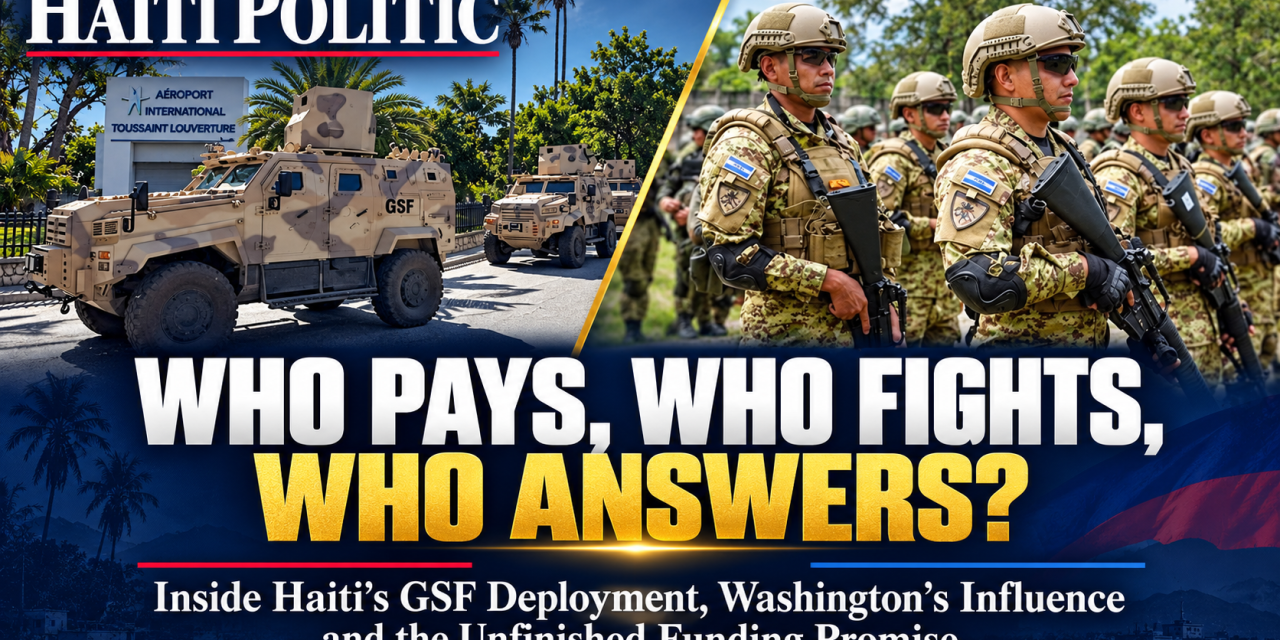
The arrival of foreign troops in Haiti raises an immediate question: can they help restore security? Behind that question sits another set of decisions—who supplies the soldiers, who pays their deployment costs, who directs operations, and who must answer when something goes wrong.
The Gang Suppression Force, or GSF, brings those decisions together in an arrangement that is often compressed into the phrase “UN-backed mission.” That description is accurate but incomplete. UN authorization, UN logistical support, national military payrolls and voluntary donor financing are different parts of the operation. Understanding those distinctions explains both the mission’s promise and its vulnerabilities.
This account draws on public mandates, government documents and reporting. It does not claim access to confidential operational plans or unpublished financial agreements.
A STRONGER MANDATE, AN INCOMPLETE FORCE
On September 30, 2025, Security Council resolution 2793 authorized the transition from the Multinational Security Support mission to the GSF and requested a UN Support Office in Haiti, known as UNSOH. The GSF is a multinational force authorized by the Security Council, rather than a conventional UN blue-helmet peacekeeping operation. [1, 2]
The authorization provides for targeted, intelligence-led operations against gangs, alongside support to Haitian security institutions. Its structure separates strategic oversight by the Standing Group of Partners from day-to-day operational decisions by the Force Commander. [1]
The distinction matters: a UN resolution supplies authority, but participating governments still have to deliver trained personnel, equipment and sustainable support.
The GSF’s first progress report recorded 1,213 uniformed personnel as of August 31, 2026, against an authorized ceiling of 5,500. El Salvador’s aviation contingent accounted for 125 at that date. The report identified deployment speed, protected mobility, engineering and aerial surveillance as constraints. [3]
October reporting put the force at a little over 2,000—still well below its authorized strength. That is a dated estimate, not a verified roster for every subsequent arrival. [4]
On September 29, the Council extended the GSF mandate until March 31, 2027. Renewing permission to operate does not itself fill the deployment gap. [5]
TWO FINANCING CHANNELS, DIFFERENT RESPONSIBILITIES
The mission’s finances have two principal channels. UNSOH’s logistical and operational support is financed through UN assessed contributions. Troop stipends and personnel support continue to depend on voluntary contributions, including money administered through the UN trust fund. Canada’s official briefing documents explicitly describe this distinction. [6]
Assessed contributions are obligations allocated among UN member states under UN budget arrangements. Voluntary contributions depend on governments choosing to commit resources. Consequently, the existence of a UN support office does not mean every part of the GSF has guaranteed funding.
The first progress report supplied the following trust-fund snapshot for July 31, 2026: [3]
• Pledged by 15 member states: US$223.9 million.
• Received in cash: US$184.2 million.
• Disbursed: US$70.4 million.
The pledge-to-cash difference was US$39.7 million. These are historical totals for the UN-administered fund supporting the MSS/GSF framework, not a current balance or the complete cost of the GSF. Disbursement is also not synonymous with soldiers’ take-home pay.
Nor does money received but not yet disbursed automatically establish waste or wrongdoing. Determining whether funds were committed, reserved, awaiting documentation or delayed would require fuller accounts.
ARE SOLDIERS PAID BY THE UN OR BY THEIR COUNTRY?
That question combines two different transactions: a government paying its personnel and a mission mechanism reimbursing deployment costs.
Resolution 2793 calls for financial support for personnel reimbursements, training and other necessary expenses through the trust fund. That establishes a financing mechanism; it does not publish a universal daily salary for every soldier. [1]
The normal national-military arrangement is that personnel remain on their country’s payroll, with overseas allowances and mission reimbursements governed by applicable agreements. For the Salvadoran contingent, however, the reviewed public material does not establish the precise payroll arrangements, individual allowances or amounts actually received.
It is therefore premature to attach one daily dollar figure to every GSF soldier. A reimbursement rate paid to a contributing government would not automatically equal the amount deposited into an individual soldier’s bank account.
Earlier reporting about Kenyan personnel under the predecessor mission cannot establish a Salvadoran GSF pay rate. Different contingents, dates and agreements require separate verification.
HAITI’S REPORTED US$50 MILLION: COMMITMENT VERSUS PAYMENT
HaitiLibre reported in December 2025 that Haiti would contribute US$50 million to the GSF, combining monetary support and support in kind. The proportions were not specified. [7]
That is materially different from saying that the Haitian Treasury deposited US$50 million into the UN trust fund.
The reviewed sources do not establish the cash portion, the value of each in-kind contribution, or how much was actually transferred into that fund. An announcement is evidence of a commitment, not a receipt.
A meaningful public accounting would identify the authorizing decision, cash-transfer dates, recipient account, valuation of noncash support and confirmation of receipt. These details would allow citizens to assess whether the government fulfilled its promise and what resources Haiti actually supplied.
The unanswered questions justify a demand for transparency. They do not, by themselves, establish that the money disappeared.
WHY NOT INVEST THE REPORTED US$50 MILLION IN HAITI’S OWN ARMY?
This is the strongest opportunity-cost question raised by Haiti’s reported commitment. National resources devoted to a temporary foreign deployment should be weighed against investments that leave Haiti with trained personnel, functioning bases, equipment, maintenance systems and accountable command.
But the available evidence does not establish that the government took US$50 million in available cash away from the Armed Forces of Haiti. The reported commitment combines cash and support in kind, and a verified transfer ledger has not been established.
Nor is it accurate to say that Haiti has undertaken no national capacity-building. At the July 20, 2026 Security Council meeting, Haiti reported that 1,500 new members were being recruited into the armed forces. Recruitment is evidence of an initiative, not proof that those recruits are fully trained, equipped or operational. [14]
The possible policy rationale is to obtain immediate international assistance while national forces develop. That is an interpretation of the approach; the reviewed sources do not provide a published cost-benefit analysis establishing why this particular contribution was preferable to alternative army or police investments.
Money can support recruitment and equipment purchases, but producing deployable units also requires instructors, logistics, leadership, maintenance, communications, medical support and continuing operating funds. An army investment and an international deployment therefore have different timelines and potential benefits.
The government should publish how much its GSF commitment actually costs, what it purchases, and how the mission will transfer skills and responsibilities to Haitian institutions. Without a funded national capacity plan and measurable handover milestones, temporary international assistance risks becoming a recurring dependency.
WASHINGTON’S ROLE WITHOUT AN AMERICAN COMBAT CONTINGENT
The absence of a publicly announced U.S. GSF combat contingent should not be confused with an absence of American influence.
In its March 2026 report to Congress, the State Department said the United States, as chair of the Standing Group of Partners, led development of the GSF concept of operations, helped mobilize voluntary financing and worked with Canada on a pledging conference. [8]
Washington’s influence therefore extends beyond writing checks. It helps shape the mission’s strategic framework and recruit its contributors. Operational command, however, remains distinct from that political role.
This arrangement also distributes exposure differently. Contributing countries place personnel in the field; Washington exercises substantial diplomatic influence without supplying an equivalent frontline combat contingent. That is an analysis of the structure, rather than evidence of a secret agreement or a confirmed motive for every U.S. decision.
The history of American intervention adds political sensitivity. U.S. forces occupied Haiti from 1915 to 1934, and contemporary policy analysis identifies that legacy as a reason a U.S.-led intervention would be contentious. [9, 10]
But there is no sound basis to conclude simply that Washington stayed out because it knew it would lose a guerrilla war. That would turn speculation about motives into a claim of fact.
American embassy protection is also a separate mission. The documented deployment of U.S. military personnel to reinforce embassy security in March 2024 was not a GSF combat contribution. [11]
EL SALVADOR’S EXPANDING ROLE AND THE OCTOBER AMBUSH
El Salvador’s legislature approved a new participation law on September 29, 2026. It authorized military and civilian personnel, aircraft and other resources according to mission requirements, for an initial twelve months beginning October 2. [12]
The October 18 attack on four Salvadoran aviation technicians brought the deployment’s risks into sharper focus. AP reported their disappearance after an attack in Croix-des-Bouquets and the subsequent arrival of Salvadoran reinforcements for search and security operations. [4]
Subsequent reports about recovered remains did not settle their identities. As of October 26 reporting, identification remained unconfirmed. Claims that the four men had definitively been killed should therefore not be presented as established fact. [13]
The reinforcements also raise administrative questions that cannot be answered by counting aircraft or uniforms: which personnel fall under the established GSF contingent, what command arrangements apply, and which deployment costs are eligible for reimbursement?
Arrival in Haiti alone does not establish entitlement to a particular trust-fund payment. Those answers require the relevant agreements and official records.
THE ACCOUNTABILITY TEST
The central challenge is whether this international structure can produce durable public security under Haitian authority.
There are separate responsibilities. Donors must explain their commitments and payments. Contributing governments must account for their personnel and conduct. Mission leadership must explain operational results and civilian protection. Haitian authorities must account for national resources and the institutions expected to sustain security.
Success should be assessed through outcomes Haitians can observe: safer travel, reopened public services, protection against displacement, lawful handling of detainees, and the ability of Haitian institutions to maintain security after an operation ends.
Troop arrivals and donor announcements are inputs. They do not establish lasting control, public trust or a functioning justice system.
The GSF’s deployment exposes a difficult bargain: international partners supply authority, resources and personnel through different channels, while Haiti bears the consequences of both success and failure. The public deserves a clear account of who promised what, who delivered, who commands—and what lasting security those commitments actually purchase.
SOURCE NOTES
[1] UN Mandate Registry, Security Council resolution 2793 (2025).
https://mandates.un.org/mandate/S/RES/2793(2025)
[2] UN Digital Library, adoption record, September 30, 2025.
https://digitallibrary.un.org/record/4089907?ln=en
[3] GSF first progress report, S/2026/732, September 10, 2026; reporting period April–August 2026. UN document reproduced by HaitiDocs.
https://docs.haitidocs.org/gsf-annual-progress-report-2026.pdf
[4] Associated Press, October 23, 2026, El Salvador deploys special forces to Haiti to help find four missing soldiers.
https://apnews.com/article/el-salvador-haiti-special-forces-gangs-03ec2bf89616d8b313c54da34c24eab1
[5] UNSOH, Security Council extends Gang Suppression Force and UNSOH mandates, September 29, 2026.
https://unsoh.unmissions.org/en/unsoh/news/security-council-extends-gang-suppression-force-and-unsoh-mandates
[6] Global Affairs Canada, parliamentary briefing documents, November 27, 2025, Haiti section.
https://international.canada.ca/en/global-affairs/corporate/transparency/briefing-documents/parliamentary-committee/2025-11-27-faae
[7] HaitiLibre, First infos on international contributions to the GSF, December 2025. Reported commitment; not proof of payment.
https://www.haitilibre.com/en/news-46393-haiti-flash-first-infos-on-international-contributions-to-the-gsf.html
[8] U.S. Department of State, Report to Congress on Options to Counter Destabilization in Haiti, March 2026. Relevant passage available in indexed official text; direct PDF retrieval was blocked.
https://www.state.gov/wp-content/uploads/2026/03/Report-to-Congress-on-Options-to-Counter-Destabilization-in-Haiti-HRC1317762-HRC1318869-Access.pdf
[9] U.S. Department of State, Office of the Historian, Haiti country guide.
https://history.state.gov/countries/haiti
[10] Carnegie Endowment for International Peace, Securing America’s Near Abroad: Recalibrating U.S. Policy Toward Haiti, July 2026.
https://carnegieendowment.org/research/2026/07/recalibrating-us-policy-toward-haiti
[11] GovInfo, H. Doc. 118-119, March 2024 embassy-security deployment notification.
https://www.govinfo.gov/app/details/CDOC-118hdoc119/CDOC-118hdoc119
[12] Legislative Assembly of El Salvador, September 29, 2026.
https://asamblea.gob.sv/node/14133
[13] The Washington Post, October 26, 2026, Confusion in Haiti over whether bodies belong to missing Salvadoran soldiers.
https://www.washingtonpost.com/world/2026/10/26/confusion-haiti-over-whether-bodies-belong-missing-salvadoran-soldiers/
[14] United Nations, Security Council meeting 10198, July 20, 2026, Haitian statement on recruitment.
https://transcripts.un.org/en/sc/10198
REPORTING LIMITS
Figures retain their source dates. This article does not establish a current audited fund balance, Haiti’s verified cash deposit, individual Salvadoran pay, or the final fate of the four missing personnel. Analytical conclusions are distinguished from documented events.