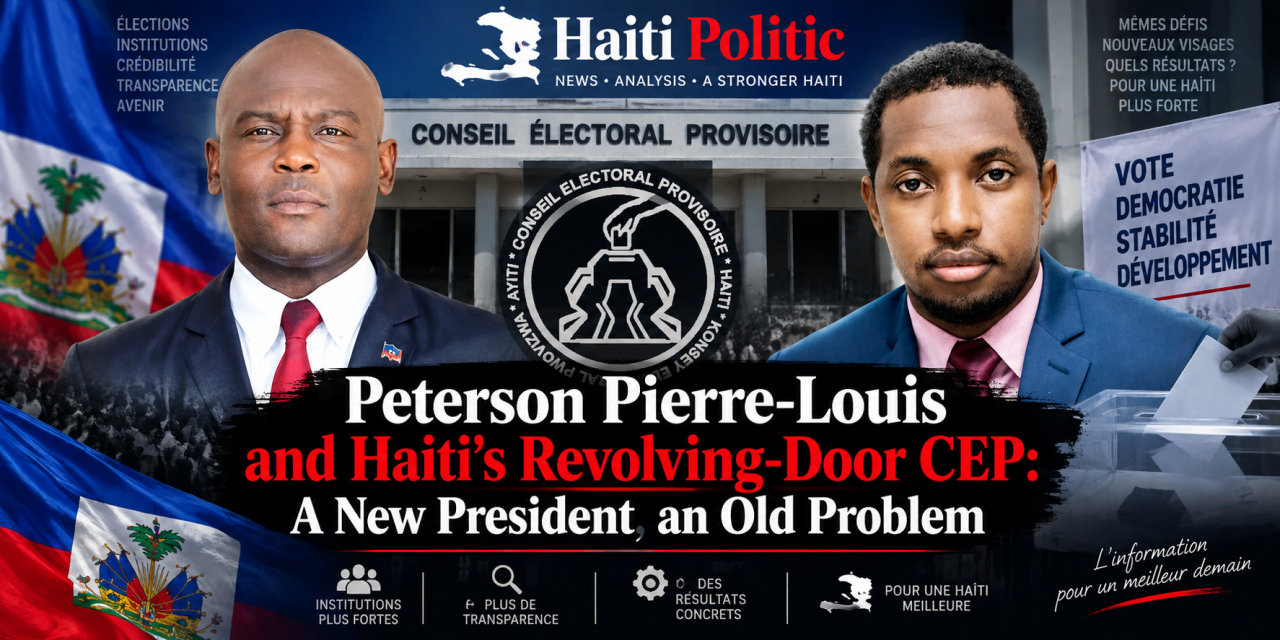
On September 8, 2026, Haiti’s Provisional Electoral Council (CEP) reshuffled its executive bureau for the third time in under two years, installing Peterson Pierre-Louis — until then the Council’s secretary-general — as president, replacing journalist-sector representative Jacques Desrosiers. The rotation leaves the underlying nine-member council untouched and does not, by itself, change the electoral calendar. But it revives a structural question that has dogged every iteration of Haiti’s electoral machinery since 1987: what does it mean for the presidency of the body organizing the country’s elections to depend on internal horse-trading among sectoral representatives, rather than on a fixed, insulated mandate?
A council that eats its presidents
Pierre-Louis is the CEP’s third president in roughly two years — after Patrick Saint-Hilaire (representing the Episcopal Conference of Haiti) and Jacques Desrosiers (representing journalists’ associations). Haitian commentary has been blunt about the pattern: one widely read editorial in Rezo Nòdwès described the institution as having been turned into an “École des fans” — a reference to a popular talent-show format — with the Primature accused of engineering rotations to suit its political interests. Desrosiers’s own removal reportedly followed friction dating back to April 2026, when the government succeeded in imposing a Director General at the CEP’s executive secretariat over the Council’s preferred Director Executive — a dispute that left Desrosiers publicly insisting on institutional neutrality while other councilors grew openly hostile toward him.
This is the deeper “CEP leadership problem” that predates Pierre-Louis: since the collapse of the 1987 Constitution’s original nine-member, three-branch-nominated model, virtually every Haitian electoral council — provisional or permanent — has been reconstituted from scratch ahead of each electoral cycle, with sectoral representatives (churches, press, human rights groups, universities, bar associations, unions, peasant organizations) horse-trading for the presidency. Continuity of institutional memory is rare; credibility fights are constant; and the executive branch has repeatedly been accused, under both elected and transitional governments, of using its leverage over funding, security, and personnel appointments to shape who ends up chairing the Council at the moment that matters most — just before a vote.
Who is Peterson Pierre-Louis?
Pierre-Louis is not a novice to the institution: he has served as the CEP’s secretary-general since taking his seat, giving him direct administrative experience with the machinery he now leads. He is also, notably, not a lawyer, electoral technocrat, or civil-society appointee in the conventional sense — he is a Protestant pastor, and a long-standing figure within the Fédération Protestante d’Haïti (FPH), where he previously held the position of secretary-general.
Why the Protestant sector, and why him specifically
Haiti’s electoral councils have historically reserved a seat for the country’s religious sector — a nod to churches’ broad social reach and their role, alongside civil-society groups, in the 1987 Constitution’s vision of a council insulated from the three traditional branches of government. In practice, that seat has rotated between confessions: the Episcopal Conference (Catholic) held it under Patrick Saint-Hilaire; the “Cultes réformés” — the umbrella term used for Protestant and evangelical churches — hold it now, through Pierre-Louis.
The FPH is the institutional body the Haitian state recognizes as its primary interlocutor with the country’s hundreds of individual Protestant churches and missionary networks. It is not a single denomination but a federation of Protestant coalitions, and it was the FPH — under its president, Calixte Fleuridor, himself a former member of the 2023 High Transitional Council (HCT) — that ran the internal process to select the Cultes réformés’ nominee to the CEP in August 2024. Pierre-Louis won that internal vote.
The selection was immediately contested. The Confédération des pasteurs haïtiens (COPAH), the Conseil national spirituel des Églises d’Haïti (CONASPEH), and the Fédération des pasteurs haïtiens (FEPHA) all publicly objected, arguing the FPH had run a process that excluded other legitimate Protestant networks and had effectively engineered a unilateral choice. Fleuridor rejected the criticism outright, calling the matter a closed chapter and dismissing his critics as sore losers. The FPH nonetheless held the state-recognized mandate to submit a nominee, and its choice was formalized by government decree on September 19, 2024, seating Pierre-Louis on the Council — over the continued objections of the rival pastoral networks, objections that resurfaced in Haitian commentary as soon as his presidency was announced this month.
Two years later, that same contested mandate has carried him to the top of the institution. Some Haitian commentators have gone further, framing Pierre-Louis as Fleuridor’s protégé — noting that Fleuridor, who could not steer Haiti to elections during his own time on the HCT, has now seen his handpicked nominee inherit precisely that unfinished task at the CEP.
Recent activity
Since the reshuffle, Pierre-Louis has moved quickly to signal continuity on the diaspora-engagement front: on August 31, 2026 — while still secretary-general — he took part in a working session with Canadian Senator Suze Youance and Haiti’s chargée d’affaires in Ottawa on diaspora participation in the upcoming vote, alongside the new secretary-general Nemrod Sanon and treasurer Schnaïda Adély. The new bureau also includes Jaccéus Joseph, representing the peasant sector, who retained the vice-presidency.
The challenges ahead
Pierre-Louis inherits an electoral process already under serious strain:
- The calendar. The CEP has published a 2026–2027 calendar targeting a first-round presidential and legislative vote on December 13, 2026, with candidate registration extended to October 14 after complaints from political parties and groupings. Whether that date survives contact with reality is an open question — some commentary suggests Pierre-Louis’s elevation may itself be a prelude to an announcement that December 13 is no longer achievable, a task Desrosiers was reportedly reluctant or unable to deliver.
- Security and territorial control. Large parts of the country, particularly around Port-au-Prince, remain under gang influence, complicating voter registration, candidate movement, and the logistics of Election Day itself.
- Institutional credibility. The rotation comes against a backdrop of accusations — echoed across Haitian commentary this week — that the Primature under Alix Didier Fils-Aimé has steadily expanded its influence over the CEP’s internal composition and administration, most visibly through the April 2026 fight over the executive secretariat’s leadership.
- Sectoral legitimacy. The unresolved 2024 dispute over his own nomination means Pierre-Louis takes the CEP presidency without full buy-in from the Protestant sector’s rival networks — a fracture that could resurface if his decisions as president touch on matters those networks care about.
Does the new leadership favor Etzer Émile?
The question deserves to be addressed directly, and carefully, because the underlying facts checked out on independent review. Etzer Émile — the economist and prominent Haitian media commentator — is confirmed to be the son of Pastor Alnève Émile, who led the Mission Évangélique Baptiste du Sud d’Haïti (MEBSH) as pastor and superintendent for years. MEBSH is a large evangelical network — overseeing schools, congregations, and the Radio Lumière network — and it is, as the mission’s own materials state, a member of the Fédération Protestante d’Haïti, the same federation whose internal process produced Peterson Pierre-Louis’s CEP nomination.
So the denominational thread is real: both men’s institutional lives run through the FPH network. What doesn’t currently exist, on the public record, is a concrete matter linking the two. Etzer Émile has not declared a candidacy in the December 13 elections, and there is no indication he has any registration, dispute, or filing currently before the CEP that Pierre-Louis’s presidency could influence. Absent such a matter, “favoritism” has no specific decision to attach to — a shared church federation is a social and institutional affiliation, not, by itself, evidence of an electoral favor in motion.
That said, the concern is not baseless as a structural point. Haiti’s sectoral-representation model for the CEP was designed to diversify institutional oversight, not to import church-network patronage into electoral administration. If Etzer Émile — or any other figure moving in the same ecclesiastical and political circles as Pierre-Louis or Fleuridor — were to enter the race, declare a party affiliation, or find himself party to a CEP dispute, the pre-existing denominational tie would immediately raise a legitimate recusal question, and Haitian civil society would be right to press for transparency about how it’s handled. Until that happens, the fairest reading is that the FPH network gives Pierre-Louis an existing web of personal and institutional relationships — the kind that matter in a small political class — without there yet being a specific electoral matter for that web to be tested against.
The bottom line
Pierre-Louis’s rise says less about him individually than about a recurring feature of Haitian electoral governance: a CEP presidency that changes hands through internal sectoral bargaining, under a government accused of shaping the outcome, with legitimacy disputes from a councilor’s original nomination following him into the role years later. Whether he can succeed where his predecessors — and his own political patron — could not, in actually delivering a credible vote, is the question that will define his tenure far more than any church-network affiliation.