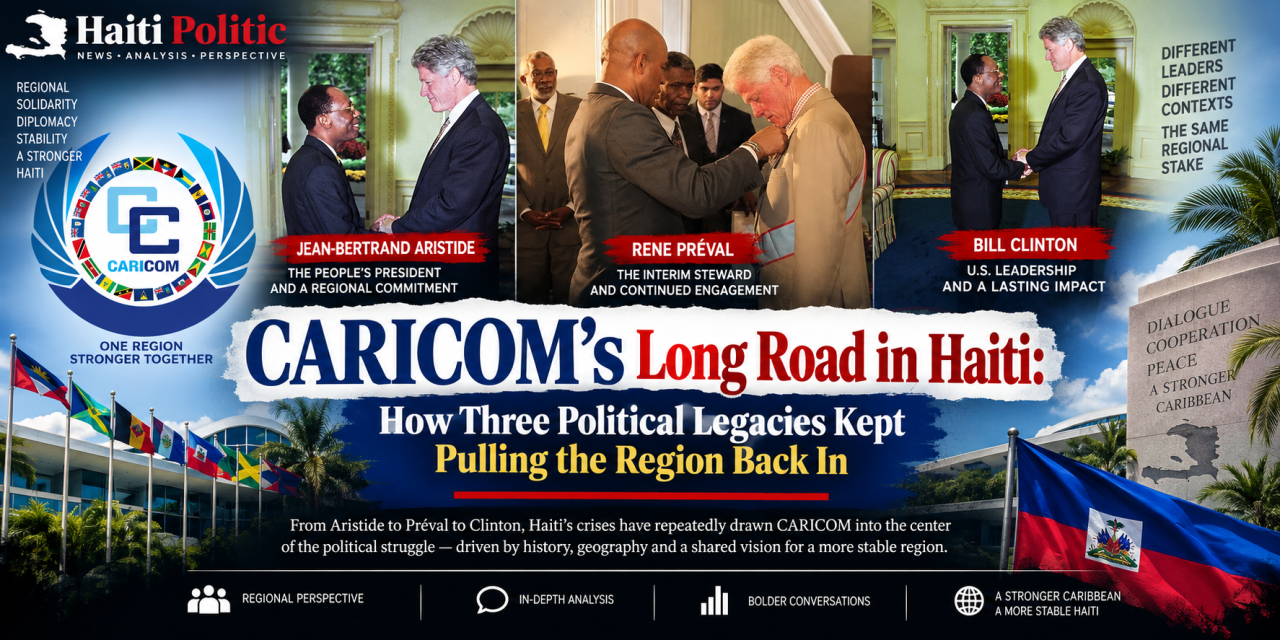
Haiti has needed CARICOM more often, and for longer stretches, than almost any other member of the bloc — and a close look at the historical record shows that this isn’t a coincidence of geography or bad luck. Each major cycle of CARICOM engagement traces back to a specific set of political decisions made by identifiable leaders, three of whom stand out for how directly their choices reshaped Haiti’s trajectory and, in turn, CARICOM’s role: Bill Clinton, Jean-Bertrand Aristide, and Michel Martelly. None of the three acted alone, and Haiti’s crises have deep structural roots that predate all of them — but the record shows each left CARICOM managing consequences of decisions made well above the Haitian people’s heads.
Founding Ties and the 1994 Intervention
CARICOM’s relationship with Haiti predates Haiti’s formal membership by nearly three decades. The bloc engaged with Haiti from its own founding in 1973, treating it as a close neighbor and a trade market despite the language barrier and political distance that came from Haiti’s history outside the English-speaking Caribbean’s institutional orbit.
The first major test came after the 1991 military coup that ousted newly elected President Jean-Bertrand Aristide. The response, Operation Uphold Democracy in 1994, was a U.S.-led multinational intervention authorized by the UN Security Council to restore Aristide to power. CARICOM member states — Jamaica, Barbados, and the Bahamas among them — contributed personnel to the effort, giving the region a direct stake in the outcome from the start.
Where Clinton enters the picture: Operation Uphold Democracy was launched under President Bill Clinton, and it is remembered in two very different ways. To Clinton’s defenders, it prevented further bloodshed under the military junta and restored a democratically elected government. To many historians and Haitian policy critics, the intervention came bundled with conditions — Aristide’s return was negotiated alongside acceptance of IMF- and World Bank-backed structural adjustment measures, including privatization of state enterprises and tariff reductions that critics argue devastated Haiti’s domestic rice and agricultural sectors by opening the market to subsidized U.S. imports. That criticism has followed Clinton for decades; he himself later publicly acknowledged, in testimony to Congress in 2010, that the trade policies pushed during his administration had hurt Haitian farmers, a rare admission of error from a former president regarding his own Haiti policy. The 1994 intervention set a template CARICOM would see repeated: outside powers resolving an immediate political crisis in Haiti while leaving underlying economic and institutional fragility largely unaddressed — fragility that would generate the next crisis CARICOM had to manage.
Full Membership and the 2004 Ouster
Haiti formally joined CARICOM on July 1, 2002, deepening the institutional relationship just as Aristide, restored to office in 1994 and re-elected in 2000 in a vote boycotted by the opposition and criticized internationally for irregularities in legislative races, was governing through what had become an increasingly polarized and violence-marked political landscape.
Where Aristide enters the picture a second time: By his second full term, Aristide’s government faced mounting accusations — from domestic opposition, international observers, and later scholarship — of tolerating or directing armed gangs (the so-called chimères) to intimidate political rivals, alongside disputed elections and a breakdown of independent institutions. Whatever the balance of responsibility between Aristide’s governance and an opposition that was itself uninterested in compromise, the result was a security collapse that, by early 2004, had armed rebels controlling much of the country. Aristide left Haiti on February 29, 2004, aboard a U.S.-arranged flight, under circumstances he has always described as a forced removal — effectively a kidnapping orchestrated by the U.S. and France — while the U.S. government’s account has maintained he resigned and requested the flight for his own safety. That dispute has never been definitively resolved to all parties’ satisfaction.
CARICOM’s institutional response is notable precisely because the bloc did not simply accept the U.S. and French position. It strongly protested the manner of Aristide’s departure, questioned whether due constitutional process had been followed, and for a time refused to recognize the interim government, sending fact-finding missions — led by figures such as Ambassador Colin Granderson — to investigate the unrest and press for accountability. In other words, CARICOM’s posture in 2004 was shaped directly by the vacuum Aristide’s fall created and by discomfort with how outside powers, principally Washington and Paris, had handled his exit.
Martelly’s Presidency and the Roots of the Current Crisis
Michel Martelly’s presidency (2011–2016) is where the line to Haiti’s present emergency — the one CARICOM’s Eminent Persons Group and Transitional Presidential Council are now trying to manage — becomes most direct.
Martelly took office after a first-round 2010 election so contested that the Organization of American States intervened to recalculate the results and put him into the runoff in place of the government-backed candidate. He governed largely by decree for extended periods after parliament’s mandate lapsed in January 2015 without new elections being held, a pattern of institutional erosion that outside observers, including CARICOM, watched with growing concern. When Martelly’s own presidential term ended in February 2016 without a successor having been elected — the runoff having been postponed amid fraud allegations — Haiti was left without a sitting president, functioning largely on a series of provisional arrangements that further hollowed out its governing institutions.
The more consequential legacy, however, surfaced years later. U.S. Treasury sanctions announced in 2022 accused Martelly, by then a former president, of using his time in office and afterward to engage in significant public corruption and to have links to two of Haiti’s most powerful and violent gangs, allegations Martelly has denied. Whatever the ultimate legal resolution, the sanctions reflect a widely shared assessment among Haiti analysts: the gang networks that later metastasized into the armed groups controlling most of Port-au-Prince by 2023–2024 — the very crisis that forced Prime Minister Ariel Henry’s 2024 resignation and triggered CARICOM’s most intensive mediation effort yet — trace organizationally and financially back to political patronage networks built up during and after the Martelly era, when politicians on multiple sides reportedly armed and funded gangs as tools of political control.
The Pattern: CARICOM as the Institution Left Holding the Transition
Read together, the three episodes form a pattern rather than three unrelated crises:
- Clinton’s 1994 intervention restored electoral democracy but paired it with economic conditions that critics say undercut the material basis for that democracy to stabilize, feeding the poverty and state weakness that made later crises more likely.
- Aristide’s second-term collapse and 2004 ouster left CARICOM defending Haitian sovereignty against a foreign-brokered exit it wasn’t sure it could trust, while the underlying armed-gang dynamic he was accused of tolerating didn’t disappear — it evolved.
- Martelly’s governance-by-decree and alleged gang ties produced the institutional vacuum and armed-group infrastructure that CARICOM’s Eminent Persons Group (former Prime Ministers Kenny Anthony, Bruce Golding, and Perry Christie) was assembled in 2023 specifically to address, culminating in the negotiated Transitional Presidential Council of April 2024 after Henry’s resignation.
Each time, CARICOM has been the regional institution called in not to originate Haiti’s political crises but to manage the aftermath of decisions made by these three men and the systems around them — mediating, monitoring elections, and now co-governing a transition process because no purely Haitian or purely external actor has proven able to break the cycle. Whether the current Transitional Presidential Council can finally deliver stable, internationally credible elections remains an open question — and, if history is a guide, one CARICOM has been asked to answer more than once before.
This article reflects publicly documented history, court and government findings (including U.S. Treasury sanctions materials), congressional testimony, and CARICOM’s own public statements. Where facts are genuinely disputed — such as the exact circumstances of Aristide’s 2004 departure or unresolved allegations against Martelly — both sides of the dispute are noted rather than resolved.