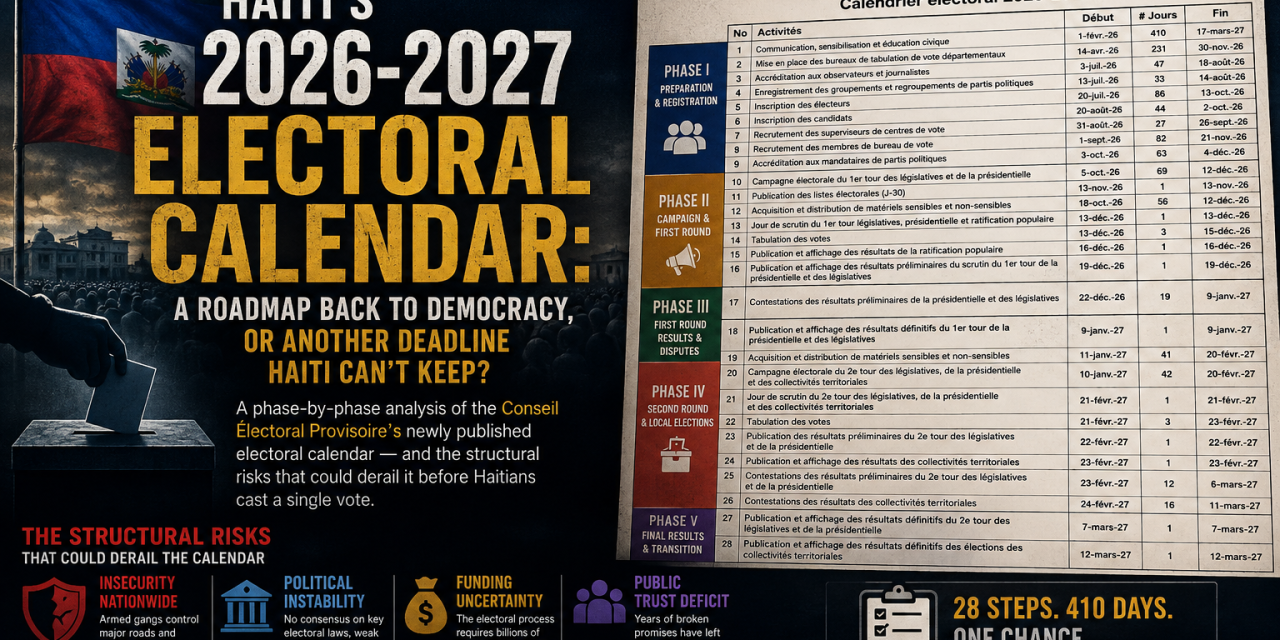
A phase-by-phase analysis of the Conseil Électoral Provisoire’s newly published electoral calendar — and the structural risks that could derail it before Haitians cast a single vote.
Why This Calendar Matters
On July 27, 2026, Haiti’s Provisional Electoral Council (CEP), under President Jacques Desrosiers, published the country’s official 2026-2027 electoral calendar — the roadmap for what would be Haiti’s first full national election in a decade, since the deeply flawed 2015–2016 cycle. The stakes could hardly be higher: the vote is meant to elect a president, both chambers of parliament (all 30 Senate seats and all 119 Chamber of Deputies seats), territorial collectivities, and to hold a popular referendum on proposed constitutional changes — all after a period that has seen the presidency vacant since Jovenel Moïse’s 2021 assassination, a series of unelected interim arrangements (Ariel Henry, then the Transitional Presidential Council, then Prime Minister Alix Didier Fils-Aimé exercising executive authority since the TPC’s dissolution in February 2026), and a security crisis that has left much of the capital under armed-group control.
It’s worth noting upfront that this is already a revised calendar: the vote had previously been targeted for August 30 and December 6, 2026, before the CEP pushed it back to the December 13, 2026 and February 21, 2027 dates now on the table. And crucially, the CEP did not publish this calendar as an unconditional promise. Its own press release explicitly ties the timeline’s viability to two preconditions: “the establishment of an acceptable security climate” and “the financial resources necessary to continue electoral operations.” In other words, the institution running the election is itself flagging, in writing, that the calendar could fail.
Walking Through the Calendar, Phase by Phase
Phase 1 — Foundation-laying (Feb. 1, 2026 – Oct. 13, 2026). The calendar opens with an extraordinarily long, 410-day civic education and communication campaign (line 1), running from February 1, 2026 all the way to March 17, 2027 — essentially bracketing the entire electoral process. Alongside it, the CEP must stand up departmental vote-tabulation bureaus (line 2, April–November 2026), accredit observers and journalists (line 3), register political parties and coalitions (line 4), and register voters (line 5, July 20–October 13, an 86-day window). This phase is the infrastructure-building stage — and it’s also the phase most exposed to Haiti’s security crisis, since voter registration requires physically operational registration centers in every commune, including areas gangs currently control or contest.
Phase 2 — Candidates and campaign staff (Aug. 20 – Dec. 12, 2026). Candidate registration runs August 20 to October 2 (line 6) — a compressed 44-day window in which Haiti must simultaneously recruit and train polling-center supervisors (line 7), recruit tens of thousands of polling-station staff (line 8, running through November 21), and accredit party poll-watchers (line 9, through December 4). The electoral campaign itself for the first round runs October 5 through December 12 (line 10) — 69 days for candidates to campaign nationally, a task complicated considerably by the fact that large parts of Port-au-Prince and other regions remain unsafe for public gatherings or even routine movement.
Phase 3 — Materials and voter lists (Oct.–Dec. 2026). Electoral lists are published 30 days before the vote (line 11, November 13), and — critically — sensitive and non-sensitive electoral materials (ballots, ink, tabulation equipment) must be acquired and distributed nationwide between October 18 and December 12 (line 12), a 56-day logistics operation that, in a country where armed groups have repeatedly blockaded roads, seized fuel terminals, and controlled checkpoints on key transit corridors, represents one of the calendar’s single largest points of physical vulnerability.
Phase 4 — First round and its aftermath (Dec. 13, 2026 – Jan. 9, 2027). Election day itself (line 13) is set for December 13, 2026 — and it is worth pausing on how much is being asked of that single day: the first round of the presidential election, the first round of legislative elections (all 149 seats), and the constitutional referendum are all scheduled simultaneously. That’s three distinct, nationally significant votes happening at once, at every polling station, on one day, with a security apparatus (the FAd’H, at roughly 1,471 personnel, working alongside a still-scaling-up UN-authorized Gang Suppression Force) that remains a fraction of the size of the armed groups it would need to hold back from disrupting voting. Vote tabulation follows over three days (line 14, Dec. 13–15), popular-ratification results are published December 16 (line 15), and preliminary presidential/legislative results follow December 19 (line 16). Then comes one of the calendar’s tightest and most consequential windows: just 19 days (line 17, December 22–January 9) are allotted for all legal contestations of the preliminary first-round results, before final results are published and posted on January 9, 2027 (line 18).
Phase 5 — Second round (Jan. 10 – Feb. 21, 2027). With final first-round results only settled January 9, the second round’s material acquisition (line 19, through February 20) and campaign period (line 20, January 10–February 20 — just 42 days) must move extremely fast. The second round of legislative and presidential elections, run alongside territorial collectivity elections, is set for February 21, 2027 (line 21), followed by a compressed three-day tabulation (line 22) and preliminary results within a day or two (lines 23–24).
Phase 6 — Final results (Feb. 23 – Mar. 12, 2027). Contestations for the second round get even less time than the first — just 12 days for legislative/presidential disputes (line 25, Feb. 23–March 6) and 16 days for territorial-collectivity disputes (line 26, Feb. 24–March 11) — before final results for the presidency and legislature are published March 7 (line 27), and final results for territorial collectivities close out the entire eighteen-month process on March 12, 2027 (line 28).
The Insight Most Coverage Has Missed: A Built-In Constitutional Contradiction
Here is the detail that deserves far more attention than it has received: Haiti’s constitutional deadline for restoring elected governance was widely understood to be February 7, 2027. The CEP’s own calendar schedules the second round of voting for February 21, 2027 — two weeks after that constitutional deadline — with final, certified results not published until March 7 and March 12, 2027, more than a full month past the deadline. Several Haitian and regional outlets flagged this discrepancy the moment the calendar was published.
This is not a minor technicality. Readers of Haitian political history will recognize the shape of this problem immediately: it is structurally the same situation that produced the 2016 power vacuum, when Michel Martelly’s term expired on February 7, 2016 with no elected successor in place, forcing Parliament to install Jocelerme Privert as a provisional president to bridge the gap — an arrangement that was supposed to last 120 days and instead stretched to over a year. If the current calendar holds exactly as published, Haiti is scheduled to pass its own constitutional deadline for restored elected government before the election that is supposed to satisfy that deadline has even finished being counted. Someone will need to explain — legally and politically, likely in real time under public pressure — who holds legitimate executive authority between February 7 and whenever final results and inauguration actually occur. Whether that gap is bridged by Prime Minister Fils-Aimé’s continued exercise of executive functions, some new legal instrument, or a repeat of 2016’s improvised parliamentary solution is, as of this calendar’s publication, an open question the CEP’s timeline does not itself resolve.
Where Else This Calendar Is Exposed
Beyond the constitutional deadline mismatch, several other points in the calendar represent genuine structural risk:
- The 56-day materials distribution window (Oct. 18–Dec. 12) crosses some of Haiti’s most contested territory. Ballots, tabulation machines, and sensitive materials must physically travel to and through areas where armed groups have previously blockaded fuel terminals, extorted transport convoys, and controlled major roads. Any disruption here doesn’t just delay logistics — it can directly compromise ballot security and chain-of-custody integrity.
- A single election day asked to carry three simultaneous national votes (presidential first round, legislative first round, constitutional referendum) multiplies the security, staffing, and administrative burden on every polling place at once, at a moment when the security forces available remain small relative to the threat environment.
- Only 19 days for first-round contestations, and just 12–16 days for second-round contestations, are notably compressed given Haiti’s own history — the 2015–2016 election cycle became mired in fraud allegations and disputes that took months, not weeks, to work through, and ultimately required rerunning the presidential vote entirely. A dispute process this compressed risks either rushing through legitimate grievances (fueling distrust in the result) or blowing through its own deadlines the moment a serious contestation arises — which would itself further compress the already-tight runway into the second round.
- The CEP’s own stated preconditions — “acceptable security climate” and “financial availability” — are not abstract concerns. Haiti’s government has repeatedly cited budget shortfalls for basic state functions throughout the ongoing crisis, and the security situation the calendar depends on improving is the same one that, as of mid-2026, had displaced roughly 1.5 million people nationally. A calendar whose own authors built in explicit escape clauses is, definitionally, a conditional plan rather than a firm commitment.
- The track record itself is the biggest risk factor of all. Haiti’s elections have been delayed repeatedly since 2019, across four separate governing arrangements (Moïse, Henry, the Transitional Presidential Council, and now Fils-Aimé). A calendar is only as credible as the state’s demonstrated capacity to hit its own deadlines, and on that measure, Haiti’s recent record gives limited grounds for confidence — even as international bodies like the OAS and CARICOM’s Eminent Persons Group have publicly welcomed the calendar’s publication as an important step.
What Failure Would Actually Look Like
If this calendar breaks down, it is unlikely to break cleanly. The more probable failure modes are partial ones: voting proceeding in relatively secure departments while being suppressed, disrupted, or skipped entirely in gang-controlled zones of Port-au-Prince and elsewhere — echoing what happened in parts of the country during the chaotic 2015–2016 cycle — producing results that technically meet the calendar’s dates but whose legitimacy is immediately contested by whichever candidates or parties underperformed in the affected regions. A second plausible failure mode is a timing slip severe enough that the February 7, 2027 constitutional deadline passes with no resolution in sight, reopening exactly the kind of power-vacuum debate — over who legitimately holds executive authority — that consumed Haitian politics for a full year after February 2016, and that echoes the arguments already being made in 2026 by figures like former provisional president Jocelerme Privert regarding the “continuity” of executive power.
Conclusion
Read charitably, the CEP’s 2026-2027 calendar is a genuinely significant, carefully sequenced attempt to return Haiti to elected constitutional government after nearly a decade without one — and its publication alone, after months of criticism over the absence of any official timetable, is itself a milestone worth acknowledging. Read skeptically, it is a calendar that schedules its own conclusion after the constitutional deadline it exists to satisfy, compresses dispute-resolution windows well below what Haiti’s own electoral history suggests is realistic, and depends on security and financial conditions that the CEP itself has publicly declined to guarantee. Both readings are true at once. Whether December 13, 2026 becomes the day Haiti finally began climbing out of its longest democratic drought in decades, or simply the next entry on a long list of missed Haitian election dates, will depend less on the calendar itself than on whether the security and financial preconditions the CEP quietly built into its own announcement are actually met between now and then.