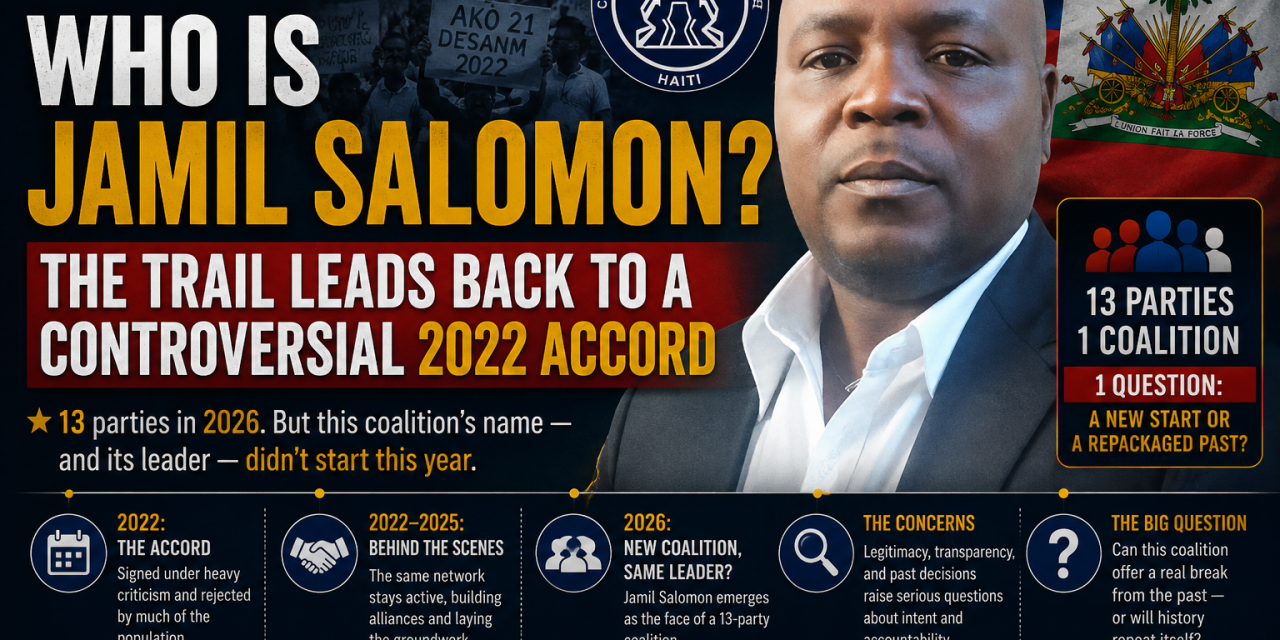
13 parties in 2026. But this coalition’s name — and its leader — didn’t start this year. Here’s what the paper trail shows.
📌 THE HEADLINE
Haiti’s electoral council approved 15 political coalitions on August 8, 2026, covering 208 parties total. The largest by party count after VIKTWA is Coppos-Haïti et Alliés (CHA), uniting 13 political parties and led by Jamil Salomon. A closer look shows this coalition isn’t a fresh 2026 creation — its name, and its leader, trace directly back to one of the most contested political agreements in Haiti’s recent transition.
🔍 THE FACTS
A quick note on identity, up front: searches for “Salomon” and Haiti also surface an unrelated and much darker record — a gang figure named Emanuel Salomon wanted by the FBI for a 2021 kidnapping-for-ransom case. That is a different person entirely — different first name, no connection to Jamil Salomon whatsoever. Worth stating plainly given how easily a shared surname can mislead.
December 2022: A signatory to the “Accord du 21 décembre.” Records from the PA-X Peace Agreements Database — which archives Haiti’s “Consensus National pour une Transition Inclusive et des Élections Transparentes,” commonly known as the Accord du 21 décembre 2022 — list “Salomon Jamil” as a signatory, representing an entity called Groupe des Partis pour l’Alternative et Alliés (GPAA), itself grouped under the umbrella “Coppos Haïti et alliés.” That’s the same name — Coppos-Haïti et Alliés — now leading his 2026 electoral coalition. This isn’t a new political brand; it’s a continuation of a grouping that existed at least three and a half years earlier.
What that 2022 accord actually was. The Accord du 21 décembre was brokered by then-Prime Minister Ariel Henry, an unelected leader governing after the 2021 assassination of Jovenel Moïse, and it established two transitional bodies — the Haut Conseil de la Transition (HCT) and the Organe de Contrôle de l’Action Gouvernementale (OCAG) — meant to oversee the path back to elections. The accord was publicly criticized by other Haitian political actors as sectarian and exclusionary, seen by critics as a vehicle for Henry to extend his own unelected rule rather than transfer power quickly. It ultimately set a target of new elections in 2023 and a newly elected government by February 2024 — neither of which happened on schedule; Henry himself was forced out in 2024 amid the country’s deepening gang crisis, superseded by the Transitional Presidential Council that governs (in successor form) today.
A cross-reference worth noting. The same 2022 signatory list also includes “Wilson Joseph, Groupe des huit (8) Parties et alliés, Coppos Haïti et alliés” — very likely the same Wuilson Joseph now leading the separate Debout Patriotes coalition profiled elsewhere in this series. Both men, in other words, were operating within the same small-party “Coppos” umbrella back in 2022, years before either became a headline CEP coalition representative in 2026.
No corruption allegations found. We found no documented corruption case, arrest, or formal misconduct allegation tied to Jamil Salomon individually. That’s worth saying directly.
🧾 WHAT THIS TRAIL ACTUALLY SHOWS
- Continuity, not novelty. “Coppos-Haïti et Alliés” as a political brand predates 2026 by years, and Salomon has been at least a visible signatory within it since the Henry-era transition talks.
- A prior alignment with a widely criticized accord. Signing the December 21 agreement doesn’t imply personal wrongdoing, but it does mean Salomon was politically aligned with an arrangement many Haitian actors — and eventually events themselves — judged to have failed at its central promise of a fast, credible return to elected government.
- A small-party network, not a mass movement. Both GPAA and the broader Coppos umbrella appear to be constellations of minor parties rather than major national forces — consistent with the pattern seen elsewhere in Haiti’s crowded 2026 field.
🏛️ THE SYSTEM HE’S STEPPING INTO
Haiti has had no functioning elected Parliament since January 2023 — the very outcome the 2022 accord Salomon signed onto was supposed to prevent. That the same “Coppos-Haïti et Alliés” name is now fronting a 13-party coalition in 2026 is a direct, documented thread connecting one failed transition effort to the next one now underway.
🤔 SO — INSTITUTIONAL MEMORY OR REPEAT PLAYER IN A FAILED PROCESS?
The skeptical take:
This is a small-party network that backed a widely criticized power-extension scheme in 2022, one that predictably failed to deliver the elections it promised. Three and a half years later, the same coalition brand resurfaces under the same leader — that’s not reform, it’s rebranding around a track record of non-delivery.
The other take:
Being one of dozens of signatories to a broad national consensus document isn’t the same as authoring or controlling it — coalition-building in Haiti’s fragmented landscape has long required working with imperfect, contested arrangements. Persistence through multiple failed transitions could reflect genuine commitment to democratic process rather than complicity in its failure.
Both readings rest on the same documented facts: a real, named connection to a controversial 2022 accord, and no evidence of personal misconduct beyond that association.
🗳️ THE BOTTOM LINE
Jamil Salomon’s 2026 coalition isn’t a blank slate — it has a name and a leader that trace directly back to one of the most contested political agreements of Haiti’s post-assassination transition. Whether that continuity reads as valuable experience navigating Haiti’s transition process, or as further evidence of the same small circle of actors cycling through failed arrangements, is exactly the kind of judgment this series keeps landing on.
The paper trail is real and documented. What it means is, again, for Haitian voters to decide.