National unity. Security. Sovereignty. Economic production. Historical accountability.
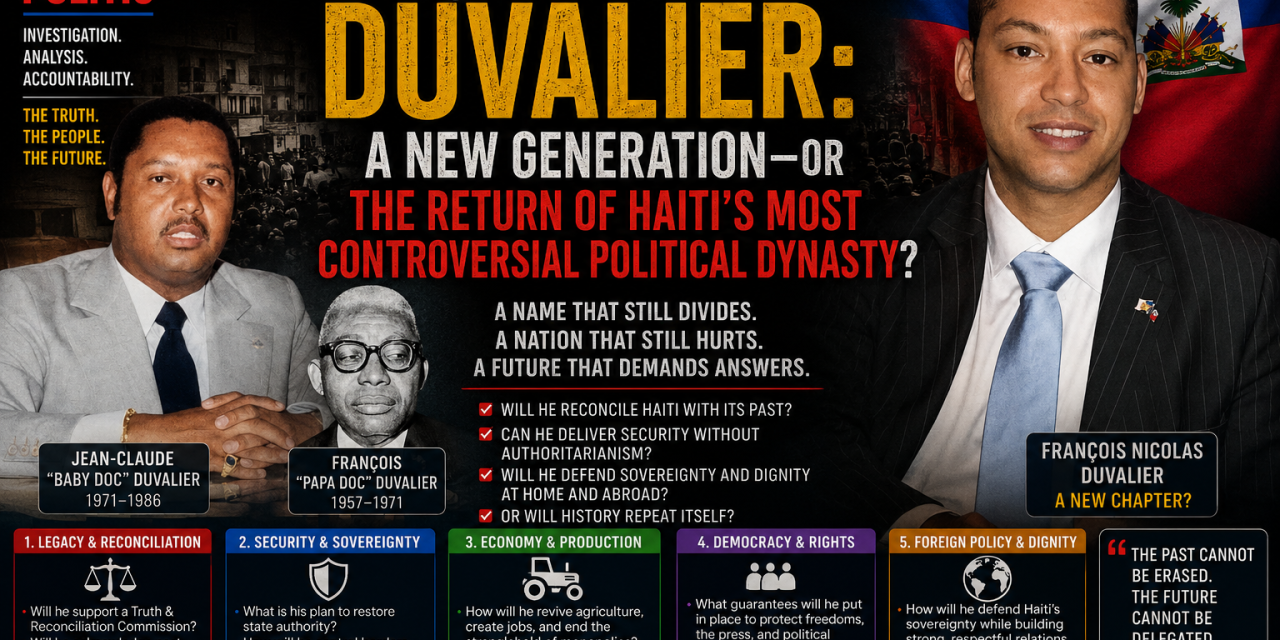
Few names in Haitian politics carry as much historical weight as Duvalier.
François Nicolas Duvalier is the son of former president-for-life Jean-Claude “Baby Doc” Duvalier and grandson of François “Papa Doc” Duvalier. Born in Port-au-Prince in 1983, he left Haiti as a small child when his father’s government collapsed in 1986 and later returned to Haiti with his father in 2011.
But ancestry is not a governing program.
And Nicolas Duvalier should neither be held personally responsible for acts committed before he was old enough to exercise political power nor exempted from answering difficult questions about a political legacy he may seek to inherit.
Haiti Politic therefore asks a different question: What has Nicolas Duvalier himself done, what does he actually propose, and what evidence exists that he could govern?
Important verification note: I could verify Duvalier’s public political interventions and reports of presidential ambitions, but I could **not independently verify from authoritative current sources the user’s description of him as founder of an organization called “Mouvement Unité Nationale (MUN),” nor a detailed MUN platform on fintech, agriculture, or foreign policy. Those claims should therefore not be presented as established facts without documentation from Duvalier or the organization.
This article is not a recommendation, ranking, or comparison of candidates. It summarizes documented third-party information and identifies questions voters could use to scrutinize Duvalier’s record and proposals.
🔎 1 | WHAT HAS NICOLAS DUVALIER ACTUALLY DONE?
The publicly documented political record I found is substantially thinner than the record of many politicians who have already administered ministries, municipalities, police institutions, businesses or major civil-society organizations.
But Duvalier has made political interventions.
During Haiti’s violent July 2018 unrest, he issued a public message calling for transparency from authorities while arguing that Haiti’s predicament represented a broader “collective failure.” He emphasized political stability, security, rule of law, good governance, civic responsibility and patriotism. Contemporary reporting interpreted the intervention against speculation that he was positioning himself for a future presidential campaign.
In 2019, he also participated in a political delegation that met President Jovenel Moïse during consultations over Haiti’s political crisis. According to HaitiLibre/iciHaiti, the delegation proposed a High Council for Reconciliation and Stability involving representatives associated with PHTK, Lavalas, Duvalierists, other parties and civil society.
Those activities demonstrate political engagement.
They do not, by themselves, demonstrate executive performance.
That distinction should become central to any investigation.
📌 QUESTIONS FOR DUVALIER
What public institution has Nicolas Duvalier managed?
What organization has he built whose finances, membership and results can independently be audited?
How many people has his political organization actually registered nationwide?
What legislation has he drafted?
What economic project has he administered?
What measurable public-policy accomplishment can voters examine independently of the Duvalier name?
Before discussing whether he could govern Haiti, voters deserve a documented answer to a simpler question:
What is Nicolas Duvalier’s own record?
🕯️ 2 | THE DUVALIER QUESTION CANNOT BE ERASED
Nicolas Duvalier did not govern Haiti between 1957 and 1986.
He therefore should not be assigned personal responsibility merely because of his family name.
But any political project invoking the Duvalier political tradition confronts an unavoidable historical record.
Human Rights Watch documented systematic abuses during Jean-Claude Duvalier’s presidency, including arbitrary detention, torture, disappearances, extrajudicial executions and repression of political dissent and independent journalism. Haitian victims subsequently pursued cases against Jean-Claude after his 2011 return.
In 2014, Haiti’s Court of Appeal ruled that the statute of limitations could not bar prosecution of alleged crimes against humanity and ordered further investigation. Jean-Claude Duvalier died later that year without standing trial. Investigations involving alleged collaborators subsequently remained an accountability issue.
That history makes Nicolas Duvalier’s position on memory, justice and democratic safeguards unusually important.
⚖️ 3 | THE QUESTION NICOLAS DUVALIER SHOULD ANSWER DIRECTLY
Would he support a credible national process examining abuses committed under previous Haitian governments—including those of his father and grandfather?
Not selective justice.
Not historical revenge.
Not collective guilt.
An evidence-based process protecting victims, defendants and due process.
Would he support opening relevant state archives?
Would victims be permitted to testify publicly?
Would surviving perpetrators remain subject to independent judicial investigation where Haitian law permits?
Would he publicly recognize documented abuses committed by state institutions during Duvalier rule?
And would the same historical-accountability standard apply to abuses committed under every subsequent Haitian government?
Those answers would tell voters considerably more about Nicolas Duvalier’s democratic philosophy than campaign slogans about unity.
🏛️ 4 | “ORDER” CAN MEAN TWO VERY DIFFERENT THINGS
Haiti desperately needs functioning state authority.
But state authority and authoritarianism are not synonyms.
That distinction is particularly important for a Duvalier candidacy.
If Nicolas Duvalier proposes a stronger Haitian state, voters should demand constitutional specifics.
Would he guarantee freedom of the press?
Would peaceful opposition parties operate without executive interference?
Would police remain institutionally separate from partisan political organizations?
Would intelligence agencies require judicial oversight?
Would arbitrary detention be prohibited in practice as well as on paper?
Would courts have authority to rule against his presidency?
Would parliamentary opposition retain meaningful investigative powers?
Would independent journalists be allowed to investigate his administration and family without retaliation?
A modern democratic Duvalier project would have to prove that “strong government” means strong institutions—not an all-powerful president.
🛡️ 5 | SECURITY: WHAT DOES “RESTORING AUTHORITY” ACTUALLY REQUIRE?
This question is no longer theoretical.
The United Nations described Haiti’s 2026 crisis as being fundamentally driven by insecurity, with gangs terrorizing communities and uprooting families.
A presidential candidate promising national authority therefore needs more than rhetoric about order.
QUESTIONS FOR DUVALIER
What would be the respective missions of the PNH and FAD’H?
Who would exercise operational command?
How would police officers and soldiers be vetted?
How would government prevent security units from becoming political instruments?
How would communities be protected during operations against armed groups?
What judicial mechanism would prosecute captured gang leaders?
How would Haiti identify and prosecute financial sponsors rather than concentrating exclusively on armed foot soldiers?
And what would prevent a newly empowered security apparatus from repeating historical abuses?
For Nicolas Duvalier, that final question carries particular historical significance.
🔫 6 | STOPPING THE WEAPONS BEFORE THEY REACH THE GANGS
Security is also foreign policy.
UNODC has documented firearms and ammunition trafficking routes into Haiti, including maritime trafficking and movement through the Dominican Republic. Its research identifies seizures around border crossings and notes the relationship between trafficking, customs/police presence and gang control.
A Duvalier foreign-policy doctrine therefore needs concrete answers.
Would Haiti seek joint intelligence teams with the United States and Dominican Republic?
Would containers be digitally tracked?
Would ports receive modern scanners?
Would customs officials undergo financial vetting?
Would maritime radar and coast-guard capabilities be expanded?
Would Haiti demand stronger investigations of overseas weapons suppliers?
Nationalism without cross-border law-enforcement cooperation cannot stop transnational weapons trafficking.
🇭🇹 🇩🇴 7 | NATIONALISM AND THE DOMINICAN REPUBLIC
This could become one of the most consequential tests of any nationalist Haitian administration.
Haiti needs border sovereignty.
It also needs trade.
It needs protection for Haitian migrants.
It needs customs enforcement.
It needs intelligence cooperation against arms traffickers.
And it shares Hispaniola permanently with the Dominican Republic.
So what would Duvalier diplomacy actually look like?
Would bilateral relations be based primarily on confrontation—or institutional negotiation?
Would there be a permanent Haiti–Dominican security commission?
How would Haiti respond to deportations and alleged mistreatment of Haitian migrants?
What border documentation system would replace chronic informality?
What commercial policy would protect Haitian producers without triggering shortages or destructive retaliation?
Sovereignty requires negotiating power, not simply nationalist language.
🌎 8 | WHAT IS HIS FOREIGN POLICY?
This is where the publicly available record remains especially incomplete.
Haiti Politic should ask Duvalier to publish a formal foreign-policy doctrine addressing:
Washington. CARICOM. The Dominican Republic. Canada. France. Taiwan. China. The United Nations. The OAS. International lenders. The diaspora.
What alliances would Haiti prioritize?
Would he maintain Haiti’s diplomatic recognition of Taiwan?
What conditions would he impose on foreign security assistance?
Would foreign NGOs be required to disclose budgets and coordinate with Haitian ministries?
How would Haiti negotiate debt and development financing?
How would his government attract diaspora capital?
And how would he prevent “sovereignty” from becoming diplomatic isolation?
Until those questions receive documented answers, describing Nicolas Duvalier as possessing a developed foreign-policy program goes beyond what I could independently verify.
🌾 9 | THE ECONOMIC TEST: HAITI CANNOT EAT NOSTALGIA
This is perhaps the most important reality confronting every Haitian political movement.
In April 2026, the World Food Programme reported that 5.8 million Haitians—about 52% of the population—were facing acute food insecurity, including more than 1.8 million at emergency levels during the March–June period.
So any promise to restore national production must answer basic questions.
Where will agricultural credit come from?
Who receives subsidized loans?
How will irrigation systems be rebuilt?
How will farmers reach markets through insecure highways?
Should Haiti impose tariffs on food imports—and, if so, how quickly?
What happens to urban food prices while domestic production expands?
How would fertilizer, machinery and improved seeds reach farmers?
How would agricultural land titles be modernized?
And what happens when politically connected importers resist reform?
“Produce nationally” sounds powerful. The difficult question is how to do it without making food more expensive for families already struggling to eat.
💰 10 | WOULD HE CONFRONT HAITI’S ECONOMIC ELITES?
A nationalist platform eventually collides with political economy.
Would a Duvalier government publish beneficial ownership information for companies receiving state contracts?
Would customs exemptions become public?
Would major importers face independent audits?
Would government procurement be searchable online?
Would political donors be disclosed?
Would public officials declare assets before and after holding office?
And would those rules apply to allies of the president?
If Nicolas Duvalier wants voters to believe he represents institutional renewal, financial transparency is one way to demonstrate it before taking office.
Publish the movement’s donors.
Publish its audited accounts.
Publish the candidate’s policy team.
Publish the economic program.
Then voters can evaluate evidence instead of mythology.
🗳️ 11 | THE MOST IMMEDIATE QUESTION: IS HE ACTUALLY RUNNING?
Haiti’s electoral timetable has changed.
On July 27, 2026, the CEP published a new official calendar setting the first presidential and legislative round for December 13, 2026, with a second round scheduled for February 21, 2027. The CEP explicitly warned that implementation depends on an acceptable security environment and sufficient financing. Candidate registration is scheduled from August 20 through October 2, 2026.
That makes verification crucial.
As of the sources I could locate, I cannot responsibly state that Nicolas Duvalier is an officially registered 2026 presidential candidate.
Reports about his political ambitions are not the same thing as CEP certification.
So Haiti Politic should ask him directly:
Are you running for president in the 2026–27 election?
Under which legally registered political organization?
Is that organization MUN? If so, publish its registration documents, leadership structure and platform.
Who finances it?
Who are its departmental coordinators?
Where are its offices?
How are candidates selected?
What democratic mechanism can remove its leader?
That documentation would convert speculation into something voters can actually investigate.
📊 THE HAITI POLITIC EVIDENCE BOARD
Rather than ranking Duvalier or comparing him with other candidates, the documented record can be separated into what is established and what still needs proof.
| Issue | What the public record supports | What voters still need documented |
|---|---|---|
| Political identity | Son of Jean-Claude Duvalier and grandson of François Duvalier. | What political identity does he claim independent of the dynasty? |
| Public political activity | Issued a national political message in 2018 and participated in 2019 political consultations. | What measurable organization or policy result followed? |
| Historical legacy | His father’s government is extensively documented for grave human-rights violations. | What is Nicolas Duvalier’s explicit position on truth, victims and accountability? |
| Executive experience | The sources reviewed here do not establish substantial prior national executive office. | What management record demonstrates readiness to administer the state? |
| Security | His 2018 message emphasized stability, security and rule of law. | Where is the operational PNH/FAD’H/security-sector plan? |
| Foreign policy | Publicly available evidence reviewed here is insufficient to establish a comprehensive doctrine. | Publish the diplomatic, diaspora, border and international-aid strategy. |
| Economic program | Public evidence reviewed here is insufficient to substantiate the detailed platform described in the prompt. | Publish costed agriculture, taxation, infrastructure and employment proposals. |
| 2026 candidacy | Haiti now has an official 2026–27 electoral calendar. | Is Duvalier registering, and under which legally recognized organization? |
🧭 THE CENTRAL INVESTIGATIVE QUESTION
Nicolas Duvalier occupies an unusual position.
His surname provides immediate political recognition.
But it also guarantees extraordinary scrutiny.
Some Haitians may remember the Duvalier period through narratives of order, sovereignty or national authority.
Others remember dictatorship, political prisoners, exile, torture, disappearances and suppressed freedoms—abuses documented extensively by human-rights investigators.
Neither nostalgia nor inherited condemnation should substitute for investigating Nicolas Duvalier himself.
His test is therefore unusually clear.
Can he acknowledge history without rewriting it?
Can he advocate security without authoritarianism?
Can he defend sovereignty without isolating Haiti?
Can he promise national production and show the numbers?
Can he demonstrate accomplishments independent of his surname?
And can he build a democratic political organization whose finances, leadership and program are transparent before asking Haitians to entrust him with the presidency?
That is not a verdict.
It is the investigation.
🇭🇹 NICOLAS DUVALIER: A NEW POLITICAL GENERATION—OR A HISTORICAL NAME STILL SEARCHING FOR A GOVERNING RECORD OF ITS OWN?
The documents matter.
The program matters.
The history matters.
The answers matter.
The Haitian people can decide.
#HaitiPolitic #NicolasDuvalier #Haiti #HaitiElections #HaitiPolitics #Duvalier #Democracy #Security #ForeignPolicy #Sovereignty #Agriculture #Accountability #LetThePeopleDecide