🇭🇹🌍 Haiti has spent generations invoking its historic relationship with Africa.
But can that history become foreign policy with measurable economic, educational and institutional results?
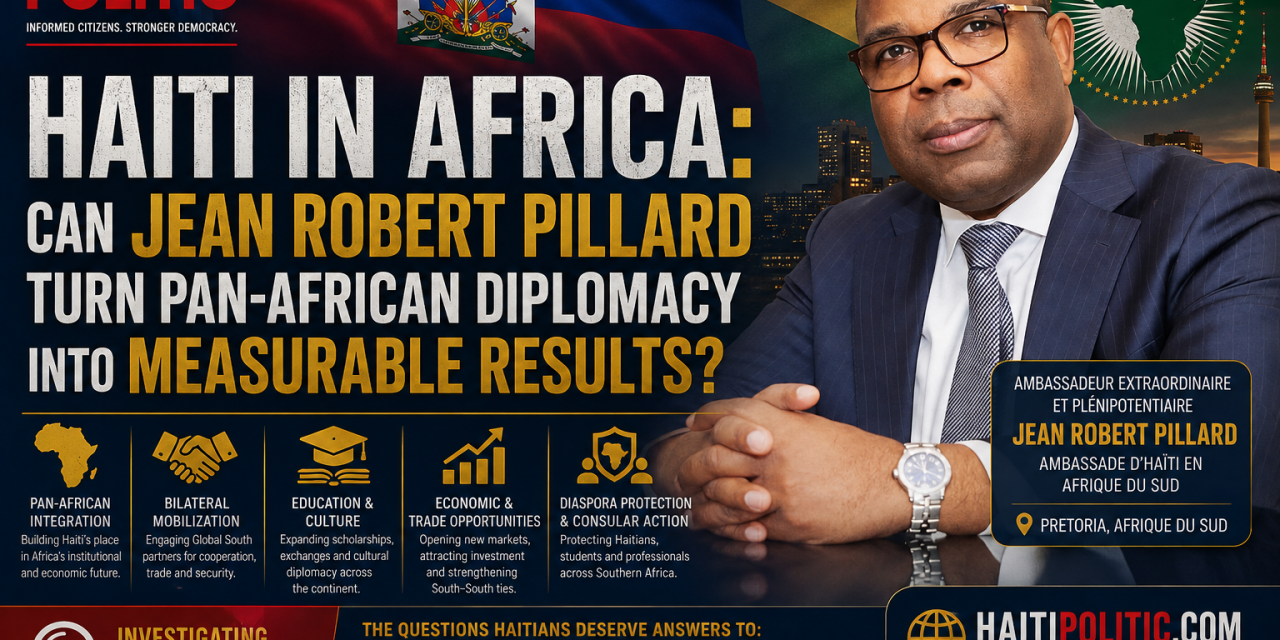
That is the challenge facing Jean Robert Pillard, Haiti’s Ambassador Extraordinary and Plenipotentiary to the Republic of South Africa.
Pillard is a relatively new ambassador in Pretoria. South African diplomatic records show that he arrived on January 7, 2026, and Haiti announced that he presented copies of his credentials to South Africa’s Department of International Relations and Cooperation on January 13. He subsequently presented his credentials to President Cyril Ramaphosa. Haiti’s Foreign Ministry and the South African government currently identify him as Haiti’s ambassador.
That short tenure matters when evaluating him.
It would be premature to demand years of results from an ambassador who has been in the post for only months.
But it is not premature to examine what he has prioritized, what he has already accomplished, which initiatives have advanced beyond meetings—and which have not.
And there is already one particularly concrete result:
🎓 A FORMAL UNIVERSITY PARTNERSHIP HAS BEEN SIGNED.
But there are also much bigger promises surrounding Haiti’s African strategy that have yet to be translated publicly into contracts, financing, trade flows or programs.
So the question for Haitians is:
IS PILLARD BUILDING A NEW AFRICAN FOREIGN POLICY—OR A POWERFUL NARRATIVE STILL WAITING FOR IMPLEMENTATION?
👤 WHO IS JEAN ROBERT PILLARD?
Pillard is not new to Haitian diplomacy.
More than a decade before Pretoria, he served as Haiti’s Chargé d’Affaires in London.
British diplomatic records from 2015 identify Jean Robert Pillard as Chargé d’Affaires at Haiti’s Embassy in the United Kingdom. International Coffee Organization documentation from the same period also identifies him as Haiti’s diplomatic representative in London.
That previous assignment provides useful evidence about his diplomatic approach.
In October 2014, Pillard and Counsellor Jean Joseph Léandre organized a meeting with Haitian professionals and entrepreneurs in Britain aimed at promoting Haiti as an investment and tourism destination and helping diaspora entrepreneurs develop commercial opportunities.
In early 2015, reporting also documented a meeting between Pillard and British Minister of State Hugo Swire concerning visa services for Haitians, with plans for biometric processing to become available in Port-au-Prince rather than requiring applicants to travel abroad for that step.
So his Pretoria assignment is not his first experiment with:
diaspora engagement,
economic diplomacy,
cultural promotion,
and
government-to-government negotiations.
That experience gives Pillard something important:
a record against which his new promises can eventually be measured.
🌍 THE PILLARD DOCTRINE: HAITI AS PART OF “GLOBAL AFRICA”
The most striking aspect of Pillard’s current diplomacy is not a traditional bilateral agenda.
It is his attempt to reframe Haiti’s geopolitical identity.
At an event honoring former Nigerian President Olusegun Obasanjo in March 2026, Pillard argued that Haiti should not be treated simply as a distant Caribbean country with African ancestry.
His argument went much further.
He presented Haiti as part of a broader African civilization and advocated moving the African Union’s concept of the diaspora as a “Sixth Region” from symbolism toward deeper institutional and economic integration.
He even recounted proposing to Obasanjo the provocative idea of Haiti becoming a “55th state” of the African Union—not as a literal description of Haiti’s current legal status, but as part of his argument for a radically deeper relationship between Haiti and Africa.
Pillard connected that vision to the African Continental Free Trade Area (AfCFTA) and proposed stronger Africa-Caribbean trade corridors and even direct air connections.
That is ambitious.
Potentially transformative.
But ambition is not accomplishment.
WHERE IS THE INSTITUTIONAL ROAD MAP?
🏛️ QUESTION #1 — FROM PAN-AFRICAN RHETORIC TO PAN-AFRICAN INSTITUTIONS
Pillard’s continental strategy deserves serious consideration.
Haiti possesses an extraordinary historical asset in Africa.
The Haitian Revolution is part of the global history of Black liberation, anti-slavery struggle and anticolonialism.
Pillard appears determined to convert that historical capital into contemporary diplomatic capital.
But this investigation could not independently establish from authoritative public documentation that his discussions around the Pan-African Parliament have yet produced a binding parliamentary framework, funded program or formal institutional mechanism for Haiti.
That does not establish that nothing is happening.
It establishes that the measurable outcome is not yet publicly documented.
So Ambassador Pillard should publish:
What did the Pan-African Parliament commit to?
Was a working group established?
Was a resolution proposed?
Is there a Haiti caucus?
Are parliamentary exchanges planned?
Is technical assistance attached?
Is there a timetable?
And most importantly:
WHAT WILL HAITI RECEIVE?
🌍 THE AFRICAN UNION QUESTION IS EVEN BIGGER
Pillard’s argument about the Sixth Region could potentially become one of the most interesting foreign-policy initiatives undertaken by a Haitian mission in Africa.
But the distinction between political vision and AU institutional reality must remain clear.
A speech calling for deeper Haitian integration is not an African Union decision.
So the public deserves to know:
Has Haiti submitted a formal diplomatic note?
Has Pillard’s embassy circulated a concept paper?
Has the Haitian government formally endorsed the strategy?
Has it been transmitted to the African Union Commission?
Which African governments support it?
Which oppose it?
What legal status is Haiti seeking?
Observer?
Special partnership?
Structured diaspora participation?
Economic framework?
Permanent institutional dialogue?
Until those questions have answers, the “Sixth Region” initiative should be described accurately:
AN AMBITIOUS DIPLOMATIC PROPOSAL—NOT YET A DOCUMENTED INSTITUTIONAL VICTORY.
🎓 ACCOMPLISHMENT #1 — UNIVERSITY OF JOHANNESBURG: THIS ONE IS REAL
Here the record becomes substantially more concrete.
On May 14, 2026, the University of Johannesburg and Haiti’s Embassy signed a Memorandum of Understanding.
This was not simply a courtesy meeting.
UJ says the agreement establishes a framework connecting the university with Haitian universities through:
student exchanges,
staff exchanges,
collaborative research,
innovation partnerships,
and
knowledge-sharing initiatives.
The agreement followed a February meeting between Pillard and UJ Vice-Chancellor Professor Letlhokwa Mpedi.
During those discussions, Pillard also expressed interest in the university’s Rescue Simulation Centre, whose personnel had participated in rescue operations in Haiti following the 2010 earthquake.
This matters.
Because it represents the clearest publicly documented example so far of Pillard moving from:
MEETING → NEGOTIATION → FORMAL FRAMEWORK.
That deserves recognition.
🔬 BUT NOW THE MOU NEEDS NUMBERS
A memorandum is a framework.
It is not yet a scholarship.
It is not yet a student exchange.
It is not yet research funding.
So Pillard should disclose:
How many Haitian universities have joined?
How many Haitian students will participate?
How many South African students will study in Haiti?
How many faculty exchanges?
What is the first academic year of implementation?
What funding supports the program?
Who pays tuition?
Who pays airfare and housing?
Are scholarships guaranteed?
Which research projects have started?
Will Haiti receive disaster-response training through UJ’s Rescue Simulation Centre?
The agreement is an accomplishment.
IMPLEMENTATION WILL DETERMINE ITS VALUE.
🇭🇹 ACCOMPLISHMENT #2 — HAITIAN FLAG DAY BECOMES DIPLOMATIC OUTREACH
The embassy also used Haitian Flag Day as an instrument of cultural diplomacy.
The May 18 event at the University of Johannesburg brought together diplomats, academics, students and cultural leaders and explicitly connected Haiti’s revolutionary history with contemporary Africa-diaspora cooperation.
South African participation also carried a policy message: according to UJ’s account, South Africa emphasized possibilities for cooperation involving education, peacebuilding, development and cultural exchange.
Cultural diplomacy can matter.
Haiti possesses enormous historical soft power.
The question is whether Pillard can do something Haitian foreign policy has often struggled to accomplish:
CONVERT SOFT POWER INTO HARD OPPORTUNITIES.
Scholarships.
Research funding.
Trade.
Technology.
Emergency-response training.
Investment.
Institutional partnerships.
That is the next test.
🤝 SOUTH AFRICA: THE AGENDA IS BECOMING BROADER
Pillard has also held discussions with senior officials at South Africa’s Department of International Relations and Cooperation.
One embassy account says discussions with Deputy Director-General Maud Dlomo covered:
AfCFTA,
SADC regional dynamics,
agriculture,
youth employment,
academic partnerships,
health and education innovation,
and
climate resilience.
Again, that indicates a broad agenda.
But it also creates an accountability problem.
When diplomacy covers ten sectors simultaneously, citizens need to know which ones actually move.
A useful benchmark would be:
By January 2027, how many of these discussion areas have produced a signed program, budget or implementation schedule?
🧭 STATESMAN DIPLOMACY: ACCESS IS NOT YET AN OUTCOME
Pillard’s outreach to African political figures, including former leaders, fits his broader Pan-African strategy.
Consultations with figures such as Thabo Mbeki or Obasanjo can be valuable.
Former African presidents possess extraordinary political networks, institutional experience and access across the continent.
But oversight must distinguish between:
ACCESS
and
DELIVERY.
Meeting a former president can open doors.
The accomplishment occurs when something comes through those doors.
So Pillard should identify:
Which educational pathway resulted?
Which institution joined?
Which technical mission was established?
Which African government changed its position?
Which investment discussion began?
Which governance expertise was made available to Haiti?
If consultations remain exploratory, the embassy should simply say so.
There is nothing improper about diplomacy being a work in progress.
There is something problematic about presenting exploratory conversations as completed achievements.
🇸🇦 SAUDI ARABIA — A PERFECT EXAMPLE OF THE DIFFERENCE
On August 12, 2026, Pillard met Saudi Ambassador Faisal Alharbi in South Africa.
The discussion covered bilateral relations, potential cooperation, Saudi Arabia’s Vision 2030, and what was described as Haiti’s “Circle of Friends” initiative.
The public report says both sides intend to continue engagement and explore opportunities for economic, political, developmental and people-to-people cooperation.
That is diplomatic groundwork.
But as of the public reporting reviewed here, it should not be described as a Saudi investment agreement, aid package, security agreement or trade deal.
None of those outcomes is documented in the report.
That distinction matters.
COURTESY VISIT ≠ AGREEMENT
DIALOGUE ≠ INVESTMENT
INTEREST ≠ MONEY DELIVERED
🌐 WHAT IS HAITI’S “CIRCLE OF FRIENDS”?
The Saudi meeting raises another potentially important question.
The article specifically says Pillard discussed a Haitian Circle of Friends initiative intended to increase international engagement around Haiti’s priorities.
That could become strategically significant.
Pretoria contains diplomatic missions from across Africa, Asia, the Middle East, Europe and the Americas.
A properly organized coalition could allow Haiti to use one embassy to cultivate relationships far beyond South Africa.
But the initiative needs transparency.
Who belongs to the Circle of Friends?
What are its objectives?
Does it have meetings?
A secretariat?
A policy document?
Funding targets?
Security objectives?
Investment priorities?
Votes coordinated in multilateral institutions?
If this is becoming a genuine diplomatic coalition, Pillard should publish its structure.
💰 THE BIGGEST UNANSWERED QUESTION: WHERE IS THE TRADE?
Pillard’s speeches emphasize economic integration.
His DIRCO discussions included AfCFTA.
His Obasanjo address envisioned Africa-Caribbean commercial corridors.
This is potentially important.
Haiti needs new markets.
Africa needs stronger connections with the Caribbean.
But economic diplomacy eventually has to appear in spreadsheets.
So:
WHAT BUSINESS HAS BEEN GENERATED?
How many South African companies have been introduced to Haitian partners?
How many Haitian companies have received market intelligence?
Has an investment forum been organized?
Has a Haiti-South Africa chamber or business council been created?
What products have been identified for export?
Coffee?
Cocoa?
Vetiver?
Rum?
Mango products?
Apparel?
Art?
Creative industries?
Has the embassy identified shipping routes?
Customs barriers?
Banking obstacles?
Air-cargo options?
Investment protections?
Without these steps, “Africa-Caribbean trade” remains an attractive concept rather than an economic strategy.
✈️ DIRECT AFRICA-CARIBBEAN AIR LINKS: VISION OR PROJECT?
Pillard has publicly advocated direct air routes connecting Africa and the Caribbean.
That would be significant.
But aviation diplomacy is complicated.
It requires passenger demand, commercial viability, bilateral air-service arrangements, airline participation and airport connectivity.
So the oversight question should be precise:
Has Pillard approached an airline?
Has a feasibility study been commissioned?
Have South African authorities discussed the proposal?
Has CARICOM been approached?
Has a potential hub been identified?
Johannesburg?
Cape Town?
Port-au-Prince?
A Caribbean connection through another capital?
Until then, it remains a proposal.
🎨 CULTURAL DIPLOMACY: HAITI HAS AN ASSET FEW COUNTRIES POSSESS
Pillard appears to understand something important.
Haiti does not enter Africa empty-handed.
Its revolutionary history gives it a form of diplomatic capital that money cannot purchase.
Its art, literature, religion, music, language and revolutionary symbolism offer enormous opportunities for cultural diplomacy.
The Obasanjo address explicitly connected Haitian and African cultural traditions, including music, while the Johannesburg Flag Day event used history and scholarship to deepen Africa-Haiti engagement.
That can create visibility.
But cultural diplomacy should eventually produce:
museum exchanges
artist residencies
university programs
film partnerships
music collaborations
research grants
tourism
and
creative-industry investment.
How many exist today?
That should be reported.
🧑🏿🎓 EDUCATION MAY BE PILLARD’S MOST PROMISING SECTOR
Of all the initiatives reviewed, education currently offers the clearest route from diplomacy to measurable benefit.
The University of Johannesburg agreement is already signed.
The opportunity now is to expand it.
Imagine a Haiti-Africa academic network involving:
University of Johannesburg,
University of Cape Town,
University of Pretoria,
Wits,
and eventually universities elsewhere on the continent.
Haiti could pursue cooperation in:
engineering
disaster management
public health
agriculture
artificial intelligence
governance
African and diaspora studies
urban planning
and
entrepreneurship.
But Pillard’s performance should be measured by actual placements.
HOW MANY HAITIAN STUDENTS WILL BE SITTING IN THOSE CLASSROOMS?
🚨 THE CONSULAR QUESTION CANNOT BE IGNORED
Prestige diplomacy attracts attention.
Citizen protection rarely does.
But protecting Haitians abroad is one of an embassy’s most fundamental responsibilities.
Haiti’s Pretoria mission operates in a geographically enormous region.
The embassy should therefore disclose whether it maintains:
a voluntary registry of Haitian citizens,
emergency telephone procedures,
student contact networks,
hospitalization protocols,
detention-response procedures,
lost-document assistance,
evacuation planning,
and
coordination with neighboring governments.
This investigation did not find sufficient authoritative public information to quantify those systems.
That is precisely why the question belongs in a formal performance report.
📊 WHAT CAN WE VERIFY SO FAR?
Several things are clear.
✔️ Pillard is an experienced Haitian diplomat, having served as Chargé d’Affaires in London more than a decade before his Pretoria appointment.
✔️ His South African ambassadorship formally began in January 2026, making this a very early assessment of his tenure.
✔️ His strategy places unusual emphasis on reconnecting Haiti institutionally, economically and culturally with Africa.
✔️ His embassy has signed a concrete MoU with the University of Johannesburg covering exchanges, research, innovation and knowledge sharing.
✔️ He has opened discussions with South African authorities across economic, academic, agricultural, health and climate-related sectors.
✔️ He has advocated deeper Haitian participation in Africa’s institutional and economic architecture, including links with AfCFTA.
✔️ He is using Pretoria’s unusually dense diplomatic environment to open conversations with third countries, including Saudi Arabia.
Those are legitimate components of an emerging record.
But there is also a clear limitation:
MOST OF THE GRANDER AFRICA STRATEGY REMAINS AT THE ADVOCACY, NETWORK-BUILDING OR FRAMEWORK STAGE.
That is not necessarily a failure after seven months.
But it is the baseline against which the next year should be judged.
📑 SEVEN QUESTIONS AMBASSADOR JEAN ROBERT PILLARD SHOULD ANSWER
1️⃣ PAN-AFRICAN PARLIAMENT — WHAT WAS AGREED?
Following your engagements with Pan-African parliamentary leadership:
What formal commitments were made?
What resolutions or parliamentary initiatives are planned?
Has a Haiti working group been established?
What is the implementation calendar?
2️⃣ AFRICAN UNION — WHERE IS THE PAPER?
You have publicly advanced a much deeper institutional relationship between Haiti and Africa.
Has Haiti submitted a formal proposal to the African Union?
What legal or institutional status is being sought?
Which governments support it?
What are the milestones?
When will the proposal move from speech to formal diplomacy?
3️⃣ MBEKI, OBASANJO AND CONTINENTAL NETWORKS — WHAT CAME OUT OF THE ACCESS?
Identify the concrete programs generated through consultations with African statesmen.
Universities?
Technical advisers?
Government partnerships?
Governance programs?
Investment introductions?
Diplomatic endorsements?
If negotiations remain preliminary, identify the next step.
4️⃣ PRETORIA DIPLOMATIC CIRCUIT — WHAT DID HAITI OBTAIN?
For meetings with Saudi Arabia, Egypt, Kenya and other missions:
What agreements were proposed?
What assistance was requested?
What commitments were obtained?
What dollar value?
What implementation dates?
Which meetings produced follow-up negotiations?
5️⃣ TRADE — SHOW THE PIPELINE
How many potential investors has the embassy identified?
How many Haitian exporters have received assistance?
What Africa-Caribbean shipping barriers have been mapped?
What investments are under discussion?
What export sectors have been prioritized?
What is the estimated pipeline value?
6️⃣ EDUCATION & CULTURE — SHOW THE BENEFICIARIES
The University of Johannesburg MoU is an important beginning.
Now quantify it.
How many scholarships?
How many students?
How many professors?
How many research projects?
How much funding?
How many artist exchanges?
What is scheduled for the 2026–27 academic year?
7️⃣ CONSULAR PROTECTION — WHERE ARE THE HAITIANS?
How many Haitian citizens are estimated to reside within the embassy’s jurisdiction?
How many are registered voluntarily?
How many students?
How many professionals?
What emergency-response network exists?
How quickly can the embassy locate and communicate with citizens during civil unrest, natural disasters, detention or immigration emergencies?
⚖️ A FAIR STANDARD FOR PILLARD
There are two mistakes the public should avoid.
The first would be declaring Pillard successful because his speeches are ambitious and his meetings are highly visible.
The second would be declaring him unsuccessful because, after only months in Pretoria, every proposed initiative has not yet produced money or programs.
Neither approach is serious oversight.
The appropriate question is:
IS THE PIPELINE MOVING?
For every initiative, citizens should be able to see:
CONCEPT → NEGOTIATION → AGREEMENT → FUNDING → IMPLEMENTATION → BENEFICIARIES → RESULTS
The University of Johannesburg partnership has reached the agreement stage.
Other initiatives appear earlier in that chain.
Now we watch what happens next.
🇭🇹 CAN PILLARD BRING SOMETHING NEW TO HAITIAN FOREIGN POLICY?
Potentially, yes.
And the reason is not simply that he is serving in Africa.
It is because his emerging strategy challenges a longstanding assumption about Haitian diplomacy.
Haiti has traditionally concentrated enormous diplomatic attention on:
🇺🇸 Washington
🇨🇦 Ottawa
🇫🇷 Paris
🇺🇳 New York
🇪🇺 Brussels
and regional Caribbean capitals.
Those relationships remain essential.
But Haiti is also the world’s first independent Black republic.
Africa is undergoing demographic, technological, educational and economic transformation.
Why should Haiti’s relationship with the continent remain mostly ceremonial?
Pillard appears to be asking that question.
And that is worth examining seriously.
But the answer cannot simply be:
because Haiti and Africa share history.
The answer eventually has to become:
because Haitian students received scholarships.
because Haitian universities gained research partners.
because Haitian businesses found markets.
because African investment reached Haiti.
because Haitian institutions received technical expertise.
because Haitians abroad received better protection.
because African governments supported Haitian priorities.
because measurable South-South cooperation occurred.
📈 CREATE A PRETORIA PERFORMANCE DASHBOARD
Every quarter, Haiti’s embassy could publicly report:
🎓 Scholarships secured
🔬 Research partnerships activated
💰 Investment pipeline
📦 Trade opportunities facilitated
🤝 Agreements signed
🌍 African governments recruited to Haitian initiatives
🏛️ AU/Pan-African Parliament milestones
✈️ Transport-connectivity negotiations
🎨 Cultural exchanges delivered
🧑🏿🤝🧑🏿 Haitians receiving consular assistance
📊 Commitments versus completed projects
That would turn diplomatic accountability into something citizens can understand.
🔎 PRELIMINARY ASSESSMENT
Jean Robert Pillard enters this investigation with one advantage:
HE HAS A CLEAR STRATEGIC IDEA.
Reconnect Haiti with Africa.
Use Haiti’s revolutionary history as diplomatic capital.
Expand South-South cooperation.
Build academic links.
Explore continental economic integration.
Use Pretoria as a diplomatic platform beyond South Africa.
And transform Haiti from a symbolic member of the African diaspora into a more active institutional partner.
There is evidence that this strategy has begun moving beyond rhetoric—most clearly through the University of Johannesburg MoU.
But there is not yet enough public evidence to conclude that the larger strategy has produced substantial new trade, investment, scholarships, AU institutional status, major aid packages or continent-wide agreements.
That is the distinction this investigation should preserve.
THE STRATEGY IS VISIBLE.
THE NETWORK IS BEING BUILT.
ONE SIGNIFICANT ACADEMIC FRAMEWORK IS SIGNED.
THE LARGE-SCALE RESULTS ARE STILL TO BE PROVEN.
📢 AMBASSADOR PILLARD: PUBLISH THE PERFORMANCE REPORT
Give the Haitian public the evidence.
Publish the University of Johannesburg implementation plan.
Publish the scholarship numbers.
Publish the AU strategy.
Publish the Pan-African Parliament follow-up.
Publish the investment pipeline.
Publish the Africa-Caribbean trade strategy.
Publish the Circle of Friends membership and objectives where diplomatically appropriate.
Publish the consular metrics.
Publish the projects that succeeded.
And publish the initiatives that stalled.
Because transparency should not be hostile to diplomacy.
TRANSPARENCY CAN MAKE DIPLOMACY STRONGER.
Then let the people decide:
🇭🇹 Is Jean Robert Pillard building a new African pillar of Haitian foreign policy?
🌍 Can Haiti convert its historic relationship with Africa into modern economic and institutional power?
🎓 Can Pan-African solidarity produce opportunities for Haitian students and universities?
💰 Can historical fraternity become investment and trade?
🏛️ Can the “Sixth Region” move from symbolism toward meaningful institutional participation?
And ultimately:
CAN HAITI TURN 1804 INTO 21ST-CENTURY DIPLOMATIC LEVERAGE?
The vision is ambitious.
The first institutional bridge has been built.
Now comes the test that matters:
RESULTS.
MEETINGS OPEN DOORS.
AGREEMENTS CREATE FRAMEWORKS.
IMPLEMENTATION CHANGES LIVES.
#Haiti #JeanRobertPillard #SouthAfrica #HaitiAfrica #AfricanUnion #PanAfricanism #Pretoria #HaitianDiplomacy #ForeignPolicy #AfCFTA #UniversityOfJohannesburg #GlobalSouth #CARICOM #Africa #Diplomacy #Accountability #Transparency #HaitiPolitic