🇭🇹🌴 Haiti does not have to cross an ocean to find some of its most strategically important diplomatic partners.
They are its Caribbean neighbors.
The Caribbean Community — CARICOM sits at the intersection of several issues that directly affect Haiti’s future:
security
political mediation
elections
regional trade
organized crime
migration
food security
economic integration
and
international coalition-building.
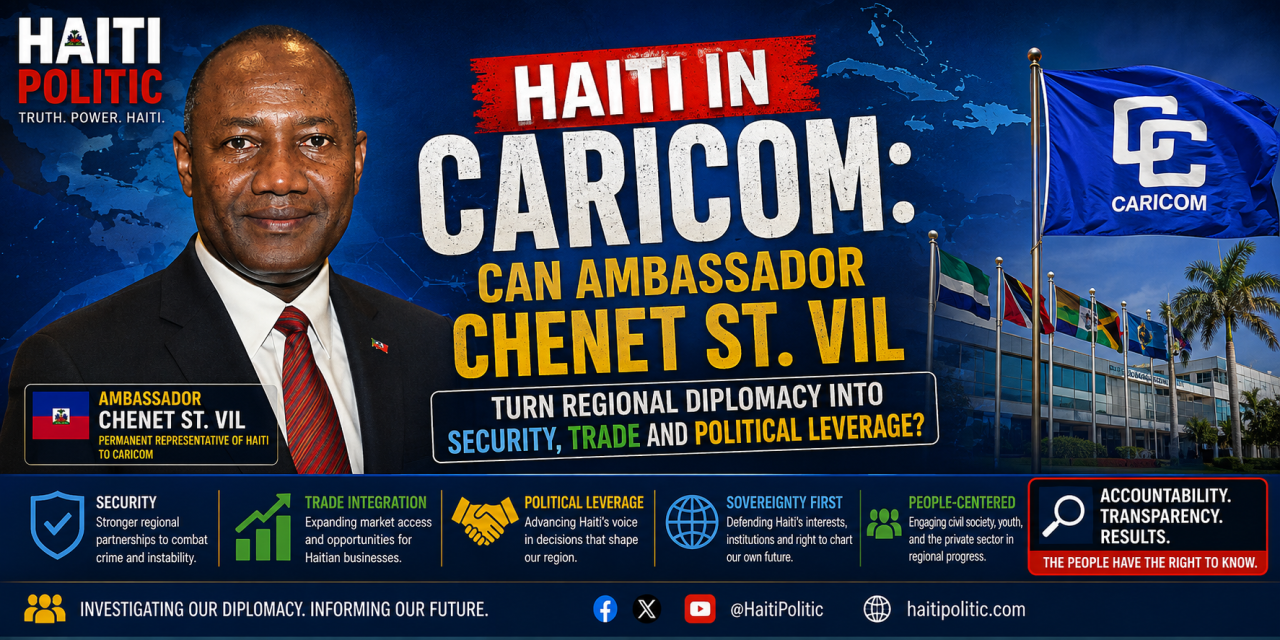
Representing Haiti inside that system is Ambassador Chenet St. Vil, whom Haiti’s Ministry of Foreign Affairs currently lists simply as “Chenet ST VIL, Ambassadeur” at the country’s Permanent Mission to CARICOM.
CARICOM’s own official roster identifies him as Haiti’s accredited ambassador and records his accreditation date as April 10, 2025.
His appointment is particularly interesting because St. Vil is not a newcomer to regional economic integration.
His public record stretches back decades.
And unlike many diplomatic postings where an ambassador must first learn the subject matter, St. Vil appears to have spent a substantial part of his professional career dealing with CARICOM, WTO rules, trade agreements and Caribbean economic integration.
That creates high expectations.
So the question is:
WHAT HAS HAITI ACTUALLY GAINED FROM HIS REPRESENTATION?
Has he transformed regional solidarity into concrete security support?
Has Haiti become more economically integrated with CARICOM?
Has his mission strengthened Haiti’s influence over regional political mediation?
Has he helped turn Caribbean institutions into practical instruments for Haitian businesses, police, civil society and public institutions?
Or does Haiti still participate in regional diplomacy without obtaining enough measurable results?
LET THE RECORD SPEAK.
👤 WHO IS CHENET ST. VIL?
The available documentary record suggests something unusual:
St. Vil’s experience with CARICOM and trade policy predates his ambassadorship by decades.
A FAO/WHO Codex Alimentarius record from around 2000 identifies a Chenet St-Vil as First Secretary at Haiti’s Permanent Mission in Geneva.
By 2018, Haitian government records identify him as a member of Haiti’s Bureau de Coordination et de Suivi des Accords de la CARICOM, de l’OMC et de la ZLEA during trade negotiations with the Dominican Republic.
During those talks, St. Vil presented the list of products on which Haiti was prepared to negotiate as both countries discussed modifications to tariff concessions under WTO principles.
His involvement continued.
A 2022 activity report from the Association des Industries d’Haïti identifies St. Vil as Coordinator of BACOZ, the office responsible for coordinating and monitoring Haiti’s CARICOM, WTO and FTAA-related agreements.
The meeting concerned Haiti’s possible integration into the CARICOM-Colombia Trade, Economic and Technical Cooperation Agreement.
That history matters.
When St. Vil presented his credentials in April 2025, he himself told the CARICOM Secretariat that much of his professional career had involved strengthening cooperation within the Caribbean Community and working toward the effective implementation of the CARICOM Single Market and Economy — CSME.
So this is not a diplomat learning CARICOM from scratch.
HE HAS BEEN WORKING AROUND THESE ISSUES FOR YEARS.
That should make the performance standard higher—not lower.
🏛️ APRIL 10, 2025 — HAITI GETS A NEW CARICOM AMBASSADOR
St. Vil formally presented his credentials to CARICOM Secretary-General Dr. Carla Barnett on April 10, 2025.
Barnett described his arrival as an opportunity to deepen and expand Haiti’s relationship with the Community at an exceptionally difficult moment in Haitian history.
St. Vil, for his part, emphasized the opportunities that full Haitian integration into CARICOM could generate. Haiti has been a full CARICOM member since 2002.
That gives us the central benchmark for evaluating his mandate:
IS HAITI BECOMING MORE INTEGRATED—OR MERELY MORE REPRESENTED?
Those are not the same thing.
⚠️ FIRST FACT CHECK: THE 48TH HEADS OF GOVERNMENT MEETING PREDATED HIS ACCREDITATION
One of the proposed oversight questions asks what text-level changes St. Vil secured during the 48th Regular Meeting of CARICOM Heads of Government in Barbados.
There is an important chronological problem.
That meeting took place from February 19–21, 2025.
St. Vil did not present his credentials as Ambassador to CARICOM until April 10, 2025.
Therefore:
THE 48TH MEETING CANNOT FAIRLY BE USED AS A PERFORMANCE TEST OF HIS TENURE AS AMBASSADOR.
At that February meeting, CARICOM leaders agreed to continue the Good Offices of the Eminent Persons Group in engaging Haitian stakeholders.
That policy belongs to the institutional continuity of CARICOM-Haiti relations—not to St. Vil’s ambassadorship.
A fair investigation should instead examine what happened after April 10, 2025.
And there is plenty to examine.
🇭🇹 ACCOMPLISHMENT OR INSTITUTIONAL RESULT #1 — CARICOM MAINTAINS HAITI AT THE TOP OF THE REGIONAL AGENDA
Three days after St. Vil presented his credentials, CARICOM issued a strong statement regarding Haiti’s deteriorating security situation.
On April 13, 2025, CARICOM condemned attempts by armed groups to overthrow the transitional political arrangements and said it was consulting with Haiti and international partners to provide additional security assistance.
This matters because small states often obtain more international leverage when they speak collectively.
Instead of Haiti standing alone, CARICOM publicly placed the Caribbean Community behind Haitian institutional continuity.
But:
DID ST. VIL HELP SHAPE THAT STATEMENT?
Was Haiti’s mission consulted on its wording?
Did the mission request specific language?
Were Haitian priorities inserted?
Which parts originated from St. Vil’s office?
The public statement exists.
The diplomatic negotiating record does not appear publicly available.
That is precisely the distinction this investigation seeks to expose.
🛡️ JULY 2025 — CARICOM PROMISES TO REDOUBLE SECURITY EFFORTS
At the 49th Regular Meeting of Heads of Government in Jamaica, CARICOM went further.
Leaders expressed grave concern over Haiti’s humanitarian deterioration and committed to redouble efforts to mobilize resources for security support and provide direct humanitarian assistance.
They also received an update from Haiti’s Transitional Presidential Council and information from the CARICOM Eminent Persons Group.
Jamaican Prime Minister Andrew Holness separately emphasized that CARICOM needed to restore international momentum behind Haiti’s security mission and noted Jamaica’s willingness to provide personnel.
That is politically significant.
But the accountability question is unavoidable:
WHAT DID “REDOUBLE EFFORTS” PRODUCE?
How many police officers were trained?
How many security personnel were pledged?
How much logistical support was delivered?
How much humanitarian assistance reached Haiti?
Which member states contributed?
And what role did St. Vil’s mission play in negotiating those commitments?
🔫 CARICOM BECOMES AN ADVOCATE FOR A STRONGER INTERNATIONAL SECURITY MISSION
By September 2025, CARICOM was publicly backing stronger international security assistance for Haiti.
The Community supported the draft UN Security Council initiative that eventually created a more robust international force.
When the Security Council adopted Resolution 2793 creating the Gang Suppression Force, CARICOM welcomed the decision and called for predictable financing and stronger logistical support.
This illustrates something potentially valuable about Haiti’s CARICOM mission:
CARICOM CAN AMPLIFY HAITI’S VOICE FAR BEYOND THE CARIBBEAN.
The Community can lobby Washington.
It can lobby the UN.
It can lobby the OAS.
It can speak collectively on Haiti’s security.
That is diplomatic leverage.
But it must eventually generate measurable contributions.
🚔 WHERE ARE THE CARIBBEAN SECURITY DELIVERABLES?
CARICOM already has specialized regional security institutions.
The most important is CARICOM IMPACS — the Implementation Agency for Crime and Security.
CARICOM describes IMPACS as the regional nerve center for collective crime and security management, responsible for information-sharing, regional security projects and policy development.
Historically, CARICOM has specifically identified Haitian National Police training and capacity-building through IMPACS as an area where the Community could assist Haiti.
IMPACS also now participates in newer information-sharing initiatives against organized crime, including a 2026 agreement with Caribbean and Latin American Crime Stoppers networks.
So the question for St. Vil becomes extremely specific:
HOW MUCH OF THAT REGIONAL SECURITY ARCHITECTURE HAS HAITI ACTUALLY ACCESSED?
🚨 QUESTION #1 — IMPACS: SHOW THE NUMBERS
Since April 2025:
How many Haitian National Police officers received CARICOM-supported training?
How many intelligence exchanges occurred through IMPACS?
How many Haitian officers participated in regional programs?
What maritime-security assistance was obtained?
What border-management technologies were delivered?
What trafficking investigations involved Haitian authorities?
How many weapons-trafficking cases were disrupted through Caribbean cooperation?
What dollar value of security assistance was mobilized?
These should become KPIs for Haiti’s CARICOM mission.
🗳️ ACCOMPLISHMENT #2 — CARICOM REMAINS DEEPLY INVOLVED IN HAITI’S POLITICAL TRANSITION
Political mediation remains one of CARICOM’s most visible roles in Haiti.
The Eminent Persons Group — EPG has continued meeting Haitian political, governmental and civil-society actors.
In June 2026, the EPG said it maintained ongoing virtual engagement with a broad range of Haitian stakeholders, including government, political sectors and civil society.
Then came a major milestone.
On July 27, 2026, the EPG welcomed publication of Haiti’s official electoral calendar, describing it as a critical and long-awaited step toward general elections.
That matters.
CARICOM’s involvement has gradually moved from trying to mediate an open-ended political crisis toward supporting a defined electoral pathway.
But attribution again matters.
🧐 DID ST. VIL COORDINATE THIS—OR WAS HE OBSERVING IT?
The EPG is a CARICOM mechanism.
The Haitian electoral calendar was produced by Haiti’s Provisional Electoral Council.
So St. Vil cannot reasonably receive personal credit simply because both events occurred while he was ambassador.
The legitimate oversight question is narrower:
WHAT DID HIS MISSION DO TO CONNECT THE TWO?
How often did St. Vil meet the EPG?
How many written briefings did his mission provide?
What electoral milestones did Haiti communicate to CARICOM through his office?
Did his mission resolve misunderstandings between the Haitian government and CARICOM mediators?
Were there disputed recommendations that Haiti rejected?
Which EPG recommendations were accepted?
Those are the missing details.
🏛️ FEBRUARY 2026 — THE TRANSITION CHANGES
When Haiti’s Transitional Presidential Council ended its mandate in February 2026, CARICOM publicly reiterated that Haiti’s political process should remain Haitian-led and Haitian-owned.
It also emphasized structured consultation with Haitian citizens, representatives and civil society.
This language is important.
Because regional mediation can quickly become politically controversial if Haitians believe foreign governments are deciding Haiti’s domestic arrangements.
A capable CARICOM ambassador must therefore accomplish two things simultaneously:
obtain regional assistance
while
defending Haitian ownership.
That is a difficult diplomatic balance.
🇭🇹 JULY 2026 — CARICOM ISSUES ONE OF ITS STRONGEST RECENT HAITI STATEMENTS
At the 51st Regular Meeting of CARICOM Heads of Government in Saint Lucia, the Community issued a dedicated statement supporting Haiti.
CARICOM reaffirmed:
solidarity with Haiti
support for restoring security
support for democratic institutions
support for constitutional governance
and
support for the electoral process.
It also backed strengthening Haiti’s national security institutions and called for full deployment and renewal of the Gang Suppression Force.
This meeting occurred well inside St. Vil’s tenure.
So this is a reasonable area for performance scrutiny.
📑 QUESTION #2 — WHICH WORDS CAME FROM HAITI?
For the 49th, 50th and 51st Heads of Government meetings:
What draft language did St. Vil’s mission submit?
What language was adopted?
What wording was rejected?
Did Haiti request explicit language protecting sovereignty?
Did Haiti demand stronger security commitments?
Did Haiti seek references to elections?
Did Haiti oppose any proposed language?
Where confidentiality allows, publish a matrix:
CARICOM DRAFT → HAITI’S AMENDMENT → FINAL TEXT
That is how citizens can measure negotiating leverage.
🌎 THEN COMES THE ECONOMIC QUESTION
Here St. Vil’s résumé should give him a considerable advantage.
He has years of experience dealing with:
CARICOM agreements
WTO arrangements
tariff negotiations
and
regional economic integration.
When presenting his credentials, he specifically highlighted the opportunities available through deeper Haitian integration into the CSME.
So:
WHERE ARE THE ECONOMIC RESULTS?
📦 HAITI HAS BEEN A CARICOM MEMBER SINCE 2002. WHY IS ECONOMIC INTEGRATION STILL INCOMPLETE?
This should become a central question of St. Vil’s tenure.
More than two decades after joining CARICOM, Haiti still faces significant obstacles to fully exploiting regional economic integration.
St. Vil’s own history shows that these problems are not new.
Back in 2018, he participated in negotiations addressing Haiti’s enormous trade imbalance with the Dominican Republic. Haitian government figures at the time cited approximately US$50 million in Haitian exports versus around US$1 billion flowing the other way.
By 2022, he was working with Haitian business organizations on Haiti’s relationship to the CARICOM-Colombia agreement.
So St. Vil understands trade friction.
Now that he is ambassador:
HAS THAT EXPERTISE PRODUCED NEW ACCESS FOR HAITIAN BUSINESSES?
💼 QUESTION #3 — COTED: WHAT HAS HAITI ACTUALLY PROPOSED?
CARICOM’s Council for Trade and Economic Development — COTED is one of the institutions where Haiti can advance commercial interests.
So publish Haiti’s record.
Since St. Vil became ambassador:
How many COTED proposals did Haiti submit?
Which dealt with Haitian SMEs?
Which addressed customs?
Which addressed shipping?
Which addressed food exports?
Which addressed agriculture?
Which addressed tariffs?
Which sought temporary relief because of Haiti’s security crisis?
Which were approved?
Which were rejected?
The public record reviewed for this article does not provide a comprehensive, attributable St. Vil-era COTED performance dashboard.
That should exist.
⚓ REGIONAL SHIPPING MAY BE AS IMPORTANT AS TARIFFS
A Haitian company cannot benefit from regional free trade if moving a container between Haiti and another Caribbean state costs too much or takes too long.
CARICOM leaders continue discussing measures aimed at reducing intra-regional cargo costs and tackling the region’s high cost of living.
This should matter enormously to Haiti.
So:
What shipping routes has St. Vil’s mission advocated for?
What port partnerships?
What customs interoperability?
What trade documentation reforms?
What regional cargo initiatives include Haiti?
How many Haitian firms benefited?
Regional integration should ultimately be visible on invoices—not only in communiqués.
🛃 CUSTOMS AND CONTRABAND: THE TWO-SIDED CHALLENGE
Haiti needs easier legitimate trade.
But it also needs stronger controls against:
arms trafficking
contraband
financial crime
human trafficking
and
organized criminal networks.
This makes customs diplomacy particularly difficult.
Opening commerce while closing illicit routes requires coordination among:
customs agencies
coast guards
police
immigration authorities
and
regional intelligence institutions.
CARICOM’s security architecture already exists for exactly this type of transnational cooperation.
So Haiti should be able to specify what it has accessed.
🚢 QUESTION #4 — WHICH BORDER PROTOCOLS HAVE BEEN SIGNED?
Since St. Vil’s appointment:
Has Haiti negotiated new protocols involving:
cargo screening?
container intelligence?
maritime surveillance?
customs data-sharing?
passenger information?
small-arms tracing?
coast-guard coordination?
financial intelligence?
Which countries?
How many operations?
How many seizures?
How many trafficking networks disrupted?
If such cooperation exists but must remain partly confidential, aggregate numbers can still be published.
👥 CIVIL SOCIETY: ONE OF THE MOST IMPORTANT TESTS
CARICOM itself has acknowledged the need to include more citizens, private-sector organizations, youth, labor and civil society in regional decision-making.
Its social-partner initiative is explicitly intended to create mechanisms for dialogue, information exchange and stakeholder participation under Article 26 of the Revised Treaty of Chaguaramas.
This is especially important for Haiti.
CARICOM mediation in Haiti has frequently been criticized or misunderstood depending on which political group is speaking.
Greater transparency and broader consultation could reduce that problem.
CARICOM itself has said Haiti’s political transition requires structured inclusion of civil society.
So:
WHERE IS HAITI’S CARICOM CIVIL-SOCIETY FORUM?
🗣️ QUESTION #5 — WHO GETS CONSULTED?
Does St. Vil’s mission maintain a structured consultation process with:
business associations?
women’s organizations?
youth organizations?
universities?
trade unions?
diaspora groups?
human-rights organizations?
farmers?
regional exporters?
grassroots organizations?
How often do consultations occur?
Are minutes produced?
Do stakeholder recommendations reach CARICOM?
Which recommendations were adopted?
If diplomacy is being conducted on behalf of Haitians, Haitians should have a mechanism for participating in it.
⚖️ SO WHAT CAN WE ACTUALLY ATTRIBUTE TO ST. VIL?
This is where a fair investigation must be disciplined.
We can verify:
✔️ St. Vil formally became Haiti’s accredited Ambassador to CARICOM on April 10, 2025.
✔️ He possesses extensive prior experience involving CARICOM, WTO matters and trade agreements.
✔️ He publicly identified deeper CSME integration as an economic opportunity for Haiti when taking office.
✔️ During his tenure, CARICOM repeatedly strengthened its political support for Haiti’s security and institutional continuity.
✔️ CARICOM advocated internationally for stronger security support that ultimately included backing the Gang Suppression Force.
✔️ The CARICOM Eminent Persons Group remained engaged with Haitian government, political and civil-society stakeholders.
✔️ The EPG welcomed Haiti’s publication of an electoral calendar in July 2026.
These are meaningful regional developments.
But there is a major limitation.
PUBLIC RECORDS SHOW WHAT CARICOM DID MORE CLEARLY THAN WHAT ST. VIL PERSONALLY NEGOTIATED.
That distinction matters.
❓ WHAT WE STILL CANNOT SEE CLEARLY
From publicly accessible sources reviewed for this investigation, it is much harder to identify:
❓ Text-level amendments personally secured by St. Vil
❓ Quantified police training directly brokered by his mission
❓ Financial value of CARICOM security assistance obtained through his intervention
❓ Specific IMPACS operations initiated by Haiti’s CARICOM mission
❓ Haitian-authored COTED initiatives advanced under his tenure
❓ Measurable trade gains attributable to his diplomacy
❓ Customs agreements personally negotiated by his mission
❓ Formal civil-society consultation mechanisms established by his office
That does not prove those accomplishments do not exist.
IT MEANS THEY HAVE NOT BEEN MADE EASY FOR THE PUBLIC TO VERIFY.
And that is a transparency problem.
📑 THE SEVEN QUESTIONS AMBASSADOR ST. VIL SHOULD ANSWER
1️⃣ EPG COORDINATION — SHOW THE MILESTONES
Since April 2025:
How many meetings has the mission held with the EPG?
What milestones were established?
What recommendations did Haiti accept?
What recommendations were rejected?
How did the mission assist transmission and regional understanding of the electoral calendar?
2️⃣ HEADS OF GOVERNMENT — SHOW THE LANGUAGE
For CARICOM meetings occurring after his April 2025 accreditation:
What language did Haiti propose?
What was adopted?
What was rejected?
Which provisions strengthened Haitian sovereignty, security and institutional stability?
The 48th Meeting should not be counted against him because it predated his tenure.
3️⃣ COTED — SHOW THE TRADE RESULTS
How many Haitian proposals?
How many adopted?
How many businesses assisted?
How much intra-CARICOM trade resulted?
Which commercial barriers were removed?
4️⃣ CUSTOMS — SHOW THE PROTOCOLS
Which regional customs-security agreements were signed?
What information is being exchanged?
What has changed in cargo-processing times?
How many contraband or trafficking cases benefited from regional cooperation?
5️⃣ SECURITY — SHOW THE RESOURCES
How many CARICOM police officers or trainers assisted Haiti?
How many Haitian officers were trained?
What equipment was delivered?
What maritime commitments?
What logistical contributions?
What financial value?
6️⃣ IMPACS — SHOW THE OPERATIONS
How many intelligence exchanges?
How many regional investigations?
How many trafficking networks disrupted?
What specific IMPACS programs currently include Haiti?
7️⃣ CIVIL SOCIETY — SHOW WHO HAS A VOICE
Which Haitian civil-society organizations does the mission consult?
How frequently?
What formal mechanism exists?
What recommendations entered CARICOM deliberations?
Transparency begins with identifying who is being represented.
🇭🇹 CAN CHENET ST. VIL BRING SOMETHING NEW TO HAITIAN FOREIGN POLICY?
His background provides a credible reason to ask the question.
Unlike someone entering CARICOM without prior exposure, St. Vil appears to have spent years working on exactly the issues now under his authority:
regional integration
WTO rules
trade agreements
CARICOM institutions
and
commercial negotiations.
That experience could make him particularly useful.
But experience alone cannot be the verdict.
A regional ambassador should be judged on whether Haiti obtains:
SECURITY SUPPORT.
TRADE OPPORTUNITIES.
REGIONAL MARKET ACCESS.
CUSTOMS COOPERATION.
INTELLIGENCE SHARING.
POLITICAL LEVERAGE.
ELECTORAL SUPPORT.
CIVIL-SOCIETY ACCESS.
MEASURABLE RESULTS.
📊 IMAGINE A CARICOM PERFORMANCE DASHBOARD
Every six months, Haiti’s Permanent Mission could publish:
🤝 CARICOM agreements negotiated — ___
📜 Haitian amendments adopted — ___
🚔 Police personnel trained — ___
💰 Security assistance mobilized — $___
🚢 Maritime-security initiatives — ___
🛃 Customs agreements — ___
📦 Haitian exporters assisted — ___
📈 Intra-CARICOM exports — +___%
🏪 SMEs receiving regional assistance — ___
🗳️ Electoral-support initiatives — ___
👥 Civil-society consultations — ___
🔎 IMPACS operations involving Haiti — ___
Then the debate surrounding Haitian diplomacy would change.
It would stop being:
“Do you like this ambassador?”
And become:
“WHAT DID THE AMBASSADOR DELIVER?”
🔎 OUR PRELIMINARY ASSESSMENT
St. Vil has one of the more directly relevant professional backgrounds among Haiti’s diplomatic representatives.
His public record suggests decades of exposure to trade negotiations and Caribbean economic integration.
During his ambassadorship, CARICOM has remained unusually active on Haiti:
It defended Haiti’s transitional institutions against violent overthrow.
It committed to mobilizing greater security and humanitarian support.
It backed stronger international security arrangements.
It continued political mediation through the EPG.
And in July 2026 it again declared strong support for Haitian security institutions, elections and constitutional governance.
Those are meaningful developments.
But:
CARICOM’S ACTIVITY IS NOT AUTOMATICALLY ST. VIL’S ACCOMPLISHMENT.
To evaluate him fairly, Haiti needs to disclose his diplomatic footprint inside those outcomes.
Which sentences?
Which negotiations?
Which commitments?
Which resources?
Which trade initiatives?
Which security agreements?
That evidence should decide.
📢 PUBLISH THE PERFORMANCE REPORT
Ambassador Chenet St. Vil should have the opportunity to answer with documents and numbers.
Publish:
the CARICOM negotiating record
the EPG coordination milestones
the security commitments
the IMPACS cooperation
the COTED proposals
the customs protocols
the business-support programs
the civil-society consultations
the successes
and
the initiatives that failed.
Because diplomacy is not weakened when citizens know what happened.
IT IS STRENGTHENED BY ACCOUNTABILITY.
Then—
🇭🇹 LET THE HAITIAN PEOPLE DECIDE.
Is Chenet St. Vil finally converting Haiti’s CARICOM membership into meaningful regional leverage?
Can his decades of trade experience accelerate Haiti’s economic integration?
Can neighboring Caribbean countries become genuine security partners?
Can regional diplomacy strengthen Haitian sovereignty rather than substitute for it?
And can Haiti finally treat CARICOM not merely as a political forum—
but as an instrument for:
SECURITY.
COMMERCE.
INTEGRATION.
STABILITY.
RESULTS.
Because after more than two decades as a full member of CARICOM, Haiti should be asking one question:
WHAT ARE WE GETTING FROM REGIONAL INTEGRATION—AND HOW DO WE GET MORE?
THE MEETING IS NOT THE RESULT.
THE COMMUNIQUÉ IS NOT THE RESULT.
THE TITLE IS NOT THE RESULT.
WHAT CHANGES FOR HAITIANS IS THE RESULT.
#Haiti #ChenetStVil #CARICOM #HaitianDiplomacy #ForeignPolicy #CSME #COTED #CARICOMIMPACS #HaitiSecurity #RegionalIntegration #HaitiTrade #Elections #CivilSociety #Accountability #Transparency #HaitiPolitic