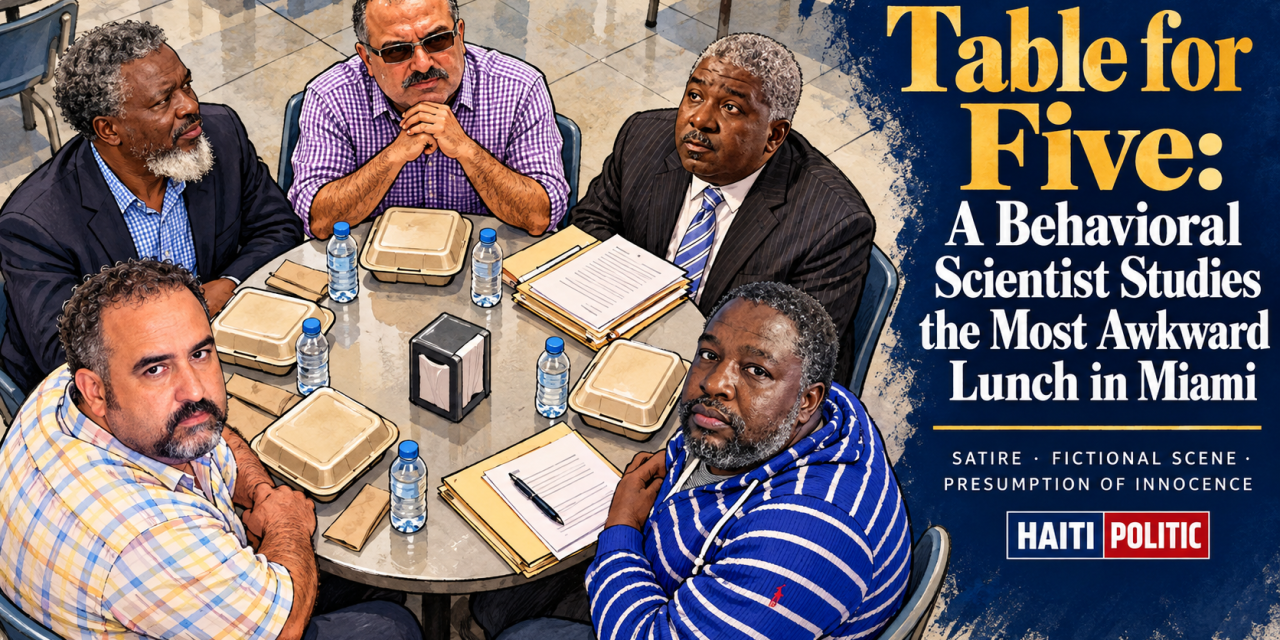
A note before we begin: this is satire. The defendants named here are real people in a real case involving the real killing of a head of state, and the humor is aimed at cafeteria psychology and courtroom paperwork, not at the victims. Those who haven’t been convicted are presumed innocent. In reality, co-defendants are usually kept apart by detention authorities, so this dinner is a thought experiment, not a reservation.
By Prof. I. M. Tray, Department of Applied Cafeteria Sociology (fictional)
Behavioral science has long asked what happens when people who share one very large legal problem are handed one very small plastic tray. Today’s imaginary experiment seats five names from the Federal Detention Center in Miami at a single table: Joseph Félix Badio, Samir Handal, Christian Emmanuel Sanon, Rodolphe Jaar, and Joseph Joel John. The variable under study is the lunch line.
Finding One: The Empty-Chair Effect
The first thing any observer notices is the reserved sixth seat. The name on the placard is Vitel’Homme Innocent, who, according to the FBI, has been “geolocated to Haiti” and has not RSVP’d. Behaviorally, absent parties are the most popular topic at any table, and by the second course, blame has been distributed generously to the one chair that cannot respond.
Finding Two: Diffusion of Responsibility, Cafeteria Edition
In the classic bystander effect, the more people present, the less likely anyone is to act. Applied here: when the dessert cup goes missing, each of the five is certain the other four saw who took it. No one ordered it. Everyone has a lawyer who will say so in writing.
Finding Three: The Prisoner’s Dilemma of the Last Dinner Roll
Game theory predicts the outcome. If all five decline the roll, it goes to waste and everyone stares at it. If one takes it, a cooperation dynamic emerges that no one at the table can quite name but everyone can smell. The one person whose locator entry already reads “LIFE” is, behaviorally, the calmest diner present, because he is the only one who isn’t refreshing the docket.
Finding Four: Motion Practice at the Salad Bar
Given the pretrial calendar, the table quickly turns procedural:
- A motion to strike surplusage from the gravy, granted without prejudice.
- A motion in limine to exclude the green beans as “inextricably intertwined” with the mystery meat.
- A demand for a bill of particulars on what, precisely, the meatloaf is charged with.
- A motion to compel production of the recipe under Brady, on the theory that exculpatory seasoning exists.
Conclusion
My research team found no evidence that shared meals produce consensus among parties with sharply divergent interests, which is a polite way of saying the table never agrees on the check. What the experiment does show is that in every human institution, from the boardroom to the chow line, the only thing everyone will readily agree on is that the food is worse than what was promised.
Further study is warranted, funding is pending, and the dessert cup is still missing.