For many Haitian political figures, security is a campaign talking point.
For Mario Andrésol, it has been most of his professional life.
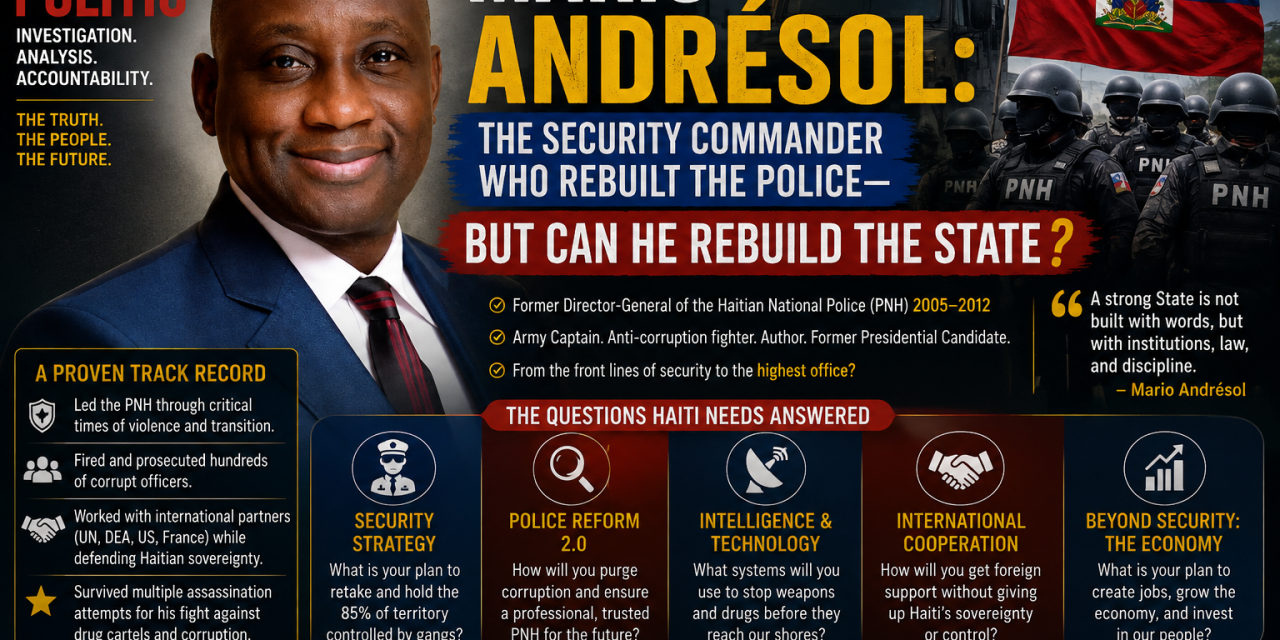
Former Haitian army captain. Senior police commander. Former head of the Central Directorate of the Judicial Police. Director-General of the Haitian National Police (PNH) from 2005 to 2012. Presidential candidate in 2015. And, importantly for evaluating him today, Andrésol has returned to the center of state power: after serving as Secretary of State for Public Security, he was installed as Haiti’s Minister of Defense on March 4, 2026.
That makes this investigation different.
We are no longer evaluating only what Mario Andrésol did fifteen or twenty years ago.
We can also ask what he is accomplishing right now.
And the central question is unavoidable:
Does Haiti need a security specialist at the top—or has the country’s crisis become far too complex to be solved primarily through a security doctrine?
🪖 FROM THE ARMY TO THE POLICE
Andrésol’s résumé is unusually extensive in Haiti’s security establishment.
After entering Haiti’s Military Academy in the 1980s, he received additional military and gendarmerie training abroad, including in the United States and France. He eventually reached the rank of captain in the Armed Forces of Haiti.
When the PNH was created in 1995, he transitioned into civilian policing.
His progression was substantial:
Pétion-Ville police commissioner → Port-au-Prince district commissioner → Director of the DCPJ → Director-General of the PNH.
From July 2005 until August 2012, Andrésol commanded Haiti’s national police across three different political periods involving the governments of Boniface Alexandre/Gérard Latortue, René Préval and Michel Martelly.
That continuity is significant in a country where institutions frequently become casualties of political transitions.
🚔 THE RECORD: DID ANDRÉSOL ACTUALLY REBUILD THE PNH?
There is a credible case that he helped professionalize it.
During his leadership, the PNH expanded its personnel, strengthened organizational structures with international assistance and began implementing vetting mechanisms aimed at improving integrity inside the force. Haiti’s Defense Ministry’s biography of Andrésol highlights these accomplishments, while independent academic analysis also notes that strengthening the PNH became a major Haitian-international project during this period.
But the historical record also requires context.
Andrésol did not accomplish this alone.
MINUSTAH and international partners provided substantial personnel, training, logistics and institutional support to the PNH. The United Nations itself described the post-2004 strengthening of the police as a combined Haitian and international effort.
So one of the first questions Haiti Politic would put directly to him is:
🎤 How much of your security success was institutional—and how much depended on MINUSTAH?
If the Andrésol model requires thousands of international personnel and massive foreign logistical assistance, can it really be described as a blueprint for Haitian security sovereignty?
🚨 QUESTION 1: CAN THE MAN WHO FOUGHT THE OLD GANGS DEFEAT TODAY’S ARMED NETWORKS?
This may determine his entire political future.
The Haiti of Andrésol’s PNH command is not the Haiti of today.
Modern armed groups have evolved in organization, weapons, financing, territorial control and political-economic relationships.
Therefore, saying “I defeated gangs before” would not be enough.
Haiti Politic wants the operational plan.
🎤 THE QUESTIONS
Which territories would be reclaimed first?
Which units would lead operations?
How would police hold neighborhoods after clearing them?
How would roads, ports and fuel terminals remain permanently secured?
How would intelligence identify gang financiers?
How would civilians trapped inside contested neighborhoods be protected?
And what happens after police operations end?
Because Haiti has learned a brutal lesson:
Taking territory is one thing. Governing it afterward is another.
👮🏿 QUESTION 2: CAN HE CLEAN THE POLICE AGAIN?
One of the strongest parts of Andrésol’s historical record concerns police integrity.
But it also reveals how serious the problem was.
In 2006, the Inter-American Commission on Human Rights reported Andrésol’s assessment that approximately 25% of the police force was suspected of corruption. The Commission described police involvement in criminal activity as a serious threat to the institution’s credibility.
His administration participated in efforts to vet and professionalize the force.
The question for 2026 is harder:
🎤 WHAT DOES PNH VETTING 2.0 LOOK LIKE?
Would every officer undergo periodic financial disclosure?
Would unexplained wealth trigger investigation?
Would senior commanders undergo polygraphs or enhanced integrity screening?
Would UCREF examine suspicious police financial activity?
Would an independent inspector general have authority to investigate politically connected commanders?
And who investigates the investigators?
A government cannot defeat organized crime when organized crime possesses information from inside government.
🪖 QUESTION 3: PNH + FAD’H = WHAT EXACTLY?
Andrésol occupies a fascinating position.
He has commanded police.
He served in the old military.
And today he is Minister of Defense.
Few Haitian public figures understand both institutions from the inside.
That could be an extraordinary advantage.
It could also create an extraordinary concentration of security thinking around one political figure.
🎤 HAITI POLITIC ASKS:
What exactly should the FAD’H do?
Border security?
Maritime defense?
Critical infrastructure?
Counterterrorism?
Disaster response?
Anti-gang operations?
And where does military jurisdiction stop and civilian policing begin?
Haiti’s Constitution deliberately created important distinctions between military and police functions.
A future Andrésol administration would need to demonstrate that rebuilding national defense does not mean militarizing civilian government.
🛰️ QUESTION 4: WHERE IS THE INTELLIGENCE REVOLUTION?
Police cannot permanently defeat organized criminal networks merely by exchanging gunfire with them.
Modern organized crime depends on:
money + weapons + communications + transportation + intelligence + political protection.
So Andrésol’s real security test is not whether he can put more officers in armored vehicles.
It is whether Haiti can build a modern intelligence state under democratic control.
🎤 SHOW HAITI THE BLUEPRINT.
Would ports use container-scanning technology?
Would customs databases communicate directly with police intelligence?
Would Haiti establish maritime radar coverage?
Would ballistic evidence be nationally catalogued?
Could authorities digitally trace weapons recovered from gangs?
Would financial intelligence automatically flag suspicious transactions?
Could Haiti negotiate real-time firearms-trafficking intelligence with the United States, Dominican Republic, Jamaica, Bahamas and other regional partners?
Stopping guns before they reach gangs is cheaper than fighting gangs after they receive them.
👁️ BUT HERE COMES THE CIVIL-LIBERTIES QUESTION
Modern intelligence capabilities create another danger:
surveillance abuse.
A president cannot simply say, “Give the security services more technology.”
Haiti has a long history of governments using state power against political opponents.
So if Andrésol advocates electronic surveillance, Haiti Politic would ask:
Who authorizes interception?
A judge?
A minister?
The police?
Intelligence officials?
How long can surveillance continue?
Can journalists be monitored?
Can opposition politicians?
Who audits the intelligence services?
Security without accountability can eventually become repression.
That is a test every security-oriented candidate must pass.
🌎 QUESTION 5: WHAT WOULD AN ANDRÉSOL FOREIGN POLICY ACTUALLY LOOK LIKE?
This is where his security résumé could become a diplomatic advantage.
Andrésol has extensive experience coordinating with international security partners. During his PNH leadership, strengthening the police involved cooperation with the United Nations and other international actors.
And his current government has continued emphasizing international cooperation as a mechanism for strengthening Haitian capacity rather than substituting for the Haitian state.
That principle could become the foundation of an Andrésol doctrine:
🇭🇹 FOREIGN ASSISTANCE WITHOUT FOREIGN COMMAND.
But slogans aren’t foreign policy.
Would Washington remain Haiti’s primary security partner?
How would he approach Canada?
France?
CARICOM?
The Dominican Republic?
Would Haiti deepen cooperation with Colombia on organized crime?
Could Haiti seek equipment or training from nontraditional partners?
What happens when Haiti’s priorities conflict with those of Washington?
A sovereign government must be capable of cooperating with powerful countries without becoming subordinate to them.
💰 QUESTION 6: WHO PAYS FOR SECURITY SOVEREIGNTY?
This question destroys many political promises.
Police officers require salaries.
Soldiers require salaries.
Armored vehicles require maintenance.
Helicopters require fuel.
Drones require operators.
Radar requires technicians.
Intelligence requires secure communications.
Courts require judges.
Prisons require guards.
🎤 SO WHERE IS THE MONEY COMING FROM?
Andrésol’s official professional biography says that while commanding the PNH he managed an annual budget of approximately US$140 million.
That gives him experience managing a significant security institution.
But national sovereignty requires something larger:
a sustainable revenue state.
Would he digitize customs?
Fight under-invoicing?
Audit major importers?
Reform property taxation?
Expand formal employment?
Recover stolen public assets?
Because a government that depends on foreigners to pay for its security apparatus can never claim complete security sovereignty.
⚖️ QUESTION 7: CAN A COMMANDER BECOME A DEMOCRATIC PRESIDENT?
This may be the greatest political question surrounding Andrésol.
Command institutions operate vertically.
Orders move downward.
Politics does not.
Presidents negotiate with Parliament, mayors, judges, unions, business associations, farmers, universities, churches, journalists, opposition parties and civil society.
Sometimes the answer is no.
Sometimes Parliament blocks you.
Sometimes courts overturn you.
Sometimes journalists expose you.
Sometimes citizens protest you.
🎤 HOW DOES MARIO ANDRÉSOL HANDLE DISSENT?
Would demonstrations be treated as legitimate democratic expression?
What restrictions would exist on emergency powers?
Would Parliament oversee intelligence spending?
Would the judiciary be genuinely independent?
Could an opposition-controlled legislature investigate his administration?
Could journalists investigate military procurement?
The test of democratic leadership isn’t respecting institutions when they agree with you.
It’s respecting them when they obstruct you.
💼 QUESTION 8: SECURITY ISN’T AN ECONOMIC PROGRAM
Suppose Andrésol succeeds.
The gangs retreat.
Roads reopen.
Ports operate.
Businesses reopen.
Then what?
Haiti still needs jobs.
Electricity.
Agriculture.
Schools.
Housing.
Healthcare.
Manufacturing.
Digital infrastructure.
Investment.
A functioning currency.
🎤 WHERE IS THE ANDRÉSOL ECONOMIC DOCTRINE?
This is where his political platform requires far more scrutiny.
A security specialist can create the conditions for economic development.
He cannot substitute security for economic development.
And unless young Haitians see legitimate economic opportunities, criminal organizations will always have another generation available for recruitment.
🏛️ QUESTION 9: HE IS IN GOVERNMENT NOW—SO MEASURE HIM NOW
This is perhaps the fairest test of all.
Mario Andrésol isn’t merely giving television interviews about what he would do.
He became Secretary of State for Public Security and, on March 4, 2026, was installed as Minister of Defense.
That means voters don’t need to judge him exclusively on his 2005–2012 record.
CREATE A SCORECARD.
How many security corridors have reopened?
How much territory has been durably restored to state control?
How many soldiers have been professionally trained?
What procurement reforms have been implemented?
How much weapons trafficking has been intercepted?
What measurable improvements have occurred in military readiness?
What has happened to kidnapping and homicide?
How much independent Haitian capacity has been created?
A current minister asking Haitians to trust his competence should welcome measurable performance standards.
📊 HAITI POLITIC ASSESSMENT
| AREA | THE CASE FOR ANDRÉSOL | THE QUESTION |
|---|---|---|
| Security | Exceptional senior command experience | Can an older counter-gang model defeat today’s more sophisticated armed networks? |
| PNH Reform | Led professionalization and vetting efforts | Can he institutionalize reform so it survives individual commanders? |
| Defense | Understands both military and policing institutions | Can he strengthen FAD’H without militarizing civilian governance? |
| International Relations | Extensive experience working with international security partners | Can cooperation become genuine Haitian sovereignty rather than dependency? |
| Leadership | Managed the PNH across multiple governments | Can command leadership translate into democratic coalition-building? |
| Economy | Security restoration could unlock investment | What is his actual economic development model? |
| Current Record | Now has direct responsibility as Defense Minister | What measurable results can his current tenure demonstrate? |
🔎 HAITI POLITIC VERDICT: THE SECURITY RÉSUMÉ IS REAL. THE PRESIDENTIAL CASE IS NOT YET PROVEN.
Mario Andrésol should not be evaluated like a politician who suddenly discovered public security during campaign season.
He has actually commanded Haiti’s police.
He has managed a national security institution.
He has confronted police corruption.
He has operated through political transitions.
And today he again holds substantial responsibility for Haiti’s security architecture as Minister of Defense.
Those facts give him credibility.
But they also remove his easiest excuse.
Mario Andrésol is no longer standing outside government explaining how security should work. He is inside the government with an opportunity to demonstrate it.
So Haiti should watch the results.
Not the speeches.
Not the uniform.
Not nostalgia for the 2000s.
Results.
And if he eventually asks Haitians for greater political power, one question should follow him everywhere:
🇭🇹 MARIO ANDRÉSOL MAY KNOW HOW TO COMMAND THE SECURITY FORCES—BUT CAN HE GOVERN A DEMOCRATIC STATE, BUILD AN ECONOMY, NEGOTIATE A NEW FOREIGN POLICY AND CREATE INSTITUTIONS STRONG ENOUGH TO FUNCTION WITHOUT HIM?
The evidence should decide.
The Haitian people should decide.
HAITI POLITIC
Investigation. Analysis. Accountability.
The Truth. The People. The Future.