Youth. Accountability. Security. Diaspora. Sovereignty.
Haiti has heard promises of change, rupture, reform and national reconstruction from generations of political leaders. Yet the fundamental question remains: who can turn political language into functioning institutions?
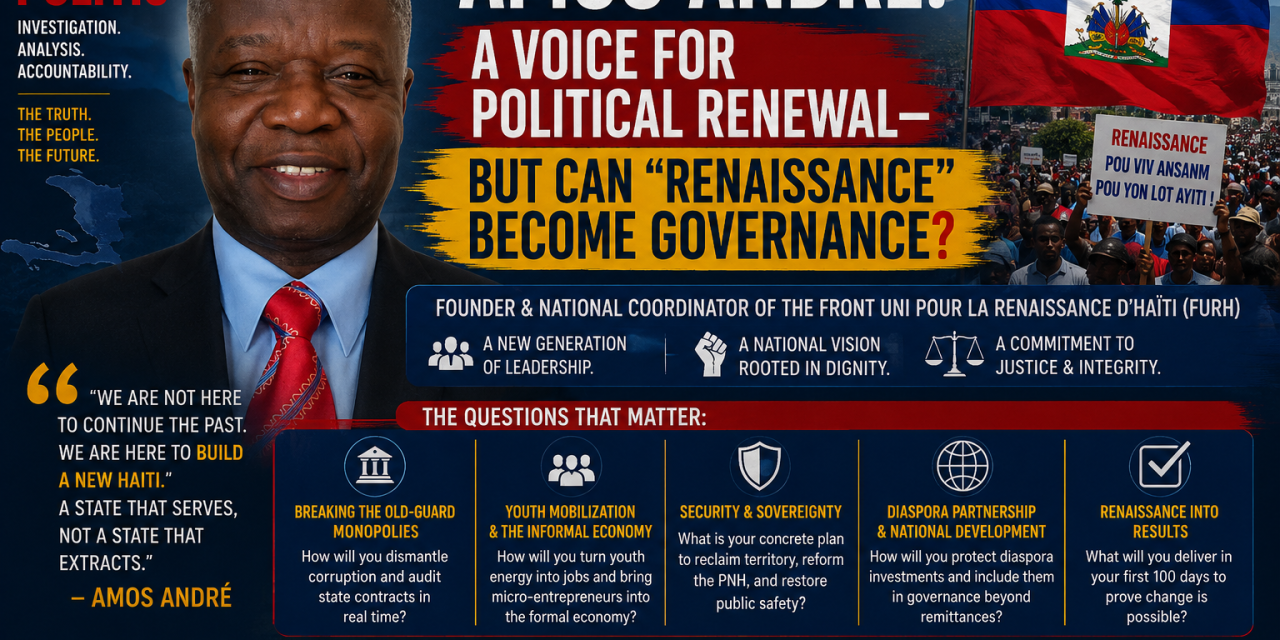
As Haiti searches for a path out of prolonged institutional, economic and security crises, Amos André and the Front Uni pour la Renaissance d’Haïti (FURH) deserve examination—not endorsement and not dismissal.
The available public record establishes something important that should be added to the profile provided: André is not simply a new prospective political figure. He was an approved FURH presidential candidate in 2015, when the Provisional Electoral Council approved 58 candidates. Contemporary election reporting records him as finishing 18th in that disputed election with 4,891 votes (0.31%). He returned for the rerun election in 2016, receiving 2,270 votes, or 0.21%.
That electoral history changes the investigation.
The question isn’t simply whether Amos André has new ideas.
It is whether a candidate who has already tested his movement nationally can demonstrate that FURH has evolved from a small political organization into a credible governing alternative.
🔎 WHO IS AMOS ANDRÉ POLITICALLY?
FURH—Front Uni pour la Renaissance d’Haïti—was the political organization under which André contested Haiti’s 2015 presidential election and returned for the 2016 rerun.
His previous electoral results reveal the central challenge facing any renewed national ambition.
A movement can have attractive ideas about renewal, youth participation and institutional reform. But presidential government requires something much larger: nationwide organization, legislative allies, administrators, financing, municipal structures and enough political support to implement a program.
The electoral numbers therefore deserve to become part of the interview:
What has FURH built since 2016 that did not exist when only 0.21% of voters supported its presidential candidate?
That isn’t an attack. It is a measurable test of political growth.
There is also evidence of André’s continued participation in political and constitutional debates. An April 2024 document from the Plateforme Constitutionnelle en faveur d’un État de droit identifies former Senator Amos André alongside FURH and other political and civic actors.
That raises another important area for investigation: his legislative record should be examined alongside his presidential campaigns.
🏛️ TEST #1 — WHAT EXACTLY DOES “RENAISSANCE” MEAN?
Almost every Haitian political movement promises change.
FURH has a more difficult responsibility: define what institutional change actually means.
A serious reform platform should answer measurable questions.
What happens during the first 100 days?
Which institutions change first?
Which laws go to Parliament?
Which expenditures disappear?
Which agencies receive additional resources?
Which government contracts become public?
And which presidential powers would André voluntarily subject to stronger oversight?
🎤 QUESTIONS FOR AMOS ANDRÉ
ANTI-CORRUPTION: If elected, would you require every major government procurement contract, beneficial owner, winning bidder, contract amendment and payment to be published electronically?
ULCC INDEPENDENCE: Would the Anti-Corruption Unit be permitted to investigate members of your own presidency without authorization from the National Palace?
PUBLIC ASSETS: Would you require ministers, senior advisers and directors-general to publicly declare their assets before entering office and after leaving?
The credibility test is straightforward:
Reform becomes meaningful when politicians design institutions capable of investigating themselves.
👨🏾🎓 TEST #2 — CAN FURH TURN YOUTH ANGER INTO ECONOMIC POWER?
Haiti’s younger generations have inherited political instability, unemployment, insecurity and deteriorating public institutions.
Simply calling young people the country’s future is insufficient.
A FURH economic program should explain how someone operating informally today becomes an entrepreneur, technician, farmer, software developer, manufacturer or employer tomorrow.
Questions André should answer:
MICROBUSINESS: Would newly registered microenterprises receive a temporary tax-free period?
CREDIT: How would young entrepreneurs without conventional collateral qualify for financing?
VOCATIONAL TRAINING: Would Haiti establish nationally certified technical programs linked directly to construction, renewable energy, agriculture, logistics and technology?
DIGITAL GOVERNMENT: Can business registration, tax identification, permits and customs documentation become primarily digital?
The bigger challenge is implementation.
A government cannot simply order banks to lend money and expect productive businesses to appear.
Where will the capital come from, who assumes the risk, and who prevents politically connected borrowers from capturing the program?
🚨 TEST #3 — WHAT IS HIS ACTUAL SECURITY DOCTRINE?
Every presidential contender now confronts the same unavoidable reality:
There can be no meaningful economic renaissance without public security.
But slogans about defeating armed groups are not security strategies.
André should therefore explain the command structure he would establish between the presidency, Haitian National Police, intelligence services, justice system, customs authorities and—where legally applicable—Haiti’s armed forces.
🎤 THE QUESTIONS
PNH: How many additional police officers does Haiti actually need?
VETTING: How will compromised officers be identified without turning internal investigations into political purges?
INTELLIGENCE: Who will build the financial and communications intelligence necessary to dismantle criminal organizations rather than merely fighting gunmen street by street?
WEAPONS: What agreements will Haiti seek from international partners to identify and disrupt firearms trafficking?
TERRITORY: Once security forces recover a neighborhood, who holds it?
Police?
Local government?
Permanent community policing?
And who immediately restores schools, courts, sanitation and commerce?
Because retaking territory and governing territory are two different operations.
🌎 TEST #4 — WHAT WOULD AN AMOS ANDRÉ FOREIGN POLICY ACTUALLY LOOK LIKE?
This may be the most important unanswered part of the proposed FURH profile.
Haiti’s foreign-policy problem cannot simply be reduced to being either “pro-foreign” or “anti-foreign.”
The deeper question is whether Haitian governments can establish national priorities and then negotiate international relationships around those priorities.
A credible André foreign policy therefore needs answers on the United States, CARICOM, Dominican Republic, Canada, France, African partners, Taiwan/China question, multilateral lenders and the Haitian diaspora.
Would his administration maintain Haiti’s traditional diplomatic relationships?
Diversify them?
Renegotiate development cooperation?
Seek new economic partners?
And most importantly:
What would Haiti ask its partners to do differently?
🌐 TEST #5 — WILL THE DIASPORA FINALLY BECOME MORE THAN A SOURCE OF REMITTANCES?
Nearly every Haitian political movement praises the diaspora.
Far fewer explain how diaspora Haitians would participate structurally in national development.
André should therefore be asked to move beyond rhetoric.
Would FURH support expanded political participation for Haitians abroad?
Would it support constitutional changes where necessary?
Could diaspora investors purchase transparent infrastructure or development bonds?
Could professionals abroad temporarily serve in public administration without abandoning careers overseas?
Could diaspora-backed businesses receive investment guarantees through an independently audited institution?
And critically:
How would Haiti protect those investments from corruption, arbitrary administrative decisions and political instability?
⚖️ TEST #6 — THE EXPERIENCE QUESTION
André’s previous presidential campaigns provide evidence of political participation.
But candidacy is not the same thing as executive performance.
His campaign should therefore identify specific accomplishments that voters can independently verify:
laws introduced or supported;
public programs administered;
budgets managed;
institutions created;
jobs generated;
communities organized;
international agreements negotiated;
or reforms successfully implemented.
Without measurable results, “renaissance” remains an aspiration rather than a governing record.
📊 THE HAITI POLITIC ASSESSMENT
| AREA | WHAT THE RECORD SHOWS | QUESTION STILL UNANSWERED |
|---|---|---|
| Electoral Experience | Presidential candidate in both the 2015 election and 2016 rerun. | Has FURH developed substantially greater national support since then? |
| Political Organization | Longstanding association with FURH. | Does the party now possess a genuine nationwide organization? |
| Institutional Engagement | Identified in a 2024 rule-of-law constitutional platform as a former senator associated with FURH. | What concrete legislative accomplishments define that record? |
| Renewal Message | FURH presents an alternative political vehicle outside Haiti’s largest traditional parties. | What laws, budgets and institutions turn “renaissance” into policy? |
| Electoral Challenge | André received 2,270 votes—0.21%—in the final 2016 presidential results. | What has changed politically and organizationally since 2016? |
| Foreign Policy | The easily verifiable public record located for this profile is much stronger on his electoral participation than on a detailed foreign-policy doctrine. | What exactly is the André doctrine toward Haiti’s major international partners? |
🔥 THE QUESTION AMOS ANDRÉ MUST ANSWER
Haiti doesn’t suffer from a shortage of political movements promising transformation.
It suffers from an enormous gap between political promises and state capacity.
So the central question for Amos André isn’t:
“Do you want a Haitian renaissance?”
Almost everyone does.
It is:
What have you built that demonstrates you can deliver one?
His previous presidential campaigns give voters a record to examine.
His political experience gives journalists questions to investigate.
His continued engagement gives him an opportunity to explain what he has learned.
But the burden now falls on André and FURH to demonstrate—with numbers, policies, personnel, financing and deadlines—how their vision would work.
Can FURH transform itself from a small electoral movement into a national governing coalition?
Can André connect youth participation to actual jobs?
Can he fight corruption while accepting scrutiny of his own administration?
Can he establish a Haitian-led foreign policy without isolating a country that still needs international trade, investment and cooperation?
Can diaspora participation become institutional rather than ceremonial?
And above everything else:
🇭🇹 CAN “RENAISSANCE” BECOME RESULTS?
We don’t answer that question for the Haitian people.
The record should be investigated.
The candidate should answer.
The people should decide.
HAITI POLITIC
Investigation • Accountability • Democracy
#HaitiPolitic #AmosAndre #FURH #Haiti #PolitiqueHaitienne #HaitiElections #DiasporaHaitienne #YouthLeadership #Governance #ForeignPolicy #AntiCorruption #HaitiRenaissance