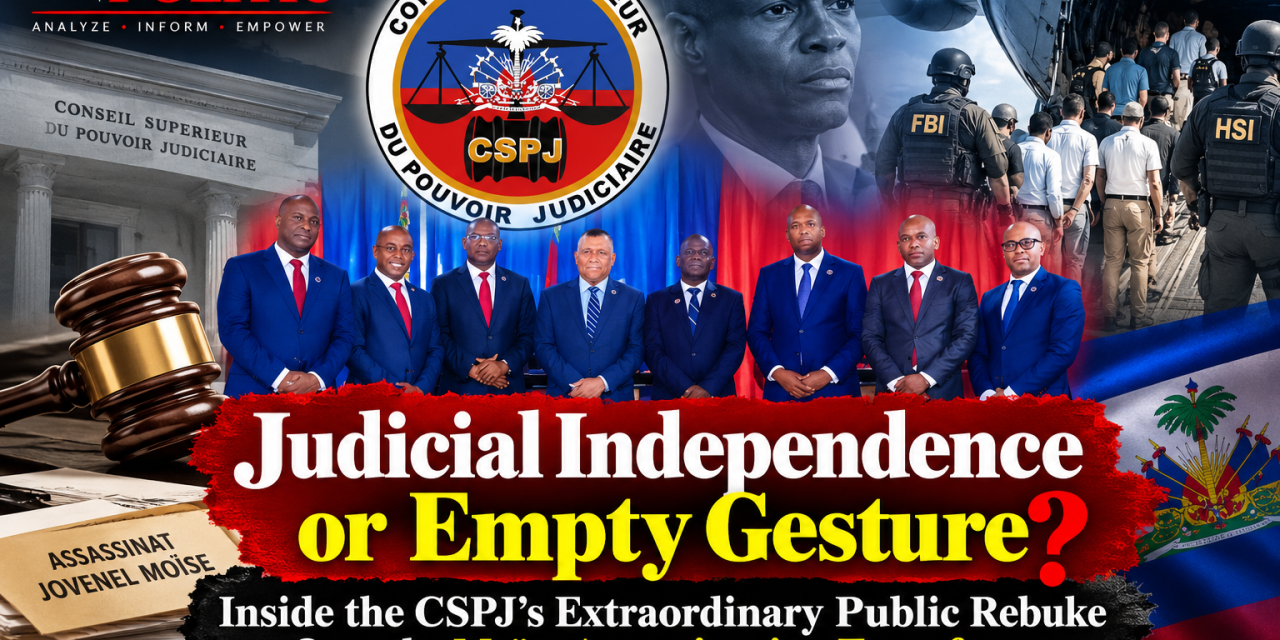
On September 22, 2026, Haiti’s Conseil Supérieur du Pouvoir Judiciaire (CSPJ) — the constitutional body charged with governing the country’s judiciary — issued a formal press release accusing the government of violating the Constitution. The trigger: the Minister of Justice and Public Security’s order transferring 18 individuals, indicted and detained in connection with the ongoing investigation (“instruction au second degré”) into the assassination of President Jovenel Moïse, to the United States. The CSPJ’s note is blunt. It states the measure occurred “en dehors des normes procédurales” — outside procedural norms — and constitutes a violation of the Constitution, which guarantees judicial independence. The council goes further, laying out the specific legal principle it says was breached: when an investigating judge is properly seized of a case, any displacement of an accused person falls within that judge’s competence and requires his or her prior authorization — even in response to an extradition request.
To understand whether this is a meaningful institutional check or a largely symbolic protest from a historically weak body, it’s worth walking through what the CSPJ actually is, how it came to exist, who sits on it, and what its track record over nearly two decades actually shows.
The Legal Foundation: A Law Passed in 2007, Installed Five Years Later
The CSPJ was created by the Loi du 13 novembre 2007 créant le Conseil Supérieur du Pouvoir Judiciaire, published in Le Moniteur (Haiti’s official gazette) on December 20, 2007. Its own preamble is explicit about what it replaced: prior to 2007, the Court of Cassation itself functioned as the “Conseil Supérieur de la Magistrature” under a framework built from laws dating to 1920 and 1925, further layered by judicial reform laws in 1998 and a 1995 decree on judicial organization. In other words, before the CSPJ existed as a distinct body, Haiti’s highest court was, in effect, self-governing — with no independent institution setting standards for judicial appointment, evaluation, or discipline across the rest of the bench.
The council’s constitutional anchor is Article 184.2 of the amended 1987 Constitution, which states that the administration and oversight of the judicial power are entrusted to a Conseil Supérieur du Pouvoir Judiciaire, which exercises a right of supervision and discipline over magistrates and holds a general power of information and recommendation regarding the state of the judiciary.
Notably, there was a significant gap between the law’s passage and its practical implementation: the CSPJ was not actually installed and made operational until July 3, 2012 — nearly five years after the law creating it was published. For most of Haiti’s post-2007 judicial history, the body meant to be the judiciary’s independent governing institution simply didn’t function as a going concern.
Core Mandate and Institutional Role
Under the 2007 law, the CSPJ’s principal responsibilities include:
- Management of judicial careers — proposing, evaluating, and disciplining magistrates across the court system
- Nominating candidates for the Court of Cassation to the President of the Republic (Article 14 of the CSPJ law)
- Designating the Director of the École de la Magistrature (EMA), Haiti’s judicial training academy
- Designating three representatives to the Provisional Electoral Council (CEP), per Article 192 of the Constitution — placing the CSPJ at the intersection of judicial governance and electoral administration
- Judicial discipline and ethics oversight, including maintaining the Guide de déontologie de la magistrature, the ethical code governing judges’ conduct
In principle, this makes the CSPJ Haiti’s equivalent of a judicial council found in many civil-law systems: the body meant to insulate judicial appointments and discipline from direct executive control, so that magistrates answer to their own profession’s standards rather than to the Ministry of Justice.
Who Sits on the Council, and How They Get There
Article 4 of the 2007 law sets the CSPJ’s composition at nine members, each drawn from a different institutional source:
- The President of the Court of Cassation — who also automatically serves as President of the CSPJ. The current officeholder is Me Jean Joseph Lebrun, who has held both positions since succeeding the late René Sylvestre (who died of COVID-19 in June 2021 while serving in the role).
- The Vice-President of the Court of Cassation
- The Commissaire du Gouvernement (chief prosecutor) attached to the Court of Cassation
- A judge of the Court of Appeal
- A judge of a Tribunal of First Instance
- A Commissaire du Gouvernement chosen directly by the Minister of Justice — the one seat with an explicit, direct executive appointment
- A justice of the peace, elected by his or her peers
- A representative of civil society organizations
- A lawyer designated by the Assemblée des bâtonniers — the assembly of sitting bar association presidents from across Haiti
This mixed composition was meant to balance judicial self-governance (seats 1–5, 7) with outside input from the executive (seat 6), civil society (seat 8), and the organized bar (seat 9). In practice, as the analysis below shows, this design has generated as many problems as it solved.
Key Areas of Operation and Recent Reforms
The CSPJ’s most visible recent institutional activity has been generational: the installation of the 5th Judicature at the École de la Magistrature, an event that saw then-Prime Minister Garry Conille appear alongside Transitional Presidential Council chief Edgard Leblanc Fils and CSPJ President Jean Joseph Lebrun — a rare moment of the three branches publicly aligning around judicial training and career development. The council has also continued publishing its ethics guide for magistrates, positioning judicial deontology as a core, ongoing project. And the September 22, 2026 press release itself represents a notable recent act: a public, on-the-record institutional objection to an executive action — something the CSPJ has done only sporadically across its history.
Systemic Obstacles and Structural Weaknesses
The CSPJ’s design has drawn sustained criticism from Haitian legal scholars since shortly after its creation, and the problems are structural rather than incidental:
- Executive capture built into the design. The Minister of Justice directly appoints one of the nine council seats — an unusual degree of executive presence on a body whose entire purpose is judicial independence from the executive.
- No judicial career plan. The 2007 law never addressed what happens to sitting magistrates whose mandates expire, or those serving without a clear mandate at all — a significant gap given Haiti has historically lacked any structured judicial career progression system.
- A “judge and party” conflict of interest. Members of the CSPJ retain their existing judicial posts while serving on the council. This creates a structural problem when the council is asked to discipline a magistrate who is, in effect, a colleague or peer of the very people judging the complaint — critics have noted it is difficult to ask a body to rule impartially on one of its own.
- No salary, only “frais de représentation.” Per Article 9 of the 2007 law, council members receive no compensation for their CSPJ duties — only representation allowances — a weak incentive structure for an institution meant to carry serious independent authority.
- A documented history of internal scandal. Within roughly its first year of operation, the CSPJ faced allegations that it violated its own law in designating three representatives to the CEP, and became embroiled in a bitter, unresolved legal dispute over whether one of its own bar-appointed members (Me Néhémy Joseph) had lost his seat after ceasing to be a sitting bâtonnier — a controversy legal commentators noted exposed real ambiguity in the council’s own governing statute.
- A deeper constitutional critique. Some Haitian legal scholars have gone further, arguing the entire 2007 law creating the CSPJ doesn’t fully align with Article 173 of the Constitution — meaning the institution’s very legal foundation has been contested by parts of the legal community for years, not just its performance.
Is the CSPJ Relevant Today?
This is the honest, harder question — and the answer is genuinely mixed.
On one hand, the CSPJ’s institutional track record supports the skeptics: a body installed five years late, built with an executive seat inside its own independence-guaranteeing structure, dogged by internal legitimacy disputes within its first year, operating without meaningful enforcement power or compensation, inside a broader Haitian judicial system that has spent the last several years operating under extraordinary strain — courts destroyed or inaccessible due to gang control of large parts of Port-au-Prince, judges threatened and in some cases killed, and case backlogs stretching years, as previous coverage in this space has documented regarding the glacial pace of Haiti’s own domestic prosecution of the Moïse assassination itself.
On the other hand, this specific press release is worth taking seriously as an institutional act, not dismissing as noise. It is a rare instance of the CSPJ using its “pouvoir général d’information et de recommandation” under Article 184.2 to directly and publicly challenge an executive-branch decision — not a routine administrative statement about judicial training or ethics, but a pointed accusation that the Ministry of Justice bypassed a sitting investigating judge’s authority over defendants in the highest-profile criminal case in modern Haitian history. That is precisely the kind of check the 1987 Constitution’s framers envisioned when they wrote Article 184.2 — a judiciary capable of pushing back against the executive rather than simply administering it.
Where the CSPJ Stands on the Moïse Case Right Now
The CSPJ’s position, as stated in its press release, is narrow but consequential: it is not disputing that the 18 individuals may ultimately need to face justice, in Haiti or abroad — it is asserting a procedural violation. Under Haiti’s judicial framework, once an investigating judge (“juge d’instruction”) is properly seized of a case, that judge — not the Ministry of Justice acting alone — holds competence over what happens to the accused persons under his or her instruction, including whether they can be displaced or transferred, even in response to a foreign extradition request. The council’s position is that this authorization was not obtained, and that the transfer therefore bypassed the constitutionally guaranteed independence of the judiciary from the executive.
This directly complicates the narrative offered by Haiti’s own Ministry of Justice communiqué authorizing the transfer, which framed the decision as a reinforcement of judicial cooperation between Haiti and the United States, undertaken specifically “in respect of judicial guarantees and free from any influence.” The CSPJ’s press release is, in effect, a direct rebuttal from Haiti’s judicial branch to that characterization — arguing the process itself violated the very judicial guarantees the executive’s communiqué claimed to protect.
Whether this objection carries any practical consequence — whether it can affect the standing of the extradition, prompt a legal challenge, or simply stand as a public record of institutional dissent — remains genuinely uncertain, and will depend heavily on factors well beyond the CSPJ’s own limited enforcement powers: the response of the Ministry of Justice, the posture of whatever investigating judge was seized of the case, and the broader question of whether Haiti’s judiciary, operating without a functioning elected government to answer to since the Transitional Presidential Council’s mandate lapsed in February 2026, has any real capacity to enforce its own constitutional objections at all.