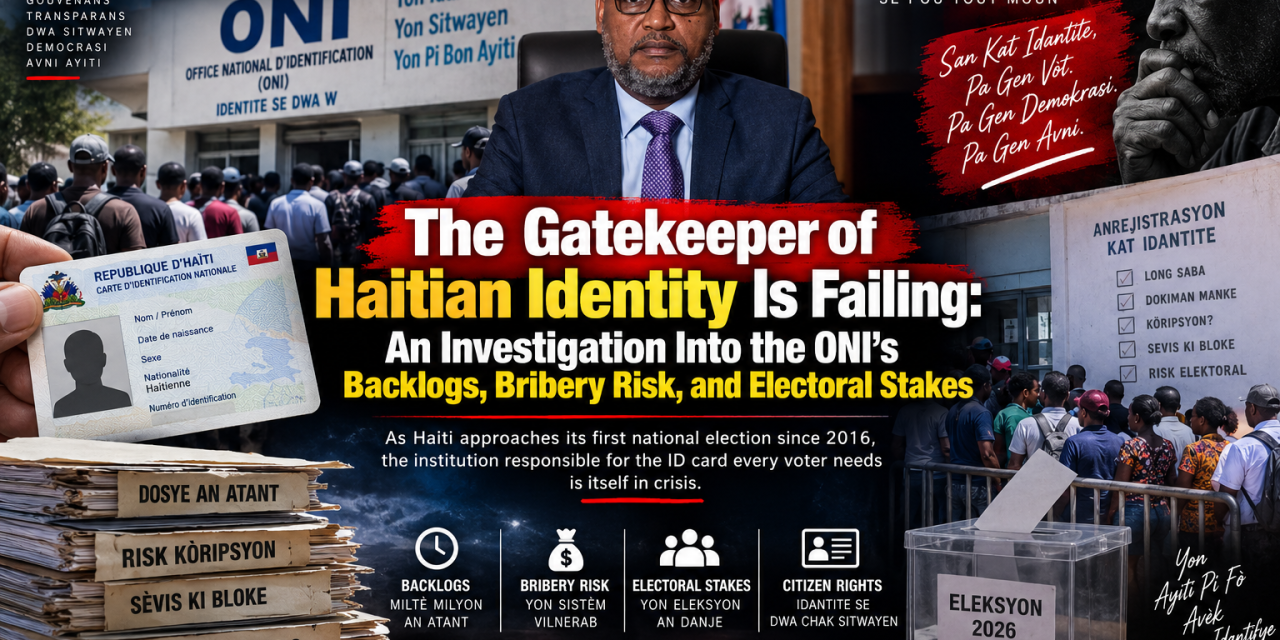
As Haiti approaches its first national election since 2016, the institution responsible for the ID card every voter needs is itself in crisis
The Office National d’Identification (ONI) occupies a uniquely consequential position in Haitian civic life. Its product, the Carte d’Identification Nationale (CIN/CINU), is not a convenience document — under Haitian decree, holding one is mandatory for every citizen over 18, and it functions simultaneously as a voting credential, a banking requirement, a tax identifier, and, per the ONI’s own public messaging, a “passport to participation in civic, professional and social life.” With Haiti’s first general election since 2016 scheduled for December 13, 2026, the ONI’s operational health is no longer an administrative footnote — it is a direct precondition for whether that election can be considered credible at all.
1. Operational Backlogs & Accessibility
The documented record on wait times is consistent and damning across multiple independent sources. Juno7, an independent Haitian digital outlet, describes the ONI as “regularly criticized for its dysfunction.” Global Press Journal and Lakay Info 509 both report very long processing delays, and the UN’s refugee agency (UNHCR) concluded in an October 2025 assessment that the primary barriers to obtaining identity documentation in Haiti are “high administrative costs, limited state capacity, and centralization of services.” That last factor compounds the others directly: with core operations concentrated in Port-au-Prince, citizens in outlying departments face the added burden of traveling into or through gang-contested territory to access services, at a moment when armed groups control an estimated 70-85% of the capital and have extended reach into outlying communes like Kenscoff.
Demand, meanwhile, is rising rather than falling. Global Press Journal reports that worsening insecurity and a corresponding surge in Haitians seeking to emigrate have driven increased demand for CINs — precisely because the card is required for passport applications and other exit-facilitating documentation. The Haitian Institute of Statistics (IHSI) estimates roughly 240,000 new citizens require registration annually, a volume the ONI’s own public materials treat as a manageable baseline — a claim the reported wait times do not support.
There is a genuine, documented effort at reform worth crediting. In April 2026, the ONI launched a program called “Kat Ou La” (“Your Card Is Here”), and expanded it nationwide on June 30, 2026, with the explicit goal of accelerating CIN distribution across all ten departments. By the program’s own reporting, nearly 90,000 cards had been distributed since launch — a figure the institution says exceeded its own projections. This is a legitimate operational improvement worth acknowledging in any fair critique, even as it does not resolve the structural centralization and capacity problems UNHCR and others have identified.
2. Financial Integrity & the Bribery Risk
Haiti’s broader transitional political environment has already drawn direct, high-level warnings about corruption tied to the current crisis. The Washington Post reported in mid-2025 that U.S. officials were tracking “reported bribery attempts” specifically aimed at destabilizing Haiti’s governing transition — a signal of how thoroughly financial corruption has become entangled with the country’s core political and administrative functions, not a phenomenon confined to any single ministry.
Within the ONI’s own documented cost structure, a specific and serious vulnerability exists: while first-time CIN issuance is legally mandated to be free, replacement, renewal, and administrative fees create exactly the kind of discretionary, cash-facing transaction points that — combined with severe processing backlogs — create structural incentive for informal payments to “expedite” service. This is not a uniquely Haitian phenomenon; it is a well-documented global pattern that backlog-heavy, high-demand civil registries are structurally prone to extraction and informal fee-taking at the point of citizen contact, particularly when, as UNHCR notes, “high administrative costs” are already a barrier. The UN’s own anti-corruption programming in Haiti — including a 2025-2026 Anti-Corruption Summer School run jointly with UNODC and Haiti’s anti-corruption unit (ULCC) — explicitly names “extortion, illicit enrichment, misappropriation of public assets, and bribery” as the specific corruption categories Haitian civil servants and citizens are being trained to recognize, indicating these are live, acknowledged risks within Haiti’s public administration broadly, not hypothetical concerns.
3. Technical & Strategic Stability — What Can Be Responsibly Assessed
Any credible technical review of ONI/DELIDOC’s underlying network security, hosting architecture, or access controls should be conducted by qualified cybersecurity auditors working directly with Haitian state authorities, international partners (UNODC, OAS technical assistance programs), or accredited security researchers under responsible disclosure frameworks — not published as a public roadmap. What can be responsibly stated is a functional critique already borne out by the operational record: an identity system generating well-documented, chronic public-facing failures (rejected valid identification numbers, cross-registration errors between agencies) is demonstrating exactly the kind of data-integrity fragility that should trigger independent technical audit, regardless of the specific infrastructure involved.
That fragility is not theoretical. It surfaced directly and publicly in September 2026: Haiti’s political parties, in the middle of the CEP’s candidate-registration process, formally alleged that “identification numbers rejected by the CEP system were recognized as valid by the National Identification Office (ONI)” — a direct, documented cross-agency data validation failure occurring in real time, at the exact moment the country’s electoral credibility depends on that data being reliable. Parties have called for the CEP-ONI validation protocol to be made public and for sanctions against anyone found misusing citizens’ personal data — demands this outlet has covered previously in reporting on FUSION/PFSDH’s own registration complaint.
4. Funding, Institutional Extortion, and the Electoral Stakes
Funding structure: Haiti’s civil identification apparatus has historically been built and sustained substantially through international donor support rather than durable domestic financing — the ONI’s own institutional history traces its modern identity-management system to international support for electoral organization provided to an earlier interim government. That donor-dependency pattern is consistent with the broader aid-architecture concerns this outlet has raised regarding BMPAD and FAES: an identity system this consequential to voting and banking should not rest on financing that rises and falls with the political priorities and budget cycles of external partners.
Institutional extortion as a systemic deterrent: The combination documented above — high administrative costs, chronic delays, centralized service points requiring travel through gang-held territory, and a cash-fee structure vulnerable to informal payments — functions cumulatively as a deterrent to lawful documentation, not merely an inconvenience. A citizen deterred from obtaining or renewing a CIN by cost, distance, or delay is a citizen structurally at risk of being unable to vote, bank, or access essential services — precisely the “civil documentation is a crucial protection tool” framing UNHCR itself uses to describe the stakes.
The electoral and democratic threat: This is where the ONI’s dysfunction stops being an administrative story and becomes a democratic one. A valid CIN or qualifying ONI documentation is a hard requirement for inclusion on Haiti’s electoral register for the December 2026 vote — but holding a CIN alone is explicitly not sufficient; citizens must also be separately entered onto the CEP’s rolls, and the CEP-ONI data mismatch already documented above shows that even citizens who did everything right can be wrongly rejected. Layer onto this: Haiti’s own citizens report catastrophic distrust in the electoral system already — a 2024 Policité/Internews survey found 93% of Haitians express no confidence in the electoral system, and a 2024 BTI report found only 37% believe Haiti is currently a democracy. An identification institution whose own errors can erroneously disenfranchise valid voters, in a country where trust in elections is already this depleted, isn’t a peripheral bureaucratic problem — it is a direct threat to whatever legitimacy the December 2026 vote is able to achieve.
Toward Realistic Fixes
A fair critique owes readers more than blame. Several concrete, achievable reforms follow directly from the problems documented above:
- Publish the CEP-ONI data validation protocol, as political parties have already formally demanded — this is a low-cost transparency measure that would let independent technical reviewers identify exactly where the two databases are failing to reconcile, without requiring public disclosure of the underlying security architecture itself.
- Expand “Kat Ou La” with a specific rural and gang-affected-zone mobile deployment mandate — the program’s nationwide expansion is a genuine, credit-worthy step; extending it further into currently underserved, insecurity-affected departments should be an explicit, funded priority ahead of December’s vote, potentially coordinated with the UN Gang Suppression Force’s own security-corridor operations.
- Move first-time issuance costs and all downstream renewal/replacement fees toward a transparent, published, non-cash digital payment system — reducing the cash-handling transaction points that create bribery opportunity at the point of citizen contact, consistent with anti-corruption best practice already being taught through the ULCC/UNODC Summer School program.
- Independent, CSCCA-level or international technical audit of ONI/DELIDOC’s data integrity systems — conducted by qualified auditors under appropriate confidentiality and responsible-disclosure protocols, focused specifically on resolving the cross-agency validation failures already causing documented harm to the 2026 candidate registration process, without that audit’s technical findings being made public in a way that could itself create new vulnerabilities.
- A dedicated, ring-fenced domestic funding line for ONI operations within Haiti’s own budget, reducing reliance on donor cycles for an institution this central to sovereign civic function — mirroring the same durable-financing argument this outlet has made regarding BMPAD and FAES.
The Bottom Line
Haiti’s national identification system was built, per its own founding decree, to “guarantee the universal and secure character of the right to identity” and to serve as a foundation for the rule of law. The documented record — chronic delays, centralization amid active gang control of key territory, a fee structure vulnerable to extraction, donor-dependent financing, and a data-validation failure now directly disrupting the 2026 candidate registration process — shows an institution falling well short of that founding mandate at precisely the moment its function matters most. The fixes available are not exotic; they are the standard toolkit of transparent protocols, expanded mobile access, cashless fee systems, independent audit, and durable domestic financing that other post-crisis civil registries have used to rebuild public trust. Whether Haiti’s government prioritizes them before December, or after a contested election has already made the ONI’s failures a matter of national dispute, is the choice the country’s leadership faces right now.
Sources: Immigration and Refugee Board of Canada (ecoi.net), Global Press Journal, UNHCR (October 2025), Le Facteur Haïti, ONI official decree and website (oni.gouv.ht), Washington Post, UN News/UNODC, Haïti Policy House Election Tracker, Policité/Internews 2024 survey, BTI 2024 Report. This report does not assess or describe ONI/DELIDOC’s specific network security architecture, hosting infrastructure, or access controls, as doing so publicly would create unacceptable risk to a live national identity and immigration database; any technical security audit of these systems should be conducted by qualified professionals through responsible, confidential channels.