Haiti Politic — Analysis
Haiti’s banking system looks, on paper, like any other in the Caribbean: a central bank, a handful of commercial banks, deposit accounts, loans, wire transfers. In practice, it sits at the intersection of a fragile domestic authority and an increasingly dense web of international oversight — a system where decisions made in Port-au-Prince, Washington, and Paris (the FATF’s headquarters) all shape whether an ordinary Haitian can access their own money.
The National Authority: BRH at the Center
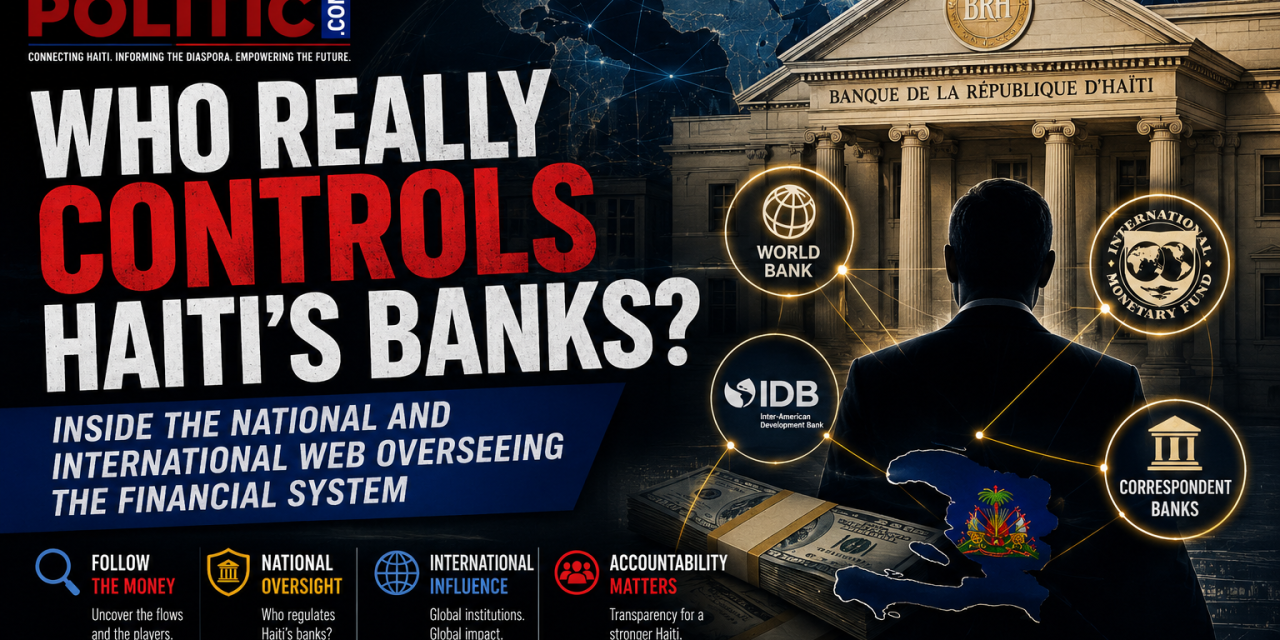
At the top of Haiti’s domestic banking hierarchy sits the Banque de la République d’Haïti (BRH), the country’s central bank. Established in 1979 as the successor to the old National Bank of the Republic of Haiti, the BRH is 100% state-owned and headquartered in Port-au-Prince, currently under the leadership of Governor Ronald Gabriel, who took over in October 2023. Its core mandate covers three functions: issuing the national currency (the gourde), conducting monetary policy, and — critically — supervising the entire commercial banking sector through its Bank Supervision Department.
That supervisory role is not symbolic. The BRH runs both “on paper” inspections, reviewing the reports banks are legally required to file, and on-site examinations of individual institutions, checking capital adequacy, liquidity, credit risk controls, and compliance with anti-money-laundering rules. As of the first quarter of 2026, total banking-sector assets stood at roughly 743.87 billion gourdes, even as gross credit portfolios contracted amid the security crisis and banks shifted funds into low-risk instruments like BRH and Treasury bonds.
The BRH has had to operate this supervisory function under extraordinary conditions. Its own Port-au-Prince headquarters was stormed by rioters in 2024, an attack repelled by the bank’s own security personnel. Despite that, the BRH has continued reporting relatively steady, if slowing, inflation — around 20% as of May 2026, down from roughly 32% the previous October — which it attributes to insecurity-driven supply shocks rather than excess money creation, and has kept monetary policy tight but stable rather than raising rates further, out of concern for already-strained borrowers.
The Commercial Banks
Haiti’s retail and commercial banking sector is small and concentrated. The dominant institutions are:
- Unibank, S.A. — Haiti’s largest bank by assets (reported at roughly $1.76 billion), the main company of Groupe Financier National, serving hundreds of thousands of depositors through dozens of branches.
- Sogebank (Société Générale Haïtienne de Banque) — one of Haiti’s three largest banks, formed in 1986 when Royal Bank of Canada sold its Haiti operations to local investors.
- Banque Nationale de Crédit (BNC) — a major commercial bank that also handles a share of state treasury functions in coordination with the BRH.
- Banque de l’Union Haïtienne (BUH) and Banque Internationale de Crédit (BIC) — smaller but still nationally significant retail and corporate lenders.
Together, Unibank, Sogebank, and BNC have historically controlled roughly 83% of total banking assets and about three-quarters of the country’s loan portfolio, making Haiti’s banking sector one of the more concentrated in the hemisphere. That concentration is a vulnerability as much as a convenience: when Sogebank suspended international transactions on its Visa debit cards in late 2024 following technical and security issues, thousands of customers were locked out of overseas and online payments for weeks, with disruptions stretching into January 2025.
Where International Authority Enters
Haiti’s domestic banking authority does not operate in isolation. Several international bodies exercise real, if indirect, control over how Haitian banks function — often more decisive, day to day, than anything the BRH itself can do.
The Financial Action Task Force (FATF). Since June 2021, Haiti has been on the FATF’s list of “Jurisdictions under Increased Monitoring” — commonly known as the grey list — for deficiencies in its anti-money-laundering and counter-terrorist-financing regime. As of the FATF’s June 2026 statement, Haiti remains grey-listed alongside more than twenty other countries. Grey-list status is not a formal sanction, but its practical effect is severe: it triggers mandatory Enhanced Due Diligence requirements on every international transaction touching a Haitian bank, and gives foreign correspondent banks a strong incentive to simply cut ties rather than absorb the compliance cost — a dynamic known in the industry as “de-risking,” which can functionally sever a national banking system from the global financial network. The BRH has reported that of eighteen reform actions required to exit the grey list, only two are fully complete, nine are largely accomplished, and six remain partial.
The International Monetary Fund (IMF). Haiti is currently under a Staff-Monitored Program (SMP) with the IMF — an informal arrangement, short of a full lending program, under which Haitian authorities commit to specific fiscal and monetary targets in exchange for IMF technical guidance and the prospect of eventually qualifying for real financial assistance. As of a March–April 2026 review mission, Haiti had met its program targets on reserves, fiscal balance, revenue collection, and limits on monetary financing of the state, even as implementation of structural reforms lagged behind schedule due to insecurity and capacity constraints. The program has since been extended to June 2027, with IMF staff pressing Haitian authorities to draw on accumulated financial buffers to cushion the economy against the 2026 oil price shock.
The U.S. Treasury’s Office of Foreign Assets Control (OFAC). Washington has used targeted financial sanctions extensively against individuals tied to Haiti’s political and gang crisis — including, in past years, designations of former officials such as ex-Chamber of Deputies president Gary Bodeau for corruption, and other politicians and gang-linked figures under Global Magnitsky and related authorities. Because Haitian banks must comply with U.S. correspondent banking rules to maintain dollar-clearing relationships, an OFAC designation of any individual — including bank founders or major shareholders — can force a Haitian institution to freeze accounts or sever relationships to protect its own access to the U.S. financial system. Canada has taken parallel action; the resignation of a senior Unibank founding director in 2023 followed his designation under Canadian sanctions.
The United Nations Security Council and allied governments. The UN imposed a Haiti sanctions regime in 2022 targeting individuals responsible for fueling gang violence and instability, and that framework has since been adopted into the domestic law of allied states — the United Kingdom updated its own Haiti sanctions list as recently as October 2025, and Australia established a new domestic Haiti sanctions framework in 2025 to implement the UN measures. Each additional layer of designation adds another name Haitian banks are legally obligated to screen for and block.
A System Under Dual Pressure
The result is a Haitian banking system governed less by a single national authority than by a layered structure: the BRH sets and enforces domestic rules, but its room to maneuver is bounded by what the FATF, the IMF, OFAC, and the UN sanctions regime require or permit. A Haitian bank today has to satisfy the BRH’s prudential standards, the IMF program’s macroeconomic targets, FATF’s anti-money-laundering benchmarks, and OFAC’s sanctions-screening obligations — all simultaneously, and all while operating branches in a country where parts of the capital are contested by armed groups and where the central bank’s own building has come under direct attack.
That layered oversight is, in one sense, exactly what a fragile financial system needs — external anchors that keep monetary policy disciplined and the banking sector honest when domestic institutions are under strain. But it also means Haiti’s banking authority is not fully Haiti’s own. Grey-list status alone can decide whether a small business receives a wire transfer from abroad; an OFAC designation halfway around the world can freeze a Haitian family’s savings. Understanding who actually controls the system — and on what terms — is no longer optional for anyone trying to make sense of Haiti’s economy.