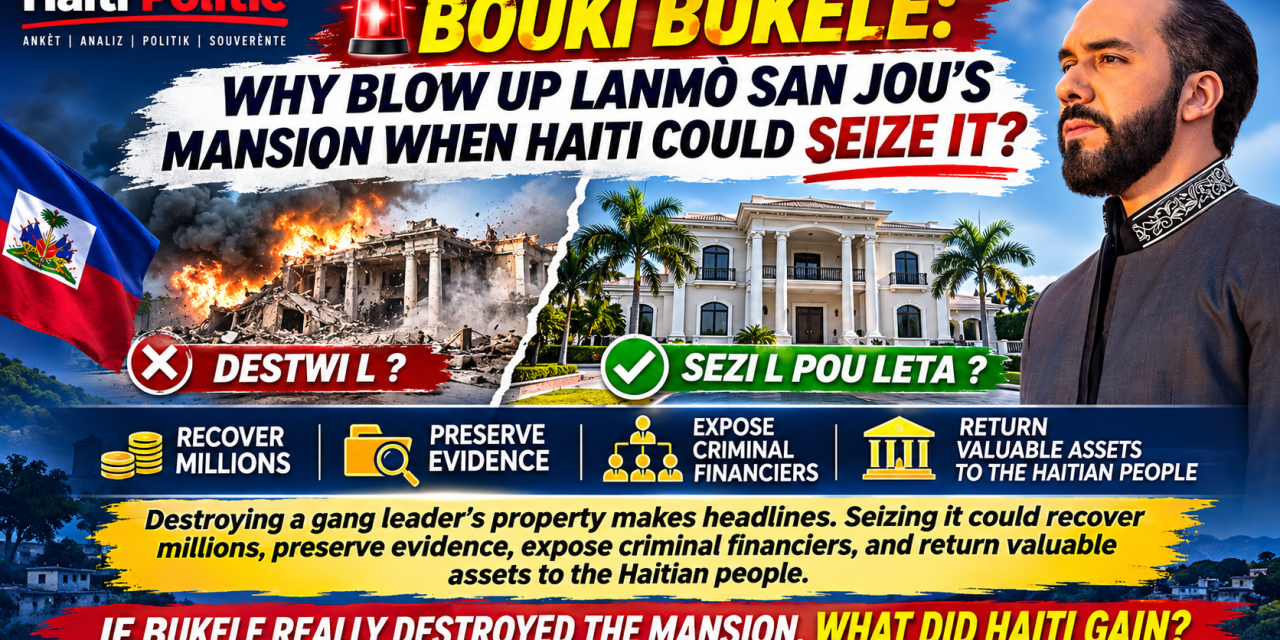
A house attributed to one of Haiti’s most notorious gang leaders has become the latest symbol of Nayib Bukele’s military intervention. But if the property can be secured, why destroy an asset that could potentially be confiscated, investigated, and returned to public use?
HAITI POLITIC | INVESTIGATIVE COMMENTARY
November 8, 2026
THE HOUSE, THE PRESIDENT, AND THE PROMISE TO DESTROY
On November 6, 2026, Salvadoran President Nayib Bukele entered a social media discussion about a luxurious residence attributed to Wilson Joseph, better known as Lanmò San Jou, the leader of Haiti’s 400 Mawozo gang.
Responding to a post on X, Bukele wrote in Haitian Creole:
“Kote kay sa a ye? Ban nou adrès egzak la, n ap detwi l.”
Translation: Where is that house? Give us the exact address, and we will destroy it.
The declaration attracted considerable attention.
For Haitians who have suffered years of kidnappings, extortion, displacement, and armed violence, the prospect of dismantling a gang leader’s infrastructure may represent a welcome development.
But there is another question worth asking.
If Bukele can locate and destroy a gang leader’s mansion, why couldn’t the property first be secured, investigated, and potentially transferred to the Haitian government?
That question deserves an answer before demolition becomes a substitute for a comprehensive security strategy.
And it raises an uncomfortable possibility:
If the house was destroyed without a compelling military necessity, was this an operation designed to recover control of Haitian territory—or simply to demonstrate destructive power?
1. DID BUKELE ACTUALLY DESTROY THE HOUSE?
The distinction between a presidential threat and a completed military operation matters.
On November 6, Bukele publicly promised to destroy the residence.
Reporting published November 7 and 8 indicates that a drone task force operating alongside Haitian police had already bombed a residence attributed to Lanmò San Jou during operations in the Cul-de-Sac Plain.
However, that reporting does not establish that Salvadoran forces carried out the strike, that Bukele personally ordered it, or that the building was completely demolished.
Indeed, accounts suggest that the reported bombing occurred before Bukele’s November 6 social media statement.
This creates an important chronological question.
Was Bukele promising to destroy a property that had already been attacked by another security force?
If so, what additional operation was he proposing?
And if a later strike occurred, where is the official operational report identifying the forces involved, the authorization, and the resulting damage?
Haiti Politic has not independently verified the complete destruction of the residence.
The public deserves an accurate account rather than another military announcement amplified through social media.
2. BUKI BUKELE: IS DESTROYING A BUILDING THE SAME AS DEFEATING A GANG?
The nickname Buki Bukele offers a satirical way to question the reasoning behind the proposed demolition.
In Haitian folklore, Bouki is often portrayed as a character whose decisions create unintended consequences.
The comparison is not about Bukele’s intelligence or intentions. It is about the practical consequences of a particular decision.
Imagine a security force discovering a valuable building allegedly financed through kidnapping and extortion.
The building may contain documents, financial records, communications equipment, and other evidence.
Its ownership may reveal connections to financiers or associates.
Its value may be recoverable through legal proceedings.
But instead of preserving the property and investigating its history, the authorities destroy it.
The immediate result may be a dramatic image.
The longer-term result could be the loss of evidence and economic value.
A destroyed building cannot be used to identify the financial network behind its construction if important evidence was lost in the process.
Nor does its destruction necessarily prevent the gang from relocating, rebuilding, or continuing criminal operations.
The relevant question is not whether gang infrastructure should be targeted.
It is whether destroying this particular property was necessary to achieve a legitimate security objective.
3. WHY NOT CONFISCATE THE PROPERTY FOR THE HAITIAN STATE?
Haiti has legal mechanisms for freezing, seizing, and confiscating assets connected to certain criminal offenses.
These mechanisms require evidence, judicial safeguards, and compliance with applicable law.
Under Article 36 of Haiti’s Constitution, private property is protected. The Constitution prohibits confiscation for political reasons and establishes protections against unlawful deprivation of ownership.
However, those protections do not prevent the state from pursuing legally authorized confiscation of criminal proceeds.
The United Nations Office on Drugs and Crime has documented provisions in Haitian law concerning the seizure and confiscation of assets derived from money laundering and other serious offenses.
That distinction is essential.
Haiti cannot simply seize a house because its alleged occupant is a gang leader. But if investigators establish that the property constitutes criminal proceeds, judicial confiscation may be available.
Such an investigation could establish:
-
Who legally owns the land and building.
-
Who financed construction.
-
Whether criminal proceeds were involved.
-
Whether the property was transferred through intermediaries.
-
Whether other individuals or businesses participated in financing it.
-
Whether the building can lawfully be confiscated.
If confiscation were authorized, the property could potentially become a public asset.
Destroying it before these questions are examined may complicate the investigation.
4. WHAT COULD HAITI DO WITH THE PROPERTY?
Suppose the building were secured, its ownership investigated, and a court ultimately authorized its confiscation.
What could the Haitian government do with it?
Depending on its location, condition, accessibility, and security requirements, several possibilities could be evaluated.
A police or public-security facility
The property could potentially support a permanent Haitian National Police presence in an area previously controlled by armed groups.
A vocational training center
A former gang property could be converted into a facility offering technical education and employment training.
A community service center
If suitable, the building could provide space for administrative services, social programs, or community organizations.
An asset sold to finance public programs
If the building were unsuitable for government use, a lawful sale could potentially recover value for public purposes.
None of these possibilities is automatic.
The property would first need to be legally recovered, inspected, secured, and evaluated.
But they illustrate a broader principle:
An asset taken from a criminal organization may have value beyond its destruction.
For communities devastated by armed violence, recovering that value could form part of a longer-term reconstruction strategy.
5. WHAT HAPPENS TO THE EVIDENCE INSIDE THE HOUSE?
There is another reason to question demolition.
A residence associated with an alleged criminal organization may be a source of investigative evidence.
Authorities could potentially find:
-
Financial documents and transaction records.
-
Computers, telephones, or electronic storage devices.
-
Weapons or ammunition.
-
Documents identifying property owners or business associates.
-
Records relevant to kidnapping or extortion investigations.
Such material could help investigators identify people involved in criminal financing or logistical support.
Of course, a building may also contain explosives, armed personnel, or other hazards that make entry dangerous.
In those circumstances, a military strike may be justified by the threat it presents.
But that justification should be based on operational facts, not merely on the identity of the person associated with the building.
Was the residence an active military position when it was attacked?
Were armed individuals firing from the property?
Could the building have been isolated and secured?
Were civilians present?
Was evidence preservation considered?
These are legitimate questions for the Haitian authorities and any foreign force involved.
6. WHO AUTHORIZED THE DESTRUCTION OF HAITIAN PROPERTY?
This question goes directly to Haitian sovereignty.
Bukele is the president of El Salvador.
He is not the president of Haiti.
His forces are operating in a country whose government retains responsibility for its territory, institutions, and legal system.
Haitian Prime Minister Alix Didier Fils-Aimé has publicly maintained that foreign security operations take place under Haitian coordination.
Yet reporting has raised questions about the precise command arrangements governing Salvadoran troops.
The United Nations has also distinguished the Salvadoran deployment from personnel formally operating within its multinational security structure.
This makes transparency especially important.
If a foreign president publicly announces that he intends to destroy a building on Haitian territory, the Haitian government should clarify the legal and operational framework governing such action.
Who authorized the strike?
Was the decision made by Haitian commanders?
Was the operation coordinated with the Haitian National Police?
Was the target assessed for civilian risks?
Was the building’s potential evidentiary value considered?
And who is responsible for reviewing the operation afterward?
Foreign assistance does not eliminate the Haitian state’s responsibility to explain what happens on its territory.
7. THE FINANCIAL QUESTION: WHO PAID FOR LANMÒ SAN JOU’S PROPERTY?
Perhaps the most consequential investigation would concern the building’s financing.
The property has been publicly attributed to Wilson Joseph, the leader of 400 Mawozo.
But attribution is not the same as a verified ownership record.
The public still needs answers about the property’s legal title, construction history, and source of funds.
If investigators establish that it was financed through criminal activity, that finding could help trace a broader financial network.
Who purchased the land?
Who paid the contractors?
Who supplied construction materials?
Were payments made in cash?
Were intermediaries involved?
Did any financial institution process relevant transactions?
These questions could reveal more about the organization than the destruction of a single building.
They also illustrate why property investigations matter in the fight against organized crime.
Arresting armed members of a gang addresses one part of the problem. Identifying and disrupting its financing addresses another.
A successful security strategy requires both.
8. WHAT ABOUT THE PEOPLE WHO LIVE NEAR THE PROPERTY?
Military operations do not take place in isolation.
Homes attributed to gang leaders may be located near civilian residences, businesses, roads, and public infrastructure.
The people living nearby may already have endured years of intimidation and displacement.
Any operation involving explosives or drone strikes raises questions about civilian protection.
Under applicable international humanitarian law, when it governs a particular conflict, attacks must comply with rules concerning distinction, proportionality, and precautions.
The precise legal framework applicable to a specific operation must be assessed based on the circumstances.
Regardless of that classification, security forces must comply with relevant legal obligations concerning the protection of life.
That means the public should know whether civilians were harmed, whether surrounding buildings were damaged, and what precautions were taken.
The objective of restoring security should include protecting the communities that armed groups have terrorized.
9. THE BIGGER QUESTION: WHAT DOES HAITI GAIN?
A military operation can produce several different results.
It can remove an immediate threat.
It can disrupt a criminal organization.
It can recover territory.
It can produce evidence.
It can help restore public services.
Or it can destroy a structure without creating lasting institutional change.
The outcomes are not interchangeable.
If the residence was being used to launch attacks, a strike may have served an immediate security purpose.
If it could have been safely secured, however, the authorities should explain whether confiscation and preservation were considered.
The same principle applies to other properties associated with organized crime.
Haiti’s security strategy should include not only the removal of armed threats but also financial investigations, lawful asset recovery, prosecution, and the restoration of public institutions.
Otherwise, the state risks repeatedly destroying infrastructure without recovering the resources needed to rebuild affected communities.
10. TEN QUESTIONS FOR BUKELE AND THE HAITIAN GOVERNMENT
1. Was the residence attributed to Lanmò San Jou completely destroyed, partially damaged, or still standing?
2. Which security force carried out the reported bombing, and on what date?
3. Did President Bukele order any strike against the property after his November 6 statement?
4. Was the building being used for an immediate hostile purpose when it was targeted?
5. Did Haitian authorities consider securing the property instead of destroying it?
6. Was there an investigation into the building’s ownership and financing?
7. Were any documents, electronic devices, or other potential evidence recovered before the strike?
8. What measures were taken to protect civilians and neighboring properties?
9. Could the property have been legally confiscated and transferred to the Haitian state?
10. What lasting security benefit did the operation produce for residents of the surrounding community?
These questions are not an argument for protecting gang leaders or allowing criminal organizations to retain their assets.
They are questions about operational necessity, accountability, and the use of public resources.
HAITI POLITIC CONCLUSION
BUKI BUKELE: WHY TURN A POTENTIAL PUBLIC ASSET INTO RUBBLE?
Nayib Bukele’s promise to destroy the residence attributed to Lanmò San Jou has generated attention far beyond Haiti.
But the essential issue is not whether a foreign president can make a dramatic declaration on social media.
It is whether the resulting security operation produces measurable benefits for the Haitian people.
If the property was an active threat that could not be neutralized safely by other means, authorities should explain the military necessity.
If it was possible to secure the building, preserve evidence, investigate its financing, and pursue lawful confiscation, the public deserves to know why those alternatives were not used.
Haiti needs the dismantling of criminal networks—not merely the destruction of buildings associated with them.
A gang leader’s mansion could potentially be evidence of criminal financing.
It could become an asset recovered through the courts.
It could, under appropriate circumstances, be repurposed for public use.
But once destroyed, those possibilities may be lost.
And that leads to the question at the center of this investigation:
IF BUKI BUKELE REALLY DESTROYED LANMÒ SAN JOU’S PROPERTY, WHAT DID HAITI GAIN THAT IT COULD NOT HAVE GAINED BY SECURING THE BUILDING AND RECOVERING IT THROUGH THE LAW?
A serious answer requires evidence about the operation, its necessity, its results, and the alternatives available.
Haiti’s security must ultimately strengthen Haitian institutions, Haitian justice, and Haitian control over its own territory.
The measure of success is not simply how much is destroyed.
It is what becomes safer, what is recovered, and what can be rebuilt.
HAITI POLITIC
Independent Political Analysis | Security | Justice | Sovereignty
Editorial note: The reported bombing of the residence is supported by recent reporting, but the available evidence does not establish that Bukele personally ordered the strike or that the property was completely demolished. The discussion of confiscation and reuse is conditional on lawful ownership proceedings and operational feasibility. “Buki Bukele” is a satirical expression, not a factual characterization.
Sources: Associated Press reporting on Salvadoran operations and 400 Mawozo, November 2026; Miami Herald reporting on drone operations, November 7, 2026; El Testigo, November 6–7, 2026; Constitution of Haiti, Article 36; UNODC review of Haiti’s asset-seizure and confiscation framework.
#HaitiPolitic #BukiBukele #Bukele #Haiti #LanmoSanJou #400Mawozo #HaitiSecurity #PNH #Justice #AssetRecovery #HaitiSovereignty