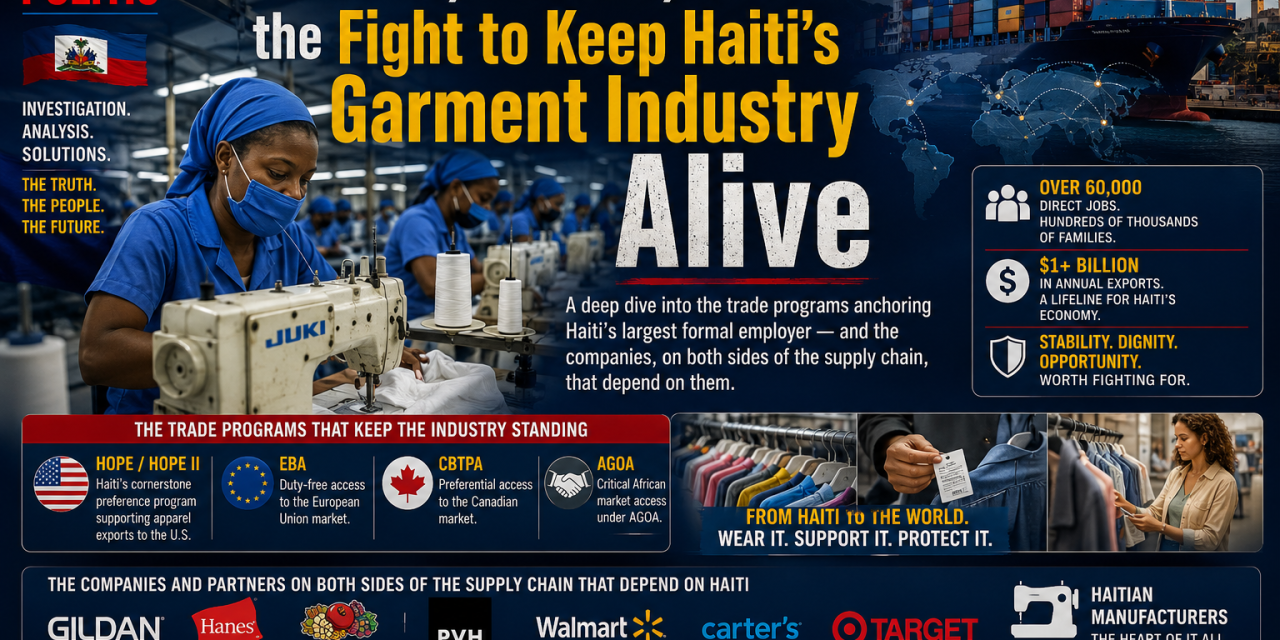
A deep dive into the trade programs anchoring Haiti’s largest formal employer — and the companies, on both sides of the supply chain, that depend on them.
What HOPE and HELP Actually Do
For nearly two decades, two pieces of U.S. trade legislation have functioned as the backbone of Haiti’s formal private-sector economy: the Haitian Hemispheric Opportunity through Partnership Encouragement (HOPE) Act, first passed in 2006 and expanded as HOPE II in 2008, and the Haiti Economic Lift Program (HELP) Act, passed in 2010 in the aftermath of that January’s devastating earthquake.
Together, they grant duty-free access to the U.S. market for qualifying apparel and textile products manufactured in Haiti — eliminating the import tariffs that would otherwise apply and, critically, relaxing the “rules of origin” requirements that normally govern trade preference programs. Under a standard U.S. trade agreement, a garment typically has to be cut and sewn from fabric that itself originated in a partner country to qualify for duty-free treatment. HOPE/HELP loosened that requirement for Haiti, allowing manufacturers to import yarn and fabric from third countries (notably from Asian textile mills) and still assemble the final garment in Haiti duty-free for the U.S. market. HELP went further still, expanding eligible product categories to more than 5,000 types of apparel and footwear.
That flexibility is the single biggest reason the industry exists in its current form: Haiti doesn’t have to build an entire domestic textile supply chain from raw cotton to finished product. It only has to be competitive at the labor-intensive final assembly stage — cut-and-sew work — while importing the rest.
In exchange for this preferential access, beneficiary factories are required to cooperate with International Labour Organization (ILO) monitoring of core labor standards, administered on the ground primarily through the Better Work Haiti program, a joint ILO–International Finance Corporation initiative that inspects factories and publishes compliance reports.
A Program That Keeps Almost Lapsing
If there’s one throughline in HOPE/HELP’s recent history, it’s instability at the legislative level colliding with instability on the ground — a compounding problem for an industry that depends on long lead times and predictable sourcing decisions.
The programs expired on September 30, 2025. Congress didn’t act to retroactively restore them until February 3, 2026, and even then only for a 15-month bridge running through the end of 2026 — not the multi-year horizon manufacturers and buyers say they actually need to justify new investment. That gap alone rattled an industry already reeling from years of gang violence, and industry groups warned at the time that further uncertainty could push buyers to shift orders to competing sourcing countries in Central America or Asia — a shift that, once made, is difficult to reverse even if trade preferences are later restored.
On August 11, 2026, the U.S. Senate passed a two-year extension, folded into a broader Continuing Resolution alongside a parallel extension of the African Growth and Opportunity Act (AGOA), pushing HOPE/HELP’s new expiration date to December 31, 2028. Senator Raphael Warnock, ranking member of the Senate Finance Subcommittee on International Trade, Customs, and Global Competitiveness, helped lead the push, and industry groups — led by the American Apparel & Footwear Association (AAFA) — immediately urged the House to pass the companion measure and send it to the president’s desk. As of this writing, the extension had cleared the Senate and was awaiting House action.
AAFA’s Vice President of Trade and Customs Policy, Beth Hughes, characterized the extension as a stabilizing move rather than a permanent fix: the goal now, industry advocates say, is using this two-year runway to build toward a longer-term, more predictable renewal — rather than repeating the pattern of last-minute, retroactive fixes that has defined the last several years.
Who Actually Benefits: The Company Landscape
HOPE/HELP’s beneficiaries split cleanly into two groups: the Haiti-based manufacturers who assemble the garments, and the U.S. and multinational brands who buy from them and whose retail prices depend on duty-free entry.
The Manufacturers on the Ground
Haiti’s garment production is concentrated in a small number of industrial parks and free zones, each anchored by a handful of major operators:
- Parc Industriel de Caracol (PIC), in Haiti’s northeast, was built after the 2010 earthquake with financing from the Inter-American Development Bank and the U.S. government specifically to decentralize the industry away from Port-au-Prince. Its anchor tenant for over a decade was Sae-A Trading Co., the South Korean conglomerate that operates in Haiti as S&H Global — at its peak, the single largest employer created by HOPE/HELP-driven investment, though the company has downsized sharply amid the security crisis (see below). PIC has also hosted MAS Akansyèl, a subsidiary of Sri Lanka’s MAS Holdings producing athleisure and activewear, though it too announced significant layoffs in 2024.
- CODEVI, a privately-owned free trade zone in Ouanaminthe near the Dominican border, has long operated as one of the industry’s more stable production hubs, run by the Dominican-Haitian Grupo M/CODEVI group.
- SONAPI (Société Nationale des Parcs Industriels), the state-owned industrial park authority overseeing the Parc Industriel Métropolitain (PIM) near Port-au-Prince, has historically been the industry’s original epicenter, hosting companies including Hansae Haiti (a subsidiary of South Korea’s Hansae Corporation, one of the world’s largest apparel manufacturers) and numerous smaller contract manufacturers.
- Other significant Haiti-based manufacturers named across industry sourcing directories and trade data include Valdor Apparel Manufacturing, DKDR Haiti, AGA Group, Island Apparel, Johan Company, Willbes Haiti, and Enmarcolda.
These companies are overwhelmingly foreign-owned — Korean, Sri Lankan, and Dominican capital in particular — reflecting a deliberate post-earthquake strategy of attracting Asian and regional apparel conglomerates to invest in Haitian assembly capacity specifically to take advantage of HOPE/HELP’s duty-free terms combined with Haiti’s low labor costs.
The U.S. Brands Sourcing From Haiti
On the buyer side, HOPE/HELP has anchored sourcing relationships for a roster of major American apparel companies. Industry reporting identifies Levi Strauss & Co. as historically the leading denim buyer from Haitian factories, alongside Old Navy, Carter’s, Gap Inc., Hanesbrands, Gildan Activewear, Fruit of the Loom, and PVH Corp. (parent of Calvin Klein and Tommy Hilfiger). Walmart has also been named as a customer for Haitian-made goods, including hospital garments and leggings produced at Caracol. For these companies, Haiti functions as a nearshore alternative to Asian manufacturing — offering shorter shipping times to the U.S. market than trans-Pacific sourcing, which matters for “quick-turn” basics like T-shirts, where retailers want to restock quickly based on real-time sales data rather than ordering months in advance.
An Industry Under Severe Strain — Independent of the Trade Policy Itself
Here is the harder truth underlying any HOPE/HELP renewal debate: even with duty-free access secured, Haiti’s garment sector has been in a severe, sustained decline since 2021 — driven not by trade policy but by the collapse of security in and around Port-au-Prince following the assassination of President Jovenel Moïse.
The numbers tell the story starkly:
- At its peak, the sector employed between 53,000 and 57,000 workers.
- Between 2021 and early 2024, the industry lost 31,000 jobs — more than half its workforce — according to Wilson Center analysis.
- A mid-2024 Better Work Haiti report documented employment falling from 42,500 to 33,857 workers in just a few months, alongside a permanent factory closure and two temporary ones, and the U.S. Commerce Department’s Office of Textiles and Apparel recorded a roughly 30% drop in textile exports.
- By 2024, S&H Global (Sae-A) had cut its Caracol workforce from roughly 7,000 down to 3,500, closing one factory outright and instituting “widespread” layoffs across its remaining facilities — with a company executive citing insecurity, not trade policy, as the driver.
- As of the 2025–2026 HOPE/HELP lapse, industry consultant Ron Sorini put total sector employment at roughly 30,000 jobs, down from a recent high of 62,000 — attributing nearly the entire gain since 2006 directly to HOPE/HELP, and warning that continued non-renewal risked an “agonizing reappraisal” among buyers that could push orders elsewhere permanently.
Workers and managers interviewed by Better Work Haiti describe an industry functioning under direct threat: factory zones “surrounded by gang territories,” reliance on the Kenyan-led Multinational Security Support Mission for protection, and a widely shared sentiment that the sector’s survival is now tied as much to Haiti’s security trajectory as to Washington’s trade policy.
The Bottom Line
HOPE and HELP remain, on paper, one of the more generous trade preference arrangements the United States extends to any country — a program that quadrupled Haiti’s apparel exports to the U.S. from roughly $231 million in 2001 to nearly $1 billion at its 2021 peak, and that both Haitian officials and U.S. industry groups credit with building the closest thing Haiti has to a modern, formal manufacturing sector. The August 2026 Senate extension to 2028 buys the industry real time and, if it clears the House, would mark the longest stretch of policy certainty the sector has had in years.
But trade preferences alone cannot rebuild an industry that gang violence has cut in half. The companies benefiting from HOPE/HELP — from Korean and Sri Lankan manufacturers operating Haiti’s industrial parks to the American brands sourcing from them — are unanimous on one point echoed throughout industry and government statements alike: duty-free access is necessary, but not sufficient. Without a parallel, sustained improvement in security around Port-au-Prince and the country’s northern industrial corridor, the trade program that built Haiti’s garment sector risks becoming a lifeline for an industry that continues shrinking anyway.