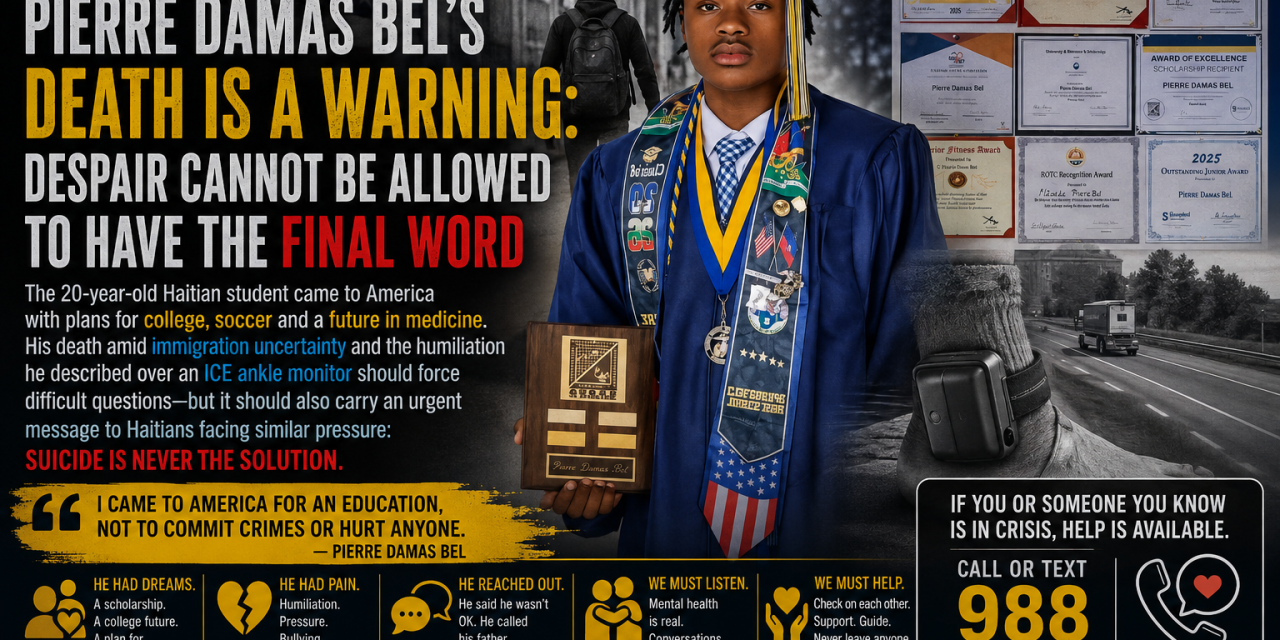
The 20-year-old Haitian student came to America with plans for college, soccer and a future in medicine. His death amid immigration uncertainty and the humiliation he described over an ICE ankle monitor should force difficult questions—but it should also carry an urgent message to Haitians facing similar pressure: suicide is never the solution.
By HMI Politic | September 1, 2026
SPRINGFIELD, Ohio — Pierre Damas Bel was only 20 years old.
He had recently graduated from Springfield High School. He had been involved in the National Honor Society, Marine Corps JROTC and varsity soccer. He received an Award of Excellence scholarship and had just begun attending Wright State University, where reporting says he planned to study physiology and neuroscience in preparation for medical school.
On Monday morning, August 31, that future ended on Interstate 70 in Clark County, Ohio.
According to the Ohio State Highway Patrol account reported by local media, Damas Bel stopped his vehicle along the highway, got out and entered the westbound lanes, where he was struck by a tractor-trailer and pronounced dead at the scene. His family says his death was suicide.
His death is already becoming part of America’s increasingly bitter immigration debate.
It should.
But it must become something else as well.
It should become an urgent conversation within the Haitian community about despair, humiliation, isolation and the importance of asking for help before a temporary crisis produces an irreversible decision.
Because no immigration case, ankle monitor, deportation threat, humiliation, political administration, financial problem, broken relationship or moment of hopelessness is worth a human life.
Suicide is never the solution.
A Young Haitian With Plans for the Future
The story is especially painful because Pierre’s life appeared to be moving toward something larger.
Springfield City Schools described him as a member of its Class of 2026 who participated in the National Honor Society, JROTC and varsity boys soccer. The district confirmed that he had received an Award of Excellence scholarship.
He subsequently enrolled at Wright State University.
According to reporting based on his social-media posts, Pierre hoped eventually to attend medical school.
This was not someone without plans.
He had plans.
He had accomplishments.
He had people who cared about him.
And yet those things do not make someone immune from psychological distress.
That may be one of the most important lessons in Pierre’s story.
Sometimes the person struggling most seriously is also the student going to class, the athlete playing soccer, the employee going to work or the young immigrant telling his parents that everything will eventually be all right.
Then Came the Ankle Monitor
Pierre’s immigration circumstances had changed dramatically.
His family and community advocates say he was required to wear an electronic GPS ankle monitor following the termination of Temporary Protected Status for Haitians.
Local reporting says some Haitians in Springfield have been fitted with monitoring devices after interactions with immigration authorities.
For Pierre, the device apparently became much more than an immigration-enforcement mechanism.
It became a source of humiliation.
On July 30, Pierre publicly described what he was experiencing. He wrote that he had come to the United States for an education rather than to commit crimes or hurt anyone, and said wearing the GPS monitor left him feeling “shame and humiliation.”
He also questioned how he would participate in college sports while wearing it.
His father later said Pierre had gone to immigration authorities seeking to have the monitor removed so that he could play soccer.
Those details matter.
But they should not be simplified into an assertion that one government policy caused one person’s suicide.
Mental-health experts caution that suicide generally does not have a single cause. It can result from interacting psychological, social, environmental and personal pressures. Reporting on Pierre’s death similarly notes that experts caution against reducing suicide to one factor.
That distinction is essential for responsible journalism.
His Last Call to His Father
Perhaps the most devastating part of the story comes from Pierre’s father.
Pierre Ronal Bel said his son called him by video shortly before his death.
According to his father’s account, Pierre told him:
“I’m not feeling OK mentally because of the bullying.”
His father told him to come home so they could talk.
Later that morning, police arrived to tell the family Pierre had died.
There is something every Haitian parent, student, church leader, coach, teacher and friend should hear in those words:
“I’m not feeling OK mentally.”
Those words should never be dismissed.
They should never be answered with ridicule.
They should never be treated as weakness.
And they should never be something a person feels ashamed to say.
They are a request for help.
Immigration Policy Is Part of This Story
We should also resist going to the opposite extreme.
Acknowledging that suicide is complex does not mean ignoring the circumstances Pierre himself described.
He explicitly wrote publicly about feeling humiliated by his ankle monitor.
His family says he was struggling with it.
His father says he sought its removal.
Community advocates say he was distressed.
And his father reported that Pierre spoke about bullying shortly before his death.
Those facts deserve scrutiny.
Ohio Governor Mike DeWine, a Republican, responded to Pierre’s death by questioning whether the government’s treatment of people such as him reflects what Americans want immigration enforcement conducted in their name. DeWine said he had been told Pierre had significant dreams about what he could accomplish and contribute to the United States.
There is therefore a legitimate public-policy question here:
What are the human consequences of immigration enforcement?
A government has the authority to enforce immigration laws.
That does not eliminate its responsibility to consider proportionality, dignity, due process and the psychological consequences of the methods it chooses.
Those questions should be investigated.
They should be debated.
And government officials should be required to answer them.
But Pierre’s Death Must Not Become a Political Weapon
There is another danger.
Within hours of a tragedy, people often attempt to transform the dead into evidence for whatever political argument they already wanted to make.
One side may say:
This administration killed him.
Another may respond:
Immigration laws are immigration laws.
Neither slogan adequately captures a 20-year-old human being.
Pierre was more than an immigration status.
More than TPS.
More than an ankle monitor.
More than a political argument.
And now, tragically, he risks becoming known primarily for the way he died rather than for the life he was trying to build.
HMI Politic believes his story deserves better.
To Haitian Young People: Your Current Situation Is Not Your Entire Future
This part of the story needs to be said plainly.
To Haitians living in the United States who are frightened about TPS, deportation, employment authorization or immigration enforcement:
Your immigration status is not your human value.
If you lose a job, your life still has value.
If your immigration case is denied, your life still has value.
If someone humiliates you, your life still has value.
If you are required to wear a monitoring device, your life still has value.
If you cannot attend school this semester, your life still has value.
If you must leave the United States, as painful and frightening as that possibility may be, your life still has value.
Policies change.
Court decisions change.
Presidents change.
Immigration cases change.
Financial circumstances change.
People relocate.
Students return to school.
Families rebuild.
A situation that appears impossible at 20 can look entirely different at 21, 25 or 30.
Death removes every possibility of seeing that next chapter.
Haitian Culture Must Also Talk About Mental Health
Pierre’s death should generate another uncomfortable conversation.
Mental health cannot remain something Haitian families discuss only after tragedy occurs.
Expressions such as depression, anxiety, panic, hopelessness and suicidal thoughts should not automatically be dismissed as weakness.
Nor can every psychological crisis simply be answered with:
“Fòk ou fò.” — You have to be strong.
Strength can mean saying:
I need help.
Strength can mean calling your father.
Strength can mean telling a professor.
Strength can mean talking to a pastor.
Strength can mean seeing a counselor.
Strength can mean calling a crisis line.
Strength can mean giving your car keys to somebody and saying:
“Please stay with me tonight.”
Sometimes survival itself is the courageous decision.
We Must Be Careful How We Remember Pierre
Responsible coverage of suicide also means refusing to romanticize the act.
Pierre’s death should not be portrayed as heroic resistance against immigration policy.
It should not be presented as an example for anyone else to follow.
It should not become a message suggesting:
“Look what someone must do before people listen.”
No.
There are other ways to protest.
There are lawsuits.
There are elections.
There are demonstrations.
There is journalism.
There are churches.
There are advocacy organizations.
There are members of Congress.
There are immigration attorneys.
There are courts.
There are community organizations.
There are 100 ways to fight an injustice while remaining alive to see whether that fight succeeds.
Pierre did not need to die for America to debate its immigration policies.
The Community’s Responsibility
Pierre’s tragedy also creates responsibilities for those of us who remain.
When someone says, “I’m not OK mentally,” listen.
When a young immigrant suddenly withdraws, check on them.
When someone loses employment authorization, don’t only ask how they’re going to pay rent.
Ask:
“How are you doing?”
When someone faces deportation, don’t assume that because they’re quiet they’re handling it well.
When somebody is being mocked because of an ankle monitor or immigration status, intervene.
And when someone talks about suicide, hopelessness or believing there is no reason to continue living, treat it seriously.
Don’t leave that person alone with the crisis.
Pierre Damas Bel Should Have Had More Chapters
The most heartbreaking part of this story is not Interstate 70.
It is everything that will now never happen.
The next soccer match.
The next semester.
The college graduation.
Medical school.
Perhaps becoming a doctor.
Perhaps falling in love.
Perhaps building a family.
Perhaps winning an immigration case.
Perhaps one day looking back at 20 years old and realizing that what once seemed impossible was actually temporary.
Nobody knows which of those chapters would have happened.
That is precisely the point.
There should have been time to find out.
Pierre Damas Bel was 20.
His death should force government officials to answer serious questions about immigration enforcement and human dignity.
It should force schools to think seriously about bullying.
It should force Haitian organizations to strengthen mental-health support.
And it should force our community to become much more comfortable saying three words before another family receives a knock on the door:
“Mwen bezwen èd.”
I need help.
There is no shame in those words.
There is hope inside them.
HMI Politic’s message is simple: Suicide will never be the solution. Stay. Speak. Ask for help. Give tomorrow the opportunity to be different from today.
If you or someone you know in the United States is thinking about suicide or experiencing a mental-health crisis, call or text 988 to reach the Suicide & Crisis Lifeline.
HMI Politic — Facts. Power. Accountability.