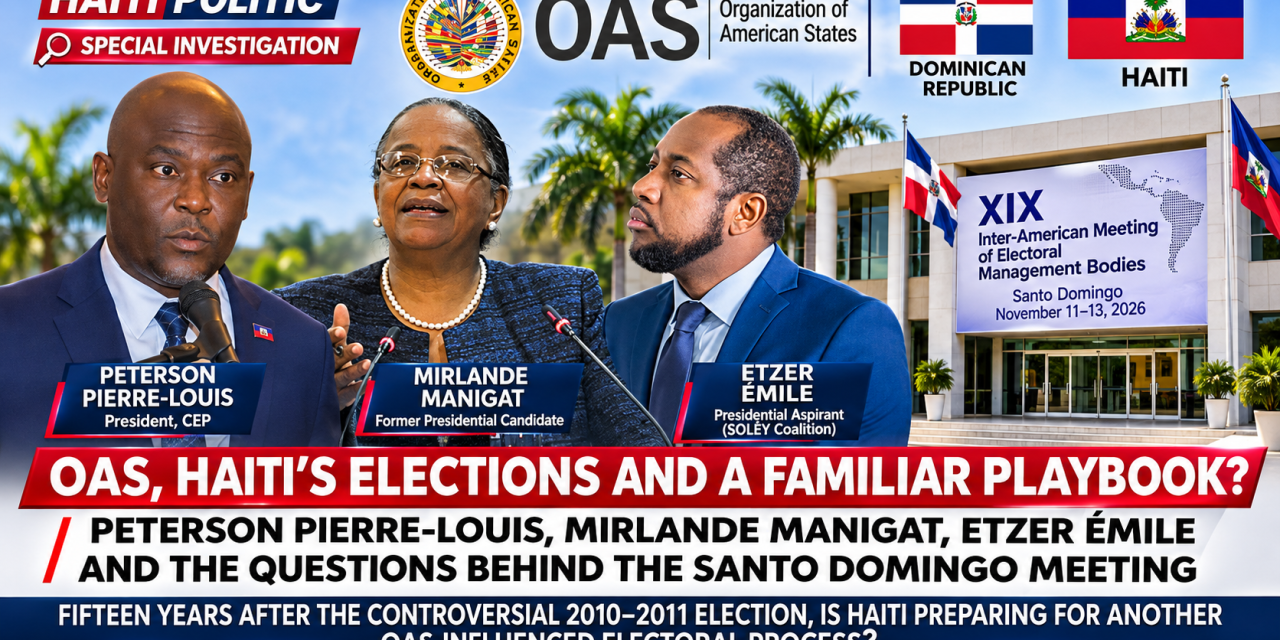
Fifteen years after the controversial OAS intervention that reshaped Haiti’s 2010–2011 presidential runoff, the president of Haiti’s Electoral Council travels to the Dominican Republic for another OAS-organized gathering. His religious-sector background, the emergence of the SOLÈY political coalition, and international consultations on diaspora voting raise questions about electoral independence, transparency, and the risk of repeating historical mistakes.
By Haiti Politic | Special Political Investigation
November 11, 2026
The controversy surrounding Haiti’s next elections is not simply about when Haitians will vote. It is increasingly about who will organize the elections, which institutions will influence the process, how candidates will be evaluated, and whether the country’s electoral authorities can operate independently of political and international pressure.
On November 10, 2026, Haiti’s Conseil Électoral Provisoire (CEP) announced that its president, Peterson Pierre-Louis, had traveled to Santo Domingo, Dominican Republic, to participate in the 19th Inter-American Meeting of Electoral Management Bodies.
The conference, scheduled for November 11–13, is organized by the Organization of American States (OAS) through its Department for Electoral Cooperation and Observation, in collaboration with the Dominican Republic’s Central Electoral Board.
The governments of Canada and Switzerland are supporting the gathering.
According to the Dominican electoral authorities, representatives from 25 countries and 35 electoral organizations are expected to participate. The agenda includes political financing, electoral technology, cybersecurity, artificial intelligence, disinformation, and institutional resilience.
On its face, this is a regional conference about improving election administration.
But Haiti’s political history gives the meeting additional significance.
In 2010–2011, an OAS electoral verification mission played a consequential role in a disputed Haitian presidential election involving Mirlande Manigat, Jude Célestin, and Michel Martelly.
Fifteen years later, Haiti’s electoral council is again engaging with the same international organization.
Meanwhile, Peterson Pierre-Louis comes from Haiti’s Protestant religious sector, and a political coalition associated with economist Etzer Émile includes organizations connected to the Christian-democratic tradition and the political legacy of Mirlande Manigat.
These developments deserve examination.
The central question is not whether attending an OAS conference constitutes wrongdoing. It is whether Haiti has established sufficient safeguards to ensure that its next election will be decided by Haitian voters, under transparent Haitian electoral rules, without improper political or foreign influence.
1. SANTO DOMINGO: WHY IS HAITI’S ELECTORAL COUNCIL MEETING WITH THE OAS?
The CEP’s November 10 press release, reference CEP/DC/091-2526, confirms Peterson Pierre-Louis’s participation in the regional electoral conference.
The Dominican Republic’s Central Electoral Board identifies the OAS Department for Electoral Cooperation and Observation as the principal organizer.
The meeting takes place at the Hotel El Embajador in Santo Domingo.
The official program includes discussions about electoral financing, the security of election technology, artificial intelligence, and strategies for strengthening electoral institutions.
It also includes a workshop on dialogue, negotiation, and mediation in electoral administration.
These are legitimate subjects for electoral authorities.
But there is a significant distinction between attending a regional conference and authorizing an international organization to influence a country’s electoral decisions.
The available announcements establish the former, not the latter.
They do not disclose any agreement giving the OAS authority over Haiti’s candidate registration, electoral calendar, vote tabulation, or dispute-resolution procedures.
Nevertheless, the CEP should clarify whether Peterson Pierre-Louis intends to hold separate meetings concerning Haiti’s elections.
Questions worth examining include whether the OAS has offered new technical assistance, whether funding commitments are being discussed, and whether the CEP will publish a report identifying the results of the conference.
The meeting’s official program also includes closed plenary sessions.
Closed working sessions are common at international conferences, but their existence makes post-conference transparency particularly useful.
What matters is not simply who attends the meeting, but what commitments are made and whether those commitments become public.
2. THE 2010–2011 ELECTION: WHEN AN OAS VERIFICATION CHANGED HAITI’S PRESIDENTIAL RUNOFF
To understand why the OAS’s current involvement attracts scrutiny