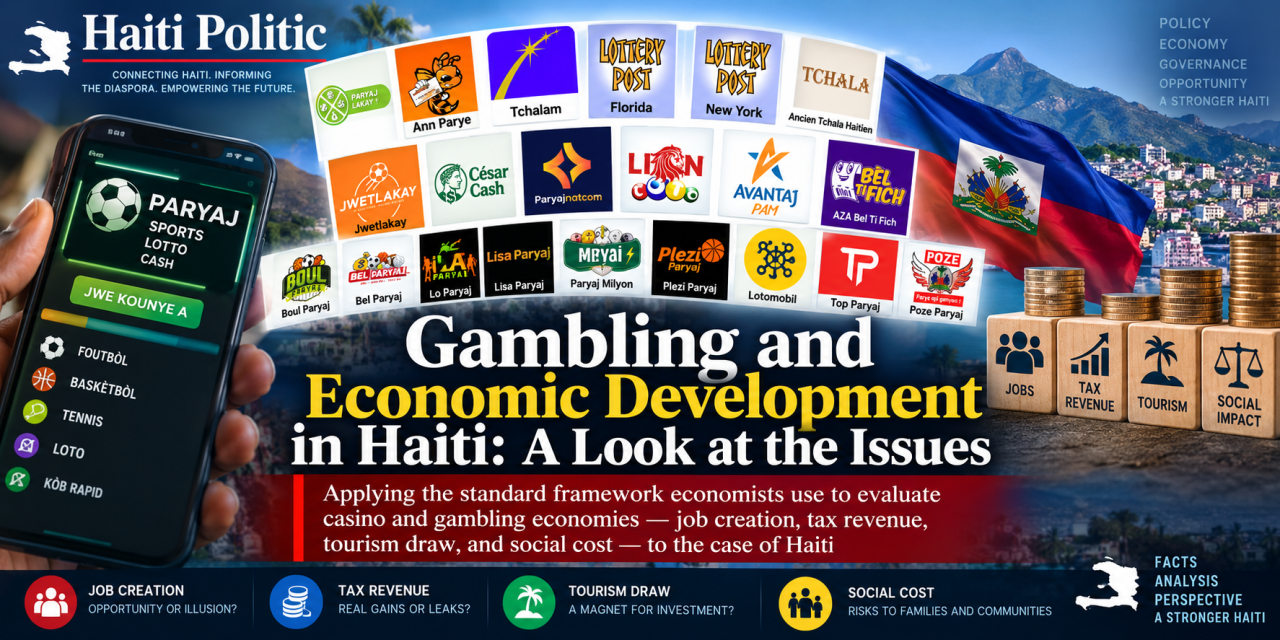
Applying the standard framework economists use to evaluate casino and gambling economies — job creation, tax revenue, tourism draw, and social cost — to the case of Haiti
The Standard Framework
When economists evaluate whether legalized gambling contributes meaningfully to a region’s economic development, they typically weigh several factors against each other: direct job creation at gaming venues, tax and licensing revenue captured by the state, whether gambling draws new outside spending (tourism) or merely redirects money that residents would otherwise have spent locally (“cannibalization”), and the offsetting social costs — problem gambling, debt, and the strain these place on social services. A casino or lottery industry only counts as a genuine contributor to GDP and public revenue if its formal, measured economic activity — wages paid, taxes collected, value added recorded in national accounts — is large enough, and well-regulated enough, to outweigh those costs.
Applying that framework to Haiti produces a striking result: Haiti has an enormous, culturally embedded gambling economy — and almost none of it shows up as a measurable contribution to the country’s GDP.
Two Very Different Gambling Sectors
Haiti’s gambling activity splits cleanly into two worlds that operate almost independently of each other.
Legal casinos are a relic, not an industry. Haiti legalized land-based casinos in 1960, under the Duvalier government, explicitly as an incentive to attract foreign tourism investment — part of a strategy that briefly made Port-au-Prince and Pétion-Ville minor Caribbean gaming destinations in the 1970s and early 1980s. Decades of political instability, the collapse of Haiti’s tourism sector, and — in the current period — armed groups controlling an estimated 90 percent of Port-au-Prince have left that vision in ruins. Today only a small number of legal casinos operate in the country at greatly diminished scale, and industry-tracking services estimate the entire formal gaming-equipment market at roughly $54,850 for 2025 — a figure so small it barely registers as a rounding error against Haiti’s roughly $33.55 billion nominal GDP. Online gambling, meanwhile, exists in a genuine legal gray zone: nothing in Haitian law licenses or prohibits it outright, so Haitians gamble on offshore platforms that pay no tax to the Haitian state at all.
The real gambling economy is the borlette — and it is enormous, informal, and largely untaxed. Haiti’s ubiquitous lottery system, known as the borlette, is sold through an estimated 35,000-plus stalls in nearly every town and neighborhood in the country — far outnumbering the country’s bank branches, in a nation where roughly 80 percent of the population lacks access to formal financial services. Researchers at Tufts University’s Center for Emerging Market Enterprises have documented the borlette less as a discrete “industry” than as a substitute financial system: a savings mechanism, a social ritual, and a spiritual practice rolled into one, filling a gap left by the near-total absence of banking access for the poor.
A Number Worth Scrutinizing
One figure circulates widely in reporting on Haitian gambling: that Haitians spend as much as $1.5 billion a year on lottery play — a sum once described as nearly a fifth of the country’s GDP. That framing deserves scrutiny on two counts. First, it appears to date to a period when Haiti’s GDP was roughly $8–9 billion; against today’s $33.55 billion economy, $1.5 billion would represent closer to 4–5 percent of GDP, not 20 percent — a reminder that widely repeated statistics about Haiti’s informal economy often outlive the context that produced them. Second, and more importantly for the “economic development” question: a substantial share of Haitian borlette betting is explicitly pegged to the results of foreign lotteries — principally the New York State Lottery and the Santo Domingo (Dominican Republic) lottery draws — rather than to any Haitian-run drawing. That detail matters enormously for GDP accounting. Money Haitians stake against a New York or Dominican lottery result, win or lose, is not value generated within the Haitian economy in the way a domestically operated casino or state lottery would be; it is closer to consumption of an imported service, more likely to represent a net outflow of scarce hard currency than a contribution to domestic production.
Why So Little of This Shows Up as “Development”
Measured against the standard casino-economics framework, Haiti’s gambling sector fails to deliver on nearly every metric that would normally justify treating gambling as an economic development strategy:
- Tax revenue. Haiti’s overall state tax collection is extraordinarily weak — the government mobilized only 5.2 percent of GDP in tax revenue in 2024, according to World Bank figures, compared with a 13–15 percent threshold economists consider the minimum needed to avoid a “low fiscal capacity trap,” and well below the regional Caribbean average. Haiti has no unified, modern tax code to begin with. Against that backdrop, a fragmented, cash-based, largely informal borlette sector — nominally licensed through the state lottery authority (Loterie de l’État Haïtien) but overwhelmingly operating outside effective state oversight — contributes negligible, unquantified tax revenue relative to the scale of money changing hands at its stalls.
- Job creation. Borlette stalls do employ vendors — likely tens of thousands of people nationwide — but these are overwhelmingly informal, low-wage, unregulated positions rather than the kind of formal, benefits-bearing employment a casino-resort industry can generate elsewhere in the Caribbean.
- Tourism draw. The 1960 legalization of casinos was explicitly a tourism-investment strategy, and it is the clearest historical case of Haiti trying to use gambling for genuine economic development. It failed — not because the gambling model was flawed, but because the political instability, and now the gang-driven security collapse that has made most of Port-au-Prince inaccessible to outsiders, made the kind of large-scale hospitality investment casino tourism requires impossible to sustain. No Haitian government since has had the security conditions necessary to revive it.
- Cannibalization and regressive impact. Where the standard framework asks whether gambling merely redirects local spending rather than attracting new money, Haiti’s case is starker: borlette spending draws on the same cash-constrained households — nearly 59 percent of Haitians live below the national poverty line — who have the least capacity to absorb losses, and a meaningful share of that spending appears to exit the country entirely through foreign-lottery-linked betting.
- Regulatory capacity. Effective gambling regulation requires a functioning state apparatus to license operators, audit revenue, and collect tax — capacity Haiti’s government has consistently lacked even for its core revenue functions, let alone for a sprawling, largely cash, largely informal betting sector.
So: Does Gambling Contribute Significantly to Haiti’s GDP?
Based on the available evidence, the honest answer is no — not in the way economists mean when they talk about an industry “contributing to GDP.”
The formal, legal casino sector is vanishingly small — a historical footnote from a 1960s tourism strategy that never recovered from decades of instability, now worth an estimated few tens of thousands of dollars in equipment terms against a $33-billion-plus economy. The informal borlette sector, while economically and culturally significant to millions of Haitian households as a savings substitute and a source of hope in a country with almost no formal financial access, does not appear as a distinct, measured line item in Haiti’s national accounts, is only thinly and unreliably taxed, and — because much of it is wagered against foreign lottery draws — may represent a net drain of hard currency out of Haiti rather than domestic value creation. Haiti’s own fiscal data underscore the point: a state that collects only 5.2 percent of GDP in taxes overall is in no position to be capturing meaningful, well-documented revenue from an industry that operates almost entirely in cash and largely outside formal oversight.
Gambling in Haiti, in short, is real, large, and economically important to how millions of poor Haitians manage scarce cash — but it functions as a symptom of underdevelopment (a substitute for banks, formal savings, and a functioning state) rather than as a driver of development in the sense that a taxed, regulated, formally measured gaming industry can be elsewhere. Any claim that gambling makes a significant, quantifiable contribution to Haiti’s GDP should be treated with the same skepticism applied to other informal-economy statistics in a country where the state itself struggles to measure — let alone tax — the majority of its own economic activity.
Sources: World Bank tax-revenue data via Le Nouvelliste (“The Haitian Fiscal Paradox,” September 2025); iGamingToday.com, Haiti iGaming Market Research Report and Gambling Regulation in Haiti; Tufts University Feinstein International Center / Center for Emerging Market Enterprises, “Savings and Chance: Learning from the Lottery to Improve Financial Services in Haiti”; Wikipedia, Economy of Haiti (World Bank/IMF-sourced GDP figures); Vice, “Haitians Are Hooked on the New York Lotto”; UC Davis working paper on SMS-lotto and financial inclusion in Haiti.