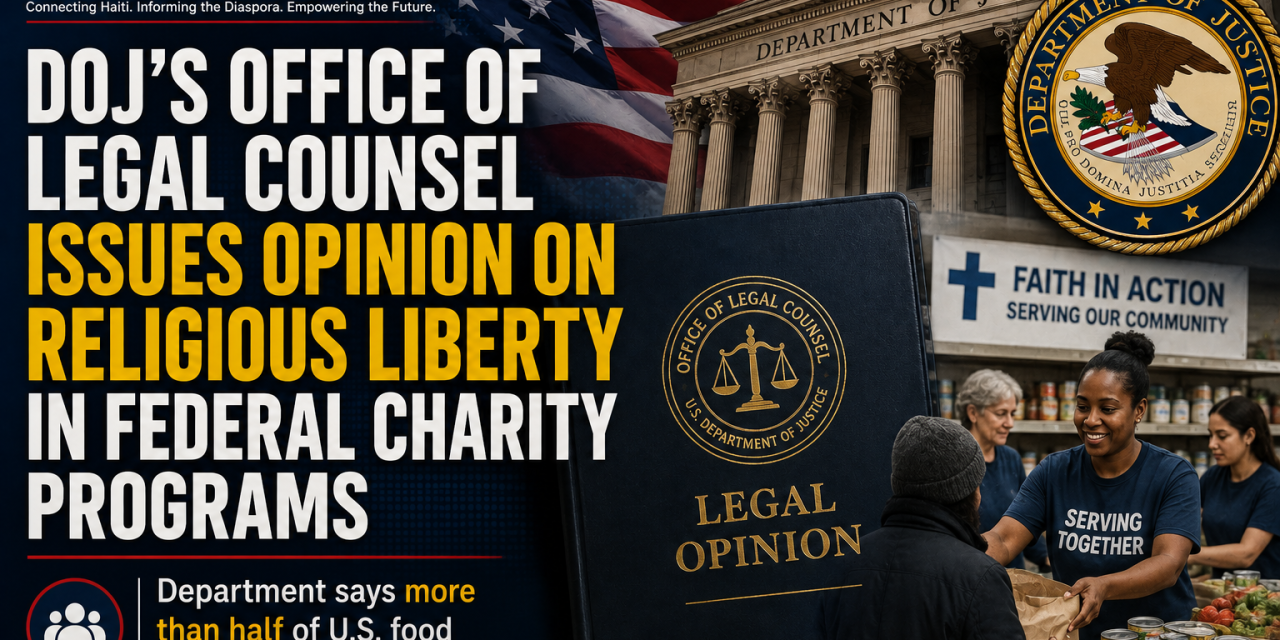
Department says more than half of U.S. food pantries and soup kitchens are faith-based
The U.S. Department of Justice announced this week that its Office of Legal Counsel (OLC) has issued a formal opinion addressing religious liberty protections for faith-based organizations participating in federally supported charity programs. In a statement posted to its official X account, the Department said the opinion protects religious liberty in federal charity programs, noting that more than half of the country’s food pantries and soup kitchens are faith-based. The Department linked to the full opinion on its website, justice.gov/olc.
Context: A Year of Expanded Religious Liberty Guidance
This opinion is the latest in a series of religious liberty actions DOJ has taken over the past several months. In July 2026, then-Acting Attorney General Todd Blanche issued updated department-wide guidance strengthening religious liberty protections across federal agencies, revising and expanding the Department’s 2017 guidelines in light of recent Supreme Court rulings. That guidance directed federal agencies to ensure religious organizations can compete on equal footing with secular organizations for federal contracts and grants, and to consult the Office of Legal Policy before finalizing any action that could burden religious exercise.
The Department has also been engaged this year through its Religious Liberty Commission, established by presidential action in May 2025, which presented a draft report to President Trump on June 26, 2026. That draft reportedly recommended the Department issue further guidance clarifying the Establishment Clause and church-state separation, and specifically flagged the importance of protecting faith-based organizations’ ability to participate in public-private partnerships, including social service providers such as Catholic Charities.
Why Faith-Based Charities Are Central to the Argument
DOJ’s emphasis on food pantries and soup kitchens reflects a broader, well-documented reality in America’s charitable food sector: religious congregations and faith-affiliated nonprofits make up a substantial share of the organizations that operate them. Research on food pantries across a sample of American states has found that roughly two-thirds carry a Christian faith-based affiliation, and older studies of major hunger-relief networks have found similarly high shares of pantries and kitchens sponsored by churches or other religious organizations. In practice, this means any federal rule governing how faith-based charities can participate in — or must operate within — publicly supported food-assistance networks touches a significant portion of the emergency food system many low-income Americans, including within immigrant and diaspora communities, rely on directly.
What the Opinion Reportedly Addresses
Based on DOJ’s public description, the opinion appears consistent with the Department’s stated position throughout 2026: that religious organizations should not be disqualified from participating in, or subjected to unequal treatment within, federally connected charitable and grant programs solely because of their religious character — a principle the Department has repeatedly traced to Supreme Court precedent, including Espinoza v. Montana Department of Revenue and this year’s Catholic Charities Bureau v. Wisconsin Labor & Industry Commission. The full text and legal reasoning of the newly issued opinion were not independently reviewed for this report; readers seeking the complete opinion can access it directly through the Department of Justice’s Office of Legal Counsel webpage.
Source: U.S. Department of Justice (@TheJusticeDept) official statement, X, August 2026, linking to the Office of Legal Counsel opinion at justice.gov/olc. Additional background from prior DOJ guidance (July 2026) and Religious Liberty Commission reporting.