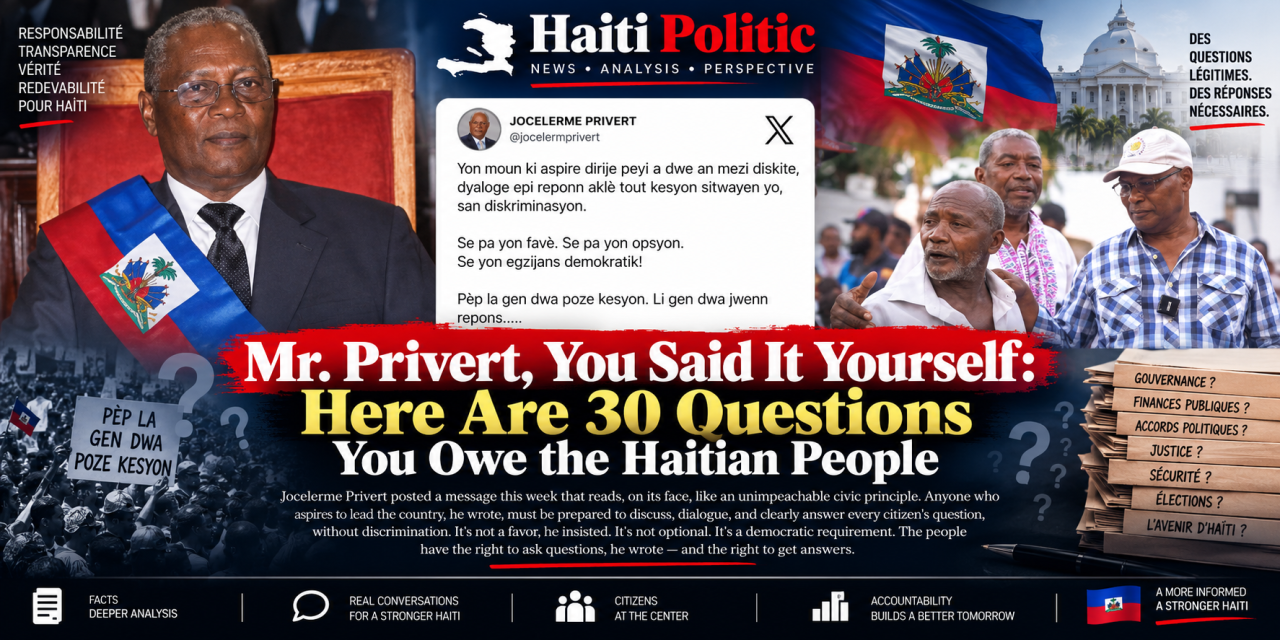
Jocelerme Privert posted a message this week that reads, on its face, like an unimpeachable civic principle. Anyone who aspires to lead the country, he wrote, must be prepared to discuss, dialogue, and clearly answer every citizen’s question, without discrimination. It’s not a favor, he insisted. It’s not optional. It’s a democratic requirement. The people have the right to ask questions, he wrote — and the right to get answers.
It’s hard to disagree with the standard. It’s much harder to see how Jocelerme Privert, of all people, meets it.
Privert is not a first-time commentator on Haitian governance — he is a man who has held the two highest offices in the Haitian executive branch (Minister of Economy and Finance, Minister of the Interior) and, for one year, the presidency itself. He has been arrested once, in 2004, over one of the darker episodes of that decade’s political violence. He had an arrest warrant issued against him again in December 2023, alongside 35 other senior officials, over corruption allegations he has never judicially cleared, only denied. And as his name resurfaces in speculation about a 2026 presidential run, the questions the Haitian public has about his record have, if anything, multiplied rather than been answered.
So let’s take Mr. Privert at his own word. If dialogue and clear answers are a democratic requirement rather than a favor, here are 30 questions — grouped by the chapters of his own career — that he should be first in line to answer, on the record, without discrimination.
On La Scierie (2004)
- More than two decades after the events at La Scierie in Saint-Marc, will you support the release of the complete judicial file so independent investigators — not just the parties involved — can assess it?
- You’ve called your 2004 detention an injustice. Have you ever requested a truth-and-reconciliation-style public hearing on La Scierie, rather than only contesting the case in private legal filings?
- What is your account, in your own words and in detail, of your specific whereabouts and actions during the period the La Scierie violence occurred?
- Do you believe the victims and families of La Scierie are owed a fuller public accounting than “no credible proof has been established,” even if you personally are never charged again?
- Would you submit voluntarily to a new, internationally observed review of the file if one were proposed, given how long the matter has lingered unresolved?
On the 2016–2017 Interim Presidency
- Your original mandate was set at 120 days, ending June 14, 2016. Why did it take until February 2017 — nearly three times that period — for a democratically elected successor to take office?
- Reporting from June 2016 described “contested parliamentarians” allied with your transition demanding ministerial posts and director-general positions as a condition for extending your mandate. Were any such demands made to you, and did your administration grant any of them?
- Can you name every ministerial or director-general appointment made during your extended mandate, and explain the criteria used for each?
- Your verification commission found the 2015 elections to be fraudulent and recommended a full rerun. Do you accept the same principle should apply retroactively to scrutinize how your own extended presidency was authorized?
- Why did the National Assembly under your transition pass no laws at all in its first several months, according to contemporaneous reporting, while devoting its sessions to negotiations over your mandate?
- The U.S. State Department publicly stated in June 2016 that “temporary political solutions” were not a substitute for an elected president. What is your response, today, to that assessment of your own tenure?
- Who funded the 2016–2017 electoral process you oversaw, and were any of those funding sources — domestic or international — ones you had personal or political ties to?
On the December 2023 Corruption Case
- An investigating judge issued an arrest warrant against you and 35 other officials in December 2023 over alleged corruption. What specifically were you accused of, in detail, beyond your general denial?
- You’ve called the warrant a politically motivated attempt to damage your reputation. Who, specifically, do you believe orchestrated that alleged persecution, and why?
- Have you ever formally appeared before the investigating judge to answer the specific allegations, rather than responding only through public statements?
- Of the other 35 officials named alongside you, how many do you believe are guilty, if any — and does grouping you together with them, as you suggest is unfair, mean you consider all 36 cases equally baseless?
- Would you support an independent, non-governmental audit of your personal and family finances covering your years in public office, to resolve the matter definitively either way?
- If the warrant is indeed baseless, why has it not been formally dismissed or withdrawn by Haitian judicial authorities in the time since it was issued?
On Economic and Personal Interests Abroad
- Reports have raised questions about your economic and political interests in the Dominican Republic. What are the full details of any businesses, property, or financial holdings you have there?
- Were any of those interests acquired during your time in public office, and if so, how were they financed?
- Do you believe a Haitian head of state or presidential candidate with significant financial interests in the Dominican Republic faces any conflict of interest given the two countries’ often tense bilateral relationship?
On Your 2026 Political Ambitions
- Your name has resurfaced in connection with the next presidential election. Under which party or platform banner, if any, do you intend to run?
- What specific, concrete plan do you have for addressing the armed-gang control of large parts of Port-au-Prince — beyond general statements about dialogue and security?
- Given the criticism of your 2016–2017 mandate extension, what guarantee can you offer that you would respect a fixed electoral timeline if elected or appointed to any future transitional role?
- Who are the financial backers of your renewed political activity, and are any of them individuals or entities under domestic or international sanction?
- What is your position on the CEP’s current registration process for parties and platforms, which multiple political actors have publicly criticized as irregular?
On the Standard You’ve Just Set for Everyone Else
- You wrote that leaders must answer citizens’ questions “without discrimination.” Will you commit, in writing, to answering every question on this list individually and specifically, rather than through a general statement?
- Do you believe the same standard of transparency you’re demanding of others should have applied to your own government’s decision-making process during your 2016–2017 presidency, in real time rather than only in retrospect?
- If elected or granted power again, will you commit to regular, unscripted press conferences open to all Haitian media outlets, without pre-screened questions?
- Finally: do you believe a politician who has faced an unresolved 2004 arrest, an unresolved 2023 corruption warrant, and public questions about foreign financial interests is the right messenger to lecture other Haitian leaders about the “democratic requirement” of transparency — or does credibility on that message have to be earned first, starting with these questions?
The Bar You Set Is the Bar You’ll Be Held To
None of the questions above amount to a verdict. Mr. Privert has never been convicted in either the La Scierie matter or the 2023 corruption case, and Haitian and international observers alike have noted that accusations in Haiti’s polarized political environment are frequently deployed as weapons rather than pursued to a judicial conclusion. He is entitled to the presumption that governs any citizen facing unresolved allegations, and his denials are part of the public record just as much as the accusations are.
But that presumption cuts both ways. If Jocelerme Privert genuinely believes, as he told his followers this week, that dialogue and clear answers are a democratic requirement rather than a favor — not an option, but an obligation owed to the people who have the right to ask and the right to receive answers — then there is no more fitting place to start living up to that standard than with the thirty questions above. The Haitian people did not wait for his tweet to start asking them. They have been asking for years. What’s been missing is the answers.
This article is based on public reporting on Jocelerme Privert’s political career, including his 2016–2017 interim presidency, the 2004 La Scierie case, the December 2023 corruption arrest warrant, and ongoing public discussion of his political future. Jocelerme Privert has denied all allegations of wrongdoing referenced in this piece, and none have resulted in a final judicial conviction.