Denouncing corruption is necessary. But honoring Dessalines must lead to cases being pursued, funds being recovered, whistleblowers being protected, and the same rules applying to everyone.
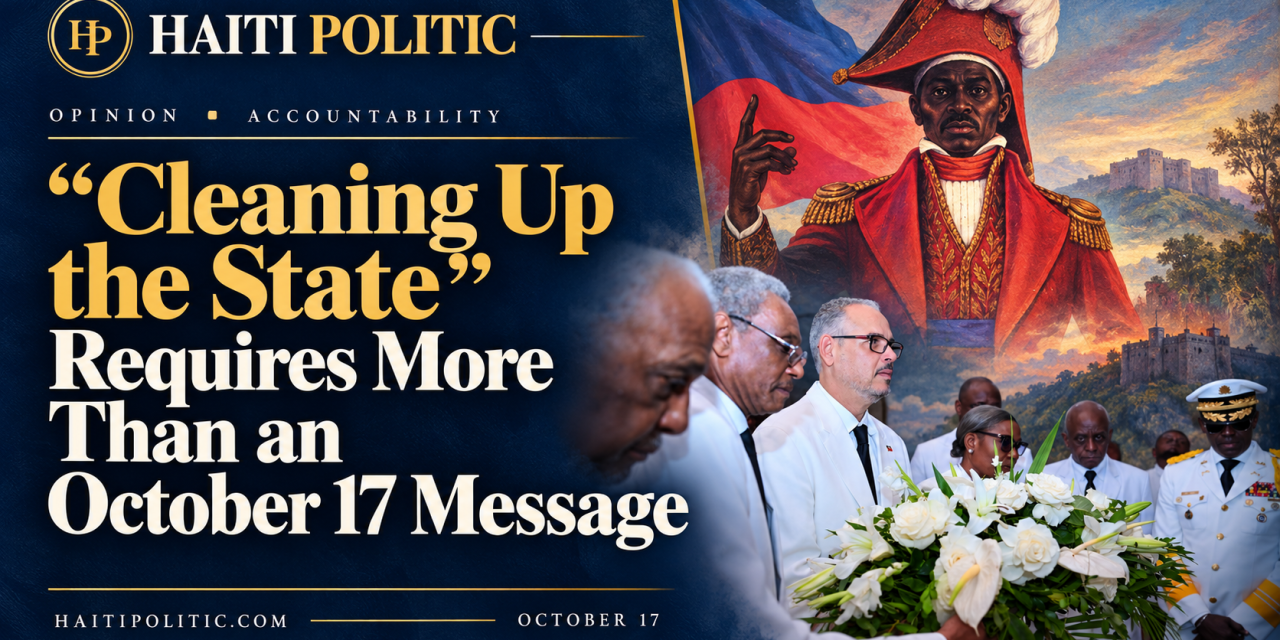
On October 17, words about freedom, dignity, and social justice occupy a special place in public discourse. It is an occasion to remember Dessalines, but also to examine what we have done with the state he helped establish. When public officials speak of “cleaning up the state,” citizens are right to ask how that commitment will translate into decisions, procedures, and results they can verify.
In his message marking the occasion, Hans Joseph denounces the plundering of public resources, corruption, and impunity. He emphasizes enforcing the law and preventing those who drain the public treasury from continuing to dominate political life. That position deserves serious discussion. But the force of a statement must not replace scrutiny of the actions behind it.
Which cases have reached the justice system? Where do the proceedings stand? What misappropriated funds have returned to the public treasury? Who has received protection after reporting wrongdoing? These are the questions that must give political and institutional substance to the phrase “cleaning up the state.”
An investigative report is a step, not the end of the work
According to the Anti-Corruption Unit’s official description of its mission, the ULCC investigates suspected corruption, gathers evidence, and can refer its findings to prosecutors. That establishes an important distinction: investigative work forms part of a process in which the justice system has its own responsibilities. [1]
A report being referred does not mean a conviction has been obtained. A person named in an investigation is not automatically guilty. And a conviction, by itself, does not tell us whether the state has recovered what it lost. If we conflate these stages, we risk celebrating an announcement as though the entire problem had already been resolved.
What we need is an accounting that allows the public to track progress: when cases were referred, which institutions received them, the stages of proceedings, and decisions that can be made public. That reporting must respect the confidentiality necessary for investigations, people’s safety, and defense rights. It does not require releasing all the evidence on social media; it requires accountability for the work.
The absence of an easily accessible public accounting is not enough to establish that no action has been taken. But it makes it harder for citizens and the press to distinguish a case that is advancing from one that has stalled.
What money has actually been returned to the public?
A sound anti-corruption policy must examine what the state manages to recover, as well as what it denounces. Authorities must distinguish suspected losses, assets frozen or seized during proceedings, and money or property ultimately recovered under the applicable decisions.
These are different categories. A frozen asset is not yet a resource available to spend. An amount appearing in an investigative report is not an amount the public treasury has already received.
That is why we propose regular public reporting on asset recovery: how much, in which cases, on what basis, and which institution manages the recovered assets. Oversight must then extend to how those resources are used. Recovering money only to place it back into the same opacity that enabled the abuse would undermine the entire effort.
Reporting wrongdoing must not mean sacrificing oneself without protection
It is easy to ask citizens to speak up. It is harder for an employee to hand over documents concerning an influential official while fearing dismissal, threats, or danger to their family.
UNODC describes a robust reporting and protection system as a cornerstone of the fight against corruption. It points to Article 33 of the United Nations Convention against Corruption concerning protection for people who report suspected wrongdoing. [2] On its own website, the ULCC also lists a preliminary draft law on protecting whistleblowers, reporting persons, witnesses, and victims. But a webpage’s reference to a draft does not establish its current legal status or prove that an operational system already protects everyone. [1]
The commitment must take practical form through channels that protect sensitive information, procedures for assessing threats, assistance suited to the risks, and safeguards against workplace retaliation. Authorities must clearly explain what protection is available and its limits. They must not promise security they cannot guarantee.
The same rules for allies and opponents
An anti-corruption campaign loses credibility when the questions change depending on who is involved. If we demand an investigation of an opponent, we must accept the same scrutiny of an ally when evidence warrants it.
That requires clear criteria, consistent procedures, and the ability to investigate without political pressure. It also requires those in power to refrain from using judicial cases as bargaining chips or instruments of protection or revenge.
Excluding people from political life must rest on applicable rules, evidence, and decisions by competent authorities, with access to avenues of appeal. A political faction must not act as the sole judge of who is honest, who is guilty, and who has the right to participate.
We cannot build a state governed by the rule of law through an anti-corruption campaign that picks and chooses whom the law should reach.
Prevention must become part of how the state operates
A serious system does not wait for a scandal before beginning its work. It establishes controls where money enters and leaves: public contracts, payments, recruitment, procurement, and asset management. It makes information that should be public accessible and documents the reasons for decisions.
Transparency is not simply publishing a massive file that no one can use. Citizens must be able to understand what services the state purchased, at what price, from whom, and whether those services were delivered. That is how public oversight can begin before the money disappears.
Institutional independence also requires resources: trained investigators, protected records, staff able to do their jobs, and tools for tracking cases. We must assess those capacities alongside the results.
A public accounting to measure the commitment
Rather than waiting for the next commemorative message, authorities should establish a public reporting schedule covering:
- Follow-up on cases referred to the justice system, including procedural developments that can legally be disclosed.
- An accounting that distinguishes frozen assets, confiscated assets, and resources actually recovered.
- Protection available to people who report wrongdoing, without exposing their identities.
- Corrective measures taken within institutions where controls proved weak.
- Obstacles encountered and each institution’s responsibility for addressing them.
These are proposals for accountability, not a claim that none of this work is being done. The goal is to give the public a consistent way to evaluate it, regardless of who leads the institutions.
Honoring Dessalines requires taking the people’s dignity seriously in how we manage their resources. Every anti-corruption commitment must carry an obligation to explain what has been done, what is blocked, and what remains to be done. A message can open the debate. Documented work, a justice system that respects everyone’s rights, and publicly verifiable results must sustain it.
Sources and editorial note
Haiti Politic opinion article, prepared October 17, 2026, in response to the Hans Joseph message. This is not an audit of ULCC cases or a comprehensive accounting of judicial decisions. It establishes no total for recovered funds or convictions. Recommendations represent editorial positions.
- ULCC — A propos de nous: mission, investigative powers, referrals to prosecutors, and preliminary draft laws listed on the page. The page does not establish that every provision or proposal is currently in force or operational.
- UNODC — Whistle-blower protection: reporting and protection principles and reference to Article 33.
Connecting Haiti. Informing the Diaspora. Empowering the Future.