
🇭🇹 Accountant. Tax administrator. Finance official. Interior Minister. Senator. Senate President. Interim President.
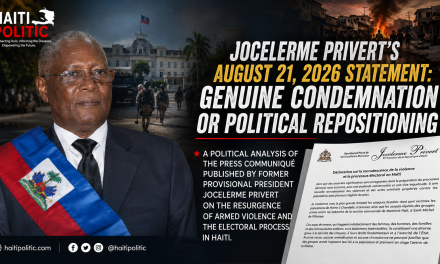
Jocelerme Privert is almost the opposite of the celebrity politician.
There is no entertainment career.
No “outsider” narrative.
No global corporate empire.
No revolutionary persona.
His career was built largely inside the machinery of the Haitian state.
Privert entered the Direction Générale des Impôts (DGI) in 1979 as an accounting inspector and spent more than two decades in public administration. He eventually became Director-General of the DGI, served as Secretary of State for Finance, Minister of Economy and Finance, Minister of the Interior, senator for Nippes and president of the Senate.
Then, in February 2016, Haiti gave him perhaps the most difficult assignment of his career:
Prevent a political vacuum from becoming a national rupture.
That experience creates an unusual question today:
Could Haiti’s future require less political theater—and more institutional competence?
Or does Privert represent precisely the bureaucratic and political establishment that Haiti needs to move beyond?
This is not an endorsement.
It is not an attack.
It is an examination of the record.
🇭🇹 WHO IS JOCELERME PRIVERT?
Privert’s career began with taxation, accounting and public finance.
He joined the DGI in 1979 and worked his way through the institution before becoming its Director-General in 1995.
His expertise in Haitian taxation became sufficiently established that he participated in IMF public-finance training in Washington in 1992. He later wrote extensively about taxation, including the Guide du contribuable haïtien.
That background matters.
Haiti’s inability to finance itself remains one of the country’s most important sovereignty problems.
A government that cannot collect revenue cannot independently finance:
👮🏾 police;
⚖️ courts;
🏫 schools;
🏥 hospitals;
🚧 roads;
🛃 borders;
🗳️ elections;
or diplomacy.
And when the Haitian state cannot finance those things?
Foreign governments and international organizations inevitably gain leverage.
Privert therefore offers an interesting proposition:
Perhaps Haitian sovereignty begins not at the United Nations—
but at the tax office.
🏛️ FROM TAX ADMINISTRATOR TO POLITICAL POWER
Privert did not remain a technician.
He entered increasingly powerful political positions under governments associated with Jean-Bertrand Aristide and René Préval.
He served as Secretary of State for Finance, Minister of Economy and Finance and later Minister of the Interior and Territorial Communities.
After returning to political life, he was elected senator for Nippes and became an influential member of the Senate, including chairing its Economy and Finance Committee.
In January 2016, he became President of the Senate.
One month later, Haiti’s political system nearly ran out of road.
🚨 FEBRUARY 2016: HAITI WITHOUT AN ELECTED SUCCESSOR
Michel Martelly’s constitutional term ended on February 7, 2016.
But Haiti had no elected president ready to replace him.
The 2015 presidential election had become engulfed in allegations of irregularities, demonstrations and political conflict.
A February 5 political accord attempted to prevent a complete institutional vacuum.
Parliament subsequently elected Privert provisional president on February 14, 2016.
His mission was narrow.
Finish the electoral transition.
And do it quickly.
His provisional mandate was designed around approximately 120 days.
That deadline would become the most controversial part of his presidency.
⏱️ TEST #1 — THE 120-DAY QUESTION
June 14, 2016 arrived.
Privert’s 120-day mandate expired.
But the electoral transition was unfinished.
And Parliament failed to settle whether his mandate should formally be extended or whether another arrangement should replace him.
Privert remained at the presidency.
His opponents called his continued tenure illegitimate.
Some accused him of attempting to manipulate the transition to benefit political factions opposed to PHTK.
Supporters countered that removing him without an agreed successor would have created yet another institutional vacuum.
This creates perhaps the hardest constitutional question in Privert’s record:
WHAT SHOULD HE HAVE DONE ON JUNE 14?
Walk out?
Remain until Parliament acted?
Transfer power to another institution?
Call another political accord?
The Haitian Constitution did not provide an elegant answer to the situation the political system had created.
So President Privert should answer:
What was the exact legal basis for remaining in office?
Which constitutional provisions?
Which parliamentary resolutions?
Which legal opinions?
Which provisions of the February agreement?
And perhaps most importantly:
If another provisional president did exactly what you did today, would you consider it constitutional?
That is the real test.
⚖️ STABILITY VERSUS LEGALITY
Privert’s experience illustrates one of Haiti’s recurring political dilemmas.
The country repeatedly reaches situations where political leaders say:
Institutions aren’t functioning, therefore exceptional action is necessary.
Sometimes that argument prevents catastrophe.
But every exception creates a precedent.
And eventually Haiti accumulates so many exceptions that constitutional government itself becomes exceptional.
Privert should therefore explain what constitutional firewall he would build today so Haiti never again faces an undefined provisional presidency.
🗳️ TEST #2 — THE 2015 ELECTION
Privert inherited a presidential election that had lost substantial public confidence.
Instead of simply completing the previously planned runoff, a new electoral verification process reviewed the contested election.
The electoral authorities ultimately abandoned the previous presidential results and organized a new presidential vote.
That decision was extremely controversial.
Supporters argued that credible elections required confronting serious irregularities.
Opponents argued that Privert’s government was effectively overturning an election because its preferred political forces had lost.
That is exactly why Privert should answer:
What evidence justified starting over?
Release the methodology.
Release the verification criteria.
Explain which irregularities were decisive.
Explain why they were serious enough to invalidate the process rather than simply correct individual polling stations.
Because electoral sovereignty requires something more than rejecting foreign pressure.
It requires Haitians to trust Haitian electoral institutions.
🇺🇸 THEN WASHINGTON PUSHED BACK
The United States disagreed with financing another two rounds of presidential voting.
On July 1, 2016, Washington notified Haitian authorities that it was suspending assistance for completion of the presidential electoral process.
The State Department said the United States had already provided more than $30 million for the 2015 electoral cycle and had not budgeted for the additional rounds required by the revised calendar.
That created an extraordinary moment.
Haiti needed an election.
A major foreign donor said:
We aren’t paying for these additional rounds.
The Haitian government proceeded anyway.
💰 TEST #3 — ELECTORAL FINANCIAL SOVEREIGNTY
This may be one of the most interesting elements of Privert’s record.
His administration operated for months without some forms of direct international financial support.
Privert later said his government responded through austerity measures including:
cash management between the Finance Ministry and Central Bank;
more restrictive management of government resources;
and
freezing or eliminating nonessential expenditures.
This deserves much greater examination.
Because Haiti frequently says:
“We want sovereignty.”
But sovereignty has a price.
If Haiti wants elections without Washington paying—
Haiti must collect taxes.
If Haiti wants police without foreign governments paying—
Haiti must collect taxes.
If Haiti wants courts without international donors—
Haiti must collect taxes.
If Haiti wants infrastructure without aid dependency—
Haiti must mobilize domestic capital.
So Privert should publish a case study:
How exactly did Haiti finance the additional electoral process?
Which budget lines were cut?
Which expenditures were delayed?
How much came from domestic revenue?
How much came from previously committed international resources?
How much did the entire election ultimately cost?
And:
Could Haiti finance every future national election primarily from a permanent domestic electoral fund?
That would be genuine institutional sovereignty.
🗳️ AND THE ELECTION ACTUALLY HAPPENED
After Hurricane Matthew forced another delay, Haiti held its presidential election on November 20, 2016.
Jovenel Moïse won in the first round.
And on February 7, 2017, something politically important happened:
Jocelerme Privert handed over power.
Moïse himself publicly thanked Privert and other authorities for the work that brought the electoral process to completion.
Whatever one thinks of the legitimacy controversy surrounding Privert’s extended interim tenure, the ending matters.
There was no attempt to prevent the opposition candidate from taking office.
There was no Privert candidate installed instead.
The PHTK candidate won.
Privert left.
In Haitian political history, peaceful transfer itself deserves examination.
📊 BUT WAS THE 2016 ELECTION REALLY A MODEL?
Not entirely.
Turnout was extremely low.
Political distrust remained high.
Haiti’s electoral institutions remained dependent on temporary arrangements.
The Permanent Electoral Council envisioned by the Constitution still had not become the stable institution Haiti needed.
Even U.S. assistance programs at the time were discussing how to create an autonomous CEP requiring minimal international support.
So Privert’s achievement was tactical:
He completed an election.
The strategic challenge remains:
How does Haiti build an electoral institution that survives presidents?
💵 TEST #4 — THE TAXMAN’S BIGGEST QUESTION
This may be the most important economic question for Privert.
He knows Haiti’s tax system better than almost any major political figure.
He spent decades inside it.
He wrote about it.
He still publicly analyzes tax reform; in 2024, for example, he criticized Haiti’s new fiscal code as a rearrangement that corrected anomalies without constituting fundamental tax reform.
So he cannot answer with generalities.
Why is Haiti still unable to collect enough revenue?
Why does the burden fall disproportionately on easy-to-tax formal businesses and consumers?
Why does customs leakage persist?
Why do politically connected businesses receive exemptions?
Why is property taxation so weak?
Why are municipal governments financially starved?
Why does informality remain enormous?
And most importantly:
Why didn’t decades of tax expertise produce a structurally different Haitian tax state?
That is a fair question.
Expertise must eventually produce results.
🏦 TAX REFORM OR ELITE CONFRONTATION?
Tax administration is not primarily an accounting problem.
It is a power problem.
Imagine a government discovers that an extremely influential importer owes millions in taxes.
Does the DGI collect?
What if that businessman finances political parties?
What if the company controls jobs?
What if powerful officials intervene?
What if customs exemptions have political protection?
This is where Privert’s technocratic reputation must face political reality.
Would President Privert publish every major tax exemption?
Would Haiti establish a public beneficial-ownership registry?
Would large tax settlements become public?
Would customs declarations become digital?
Would property ownership be connected to tax identification numbers?
Would politically connected tax debtors be prosecuted?
Would ministers lose the ability to negotiate special arrangements?
Those answers tell us whether a tax expert can become a reformer.
⚖️ TEST #5 — LA SCIERIE
Privert’s biography contains another controversial chapter.
After the 2004 overthrow of President Aristide, Privert was arrested in connection with allegations surrounding violence at La Scierie in Saint-Marc.
He spent more than two years in detention before being released.
The episode became deeply politicized.
Supporters characterized Privert as a political prisoner targeted because of his association with the Aristide government.
Critics and human-rights advocates treated the allegations much more seriously.
Because accounts of the case’s legal disposition differ, it should not be reduced to either:
“Privert was guilty”
or
“Privert was completely exonerated.”
The more useful question is what he learned from detention.
🔒 PRESIDENT PRIVERT: WHAT DID PRISON TEACH YOU ABOUT THE HAITIAN JUSTICE SYSTEM?
What happens when someone spends years detained without a timely trial?
Should pretrial detention have strict statutory limits?
Should judges receive stronger tenure protections?
Should prosecutors be independent from the executive?
Should politically sensitive prosecutions receive independent review?
Should Haiti create compensation for unlawful prolonged detention?
Would you support those protections for:
your political enemies?
That last part matters.
Every politician supports judicial independence when he is the defendant.
The test comes when his opponent is the defendant.
🌪️ THEN CAME HURRICANE MATTHEW
On October 4, 2016, Hurricane Matthew struck Haiti.
The Category 4 storm devastated the southern peninsula.
Grand’Anse and Sud suffered catastrophic destruction.
Homes disappeared.
Agriculture was destroyed.
Infrastructure collapsed.
Hundreds of thousands of people required assistance.
And Haiti suddenly faced two national emergencies simultaneously:
an unfinished presidential transition;
and
a major humanitarian disaster.
Reuters reported shortly afterward that Privert said Haiti was initially financing much of its own response while promised international assistance was still materializing.
This is an important part of his record.
🚨 TEST #6 — DID HAITI ACTUALLY CONTROL HURRICANE AID?
The premise deserves careful scrutiny.
It is tempting to say Privert solved the NGO-accountability problem by forcing all aid through the Haitian state.
The evidence is more complicated.
International humanitarian organizations—including the Red Cross—continued major independent relief operations. In January 2017, Privert himself publicly recognized the Red Cross/Red Crescent network for its Hurricane Matthew response.
So the question should not be built around a claim that all assistance passed through Haitian institutions.
Instead ask:
How much did?
How much humanitarian assistance entered Haiti?
How much went directly through ministries?
How much through UN agencies?
How much through NGOs?
How much reached municipalities?
How much reached farmers?
How much became administrative overhead?
And how much can be traced today?
If Privert wants to offer a model for humanitarian sovereignty:
Show the accounting.
🌾 THE MATTHEW AGRICULTURE TEST
The hurricane devastated rural livelihoods.
Reuters reported that farmers in Haiti’s southwest were among the hardest hit.
So another question follows:
What percentage of reconstruction spending went to:
🌱 seeds?
🐄 livestock replacement?
🚜 agricultural equipment?
💧 irrigation?
🛣️ rural roads?
🏪 local markets?
🏦 agricultural credit?
🏠 resilient housing?
Haiti repeatedly rebuilds physical structures after disasters.
The deeper challenge is rebuilding local productive capacity.
🌎 TEST #7 — WHAT IS THE PRIVERT FOREIGN-POLICY DOCTRINE?
Here the record becomes interesting.
Privert was not primarily a foreign-policy president.
His mandate was transitional.
But he still represented Haiti internationally.
At the 2016 Association of Caribbean States summit in Havana, Privert emphasized Caribbean cooperation, sustainable development, transportation links and regional solidarity.
He met Cuban President Raúl Castro, with the two governments discussing Cuba’s longstanding cooperation with Haiti.
He also met Dominican President Danilo Medina, and both governments agreed to advance their bilateral agenda.
At the United Nations, Privert supported multilateral cooperation while also explicitly encouraging greater international participation for Taiwan, Haiti’s diplomatic partner.
Those are pieces of a foreign policy.
But they are not yet a doctrine.
🇭🇹 COULD FISCAL SOVEREIGNTY BECOME FOREIGN-POLICY SOVEREIGNTY?
This is where Privert could offer something genuinely different.
Haiti frequently debates sovereignty as if sovereignty were primarily rhetorical.
Foreign troops.
The Core Group.
Washington.
Ottawa.
Paris.
The UN.
But another kind of dependency receives less attention:
Financial dependency.
If foreign governments finance elections, they gain leverage over electoral policy.
If donors finance the police, they gain leverage over security policy.
If international institutions finance the budget, they gain leverage over fiscal policy.
If NGOs provide basic services the government cannot provide, they gain practical authority inside Haitian territory.
So perhaps the Privert doctrine should begin with a simple principle:
THE STATE THAT PAYS ITS OWN BILLS NEGOTIATES FROM A STRONGER POSITION.
That would turn his tax expertise into foreign policy.
🇺🇸 THE WASHINGTON QUESTION
Privert experienced direct disagreement with Washington over the electoral process.
The United States stopped financing completion of the presidential election.
His government proceeded.
That gives him experience few Haitian leaders possess:
saying no to a major donor and continuing the policy.
But the next question is harder.
How does Haiti disagree with Washington without destroying the relationship?
Would a Privert administration cooperate with the United States on:
security?
weapons trafficking?
narcotics?
migration?
customs?
intelligence?
trade?
Yes?
Then where are Haiti’s red lines?
A serious sovereignty doctrine is neither obedience nor hostility.
It is negotiated interdependence.
🇩🇴 THE DOMINICAN QUESTION
Privert met Dominican President Danilo Medina during his provisional presidency and agreed to advance the bilateral agenda.
But today’s challenges are even greater.
Migration.
Mass deportations.
Border security.
Weapons trafficking.
Agricultural trade.
Customs leakage.
Water.
Cross-border markets.
Haitian labor.
So:
What permanent Haitian-Dominican institution would Privert build?
A standing presidential commission?
Integrated customs intelligence?
Formal border markets?
Migration protocols?
Joint anti-trafficking operations?
Water commissions?
Commercial arbitration?
Haiti cannot manage its most important bilateral relationship through crisis diplomacy.
🇨🇺 THE CUBA QUESTION
Cuba has provided Haiti with significant cooperation, particularly in health and education.
Privert publicly valued that relationship during his presidency.
Could Haiti expand the relationship into:
medical training?
agricultural research?
disaster preparedness?
public-health surveillance?
technical education?
Or should Haiti diversify further?
The broader question is whether Haiti can build partnerships based on specific national objectives rather than ideological alignment.
🌎 CARICOM: UNDERUSED HAITIAN POWER?
Privert emphasized Caribbean regional integration.
That deserves attention.
Haiti often focuses so heavily on Washington, Ottawa and Paris that it underuses its own Caribbean identity.
A stronger CARICOM strategy could include:
regional food security;
maritime transportation;
university exchanges;
disaster response;
energy cooperation;
joint diplomatic positions;
Caribbean tourism circuits;
and regional security intelligence.
Privert’s 2016 Caribbean diplomacy suggests he understood this potential.
But what would he actually build today?
🧠 TEST #8 — TECHNOCRAT OR POLITICAL OPERATOR?
This is perhaps the biggest contradiction in Privert’s profile.
Supporters see:
a careful administrator;
a tax expert;
a negotiator;
a legislator;
a crisis manager;
someone capable of navigating Haiti’s institutions.
Critics see:
an extraordinarily experienced political insider.
Someone who knows how Haiti’s political machinery operates precisely because he spent decades inside it.
Both interpretations may contain truth.
So ask:
DOES HAITI NEED SOMEONE WHO KNOWS THE SYSTEM—OR SOMEONE WILLING TO BREAK WITH IT?
Privert’s answer cannot simply be:
“Experience.”
Experience is useful only if it produces reform.
📊 THE JOCELERME PRIVERT TEST
| AREA | DOCUMENTED EXPERIENCE | QUESTION HAITIANS SHOULD ASK |
|---|---|---|
| Public finance | Decades at DGI and senior finance positions | Why does Haiti’s tax system remain structurally weak? |
| Fiscal expertise | Tax specialist and author | Can technical knowledge overcome politically protected tax evasion? |
| Legislature | Senator for Nippes and Senate President | Does parliamentary experience represent institutional competence or establishment politics? |
| Transition management | Interim president during the 2016 constitutional crisis | Was remaining beyond 120 days necessary continuity or constitutional overreach? |
| Elections | Oversaw completion of the 2016 presidential process | Can Haiti permanently finance and administer credible elections itself? |
| Political transfer | Handed power to Jovenel Moïse in February 2017 | Can peaceful transfer become institutional rather than exceptional? |
| Crisis management | Governed during Hurricane Matthew | How much relief actually passed through accountable Haitian institutions? |
| Justice | Experienced prolonged detention after 2004 | What reforms would he implement to prevent politicized or indefinite detention? |
| Foreign policy | Engaged Cuba, CARICOM, Dominican Republic, UN and other partners | What is the coherent doctrine connecting those relationships? |
| Sovereignty | Government continued electoral process despite U.S. funding withdrawal | Can Haiti turn fiscal self-reliance into diplomatic leverage? |
⚖️ THE ARGUMENT HIS SUPPORTERS WILL MAKE
Privert’s supporters can make a serious case.
He understands the Haitian state.
Not theoretically.
Operationally.
Taxes.
Budgets.
Ministries.
Parliament.
Political negotiations.
Electoral administration.
Disaster response.
International diplomacy.
He inherited a country without an elected presidential successor and eventually transferred power peacefully to one.
He managed an electoral confrontation with foreign donors without simply abandoning the process.
He governed through Hurricane Matthew.
And he left office without attempting to convert a provisional presidency into a permanent one.
In a country suffering from institutional collapse, supporters may argue:
Perhaps competence is revolutionary enough.
🚨 THE ARGUMENT HIS CRITICS WILL MAKE
Critics can make an equally serious argument.
Privert is not outside Haiti’s old system.
He is a product of it.
His public career stretches back decades.
He served governments associated with Aristide and Préval.
He became an influential senator.
His provisional mandate expired long before he actually left the presidency.
His decision to revisit the 2015 election was fiercely contested.
And despite his extraordinary knowledge of taxation and public finance, Haiti never achieved the fiscal transformation his expertise would seem to promise.
So critics may ask:
If Jocelerme Privert knows the state better than almost anyone, why is the state still so weak?
That question deserves an answer.
🔥 25 QUESTIONS JOCELERME PRIVERT SHOULD ANSWER
1. What was the precise legal basis for remaining president after June 14, 2016?
2. Would you support another provisional president doing the same thing today?
3. What constitutional amendment would prevent another undefined presidential transition?
4. What evidence justified abandoning the contested 2015 presidential results?
5. Would you publish the complete verification methodology today?
6. How much did the additional 2016 presidential electoral process actually cost?
7. How much was financed directly from Haitian public resources?
8. Which expenditures were cut or frozen to finance the transition?
9. Should Haiti establish a permanent sovereign election fund?
10. Why does the Haitian government still collect so little domestic revenue despite decades of tax-reform efforts?
11. Would you publish every corporate tax exemption?
12. Would you digitize customs and DGI records?
13. Would you establish a public beneficial-ownership registry?
14. Would politically connected businesses receive exactly the same tax enforcement as everyone else?
15. What did your detention after 2004 teach you about Haitian justice?
16. Would you impose strict limits on pretrial detention?
17. How much Hurricane Matthew assistance passed directly through Haitian state institutions?
18. How much reached municipalities?
19. What percentage went directly toward restoring agricultural production?
20. What should Haiti’s foreign-policy doctrine toward Washington be?
21. How should Haiti restructure relations with the Dominican Republic?
22. Should CARICOM become more important to Haitian diplomacy?
23. How should Haiti use relations with Cuba, Taiwan and other partners without becoming dependent on any one bloc?
24. What three reforms would you implement that you were unable to implement during your decades inside government?
And finally:
25. ARE YOU THE MAN WHO KNOWS HOW TO REFORM HAITI’S SYSTEM—OR THE MAN WHO KNOWS HOW TO SURVIVE INSIDE IT?
🇭🇹 THE CENTRAL QUESTION
Jocelerme Privert presents Haitians with a very different leadership test.
He does not need to prove that he understands government.
His résumé already establishes that.
He understands taxation.
He understands public finance.
He understands Parliament.
He understands executive government.
He understands political negotiation.
He understands transition.
And he has experienced both the power of the state and detention by the state.
The harder question is what all that knowledge produces.
Does Haiti need another disruptive outsider?
Or, after years of institutional collapse, does it need someone who understands exactly how the machinery is supposed to work?
But there is a warning.
EXPERIENCE IS NOT REFORM.
Knowing every corridor of government does not automatically mean you can rebuild government.
Knowing tax law does not automatically mean you can confront tax evasion.
Knowing Parliament does not automatically mean you can eliminate patronage.
Knowing political compromise does not automatically mean you can restore constitutional authority.
And maintaining stability does not automatically mean you have transformed the country.
So the defining question for Privert is not:
CAN JOCELERME PRIVERT MANAGE THE HAITIAN STATE?
He already has.
The defining question is:
CAN HE CHANGE THE HAITIAN STATE HE SPENT DECADES LEARNING TO MANAGE?
And there is one foreign-policy lesson from his brief presidency worth debating.
Haiti’s diplomatic weakness may begin with its fiscal weakness.
A country dependent on outsiders to finance its elections, security, hospitals and infrastructure will always negotiate from a weaker position.
So perhaps the most provocative Privert proposition is also the simplest:
NATIONAL SOVEREIGNTY REQUIRES FINANCIAL SOVEREIGNTY.
But if that is the doctrine—
show Haitians the tax plan.
show them the election fund.
show them the customs reform.
show them the anti-corruption safeguards.
show them the constitutional limits.
show them the foreign-policy strategy.
Then let the Haitian people decide whether Jocelerme Privert represents institutional memory Haiti needs—or a political system Haiti needs to leave behind.
🇭🇹 Pa sèlman mande si li konnen Leta.
Mande si li kapab chanje Leta.
Pa sèlman mande si Ayiti kapab di peyi etranje “non.”
Mande si Ayiti kapab peye pwòp bòdwo li apre li fin di “non.”
🇭🇹 LET THE HAITIAN PEOPLE DECIDE.
HAITI POLITIC — Investigation. Accountability. Debate.