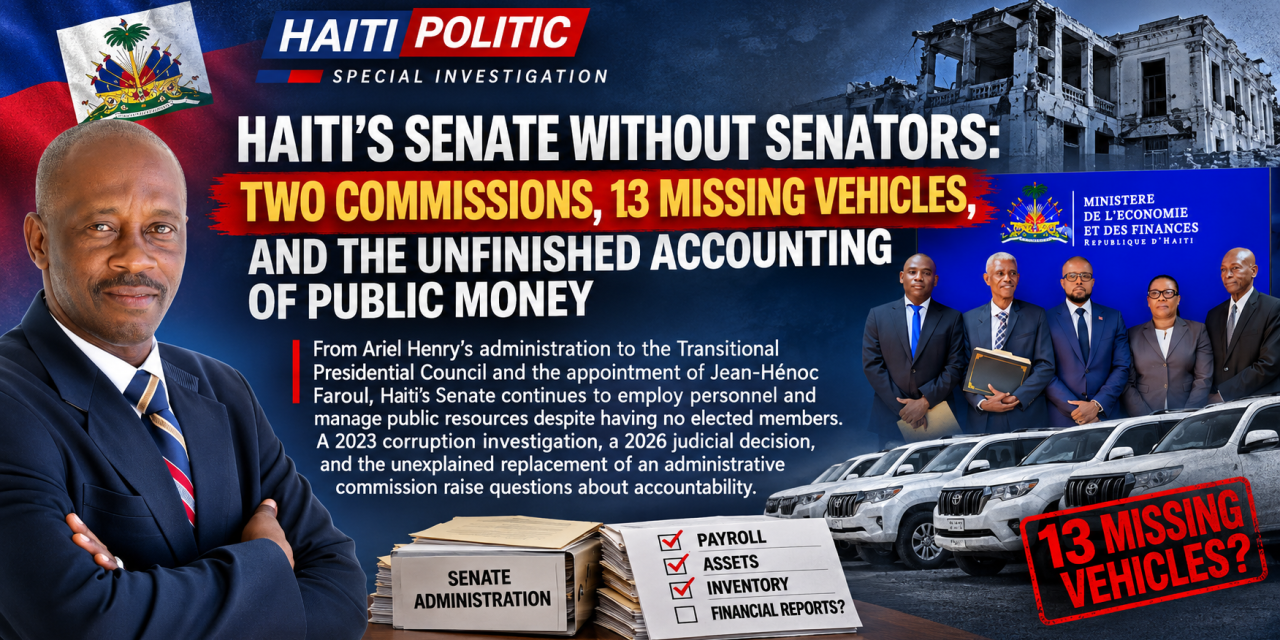
From Ariel Henry’s administration to the Transitional Presidential Council and the appointment of Jean-Hénoc Faroul, Haiti’s Senate continues to employ personnel and manage public resources despite having no elected members. A 2023 corruption investigation, a 2026 judicial decision, and the unexplained replacement of an administrative commission raise questions about accountability.
HAITI POLITIC | SPECIAL INVESTIGATION
November 16, 2026
A Senate Without Senators — But Not Without Public Money
Haiti’s Senate has not had a single elected member since January 9, 2023.
All 30 seats remain vacant. The Chamber of Deputies has also been without elected representatives since January 2020.
For nearly four years, Haiti has operated without a functioning national legislature.
Yet the Senate continues to exist administratively.
It retains personnel, financial responsibilities, government-assigned assets, records, and an institutional budget.
On November 16, 2026, Finance Minister Serge Gabriel Collin officially installed another three-member commission to manage the Senate’s administrative services and personnel.
The new commission consists of Jean-Hénoc Faroul, president; Nelia Lubin, vice president; and Anthony Jean-François, member.
According to the Ministry of Economy and Finance, the commission was appointed through an arrêté dated October 5, 2026.
Its responsibilities include managing personnel, maintaining administrative services, and safeguarding the Senate’s resources, property, and archives.
But the announcement leaves a fundamental question unanswered:
Why does Haiti need another administrative commission when a previous commission was appointed less than two years ago to perform substantially similar duties?
And what happened to the previous commission’s financial reports, asset inventories, and administrative findings?
Those questions become more significant when examined alongside the Senate’s history of disputed public expenditures and the investigation into government vehicles that were not returned after senators left office.
1. January 2023: The Senators Leave, but the Administration Remains
The departure of Haiti’s last ten senators in January 2023 created an unusual institutional situation.
The Senate no longer had elected officials capable of exercising legislative authority or providing ordinary parliamentary oversight.
Nevertheless, its administrative structure did not disappear.
Government employees continued to be associated with the institution. Public property remained assigned to its services. Financial and administrative responsibilities continued.
The Senate’s former parliamentary headquarters had been destroyed during the January 12, 2010 earthquake, forcing legislative operations into alternative facilities.
The destruction of the building did not eliminate the institution’s administrative obligations.
A government institution does not need to own a permanent building to possess public assets. Vehicles, furniture, computers, equipment, archives, and financial resources can remain under its administrative control.
However, the absence of elected senators raises questions about who was authorized to manage those resources.
Who approved expenditures? Who controlled the payroll? Who supervised administrative employees? Who was responsible for recovering vehicles assigned to former senators?
These questions became particularly important during the administration of Prime Minister Ariel Henry.
The Ariel Henry Period: January 2023–April 2024
When the final senators departed in January 2023, Ariel Henry was Haiti’s prime minister.
His government continued exercising executive authority without a functioning Parliament.
However, the available records do not establish that Henry personally managed the Senate’s administrative affairs.
Nor have we identified an official appointment order demonstrating that his government created a special Senate management commission equivalent to the one installed in December 2024.
The distinction is important.
The executive government may have exercised responsibilities concerning public expenditures while Senate administrators continued handling internal operations.
The unanswered question is who possessed formal financial and administrative authority over the Senate during this period.
Identifying those officials is necessary before assigning responsibility for particular expenditures or missing assets.
2. The 2023 ULCC Investigation: Thirteen Senate Vehicles Unaccounted For
One of the most consequential developments occurred in November 2023.
Haiti’s Anti-Corruption Unit, the Unité de Lutte Contre la Corruption (ULCC), investigated the management and restitution of vehicles assigned to former senators.
According to the findings reported from the investigation, 33 vehicles had been placed at the disposal of Haiti’s last ten senators.
Only 20 had reportedly been recovered.
Thirteen vehicles remained unreturned at the time of the investigation.
The ULCC findings attributed the outstanding vehicles as follows:
| Former senator | Vehicles identified in the 2023 investigation |
|---|---|
| Gracia Delva | 5 |
| Joseph Lambert | 4 |
| Wanique Pierre | 3 |
| Richard Lénine Hervé Fourcand | 1 |
| Total | 13 |
These figures reflect the investigation’s findings in 2023. They do not establish that all thirteen vehicles remain missing today.
The allegations led to judicial proceedings involving former senators and Senate administrative officials.
The investigation also raised questions about internal controls.
How were vehicles assigned to elected officials? Who maintained the inventory? What procedures governed their return? Were formal recovery notices issued?
And what happened when the senators’ mandates expired?
The distinction between possession and ownership is fundamental.
Government vehicles assigned to parliamentarians for official use do not automatically become their personal property when their mandates end.
The state therefore has an obligation to account for those vehicles, regardless of whether criminal responsibility can be established against a particular individual.
The ULCC investigation made the Senate’s administrative weaknesses a matter of public concern.
But another development followed.
In December 2024, the government appointed a commission specifically responsible for managing the Senate’s administration and safeguarding its resources.
3. December 2024: The Transitional Presidential Council Creates a Management Commission
On December 26, 2024, Finance Minister Alfred Fils Metellus installed a three-member administrative commission.
The commission consisted of:
Graduel Francisque — President
Willy Dupervil — Vice President
Julio-Fils Cham — Member
The ceremony took place at the Ministry of Economy and Finance.
Edgard Leblanc Fils, a member of Haiti’s Transitional Presidential Council, participated and presented the appointment documents to the commissioners.
Leblanc had previously served as the CPT’s first rotating president, from April to October 2024.
By December, Leslie Voltaire had assumed that rotating presidency.
Therefore, the commission was established under the CPT administration, but its creation should not automatically be attributed to Leblanc acting alone.
The government described the commission as an administrative solution necessitated by the absence of elected senators and the resulting institutional difficulties.
Its mission was to manage the Senate’s administrative services and personnel pending the return of elected senators.
At the time, the commission was presented as a temporary arrangement.
Yet less than two years later, another commission would replace it.
Why?
The available appointment announcements do not provide a complete explanation.
4. Graduel Francisque’s Installation Speech Reveals an Important Financial Assignment
Haiti Politic examined a recording of Graduel Francisque’s December 2024 installation speech.
His remarks provide insight into the commission’s original objectives.
Francisque described a long professional history within the Senate.
He stated that he entered the institution in 2004 as an accountant and eventually became its administrative and financial director.
This matters because Francisque was not an unfamiliar outsider brought into the institution.
He had worked within its financial administration for approximately two decades.
His appointment therefore placed an experienced Senate administrator at the head of the new commission.
But the most important part of his speech concerned the work he intended to undertake.
Francisque identified an inventory of Senate assets and an assessment of the previous administration’s financial records among his priorities.
He also emphasized transparent resource management, administrative continuity, and cooperation with other state institutions.
Which Previous Administration?
Francisque’s reference to the previous administration deserves examination.
Was he referring to the Senate’s last elected leadership under Joseph Lambert?
Was he referring to the administrative arrangements that continued after January 2023?
Did the financial review include expenditures authorized during Ariel Henry’s government?
Or did it cover several successive periods?
The speech does not identify a particular government or official.
It would therefore be inaccurate to conclude that Francisque specifically accused Ariel Henry’s administration of financial misconduct.
Nevertheless, his remarks establish that reviewing prior financial management was a stated priority when the commission took office.
That creates a measurable accountability obligation.
Did the commission complete the inventory? Did it prepare the financial assessment? Were its findings submitted to the Ministry of Economy and Finance?
And if those reports exist, why have they not been made readily available to the public?
5. The Senate’s Administrative Workforce: A Major Budgetary Question
The Senate’s continued administrative operations raise another important issue: public payroll expenditures.
Haiti’s 2026–2027 national budget includes personnel information for the institution.
The figures previously identified in the budget indicate approximately 1,388 Senate employees, with a reported payroll amount of approximately 69.8 million gourdes in the personnel data.
These figures require careful interpretation. The relevant budget tables and payroll reporting periods must be examined before calculating annual costs or determining how many employees were actively performing duties.
Nevertheless, the existence of a substantial administrative workforce in an institution without elected senators deserves scrutiny.
What services are these employees providing?
How many are assigned to administrative operations, accounting, archives, maintenance, security, and other essential functions?
How many positions existed before the last senators departed?
Have staffing levels changed since January 2023?
And what mechanisms verify attendance, payroll eligibility, and actual work performed?
The absence of elected senators does not automatically make Senate employees unnecessary.
Institutions may require personnel to preserve records, protect public assets, process administrative obligations, and prepare for the restoration of legislative operations.
But maintaining those services requires transparent budgeting and oversight.
The public has a legitimate interest in knowing what it receives in exchange for continued Senate administrative expenditures.
6. October 2026: A Judicial Decision Changes the Vehicle Investigation
The investigation into the Senate’s missing vehicles reached another important stage in October 2026.
According to published accounts of an October 9 judicial order, investigating judge Mathieu Chanlatte referred former senator Wanique Pierre and former Senate chief accountant Alexandre Joseph to criminal court.
The case concerns alleged misappropriation of public property connected to the non-return of Senate vehicles.
The referral is not a conviction.
Both individuals retain the presumption of innocence and the legal rights available to them.
Gracia Delva, Joseph Lambert, and Hervé Fourcand
The same judicial decision reportedly granted non-lieu decisions to former senators:
Gracia Delva
Joseph Lambert
Richard Lénine Hervé Fourcand
A non-lieu means that the investigating judge did not find sufficient grounds to send the individual to criminal trial in that proceeding.
It is not equivalent to a conviction, and it should not be represented as one.
The decision also reportedly covered several former Senate administrative officials.
Importantly, published accounts identify Francisque Gérald Graduel among those receiving a non-lieu.
That name appears to correspond to Graduel Francisque, the president of the commission installed in December 2024.
However, the original judicial order and identity records should be examined before treating that identification as conclusively established.
A Critical Distinction
The judicial decision concerns the criminal responsibility of particular individuals.
It does not necessarily answer the administrative question of what happened to every vehicle identified in the 2023 investigation.
A former senator may receive a non-lieu because the evidence is insufficient to support prosecution.
That does not automatically establish whether a particular government vehicle was recovered, transferred, reassigned, lost, or remains unaccounted for.
Criminal accountability and public asset accounting are related but separate responsibilities.
The state must still maintain accurate inventories of its property.
That obligation remains regardless of the outcome of individual criminal proceedings.
7. Wanique Pierre: The Remaining Criminal Proceedings
The case involving Wanique Pierre is particularly relevant because he is also reported to be seeking a return to the Senate through the DEBLOKE political organization.
According to reporting on the October 2026 judicial order, Pierre and Alexandre Joseph were referred to criminal court because the investigating judge considered the evidence sufficient to justify further proceedings.
A government vehicle associated with Pierre was reportedly deposited at the Ouanaminthe police station in February 2024.
That reported return raises additional questions about the vehicle inventory.
Was the vehicle formally transferred back to the Senate?
Was its condition documented?
Was it one of the three vehicles attributed to Pierre in the original ULCC investigation?
And what happened to the other vehicles?
These questions require official records rather than assumptions.
The judicial referral does not establish Pierre’s guilt.
Likewise, a political candidacy does not erase pending judicial questions.
His reported registration as a DEBLOKE candidate should also be distinguished from final approval by Haiti’s Provisional Electoral Council.
Candidate registration is not the same as final electoral qualification.
The court proceedings and the electoral process must be evaluated according to their respective legal standards.
8. November 2026: Jean-Hénoc Faroul Replaces Graduel Francisque
On November 16, 2026, Finance Minister Serge Gabriel Collin installed the new Senate administrative commission.
Its members are:
| Position | December 2024 commission | November 2026 commission |
|---|---|---|
| President | Graduel Francisque | Jean-Hénoc Faroul |
| Vice President | Willy Dupervil | Nelia Lubin |
| Member | Julio-Fils Cham | Anthony Jean-François |
The government describes the new commission’s responsibilities as strictly administrative.
They include maintaining administrative services, managing personnel, and safeguarding institutional resources and archives.
But those responsibilities substantially resemble the mandate assigned to the Francisque commission.
The government has not provided a sufficiently detailed public explanation of why the earlier commission was replaced before elected senators returned.
Was the Previous Commission’s Mandate Terminated?
Several possibilities exist.
The government may have decided to reorganize the Senate’s administration.
It may have sought different leadership or administrative expertise.
There may have been internal disagreements, personnel issues, or concerns about administrative performance.
But these remain possibilities, not established explanations.
Without the appointment orders, revocation documents, and official administrative reports, Haiti Politic cannot responsibly identify the government’s actual motivation.
The October 5, 2026 arrêté is therefore essential.
So is the legal instrument that originally established the December 2024 commission.
The two documents should be compared to determine whether the new commission has the same authority, expanded responsibilities, or different financial controls.
9. Senate Employees Object to the New Commission
The October 2026 appointments generated objections from Senate employees.
During an October 16 press conference, employee spokesperson Wesly Hector criticized the selection of individuals reportedly coming from outside the institution.
According to published reporting, the objections specifically concerned Jean-Hénoc Faroul and Anthony Jean-François.
Employees argued that experienced Senate administrators should be entrusted with managing the institution.
Their position raises questions about selection criteria and institutional continuity.
Faroul’s reported professional background includes law, journalism, electoral administration, and work involving international organizations.
Those experiences may be relevant to public administration.
However, the government should explain the qualifications required for managing Senate personnel, financial records, and public assets.
The same standard should apply to Nelia Lubin and Anthony Jean-François.
Nelia Lubin’s possible previous service in municipal government also warrants verification, including the municipality involved, dates of service, and whether she exercised responsibility for public funds.
At present, that possible mayoral background should not be presented as confirmed.
The larger question is institutional:
How were the commissioners selected, and what safeguards ensure that their decisions are based on administrative responsibilities rather than political considerations?
10. The Unanswered Question: What Happened to Francisque’s Reports?
The transition between the two commissions creates a significant opportunity to examine administrative accountability.
In December 2024, Francisque announced plans to inventory Senate property and assess previous financial management.
In November 2026, the new commission was again instructed to undertake an administrative and financial assessment.
Why was another assessment necessary?
A new commission may reasonably conduct its own review when taking office.
That is a normal administrative practice.
But a proper transition should also involve the transfer of records, inventories, financial statements, personnel files, and outstanding obligations.
The public should be able to determine whether Francisque’s commission completed its assignments.
The key records include:
The initial asset inventory prepared after December 2024.
The assessment of the preceding administration’s finances.
Quarterly activity reports submitted during the commission’s tenure.
The final administrative and financial handover report.
Any unresolved asset recovery cases transferred to the Faroul commission.
Without these documents, it is difficult to evaluate the previous commission’s performance or determine what problems the new commission inherited.
There is an additional question.
If Francisque was previously the Senate’s administrative and financial director, what responsibilities did he exercise before becoming commission president?
His professional history makes it particularly important to distinguish his earlier administrative duties from the authority he received in December 2024.
That distinction could help clarify which financial decisions fell within his responsibility and which were controlled by other officials.
11. The Missing Vehicles: Where Is the Final Inventory?
The 2023 ULCC investigation provides a concrete starting point for measuring administrative accountability.
Thirty-three vehicles were reportedly assigned to the last ten senators.
Twenty had been recovered.
Thirteen were identified as unreturned.
The subsequent judicial proceedings changed the legal status of several individuals named in the investigation.
But the available reporting does not establish the final administrative disposition of all thirteen vehicles.
This is the question Haiti Politic believes deserves a complete documentary answer:
Where are the vehicles today?
Were they returned to the Senate?
Were they transferred to other government agencies?
Were any sold, damaged, destroyed, or formally written off?
Were recovery proceedings initiated?
What documentation supports each disposition?
The answer should be available through vehicle identification numbers, registration records, assignment documents, return receipts, and inventory reports.
A complete accounting would not require speculation about criminal responsibility.
It would require the government to identify each vehicle and document its status.
The same principle applies to other Senate assets.
12. The Broader Problem: Public Administration Without Parliamentary Oversight
The Senate’s situation reflects a larger institutional challenge.
Haiti’s Constitution assigns important oversight responsibilities to Parliament.
These include reviewing public expenditures and participating in procedures governing the accountability of senior officials.
But since January 2023, Haiti has had no sitting senators.
The Chamber of Deputies has been vacant even longer.
Administrative commissions cannot replace the constitutional functions of elected legislators.
They may be authorized to manage personnel and institutional resources, but that does not make them a functioning Parliament.
The absence of elected representatives therefore creates an oversight gap.
Who reviews the administrative decisions of the Senate commission?
Who verifies its expenditures?
Who ensures compliance with public procurement rules?
Who investigates irregularities?
And who determines whether the commission has fulfilled its mandate?
The Ministry of Economy and Finance and the Superior Court of Accounts have responsibilities within Haiti’s public financial system.
But their respective powers must be exercised according to law.
The commission’s appointment order should clearly identify its reporting obligations, expenditure authority, and limits.
An administrative commission may preserve an institution. It cannot substitute for the constitutional accountability provided by an elected legislature.
13. From Ariel Henry to the CPT: A Chain of Responsibility That Must Be Documented
The history of the Senate’s administrative management since January 2023 can be divided into three periods.
Period One: January 2023–April 2024
The Ariel Henry administration
The Senate had no elected members, but its administrative obligations continued.
The identity of the officials holding formal authority over its expenditures and assets during this period requires further documentation.
Period Two: April 2024–October 2026
The Transitional Presidential Council period
The CPT administration established the Francisque commission in December 2024.
Edgard Leblanc Fils participated in its installation.
The commission was tasked with maintaining administrative continuity and managing Senate resources.
Its completed financial reports and final handover records have not been independently obtained for this investigation.
Period Three: October–November 2026 onward
The Faroul commission
The government appointed new administrative leadership through an order dated October 5, 2026, and formally installed the commission on November 16.
The government has not yet provided a detailed public explanation establishing why the previous commission was replaced.
These periods should not be treated as evidence that the respective governments committed wrongdoing.
Rather, they provide a framework for identifying who held responsibility for particular administrative decisions.
Accountability requires assigning responsibility according to actual legal authority, not simply the dates when a government was in office.
14. Ten Questions the Government Should Answer
Haiti Politic identifies ten questions that would help clarify the Senate’s administrative and financial situation.
1. Who controlled the Senate’s administrative expenditures between January 2023 and December 2024?
Which officials possessed legal authority to approve payments and manage public assets during Ariel Henry’s administration and the CPT’s first months?
2. Why was Graduel Francisque appointed in December 2024?
What specific administrative problems prompted the creation of the commission?
3. What did Francisque’s financial assessment reveal?
Did the commission complete its review of the preceding administration’s financial records?
4. Where is the inventory promised in December 2024?
Did it identify missing vehicles, equipment, or other public property?
5. What happened to the thirteen vehicles identified in the 2023 ULCC investigation?
How many were recovered, and what is the documented status of each vehicle?
6. Why was Francisque’s commission replaced in October 2026?
Was its mandate formally terminated, and what reasons did the government provide?
7. Did the outgoing commission submit a final financial report?
Was there a documented transfer of assets, records, and administrative responsibilities?
8. How much does the Senate’s administration cost annually?
What are its verified personnel expenses, operating costs, and other budgetary commitments?
9. What qualifications were used to select Jean-Hénoc Faroul, Nelia Lubin, and Anthony Jean-François?
Were Senate employees or professional associations consulted?
10. Who will independently audit the new commission?
What public reporting mechanisms will ensure accountability until elected senators return?
These questions are not accusations.
They concern the management of public resources and the obligation of state institutions to explain their decisions.
15. The Documents Haiti Politic Still Needs
Several essential records have not been independently examined in their original form.
They include the December 2024 commission’s appointment order, the October 5, 2026 appointment order, the original October 9, 2026 judicial decision, and the administrative inventories and financial reports produced under Francisque.
Their absence limits what can responsibly be concluded.
The public announcements establish that two successive commissions were installed.
The 2023 ULCC investigation establishes that serious concerns were raised about Senate vehicle management.
The reported October 2026 judicial decision establishes that the case advanced against two individuals while other investigated persons received non-lieu decisions.
What remains unresolved is the complete administrative accounting.
A judicial decision concerning individual responsibility does not replace a financial audit or a complete inventory of public property.
CONCLUSION: THE SENATORS ARE GONE. THE QUESTIONS REMAIN.
Haiti’s Senate has been without elected members since January 2023.
Its original parliamentary headquarters was destroyed in the 2010 earthquake.
Its administrative structure nevertheless continues to exist, employing personnel and managing public resources.
During Ariel Henry’s administration, questions arose about who controlled Senate assets after the departure of elected legislators.
In November 2023, the ULCC identified thirteen government vehicles that had not been returned.
In December 2024, the Transitional Presidential Council’s administration installed Graduel Francisque to lead a commission responsible for administrative management, asset inventories, and financial review.
In October 2026, a judicial decision reportedly sent former senator Wanique Pierre and former chief accountant Alexandre Joseph to criminal court while granting non-lieu decisions to several other former senators and administrative officials.
And in November 2026, the government installed Jean-Hénoc Faroul to lead another administrative commission.
Each development raises legitimate questions.
But the most important issue is not simply why the government appointed another commission.
It is whether Haiti’s public institutions can produce a complete accounting of the money, personnel, vehicles, equipment, and other resources managed in the Senate’s name since its elected members departed.
The government should publish the relevant appointment orders, administrative reports, asset inventories, and financial records.
The judiciary should be allowed to determine individual criminal responsibility according to law.
And the public should be able to examine how its resources are being used.
The absence of elected senators does not suspend the state’s obligation to account for public money.
Haiti may have a Senate without senators. It should not have a Senate without accountability.
HAITI POLITIC — SPECIAL INVESTIGATION
This article distinguishes documented administrative developments, reported investigative findings, judicial decisions, and unresolved questions. Allegations are not findings of guilt. The October 2026 judicial order and several administrative records have not been independently inspected in their original form.