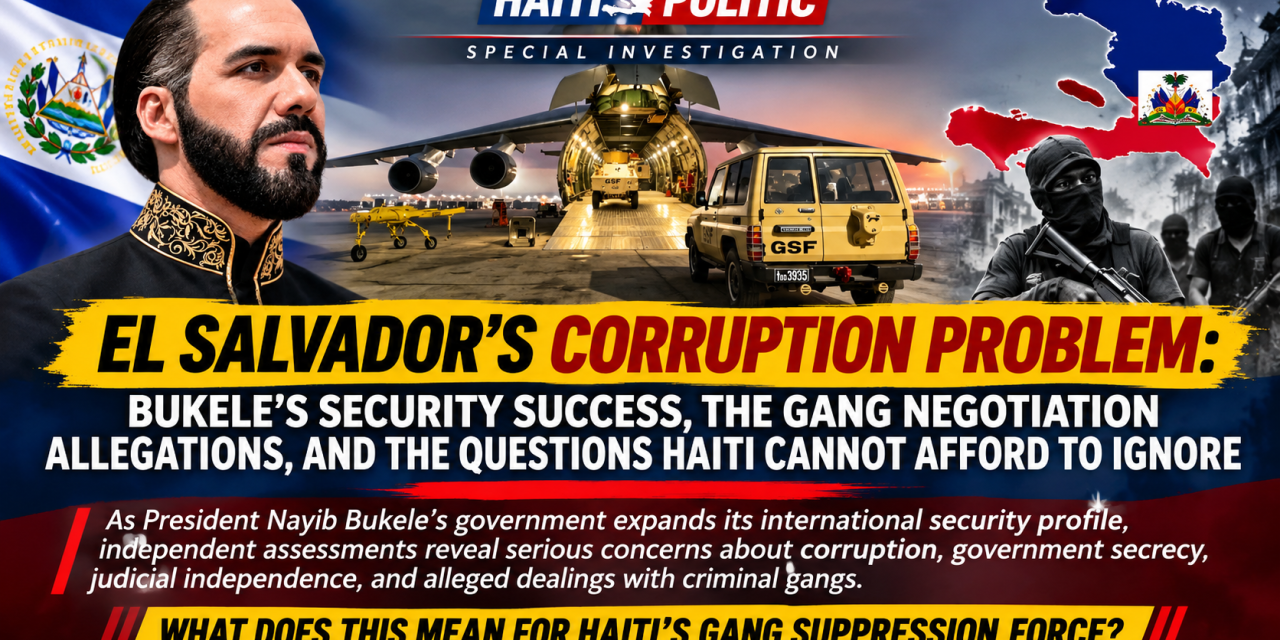
As President Nayib Bukele’s government expands its international security profile, independent assessments reveal serious concerns about corruption, government secrecy, judicial independence, and alleged dealings with criminal gangs. What does this mean for Haiti’s Gang Suppression Force?
HAITI POLITIC | SPECIAL INVESTIGATION
November 15, 2026
INTRODUCTION: THE SECURITY MODEL AND THE CORRUPTION QUESTION
President Nayib Bukele has become internationally known for his aggressive campaign against organized crime in El Salvador.
His government has overseen a dramatic reduction in gang-related violence, transformed the country’s security environment, and promoted an approach built around mass arrests, expanded police and military powers, and prolonged emergency measures.
For countries struggling with organized crime, including Haiti, El Salvador’s experience has attracted attention.
But behind Bukele’s international reputation lies another story.
Independent organizations have documented serious weaknesses in El Salvador’s anti-corruption safeguards, public financial transparency, judicial independence, and democratic oversight.
Investigative reporting and U.S. government actions have also raised questions about alleged negotiations between senior Salvadoran officials and criminal gangs.
These issues deserve particular attention as El Salvador participates in international discussions and operations concerning Haiti’s security.
The question is not simply whether Bukele knows how to confront gangs. It is whether the institutions surrounding his security policies provide sufficient transparency, financial accountability, and independent oversight.
For Haiti, where international security interventions have repeatedly generated controversy over spending, accountability, and effectiveness, that distinction is essential.
1. HOW CORRUPT IS EL SALVADOR?
Transparency International’s 2025 Corruption Perceptions Index assigned El Salvador a score of 32 out of 100, placing it 120th among 182 countries and territories.
A score of zero represents a public sector perceived as highly corrupt, while 100 represents one perceived as very clean.
El Salvador’s score reflects significant concerns about corruption in public institutions.
However, the index does not establish how much money has been stolen or identify individual officials responsible for criminal wrongdoing.
It measures perceptions of public-sector corruption using multiple expert and business assessments.
Nevertheless, a score of 32 is an important warning sign for a government increasingly presenting itself as a model of effective security administration.
A government can reduce criminal violence while still experiencing serious corruption and transparency problems.
These are separate measures of institutional performance.
Source: Transparency International, Corruption Perceptions Index 2025.
2. FREEDOM HOUSE: ZERO POINTS FOR CORRUPTION SAFEGUARDS AND TRANSPARENCY
The concerns extend beyond Transparency International.
In its Freedom in the World 2026 report, Freedom House assigned El Salvador an overall freedom score of 42 out of 100, classifying the country as Partly Free.
More significantly, El Salvador received:
0 out of 4 points for effective safeguards against official corruption.
0 out of 4 points for government openness and transparency.
0 out of 4 points for judicial independence.
These scores do not constitute criminal findings against individual government officials.
They are institutional assessments indicating serious weaknesses in the mechanisms intended to prevent, expose, and punish misconduct.
Freedom House also reports that the executive branch has consolidated control over the legislature, judiciary, and oversight institutions.
That concentration of power creates a fundamental accountability concern.
When the same political leadership dominates the institutions responsible for making decisions, approving expenditures, conducting investigations, and reviewing legal challenges, independent scrutiny becomes more difficult.
For Haiti, this raises an important question:
If Salvadoran authorities participate in international security operations, what independent mechanisms will examine their expenditures, contracts, and operational decisions?
Source: Freedom House, Freedom in the World 2026 — El Salvador.
3. THE ALLEGED GANG NEGOTIATIONS: WHAT U.S. INVESTIGATORS EXAMINED
One of the most serious controversies surrounding Bukele’s government concerns allegations that senior Salvadoran officials negotiated with criminal gangs.
Investigative reporting by ProPublica, drawing on U.S. court records, sanctions, and interviews with former officials, described investigations into alleged negotiations involving members of the Bukele administration and leaders of MS-13.
Two Salvadoran officials repeatedly identified in reporting about these allegations are:
Osiris Luna, a senior prison official.
Carlos Marroquín, a government official associated with social welfare programs.
U.S. investigators examined allegations that government representatives offered concessions to gang leaders in exchange for reductions in violence and political benefits.
ProPublica also reported that investigators explored whether U.S. development assistance had been misused in connection with alleged dealings involving gangs.
Importantly, an investigation into possible financial misconduct is not proof that the suspected diversion occurred.
The reported outcome of certain investigative requests remains unclear.
Bukele has denied allegations of improper dealings with gangs, and the reporting does not establish that he was criminally convicted of such conduct.
Nevertheless, the existence of investigations and documented allegations involving senior officials is relevant to evaluating the government’s institutional integrity.
The contradiction
Bukele’s political reputation rests heavily on his government’s confrontation with criminal gangs.
Yet investigations have examined allegations that officials associated with his administration previously negotiated with those same organizations.
Those allegations do not erase the documented reduction in violence.
They do, however, raise questions about how security policies were developed, what arrangements may have preceded the crackdown, and whether public institutions can independently investigate politically sensitive conduct.
For Haiti, the lesson is that a security operation’s public narrative should be examined alongside its institutional record.
Source: ProPublica investigation into Bukele, U.S. law enforcement inquiries, and alleged gang negotiations.
4. WHEN ANTI-CORRUPTION INSTITUTIONS LOSE THEIR INDEPENDENCE
A functioning anti-corruption system requires more than laws prohibiting bribery and embezzlement.
It requires institutions capable of investigating powerful individuals without political interference.
In May 2021, El Salvador’s government-aligned legislature removed the members of the Supreme Court’s Constitutional Chamber and the attorney general.
The changes prompted widespread concerns about judicial independence.
Freedom House subsequently documented the weakening of institutions responsible for investigating corruption and reviewing government conduct.
This matters because corruption investigations frequently involve individuals connected to the political establishment.
If prosecutors, judges, auditors, and public-information officials cannot operate independently, allegations involving senior government officials become more difficult to investigate credibly.
The problem is not unique to El Salvador.
Haiti has also struggled with weak institutions, political interference, and limited accountability.
But that similarity raises a question about the proposed transfer of security expertise.
Can a country facing serious institutional accountability concerns provide Haiti with a security model that addresses not only armed violence but also the corruption that enables organized crime?
A reduction in gang violence is one outcome.
The development of accountable institutions is another.
Both matter.
5. GOVERNMENT SECRECY AND PUBLIC CONTRACTS
Public procurement is one of the areas where corruption risks can become especially significant.
Governments purchase vehicles, weapons, communications systems, surveillance equipment, construction services, and logistical support.
Security operations may involve substantial expenditures, sometimes under emergency procedures that reduce normal competitive bidding and disclosure requirements.
Freedom House has documented restrictions on access to public information in El Salvador and concerns about the management of public funds under emergency measures.
Its reporting describes weakened transparency protections and obstacles to examining government expenditures.
These concerns become more consequential when security operations cross international borders.
An overseas deployment may involve multiple governments, international organizations, contractors, and funding mechanisms.
Without clear disclosure, determining who pays whom—and for what services—can become difficult.
For Haiti, any Salvadoran participation should therefore be accompanied by transparent financial arrangements.
At minimum, the public should be able to determine which institution pays for personnel, equipment, transportation, accommodations, insurance, and operational support.
The public should also know who audits those expenditures and what happens when irregularities are discovered.
Security spending should not become exempt from scrutiny simply because it is described as an emergency.
6. DOES EL SALVADOR’S REDUCTION IN GANG VIOLENCE PROVE ITS GOVERNMENT IS FREE OF CORRUPTION?
No.
The reduction in violence and the integrity of public institutions are different questions.
El Salvador has experienced a substantial decline in gang-related violence under Bukele’s security policies.
That improvement has changed daily life for many Salvadorans.
However, human rights organizations have documented serious concerns about arbitrary detention, due process, prison conditions, and the prolonged use of emergency powers.
At the same time, corruption assessments continue to identify weaknesses in transparency and independent oversight.
The security results should be examined on their own evidence.
So should the allegations of misconduct.
A government may achieve measurable progress in one area while experiencing serious deficiencies in another.
This distinction is especially important for Haiti.
The ability to arrest gang members does not automatically establish the ability to administer public funds transparently, protect constitutional rights, or build independent institutions.
Haiti needs security improvements that can be sustained by functioning Haitian institutions.
7. THE HAITI QUESTION: WHO PAYS, WHO CONTROLS, AND WHO AUDITS?
El Salvador’s involvement in Haiti’s international security efforts introduces an additional layer of accountability questions.
Haiti’s Gang Suppression Force operates within a multinational security framework intended to confront armed groups and support the restoration of public security.
The precise financial and operational arrangements governing individual participating countries must be established from official deployment agreements, budgets, and reporting documents.
It would be inappropriate to assume that Salvadoran officials have misused funds allocated to Haiti without evidence.
However, El Salvador’s documented institutional weaknesses make independent oversight especially important.
Consider the financial questions that should be answered before any international deployment is presented as a success.
Who is financing Salvadoran participation?
Are personnel and equipment paid for by El Salvador, the United States, international donors, a United Nations mechanism, or another arrangement?
Are these contributions cash payments, reimbursements, equipment donations, or logistical assistance?
Who controls procurement?
Which government or organization selects suppliers?
Are security contracts competitively awarded?
Are subcontractors publicly identified?
Who receives payments?
Do funds flow directly to government agencies, international organizations, private companies, or individual service providers?
Are payment records available for independent review?
Who investigates misconduct?
If allegations arise involving financial irregularities, excessive force, or operational failures, which institution has jurisdiction?
Can Haitian authorities independently investigate?
Are findings made public?
Who evaluates performance?
How will success be measured?
By arrests?
By reductions in killings and kidnappings?
By reopening roads?
By restoring access to hospitals, schools, ports, and markets?
Or by the ability of Haitian institutions to maintain security after foreign personnel leave?
A security mission without transparent financing, independent oversight, and measurable objectives risks reproducing the accountability problems that have undermined earlier interventions.
8. HAITI’S OWN EXPERIENCE WITH INTERNATIONAL SECURITY OPERATIONS
Haiti has experienced decades of international involvement in policing, security assistance, institutional development, and humanitarian response.
The results have been mixed.
International missions have contributed personnel, training, equipment, and operational support.
But Haiti continues to confront profound weaknesses in public security, judicial administration, government accountability, and economic opportunity.
This history makes it important to distinguish temporary security assistance from long-term institutional development.
Foreign personnel may help confront immediate threats.
They cannot substitute indefinitely for a functioning Haitian police force, justice system, public administration, and accountable political leadership.
The same principle applies to El Salvador’s involvement.
A Salvadoran contribution should be evaluated according to its actual mandate, costs, conduct, and measurable results—not simply the international reputation of its president.
The financial accountability problem
Haiti’s security crisis also creates opportunities for substantial international spending.
Equipment must be purchased.
Personnel must be transported.
Facilities must be maintained.
Contractors may provide transportation, food, technology, communications, and other services.
Each expenditure creates an accountability obligation.
That is why Haiti Politic believes the financial structure of international security operations deserves scrutiny alongside battlefield developments.
The central question is not only whether foreign security personnel can confront gangs. It is whether Haitians can verify what is being done in their name, how much it costs, and who benefits financially.
9. SECURITY COOPERATION IS NOT THE SAME AS ECONOMIC DEVELOPMENT
Recent discussions about Haiti’s relationship with El Salvador have also emphasized trade, investment, infrastructure, and long-term economic cooperation.
Those possibilities deserve examination.
However, security cooperation does not automatically produce economic prosperity.
A functioning economy requires predictable laws, enforceable contracts, reliable transportation, functioning financial institutions, and public confidence.
It also requires safeguards against corruption.
Investors need to know that public contracts are awarded fairly, property rights are protected, and disputes can be resolved through independent institutions.
A government cannot establish those conditions through policing alone.
El Salvador’s experience illustrates the importance of examining security outcomes and institutional accountability together.
For Haiti, the challenge is even greater.
Restoring access to Port-au-Prince and major transportation corridors would be an important achievement.
But sustainable development would also require rebuilding public administration, strengthening the justice system, reducing corruption, and creating opportunities for Haitian businesses.
Security may create the conditions for economic recovery. It does not guarantee that recovery.
10. TEN QUESTIONS FOR BUKELE, HAITI’S AUTHORITIES, AND INTERNATIONAL FUNDERS
Haiti Politic believes the following questions deserve public answers:
1. What is the complete financial arrangement governing El Salvador’s participation in Haiti’s security operations?
2. Which governments and international organizations are responsible for financing Salvadoran personnel, equipment, and logistical support?
3. Are contracts connected to the deployment publicly available, and are private contractors subject to independent audits?
4. What safeguards prevent political interference in investigations involving Salvadoran personnel or officials operating abroad?
5. How does El Salvador address the concerns raised by Transparency International and Freedom House regarding corruption and government transparency?
6. What is the Salvadoran government’s response to documented allegations involving negotiations between senior officials and criminal gangs?
7. What independent institutions will investigate allegations of misconduct involving Salvadoran personnel in Haiti?
8. What measurable security objectives have been established, and how will progress be independently verified?
9. How will the operation strengthen Haiti’s own police, courts, and public institutions rather than create long-term dependence on foreign personnel?
10. When the international operation eventually ends, what institutions and resources will remain under Haitian control?
These questions are not accusations of wrongdoing in Haiti.
They are basic accountability questions that should accompany any publicly financed international security operation.
CONCLUSION: HAITI NEEDS ACCOUNTABILITY, NOT ANOTHER SECURITY MYTH
Nayib Bukele’s government has overseen a major reduction in gang-related violence in El Salvador.
That outcome deserves factual examination.
But it should not obscure the country’s documented corruption concerns, restrictions on transparency, weakened judicial independence, or allegations involving senior officials and criminal organizations.
Transparency International’s corruption assessment and Freedom House’s institutional findings demonstrate that El Salvador’s governance record is more complicated than its international security reputation might suggest.
For Haiti, this distinction matters.
The country needs assistance capable of addressing armed violence while strengthening accountable Haitian institutions.
It also needs transparent financing, independent oversight, and clearly defined operational objectives.
No foreign government should receive an exemption from scrutiny because its president has developed a reputation for confronting gangs.
Nor should allegations against that government be treated as proof of wrongdoing in Haiti without evidence.
The appropriate standard is the same for every participant: disclose the money, explain the mission, identify the decision-makers, investigate misconduct, and demonstrate measurable results.
Haiti’s security crisis is too serious to be addressed through reputation alone.
HAITI POLITIC’S FINAL QUESTION
If El Salvador’s own anti-corruption safeguards, government transparency, and judicial independence receive some of the lowest possible institutional assessments, what guarantees will ensure that its participation in Haiti’s security operations is financially transparent, independently monitored, and accountable to the Haitian people?
That question deserves an answer before political leaders describe international security cooperation as a model for Haiti’s future.
SOURCES AND DOCUMENTARY REFERENCES
Transparency International — Corruption Perceptions Index 2025: El Salvador. Score: 32/100; rank: 120/182.
Freedom House — Freedom in the World 2026: El Salvador. Overall score: 42/100; institutional assessments covering corruption safeguards, transparency, and judicial independence.
Freedom House — Freedom in the World 2025: El Salvador. Background on judicial changes, public procurement transparency, emergency powers, and government oversight.
ProPublica — Investigative reporting on alleged negotiations involving senior Salvadoran officials and MS-13, U.S. law enforcement inquiries, and allegations of corruption.
Editorial note: This article distinguishes documented institutional assessments, reported allegations, and questions requiring further investigation. Allegations involving individual officials should not be interpreted as criminal convictions. No evidence presented here establishes that Salvadoran personnel or officials have misappropriated funds connected to Haiti’s security deployment.
© 2026 Haiti Politic | Special Investigation