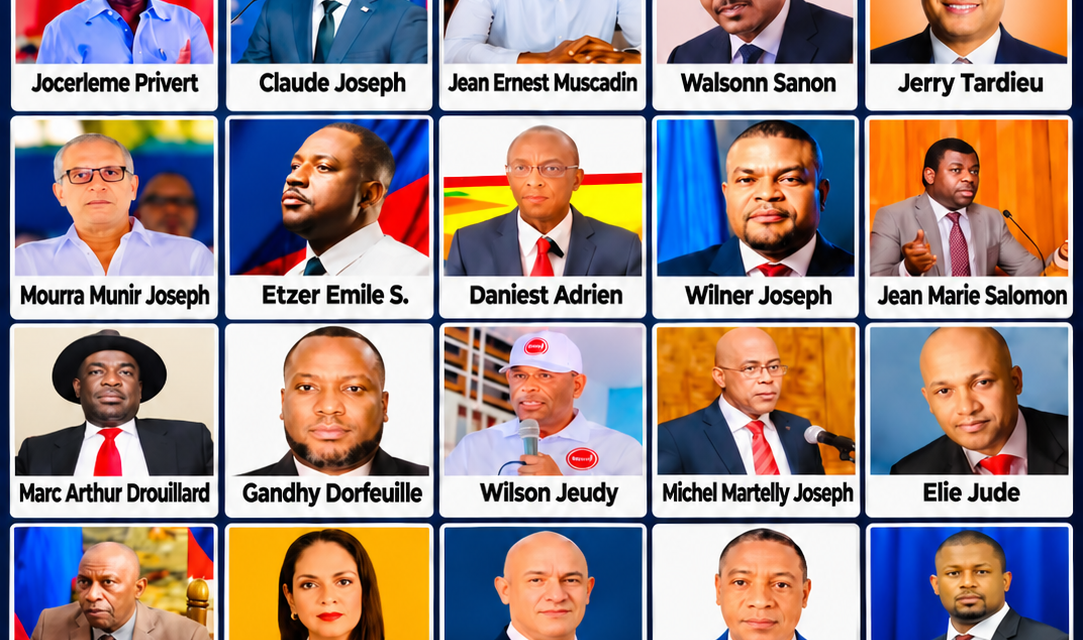
From Michel Martelly and Jocelerme Privert to Claude Joseph, Gary Bodeau, Dominique Dupuy and Jean Ernest Muscadin: Which Applicants Previously Held Public Office, and What Financial-Accountability Documents Should Be Examined?
HAITI POLITIC — SPECIAL INVESTIGATION
November 12, 2026 | Elections 2026–2027
Twenty-six individuals have registered to seek Haiti’s presidency. Some previously governed the country, served in Parliament, directed public institutions, administered municipalities or exercised other governmental authority. Others have less extensively documented public-service histories. Haiti Politic examines all 26 registrations and identifies the constitutional and legal questions arising from their previous responsibilities.
INTRODUCTION: BEFORE THE CEP APPROVES THE CANDIDATES, WHAT DO THEIR PUBLIC RECORDS SHOW?
Haiti’s approaching presidential election raises a question that goes beyond political promises, party affiliations and campaign announcements.
What financial-accountability obligations did the presidential applicants acquire through their previous public offices, and is there documentary evidence that those obligations were fulfilled?
The question has become particularly relevant following former Prime Minister Laurent Lamothe’s November 12, 2026, public statement concerning parliamentary discharge.
Lamothe argues that the absence of a functioning Parliament has created an obstacle for former ministers and prime ministers seeking elected office.
He proposes that the executive branch issue a decree granting discharge to former officials with favorable audit reports.
But the controversy exposes a broader issue.
Haiti’s Constitution and the February 12, 2008, asset-declaration law establish obligations for presidents, prime ministers, ministers, senators, deputies and several other categories of public officials.
These obligations exist independently of political affiliation.
They also exist independently of the debate surrounding discharge.
The CEP-derived registration database currently identifies 26 presidential applicants representing 26 political structures.
Some have extensive public-service histories.
Others have backgrounds that require additional verification.
Haiti Politic examined the complete list to identify which applicants have documented connections to public offices covered by financial-disclosure requirements.
This investigation does not presume that any applicant failed to declare assets, mismanaged public funds or obtained an unlawful discharge.
Its purpose is to identify the records that should be examined before conclusions are drawn.
PART I — THE CONSTITUTIONAL FRAMEWORK
1. WHAT DOES HAITIAN LAW REQUIRE?
Three separate financial-accountability mechanisms must be distinguished.
A. Declaration of assets
Article 238 of the Constitution establishes an obligation for designated public officials to declare their assets.
Articles 279 and 279-1 establish specific declaration obligations for the president, prime minister, ministers and secretaries of state.
The February 12, 2008, law extends the asset-declaration framework to additional categories, including senators, deputies, certain judicial officials, directors general, mayors and other designated public officials.
The law generally requires covered officials to submit declarations upon entering and leaving office.
The ULCC has responsibilities concerning the collection, processing and verification of these declarations.
B. Financial audits
The Superior Court of Auditors and Administrative Disputes, or CSCCA, exercises constitutional and statutory responsibilities concerning public financial management.
Its audits may provide evidence about how public resources were administered.
However, the significance of any particular audit depends on the institution, financial period, transactions and issues actually examined.
C. Discharge
Article 233 establishes a parliamentary mechanism for examining ministers’ management.
It provides for a commission composed of nine deputies and six senators.
The commission reports to the legislative chambers so they can decide on discharge.
The absence of a functioning Parliament creates an institutional obstacle to this procedure.
However, an asset declaration, a favorable audit and a parliamentary discharge are not interchangeable documents.
Nor does every person who previously held public office automatically require the same type of discharge.
The applicable constitutional eligibility provisions and the person’s actual financial responsibilities must be examined.
PART II — THE 26 PRESIDENTIAL REGISTRATIONS
The following table identifies all 26 applicants appearing in the November 12 electoral registry.
The classifications distinguish documented or credibly reported previous public positions from cases where further research is necessary.
| # | Presidential applicant | Political structure | Previous public office or relevant background |
|---|---|---|---|
| 1 | Daniest Adrien | PRC | Previous covered public office not established in sources reviewed |
| 2 | Lucien Olivier Barrau | MTH | Previous covered public office not established |
| 3 | Gary Bodeau | Platfòm Rekonsilye | Former deputy and president of the Chamber of Deputies |
| 4 | Jude Célestin | Entente Nationale | Former director of the National Equipment Center (CNE) |
| 5 | Deus Deronneth | DVNH | Former deputy |
| 6 | Gandhy Dorfeuille | Ansanm Nou Fò | Previous legislative or other public-service history requires documentary confirmation |
| 7 | Marc Arthur Drouillard | MRN | Previous covered public office not established |
| 8 | Dominique Dupuy | Pati Vizyon Dayiti | Former foreign minister and diplomatic representative |
| 9 | Moïse Durocher | Solidarité pour Ayiti Respire | Previous covered public office not established |
| 10 | Jude Élie | Parti Unité Réformé | Previous covered public office not established |
| 11 | Etzer S. Émile | SOLÈY | Economist; previous covered public office not established |
| 12 | Joanas Gué | KAPAB | Identified in a public-record directory as a former minister; exact appointment requires confirmation |
| 13 | Ricardo Jean-Pierre | PANAH | Previous covered public office not established |
| 14 | Wilson Jeudy | VAR | Public-service history associated with municipal administration requires identity and appointment verification |
| 15 | Claude Joseph | EDE | Former foreign minister and acting prime minister |
| 16 | Maxo Joseph | RCH | Previous covered public office not established |
| 17 | Wilner Joseph | VIKTWA | Previous covered public office not established |
| 18 | Joseph Michel Martelly | DEBLOKE | Former president of Haiti |
| 19 | Munir Joseph Mourra | MPH | Previous covered public office not established |
| 20 | Jean Ernest Muscadin | FCN | Government commissioner and former Justice Ministry official |
| 21 | Jocelerme Privert | Ayiti Transfòme | Former provisional president, senator and minister |
| 22 | Jean-Marie Junior Salomon | OPL | Former senator |
| 23 | Walsonn Sanon | Anfòs Pou Sove Lonè | Previous covered public office not established |
| 24 | Marie-Anne Savannah Hadid Savary | HAMAD | Previous covered public office not established |
| 25 | René St Fort | PRN | Previous covered public office not established |
| 26 | Philippe Gérard Jerry Tardieu | En Avant pour Haïti | Former deputy for Pétion-Ville |
Methodological note: An unidentified previous office means the research has not established one. It does not establish that the applicant has never worked for the government.
The public electoral registry identifies registrations and political structures. It does not provide a complete employment history or proof of compliance with financial-disclosure requirements.
PART III — THE FORMER PRESIDENTS
2. MICHEL MARTELLY — FORMER PRESIDENT OF HAITI
Registered political structure: DEBLOKE
Michel Martelly served as president of Haiti from May 2011 to February 2016.
His previous presidency places him within the constitutional asset-declaration framework.
Article 279 requires the president to declare assets after election and at the end of the mandate.
For Martelly, the relevant inquiry concerns his financial declarations associated with the beginning and end of his presidency.
Questions requiring documentary verification
Did Martelly file the required declaration after his election in 2011?
Did he submit the corresponding declaration when his presidential mandate ended in February 2016?
What confirmation of filing exists in the relevant court registry or ULCC records?
Were the declarations examined under the applicable legal procedures?
Are there publicly releasable compliance records?
The discharge question
A former president’s eligibility must be assessed under the constitutional provisions governing presidential candidacies, including any applicable discharge requirement arising from prior responsibility for public funds.
However, Article 233 specifically addresses the parliamentary examination of ministers’ management.
It should not automatically be treated as an identical discharge procedure for every former president.
The CEP must establish which provisions apply to Martelly’s previous responsibilities and current application.
Haiti Politic finding: Martelly’s former presidency clearly places his asset-declaration obligations within the scope of this investigation. His individual filing compliance has not been established through the electoral registration database.
3. JOCELERME PRIVERT — FORMER PROVISIONAL PRESIDENT, SENATOR AND MINISTER
Registered political structure: AYITI TRANSFOME
Jocelerme Privert presents a particularly complex financial-accountability profile because he has served in several branches of government.
His previous positions include:
-
Minister of the Interior.
-
Senator of the Republic.
-
President of the Senate.
-
Provisional president of Haiti in 2016–2017.
These different responsibilities must be examined separately.
Ministerial responsibilities
Privert’s previous ministerial service raises questions about financial management, applicable audits and discharge.
Legislative responsibilities
His service as senator falls within the category of officials covered by the 2008 asset-declaration law, subject to the law’s applicable dates and requirements.
Presidential responsibilities
His provisional presidency raises additional questions concerning the constitutional and statutory obligations applicable to the office and the circumstances of his assumption of presidential functions.
Questions for Privert
What asset declarations did he submit during the periods when the applicable law required them?
What documents exist concerning his management as minister?
Were any discharge decisions issued concerning the relevant ministerial period?
What declarations were required and filed during his provisional presidency?
What records can the competent institutions lawfully disclose?
Haiti Politic finding: Privert’s extensive public-service history requires a position-by-position review. One document covering one office would not necessarily resolve obligations associated with another.
PART IV — FORMER MINISTERS AND SENIOR EXECUTIVE OFFICIALS
4. CLAUDE JOSEPH — FORMER PRIME MINISTER AND FOREIGN MINISTER
Registered political structure: EDE
Claude Joseph served as Haiti’s minister of foreign affairs and exercised the functions of acting prime minister.
His previous executive responsibilities make him directly relevant to the asset-declaration investigation.
Records to examine
The declarations required upon entering and leaving his covered ministerial responsibilities.
The legal treatment of his acting prime-ministerial service.
Any CSCCA reports concerning the management of public resources within his responsibility.
Any discharge requirements applicable to his previous financial responsibilities.
Questions for Claude Joseph
Were the required entry and exit asset declarations filed?
Were separate declarations required for his ministerial and acting prime-ministerial functions?
What publicly available audit records concern the relevant periods?
What discharge documentation, if any, is required for his presidential application?
Haiti Politic finding: Joseph’s former ministerial responsibilities place him within the statutory asset-declaration framework. His actual compliance requires confirmation from competent institutions.
5. DOMINIQUE DUPUY — FORMER FOREIGN MINISTER
Registered political structure: PATI VIZYON DAYITI
Dominique Dupuy previously served as Haiti’s minister of foreign affairs and held diplomatic responsibilities.
The 2008 law covers ministers and certain diplomatic officials.
Consequently, her previous public-service record raises questions about the declarations required for those positions.
Questions for Dominique Dupuy
What declarations were required when she assumed her diplomatic and ministerial functions?
Were the required declarations submitted?
What exit declarations were required when those functions ended?
What financial-management responsibilities did she personally exercise?
Are there any applicable audit or discharge records?
The answers must distinguish her ministerial responsibilities from her diplomatic service.
Haiti Politic finding: Dupuy’s previous ministerial appointment establishes a relevant asset-declaration obligation. The precise documentary record remains to be verified.
6. JOANAS GUÉ — REPORTED FORMER MINISTER
Registered political structure: KAPAB
A public-record candidate directory identifies Joanas Gué as a former minister.
However, the exact ministerial appointment, dates of service and scope of responsibilities require confirmation from official appointment records.
If that appointment is established, the relevant asset-declaration and financial-accountability obligations must be examined.
Questions for Joanas Gué
Which ministry did he lead?
During what period?
What public funds or administrative responsibilities fell under his authority?
What declarations and audit records exist?
Was discharge required or granted?
Haiti Politic finding: A former ministerial role has been reported, but the specific appointment record should be obtained before making definitive conclusions about his obligations.
PART V — FORMER PARLIAMENTARIANS
7. GARY BODEAU — FORMER DEPUTY AND CHAMBER PRESIDENT
Registered political structure: PLATFÒM REKONSILYE
Gary Bodeau served as a deputy and later became president of Haiti’s Chamber of Deputies.
The 2008 law expressly includes deputies among the officials required to declare their assets.
His previous legislative responsibilities therefore warrant examination.
Questions for Gary Bodeau
Were the required asset declarations filed during his legislative service?
What declaration was required when his parliamentary mandate ended?
Did his leadership of the Chamber involve financial-management responsibilities requiring additional examination?
What documents are available concerning parliamentary administrative spending during his presidency of the Chamber?
The financial responsibilities of the Chamber’s leadership should be established from the applicable institutional rules rather than assumed.
Haiti Politic finding: Bodeau’s former legislative office places him within the statutory asset-declaration framework.
8. DEUS DERONNETH — FORMER DEPUTY
Registered political structure: DVNH
Deus Deronneth is identified in public-record electoral research as a former deputy.
That previous legislative service is directly relevant to the 2008 asset-declaration law.
Questions for Deus Deronneth
During which parliamentary term did he serve?
Were entry and exit asset declarations required and submitted?
Did he hold any additional public position involving the management of public funds?
What documentary evidence is available concerning compliance?
Haiti Politic finding: His former legislative role warrants a review of the declarations applicable to his period of service.
9. JEAN-MARIE JUNIOR SALOMON — FORMER SENATOR
Registered political structure: OPL
Jean-Marie Junior Salomon previously served in Haiti’s Senate.
Senators are expressly covered by the 2008 asset-declaration law.
The investigation should therefore examine the declarations required during his legislative service.
Questions for Salomon
What were the exact dates of his Senate mandate?
Did he file the required asset declarations?
Were there additional public-financial responsibilities associated with committee or administrative positions?
What records are available concerning the end of his mandate?
Haiti Politic finding: Salomon’s former Senate service establishes a relevant category of statutory financial-disclosure obligations.
10. JERRY TARDIEU — FORMER DEPUTY FOR PÉTION-VILLE
Registered political structure: EN AVANT POUR HAÏTI
Philippe Gérard Jerry Tardieu previously represented Pétion-Ville in Haiti’s Chamber of Deputies.
His legislative service places him within the asset-declaration framework.
Questions for Jerry Tardieu
Did he file the required declaration when he entered Parliament?
Did he file the required declaration after his legislative mandate ended?
What publicly available documentation establishes compliance?
Did he previously exercise any additional responsibility for public funds that would trigger a separate discharge requirement?
Haiti Politic finding: Tardieu’s previous legislative office is established. The availability and status of his individual asset declarations require institutional confirmation.
11. GANDHY DORFEUILLE — PREVIOUS PUBLIC-SERVICE HISTORY REQUIRES VERIFICATION
Registered political structure: ANSANM NOU FÒ
Gandhy Dorfeuille appears in the presidential registration database.
Some political references associate him with previous legislative activity.
However, the sources examined for this article do not establish the exact mandate, appointment or financial responsibilities with sufficient certainty.
Before classifying him definitively as a former deputy for this investigation, Haiti Politic should obtain an official parliamentary membership record.
If former legislative service is confirmed, the applicable asset-declaration requirements should be examined.
Haiti Politic finding: Further documentary verification is necessary.
PART VI — FORMER DIRECTORS, MUNICIPAL OFFICIALS AND JUSTICE OFFICIALS
12. JUDE CÉLESTIN — FORMER DIRECTOR OF THE NATIONAL EQUIPMENT CENTER
Registered political structure: ENTENTE NATIONALE
Jude Célestin previously directed Haiti’s Centre National des Équipements, commonly known as the CNE.
This is significant because the 2008 asset-declaration law covers designated senior public administrators and officials responsible for public resources.
Why his former position matters
The CNE is associated with public equipment, infrastructure and administrative expenditures.
Its director’s precise legal obligations must be determined from the institution’s status, the applicable law and the powers exercised during his tenure.
Questions for Jude Célestin
What were the exact dates of his CNE leadership?
What asset-declaration obligations applied during that period?
Were the required declarations submitted?
What CSCCA reports concern the institution during his administration?
Did his position create a discharge requirement relevant to his presidential candidacy?
Haiti Politic finding: Célestin’s previous leadership of a public institution warrants examination of the applicable financial-disclosure and audit framework.
13. JEAN ERNEST MUSCADIN — GOVERNMENT COMMISSIONER
Registered political structure: FÒS CHANJMAN NASYONAL
Jean Ernest Muscadin has served as a government commissioner and previously held responsibilities within Haiti’s Ministry of Justice.
His professional history is relevant because the 2008 law expressly covers specified judicial officials, including government commissioners.
Questions for Muscadin
What declarations were required upon assuming his covered public functions?
What declarations were required when those functions ended?
What financial or administrative responsibilities did he exercise?
Did he hold any position involving direct accountability for public funds?
Does any separate discharge requirement apply to his presidential application?
A government commissioner’s judicial and prosecutorial functions should not automatically be treated as equivalent to those of a minister managing a departmental budget.
Haiti Politic finding: Muscadin’s public-service history raises statutory asset-declaration questions. Any discharge obligation requires a separate legal assessment.
14. WILSON JEUDY — MUNICIPAL PUBLIC-SERVICE QUESTIONS
Registered political structure: VISION-ACTION-RÉALISATION
The name Wilson Jeudy is associated with municipal political activity in Delmas.
However, the electoral registry also contains municipal candidacies involving the same name.
For this investigation, the identity of the presidential registrant and the exact previous municipal appointments must be established before attributing a particular administrative record to him.
If the presidential applicant previously served as mayor or another official covered by the 2008 law, the relevant declarations should be examined.
Questions requiring verification
Is the presidential registrant the same individual identified in previous Delmas municipal leadership records?
What were the dates and legal nature of his public appointments?
What asset declarations were required?
What municipal financial-management responsibilities did he exercise?
Haiti Politic finding: The previous municipal-service connection requires identity verification before a definitive compliance assessment.
PART VII — APPLICANTS WHOSE PREVIOUS COVERED PUBLIC OFFICES REMAIN UNVERIFIED
The remaining applicants must not be excluded from scrutiny.
However, political activity, business ownership, academic employment or previous participation in elections does not automatically establish that someone held an office covered by the 2008 asset-declaration law.
For the following applicants, the sources examined do not yet establish a qualifying previous public appointment with sufficient certainty.
15. DANIEST ADRIEN — PRC
The electoral registry confirms his presidential registration.
His previous government-service history requires further verification.
Question: Has he ever held a public appointment covered by the asset-declaration law?
16. LUCIEN OLIVIER BARRAU — MTH
The available registration record does not establish a previous covered public office.
Question: Has he previously exercised responsibilities involving public administration or public funds?
17. MARC ARTHUR DROUILLARD — MRN
His presidential registration is documented, but his previous government appointments have not been established in the sources reviewed.
Question: Has he previously occupied a public position requiring an asset declaration?
18. MOÏSE DUROCHER — SOLIDARITÉ POUR AYITI RESPIRE
The available registration information does not establish previous covered public service.
Question: What public positions, if any, has he held?
19. JUDE ÉLIE — PARTI UNITÉ RÉFORMÉ
His previous covered public-service history remains unverified.
Question: Has he previously managed public resources or occupied a position listed in Article 7 of the 2008 law?
20. ETZER S. ÉMILE — SOLÈY
Etzer Émile is publicly known as an economist and political commentator.
His professional visibility does not, by itself, establish previous service in a public office covered by the asset-declaration law.
Question: Has he held any government appointment that created statutory asset-declaration obligations?
21. RICARDO JEAN-PIERRE — PANAH
The sources reviewed establish his registration but do not confirm a previous covered public office.
Question: Has he held a public administrative or financial-management position?
22. MAXO JOSEPH — RCH
His previous government-service history requires further verification.
Question: What public responsibilities, if any, has he exercised?
23. WILNER JOSEPH — VIKTWA
The electoral registration record does not establish a previous covered public office.
Question: Has he previously held a government position subject to the 2008 law?
24. MUNIR JOSEPH MOURRA — MPH
His presidential registration is documented.
However, the available sources do not sufficiently establish a previous public appointment covered by the asset-declaration law.
Question: Has he previously exercised public financial or administrative responsibilities?
25. WALSONN SANON — ANFÒS POU SOVE LONÈ
The available sources do not establish a previous covered public office.
Question: Has he held any government position requiring an entry or exit asset declaration?
26. MARIE-ANNE SAVANNAH HADID SAVARY — HAMAD
Her presidential registration is documented.
The sources examined do not establish a previous covered public appointment.
Question: Has she previously held a public office that created statutory financial-disclosure obligations?
27. RENÉ ST FORT — PRN
His previous public-service history requires further verification.
Question: Has he previously occupied a position involving public funds or covered administrative responsibilities?
PART VIII — WHAT THE INVESTIGATION ESTABLISHES
The examination identifies three distinct groups.
GROUP 1 — APPLICANTS WITH ESTABLISHED PREVIOUS COVERED PUBLIC OFFICES
These include:
Michel Martelly, Jocelerme Privert, Claude Joseph, Dominique Dupuy, Gary Bodeau, Deus Deronneth, Jean-Marie Junior Salomon, Jerry Tardieu, Jude Célestin and Jean Ernest Muscadin.
Their previous public positions provide a concrete basis for examining applicable asset-declaration requirements.
The exact requirements must still be matched to the dates and legal status of their appointments.
GROUP 2 — APPLICANTS WHOSE PREVIOUS PUBLIC ROLES REQUIRE ADDITIONAL DOCUMENTARY CONFIRMATION
These include:
Joanas Gué, Gandhy Dorfeuille and Wilson Jeudy.
Their previous government-service histories require additional verification before definitive conclusions can be reached.
GROUP 3 — APPLICANTS WITHOUT A VERIFIED PREVIOUS COVERED OFFICE IN THE SOURCES REVIEWED
These include the remaining thirteen applicants.
Their electoral registration does not establish whether they previously held covered public responsibilities.
Further biographical and institutional research is necessary.
Important: These categories describe the status of the available evidence, not the applicants’ integrity, legal eligibility or compliance.
PART IX — THE DISCHARGE QUESTION MUST BE EXAMINED INDIVIDUALLY
The constitutional debate surrounding Laurent Lamothe makes this investigation particularly relevant.
But the CEP cannot simply treat every former public official as though the same discharge rules apply.
A former president, former minister, former deputy, former government commissioner and former director of a public institution may have different legal obligations.
The applicable provisions depend on the nature of the previous position, responsibility for public funds, the office now being sought and the relevant constitutional and electoral rules.
For former ministers
Article 233 establishes a parliamentary mechanism for discharge.
For former presidents
The applicable presidential eligibility and financial-accountability provisions must be examined, including any discharge requirement arising from previous responsibility for public funds.
For former legislators
Asset declarations are required under the 2008 law, but legislative service alone does not automatically establish that the person must obtain the same parliamentary discharge as a former minister.
For former directors general and other public administrators
The legal responsibilities of the particular institution and position must be established.
For judicial officials
The 2008 asset-declaration framework may apply, but a separate analysis is necessary before asserting that a parliamentary discharge is required.
The CEP must distinguish between verifying compliance with existing law and creating new requirements that the Constitution or legislation does not authorize.
PART X — WHAT DOCUMENTS SHOULD THE CEP EXAMINE?
Haiti Politic identifies several categories of records relevant to a lawful eligibility review.
1. Previous appointment records
Official appointment decrees, election results and institutional records should establish which public positions the applicant previously held.
2. Asset-declaration compliance
Where legally relevant, the competent institutions should verify whether required entry and exit declarations were submitted.
Because the 2008 law protects the confidentiality of their contents, this does not mean the CEP or the public automatically has unrestricted access to the complete documents.
3. Financial-management records
Where an applicant previously managed public resources, relevant CSCCA reports and other legally available records may help establish the nature and status of that management.
4. Discharge documentation
Where the applicable constitutional or electoral rules require discharge, the CEP should determine what legally sufficient evidence must be submitted.
5. Judicial decisions
Any final, legally relevant judicial decisions affecting eligibility should be examined according to the applicable legal framework.
6. Opportunity to respond
Applicants should have an opportunity to address questions concerning their records through the procedures established by law.
A missing document in a journalist’s research is not proof that an applicant failed to submit it to the competent authority.
PART XI — THE PUBLIC HAS A RIGHT TO ASK QUESTIONS, BUT NOT UNRESTRICTED ACCESS TO PRIVATE FINANCIAL RECORDS
The February 12, 2008, law protects the confidentiality of asset declarations.
This creates an important distinction.
Haitian citizens may ask the ULCC for publicly releasable compliance information.
They may request published CSCCA audit reports.
They may examine legally available discharge decisions.
They may ask former officials to authorize disclosure of appropriate financial summaries.
But the public does not automatically have a right to obtain complete confidential declarations containing bank accounts, assets, liabilities and other protected information.
A refusal to release such information voluntarily does not, by itself, establish wrongdoing.
A more transparent system would require appropriate legal reform.
PART XII — TEN QUESTIONS FOR THE CEP
As the electoral process advances, Haiti Politic submits ten questions to the Provisional Electoral Council.
1. What documents must a former president submit to establish compliance with applicable discharge requirements?
2. What documents must former prime ministers and ministers submit?
3. How will the CEP assess applicants who previously served as senators or deputies?
4. How will it determine whether a former director general or public administrator was personally accountable for public funds?
5. Will the CEP seek legally authorized confirmation of asset-declaration compliance from the ULCC?
6. How will the CEP distinguish between an audit report and a discharge decision?
7. What legal treatment will be given to discharge decrees issued during periods without Parliament?
8. What procedures will applicants have to challenge an adverse eligibility determination?
9. Will the CEP publish the legal criteria used to examine discharge-related documents?
10. Will the same documentary standards apply to every applicant regardless of political affiliation?
These questions concern the administration of electoral law.
They do not presume that the CEP has already accepted or rejected any particular applicant.
PART XIII — THE LARGER PROBLEM: HAITI’S FINANCIAL-ACCOUNTABILITY SYSTEM
The ULCC’s 2023 diagnostic of the 2008 asset-declaration law documented significant implementation problems.
For the period from March 2008 through May 2022, the institution reported collecting:
3,458 asset declarations.
Of those:
3,179 were entry declarations.
279 were exit declarations.
The relatively small number of exit declarations raises questions about enforcement, although those totals alone do not establish the precise exit-compliance rate.
The report also identified weaknesses concerning sanctions, verification and administrative implementation.
These findings are relevant to the presidential election because the 2008 law covers several categories of officials represented among the current applicants.
However, the aggregate statistics do not establish whether any particular presidential applicant complied with the law.
Individual conclusions require individual records.
PART XIV — A PROPOSAL FOR GREATER TRANSPARENCY
Haiti Politic identifies several possible institutional reforms for public discussion.
First, the ULCC could publish updated aggregate compliance statistics by category of public office.
Second, the authorities could establish a legally authorized mechanism for confirming whether required declarations were filed.
Third, the CEP could publish clear explanations of how discharge requirements apply to applicants with different public-service histories.
Fourth, Haiti could consider amending the 2008 law to permit standardized public financial summaries while protecting sensitive personal information.
Fifth, a functioning Parliament would be necessary to restore the ordinary constitutional discharge mechanism established by Article 233.
These measures would address different problems.
They should not be confused with one another.
CONCLUSION: 26 REGISTRATIONS, 26 RECORDS TO EXAMINE
The November 12 electoral registry identifies 26 individuals seeking Haiti’s presidency.
Some previously exercised presidential authority.
Others served as ministers, legislators, public administrators or judicial officials.
Several have public-service histories that remain insufficiently documented.
For applicants who previously occupied positions covered by the 2008 law, the relevant questions concern the declarations legally required during those periods.
For applicants who managed public funds, additional questions may concern audits and discharge.
For applicants without established previous public office, investigators must first determine whether any such obligations arose.
Registration is not proof of eligibility.
Previous public office is not proof of wrongdoing.
The absence of a publicly available asset declaration is not proof that it was never filed.
And a favorable audit is not automatically equivalent to parliamentary discharge.
These distinctions matter because electoral accountability must rest on documents and law rather than assumptions.
Laurent Lamothe’s recent intervention has drawn attention to the difficulties created by the absence of Parliament.
But the presidential registration list raises a broader question:
HAITI POLITIC’S CENTRAL QUESTION
Before Haiti selects its next president, can the competent institutions establish which applicants previously exercised public authority, what financial-accountability obligations applied to them, and whether those obligations were fulfilled?
That is a question for the CEP, the ULCC, the CSCCA and, where appropriate, the courts.
It is also a question that deserves public answers within the limits established by law.
Haiti’s electoral process should be supported by verifiable records, consistent legal standards and meaningful institutional accountability.
DOCUMENTARY REFERENCES
1. Conseil Électoral Provisoire (CEP)
Presidential registration database, November 12, 2026.
2. Constitution of Haiti, 1987, as amended
Relevant provisions include Articles 135, 200, 233, 238, 279 and 279-1.
3. Law of February 12, 2008, on Asset Declarations
Relevant provisions include Articles 5, 7, 8, 10, 11, 12, 14 and 16–19.
4. ULCC, 2023 Diagnostic Report
Historical findings concerning asset-declaration compliance and institutional implementation.
5. Public-record candidate directories and historical institutional records
Used to identify previously held offices. Where official appointment records were not available, the article explicitly identifies the need for additional verification.
EDITORIAL NOTE: This investigation does not establish that any named applicant failed to declare assets, committed corruption or violated constitutional eligibility requirements. The classifications reflect the documentary evidence available for this review as of November 12, 2026. The CEP has not yet published its definitive list of approved presidential candidates.
© 2026 HAITI POLITIC — SPECIAL INVESTIGATION