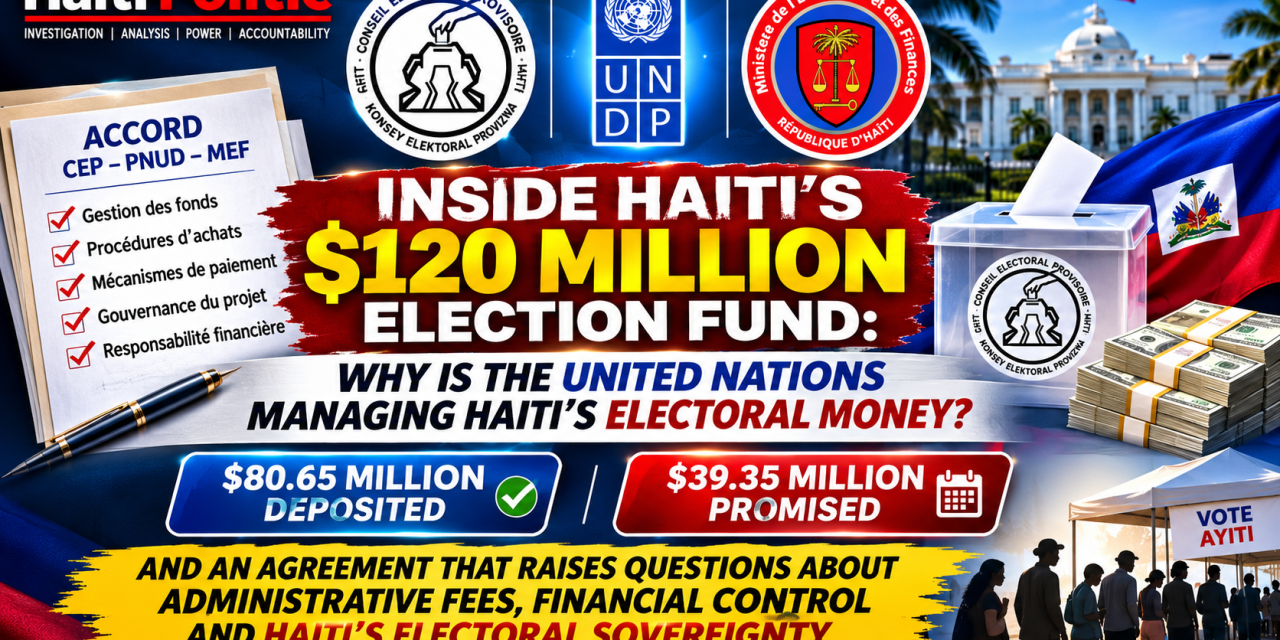
$80.65 Million Deposited, Another $39.35 Million Promised, and an Agreement That Raises Questions About Administrative Fees, Financial Control and Haiti’s Electoral Sovereignty
HAITI POLITIC | SPECIAL INVESTIGATION
November 8, 2026
For more than two decades, the United Nations Development Programme has administered substantial portions of Haiti’s electoral financing. Now, as Haiti prepares for another delayed election, the government says it has deposited $80.65 million into a UNDP-managed fund and plans to provide another $39.35 million. But how much does the UNDP receive for administering that money? Who controls procurement? Who audits the spending? And why does Haiti still depend on an international organization to manage its elections?
THE $120 MILLION QUESTION
On November 5, 2026, Haiti’s Ministry of Economy and Finance met with representatives of the Provisional Electoral Council (CEP) to discuss the financial requirements of the country’s upcoming elections.
The ministry’s public statement acknowledged that the electoral calendar had changed and that the government and CEP needed to reassess the resources required to implement the electoral process.
It also raised the possibility of increasing the originally planned electoral allocation.
But an earlier government disclosure, published on November 4, reveals an even more important financial arrangement.
According to the Ministry of Economy and Finance, Haiti’s electoral budget stood at $120 million before the latest calendar revision.
By September 30, 2026, approximately $80.651 million had been contributed to a joint electoral fund administered by the United Nations Development Programme (UNDP), known in Haiti as the PNUD.
The remaining $39.349 million was included in Haiti’s 2026–2027 national budget, with disbursements expected to follow the operational requirements of the electoral process.
The numbers are significant.
But the financial arrangement behind them deserves even closer examination.
Why is the Haitian government transferring electoral funds to a United Nations agency instead of administering those resources directly through its own electoral institutions?
And what does Haiti receive in exchange for that arrangement?
Sources: Ministry of Economy and Finance, November 4–5, 2026; CEP official communications.
1. HAITI IS PROVIDING THE MONEY. UNDP IS MANAGING IT.
The most important distinction in the current electoral financing arrangement concerns the source of the money.
In a 2026 interview, CEP President Jacques Desrosiers explained that Haiti’s electoral operations were being financed by the Haitian state.
He specifically distinguished the UNDP’s administrative role from the actual financing of elections.
According to Desrosiers, the arrangement operates through an agreement involving three parties:
The Haitian government, the Provisional Electoral Council, and the United Nations Development Programme.
Under this framework, Haiti provides the financing while UNDP administers the operational funds through the electoral Basket Fund.
The CEP submits requests for electoral expenditures, and UNDP processes payments under the project’s financial procedures.
This is an important distinction because the presence of the United Nations in the financial system can create the impression that international organizations are paying for Haiti’s elections.
The available statements indicate otherwise for the current electoral operations.
Haiti is financing them.
UNDP is administering the money.
But who pays UNDP for administering it?
That is one of the questions the government and the United Nations should answer publicly.
Source: CEP President Jacques Desrosiers, interview published by AyiboPost in 2026.
2. THE AGREEMENT THAT DESERVES PUBLIC SCRUTINY
On May 22, 2026, the CEP and UNDP organized a workshop concerning the Electoral Process Support Project in Haiti, known as PAPEH.
In its official statement, the CEP described UNDP as the principal manager of the funds allocated to electoral operations.
The workshop addressed several areas of cooperation, including:
-
Project governance and management.
-
Procurement procedures.
-
Payment arrangements.
-
Institutional partnerships.
-
Financial accountability.
These are not minor administrative functions.
They concern the mechanisms through which electoral resources are converted into contracts, purchases, payments and operational services.
The CEP remains the institution responsible for organizing Haiti’s elections.
However, the organization administering payments and procurement can have substantial operational influence over how electoral preparations are implemented.
That makes the terms of the agreement particularly important.
Who approves expenditures? Who selects suppliers? Who signs contracts? Who determines whether a payment satisfies the applicable rules?
And when disputes arise between the CEP and UNDP, which institution has the final authority?
The answers should be found in the signed agreement and its operating procedures.
Yet the complete current financial agreement, including its fee schedule and decision-making provisions, has not been established in the documents reviewed for this article.
That is a significant transparency gap.
Source: CEP official statement, May 22, 2026.
3. THE UNITED NATIONS HAS BEEN MANAGING HAITI’S ELECTORAL FUND SINCE 2005
This arrangement did not begin in 2026.
According to the ACE Electoral Knowledge Network’s study of Haiti’s electoral administration, UNDP has managed the electoral Basket Fund since 2005.
The mechanism developed amid concerns about the financial management of Haiti’s electoral institutions and the instability created by successive provisional electoral councils.
The fund historically combined Haitian government resources with contributions from international donors.
UNDP’s responsibilities included purchasing electoral materials, administering payroll-related operations, supporting institutional capacity and providing technical assistance.
The arrangement was intended to improve financial controls and support electoral operations.
But more than two decades later, Haiti continues to rely on a similar mechanism.
That raises an institutional question.
If the original purpose included strengthening Haiti’s electoral institutions, why has the country not developed sufficient capacity to administer these funds independently?
There may be legitimate explanations, including political instability, repeated changes in electoral administration, insecurity and weaknesses in public procurement systems.
But those explanations do not eliminate the need to measure results.
After approximately 21 years, the public should be able to examine how much money has been spent on institutional capacity building and what improvements have actually been achieved.
A technical assistance arrangement should have measurable objectives.
It should also have a clear framework for determining when the beneficiary institution can assume greater responsibility.
Otherwise, temporary assistance risks becoming a permanent administrative dependency.
Source: ACE Electoral Knowledge Network, “Haiti: A Crisis of Credibility.”
4. HOW MUCH MONEY DOES UNDP RECEIVE FOR MANAGING HAITI’S ELECTIONS?
This is one of the central questions of the investigation.
UNDP is a nonprofit United Nations development agency.
Nevertheless, its projects involve administrative expenses.
Those expenses can include personnel, financial administration, procurement, project management, technical services, reporting and organizational cost recovery.
UNDP may recover eligible administrative and operational costs under the applicable project arrangements.
That does not necessarily mean it earns a commercial profit.
But the financial distinction matters little to Haitian taxpayers unless the actual charges are disclosed.
Consider the following illustration.
If an administrative charge were calculated against the entire $120 million electoral budget, different rates would produce the following amounts:
| Hypothetical rate | Illustrative amount |
|---|---|
| 3% | $3.6 million |
| 5% | $6 million |
| 7% | $8.4 million |
| 8% | $9.6 million |
These figures are hypothetical. Haiti Politic has not verified that any of these percentages applies to the current agreement.
The actual cost-recovery structure may involve different rates, eligible expenditure categories, direct project expenses or separate contractual provisions.
That is precisely why the agreement should be disclosed.
The public needs to know the actual amount UNDP receives for administering the electoral fund.
It also needs to know whether procurement services, international consultants, project personnel and technical assistance are charged separately.
The red flag is not proof that UNDP is making an improper profit.
The red flag is the absence, in the financial disclosures reviewed here, of a clear explanation of the total cost of administering Haitian electoral money.
If Haiti provides $120 million, taxpayers should be able to determine how much finances electoral operations and how much finances the administrative machinery supporting those operations.
5. $80.65 MILLION HAS BEEN CONTRIBUTED. HOW MUCH HAS ACTUALLY BEEN SPENT?
The Ministry of Economy and Finance’s November disclosure establishes that approximately $80.651 million had been contributed to the electoral Basket Fund by September 30, 2026.
But the ministry’s statement does not provide a complete expenditure breakdown.
It does not establish how much of that amount has been spent, committed under contracts or remains available.
These distinctions are essential.
Money deposited into an account is not necessarily money spent.
Money committed under a procurement contract is not necessarily money disbursed.
And money spent does not automatically demonstrate that the intended electoral preparations have been completed.
A transparent financial report should distinguish all four categories.
Contributions received. Contractual commitments. Actual expenditures. Remaining available funds.
Without that information, the public cannot accurately evaluate the financial position of the electoral process.
There is also a historical accounting question.
Some reporting indicates that substantial contributions were made to the electoral fund before 2026.
Therefore, the public needs to know whether the $80.651 million represents new contributions for the current electoral cycle, accumulated government payments, or a combination of earlier and more recent funding.
The answer matters because money transferred in previous years may already have financed activities that did not produce completed elections.
Haiti Politic is not asserting that the money has disappeared.
The question is whether the government and UNDP can provide a complete reconciliation of the funds received and the results delivered.
6. THE MISSING $39.35 MILLION: WHO WILL PAY?
The government says the remaining $39.349 million is included in Haiti’s 2026–2027 national budget.
That means the Haitian state has assumed responsibility for financing the outstanding balance.
But inclusion in a budget is not the same as an actual transfer.
The money still has to be made available and disbursed.
There is also a separate question concerning the government’s revenue sources.
Will the outstanding balance come from tax collections, customs revenues, Treasury financing, external budget support or other public resources?
The November statement does not provide that level of detail.
Nor does it identify a foreign country as the direct financier of the remaining amount.
This distinction is important.
Historically, foreign governments have contributed to Haitian elections.
But the available documentation does not establish that a specific foreign government is financing part of the current $120 million allocation.
The government should therefore publish a contribution schedule identifying the source, date and amount of each transfer.
That would clarify whether the money comes exclusively from Haitian public resources or whether other contributors participate in the current fund.
7. THE ELECTORAL BUDGET WAS $230 MILLION BEFORE IT BECAME $120 MILLION
Another important detail appears in a July 2026 report by the United Nations Secretary-General.
According to that report, the Haitian government expressed concerns about the efficiency of expenditures under a proposed electoral budget of approximately $230 million.
On July 3, 2026, the government and CEP reached an agreement on a $120 million budget for electoral operations.
That represents a reduction of approximately $110 million from the earlier proposal.
The difference raises legitimate questions.
What expenses were removed?
Were certain activities postponed?
Were procurement costs reduced?
Did the revised budget assume a different election calendar?
And did UNDP participate in the technical assessment of those changes?
The CEP’s April 2026 announcement confirms that representatives of UNDP, UNOPS and BINUH participated in technical work concerning a revised electoral budget.
The government and CEP subsequently agreed on the $120 million figure.
But the public needs a detailed comparison showing how the budget changed.
A reduction of nearly half the proposed amount should be accompanied by an explanation of what changed operationally.
Otherwise, taxpayers cannot determine whether the original proposal was excessive, the revised proposal was more efficient, or the two estimates reflected materially different electoral plans.
Sources: United Nations Secretary-General report S/2026/574, July 2026; CEP, April 29, 2026.
8. ANOTHER ELECTORAL DELAY — AND ANOTHER POSSIBLE BUDGET INCREASE
On October 28, 2026, the CEP published another revised electoral calendar.
The revised schedule placed the first round of elections on July 18, 2027, with a second round planned for October 4, 2027.
The calendar change matters financially.
Longer electoral preparations can create additional expenses involving personnel, facilities, security arrangements, logistics and procurement.
But they can also create opportunities to renegotiate contracts, eliminate unnecessary costs or improve operational planning.
That is why the November 5 meeting between the Ministry of Economy and Finance and CEP deserves attention.
The ministry acknowledged that the revised calendar required updated expenditure planning.
It also referred to the possibility of increasing the originally planned allocation.
How much more will Haiti be asked to spend?
The public statement does not specify an additional amount.
Nor does it establish whether any increase has already been approved.
The important issue is whether the government will publish a revised budget before authorizing additional expenditures.
If the electoral calendar changes repeatedly, financial accountability becomes even more important.
Each revision should identify the activities affected, the costs incurred, the contracts requiring modification and the amount of additional financing needed.
A postponed election should not automatically become an open-ended financial commitment.
9. WHO CONTROLS THE CONTRACTS?
Elections require extensive procurement.
Ballots must be printed.
Electoral equipment must be acquired.
Materials must be transported.
Personnel must be trained.
Polling centers must be prepared.
Communications and information systems must be maintained.
Some operations may require specialized logistics and security arrangements.
These activities can involve substantial contracts.
The CEP’s May 2026 statement confirms that procurement procedures and payment mechanisms form part of its cooperation with UNDP.
But the public needs to know how responsibility is divided.
Does the CEP identify suppliers?
Does UNDP conduct competitive procurement?
Which institution approves the technical specifications?
Who signs the contracts?
What procedures apply when a supplier fails to deliver?
Are contract awards published?
And can Haitian oversight institutions examine the complete procurement records?
These questions do not imply that procurement violations have occurred.
They concern the accountability structure of an arrangement involving public money.
There is also a broader issue.
If international agencies administer procurement using their own procedures, Haitian taxpayers should understand which rules apply and what access Haitian oversight institutions have to the resulting records.
International procurement standards and Haitian public accountability should reinforce each other—not leave gaps between them.
10. WHO AUDITS THE UNDP-MANAGED FUND?
The Haitian government has a responsibility to account for public expenditures.
The CEP has responsibilities under Haiti’s electoral and financial framework.
UNDP also operates under its own financial regulations, oversight procedures and audit arrangements.
But the existence of separate oversight systems does not automatically guarantee that the Haitian public can examine every relevant expenditure.
The central question is whether the agreement establishes an effective and accessible accountability mechanism.
Haiti Politic believes the public should be able to obtain a complete financial report identifying the fund’s contributions, expenditures, administrative charges, procurement commitments and remaining balances.
It should also be clear whether Haiti’s Superior Court of Auditors and Administrative Disputes—CSCCA—has access to the documentation necessary to examine the use of Haitian public funds under this arrangement.
UNDP’s internal oversight mechanisms may provide important safeguards.
But those safeguards do not eliminate the need for transparent reporting to the Haitian government and public.
A financial arrangement can comply with an international organization’s procedures while still leaving citizens with insufficient information about how their country’s money was spent.
That is the accountability gap that deserves examination.
11. DOES THE AGREEMENT CREATE AN INCENTIVE TO MAINTAIN THE SYSTEM?
There is a legitimate institutional question concerning long-running technical assistance projects.
Organizations that administer development projects require personnel, budgets and operational resources.
Administrative cost recovery helps sustain those functions.
But when an institution manages the same category of project for decades, the public is entitled to ask whether the arrangement includes measurable objectives for transferring responsibility to national institutions.
That is not an accusation that UNDP deliberately prolongs Haiti’s electoral problems.
There is no evidence presented here establishing such conduct.
The concern is structural.
If Haiti’s electoral institutions remain dependent on external financial administration, the arrangement should be evaluated against its original capacity-building objectives.
What milestones were established?
Which have been achieved?
What prevents the CEP from assuming greater financial responsibility?
And what would it cost to build a permanent Haitian electoral financial-management system?
The answers would help determine whether continued UNDP administration remains necessary and whether alternatives have been seriously evaluated.
12. HAITI’S ELECTORAL SOVEREIGNTY IS ALSO A FINANCIAL QUESTION
Electoral sovereignty is often discussed in terms of voting rights, candidate eligibility, political independence and the legitimacy of elected officials.
But it also involves institutional control over the resources required to organize elections.
A country that finances its elections should have meaningful authority over its electoral priorities and access to comprehensive financial information.
That does not mean international technical assistance is inherently incompatible with sovereignty.
Countries routinely obtain external assistance for complex public projects.
The question is how authority and accountability are distributed.
If UNDP manages procurement and payments under an agreement accepted by Haitian authorities, that arrangement may be lawful and operationally justified.
But the Haitian government must still explain why the arrangement remains necessary, what it costs and how it supports the development of national institutions.
The issue is not whether Haiti should reject international expertise. It is whether international assistance is strengthening Haiti’s capacity to administer its own elections.
13. TEN QUESTIONS HAITI POLITIC WANTS THE GOVERNMENT, CEP AND UNDP TO ANSWER
1. WHERE IS THE COMPLETE AGREEMENT?
Will the Haitian government, CEP and UNDP publish the current signed agreement governing the electoral Basket Fund, including amendments and financial annexes?
2. HOW MUCH DOES UNDP RECEIVE?
What administrative fees, cost-recovery charges and direct project-management expenses apply to the $120 million electoral budget?
3. HOW MUCH OF THE $80.651 MILLION HAS BEEN SPENT?
What amounts have been disbursed, contractually committed or left available?
4. WHO FINANCED THE FUND?
Will the government publish a contributor-by-contributor statement identifying Haitian Treasury transfers and any foreign contributions?
5. WHO APPROVES PROCUREMENT?
Which institution selects suppliers, authorizes contracts and approves payments?
6. WHO AUDITS THE EXPENDITURES?
What audit reports are available, and what access does the CSCCA have to the records?
7. WHAT HAPPENED TO THE EARLIER BUDGET PROPOSAL?
How did the proposed electoral budget move from approximately $230 million to $120 million?
8. WILL THE NEW CALENDAR COST MORE?
What additional expenditures result from postponing the first round until July 2027?
9. HOW MUCH HAS HAITI PAID UNDP SINCE 2005?
What is the cumulative value of electoral funds administered, and how much has been charged for management and technical services?
10. WHEN WILL HAITI MANAGE ITS OWN ELECTORAL FUNDS?
Does the current agreement contain measurable institutional capacity-building objectives or a transition plan?
These questions should be answered with documents rather than general assurances.
14. THE DOCUMENTS THAT SHOULD BE MADE PUBLIC
A serious financial examination of Haiti’s electoral arrangements requires more than press releases.
At a minimum, the government, CEP and UNDP should make available the current tripartite agreement, the project’s approved budget and fee schedule, contribution records, financial statements, procurement reports, and applicable audit findings.
The government should also publish the revised electoral budget associated with the October 28 calendar.
Those documents would allow independent analysts to distinguish administrative costs from electoral operating costs.
They would also establish whether the $39.349 million outstanding commitment is sufficient to complete the electoral process.
Without this documentation, important financial questions remain unresolved.
CONCLUSION: HAITI IS PAYING FOR ITS ELECTIONS. WHO IS ACCOUNTABLE FOR THE MONEY?
Haiti is approaching another electoral cycle amid insecurity, institutional uncertainty and repeated changes to the election calendar.
The government says it has contributed approximately $80.65 million to a UNDP-managed electoral fund.
It plans to provide another $39.35 million.
The CEP and government have already reduced an earlier proposed budget to $120 million.
Now, following another calendar revision, the government is considering whether additional financing may be necessary.
Meanwhile, UNDP continues to administer the operational fund under an arrangement that traces its origins to 2005.
These facts do not establish corruption, financial misconduct or improper profit.
But they do establish the need for a more complete public accounting.
Haiti’s taxpayers deserve to know how much money UNDP receives for managing their electoral resources, who controls the contracts, how much has been spent and what results have been delivered.
They also deserve an explanation of why the country continues to depend on external financial administration after more than two decades of electoral assistance.
There may be defensible reasons for continuing the arrangement.
There may also be opportunities to strengthen Haitian institutions and reduce long-term administrative dependence.
The evidence needed to evaluate those possibilities should be available for public examination.
The November 5 meeting between the Ministry of Economy and Finance and CEP provides an opportunity to address these questions before further financing is approved.
Because the central issue is not simply the size of the electoral budget.
It is the accountability of the institutions responsible for managing it.
HAITI HAS PUT $80.65 MILLION INTO AN ELECTORAL FUND MANAGED BY THE UNITED NATIONS. ANOTHER $39.35 MILLION IS PROMISED. BEFORE MORE MONEY IS COMMITTED, WILL THE GOVERNMENT, CEP AND UNDP SHOW HAITIANS THE AGREEMENT, THE FEES, THE CONTRACTS AND THE ACCOUNTS?
Haiti’s elections must be credible. Their financing must also be transparent.
HAITI POLITIC
Investigative Journalism | Public Finance | Electoral Accountability | Institutional Sovereignty
DOCUMENTARY SOURCES
1. Ministry of Economy and Finance — November 4–5, 2026. Official communications concerning the $120 million electoral budget, contributions of $80.651 million, the remaining $39.349 million and discussions with the CEP.
2. Conseil Électoral Provisoire — May 22, 2026. Official statement identifying UNDP as the principal manager of electoral operational funds and describing cooperation on procurement, payments, governance and accountability.
https://cephaiti.ht/le-cep-et-le-pnud-organisent-un-atelier-de-renforcement-des-capacites-et-dintegration-dans-le-cadre-du-papeh/
3. Conseil Électoral Provisoire — April 29, 2026. Official announcement concerning the revised electoral budget and technical participation by UNDP, UNOPS and BINUH.
https://cephaiti.ht/le-conseil-electoral-provisoire-transmet-a-lexecutif-un-budget-revise-en-vue-de-lorganisation-des-prochaines-elections/
4. United Nations Secretary-General — Report S/2026/574, July 2026. Documents the government’s concerns regarding an approximately $230 million proposed electoral budget and the July 3 agreement on $120 million.
5. ACE Electoral Knowledge Network — “Haiti: A Crisis of Credibility.” Historical examination of Haiti’s electoral administration and UNDP’s management of the electoral Basket Fund since 2005.
https://aceproject.org/ace-en/topics/em/electoral-management-case-studies/haiti-a-crisis-of-credibility
6. Interview with CEP President Jacques Desrosiers — 2026. Explains the distinction between Haitian government financing and UNDP financial administration.
https://backoffice.ayibopost.com/interview-exclusive-avec-le-president-du-conseil-electoral-provisoire/
Editorial disclosure: The administrative-fee examples in this article are hypothetical and do not represent verified charges. The current agreement’s complete financial terms, the amount of actual expenditures and the composition of all fund contributions require further documentary verification. No finding of corruption or improper financial conduct by UNDP, the CEP or Haitian government officials is established by the information presented here.