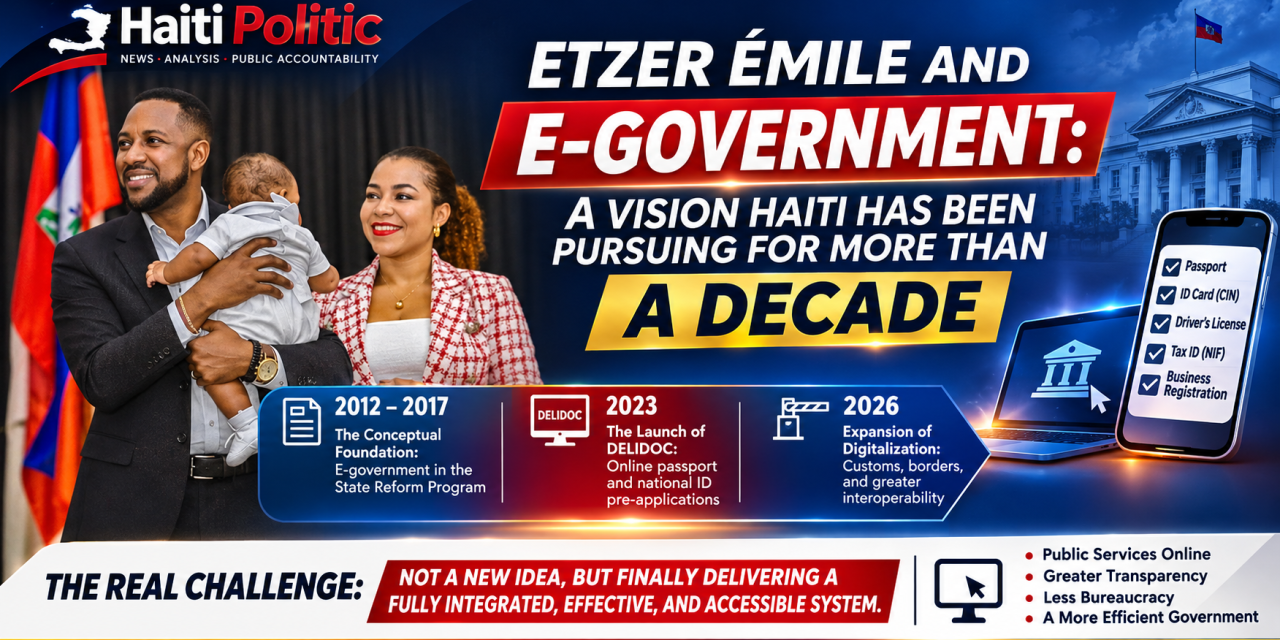
ETZER ÉMILE AND E-GOVERNMENT: A VISION HAITI HAS BEEN PURSUING FOR MORE THAN A DECADE
One digital account for passports, driver’s licenses, birth certificates, and tax identification numbers sounds revolutionary. But Haiti began pursuing electronic government years ago. From the 2012–2017 State Reform Program to DELIDOC in 2023 and expanding digital services in 2026, the real question is not who proposes digital government—but who understands what already exists and how to make it work.
HAITI POLITIC | POLITICAL ANALYSIS & PUBLIC ADMINISTRATION
November 4, 2026
INTRODUCTION: AN INTERESTING PROPOSAL, BUT IS IT REALLY NEW?
A recent social media post by a user identified as Jeffson has renewed discussion about the modernization of Haiti’s public administration.
The proposal, presented in connection with economist Etzer Émile’s political vision, asks a simple question:
How many working days does an ordinary Haitian citizen lose trying to obtain a government document?
Jeffson suggests that within the first 100 days of a new administration, citizens should be able to use a single online account to request passports, driver’s licenses, civil registry extracts, and fiscal identification numbers while tracking the progress of their applications.
The proposal is attractive.
It addresses a genuine problem affecting millions of Haitians: an administrative system in which obtaining basic documents can require repeated visits, long waiting periods, transportation expenses, and interactions with multiple government offices.
Jeffson explicitly states that his proposal does not constitute an official commitment by Etzer Émile.
That distinction matters. It would be inaccurate to attribute the proposal directly to Émile without evidence that he has formally adopted it.
Nevertheless, the proposal raises a larger question about political leadership and institutional knowledge in Haiti.
Is the concept of electronic government genuinely new to Haiti?
The answer is no.
Electronic government, commonly known as e-government, has appeared in Haiti’s public administration reform agenda for well over a decade.
Several government institutions have already introduced digital platforms for administrative services.
The problem is that these systems remain fragmented, unevenly implemented, and insufficiently accessible to the general population.
Haiti does not need another politician to discover e-government. It needs leaders capable of completing, integrating, and improving the digital transformation already underway.
1. WHAT IS E-GOVERNMENT?
Electronic government refers to the use of information and communication technologies to improve how public institutions deliver services, manage information, conduct transactions, and interact with citizens and businesses.
It involves much more than establishing a government website.
A functioning e-government system can allow citizens to apply for documents, pay government fees, submit tax declarations, register businesses, verify records, and monitor administrative requests electronically.
At a more advanced level, it allows government institutions to exchange authorized information securely without requiring citizens to submit the same documents repeatedly.
For example, a citizen applying for a passport should not necessarily have to obtain a paper document from one government agency simply to deliver it physically to another agency if the relevant information can be verified electronically and lawfully.
The goal is to make government services faster, more accessible, more transparent, and less expensive.
The Five Core Purposes of E-Government
1. Administrative Efficiency
Electronic systems can reduce paperwork, eliminate repetitive procedures, and improve the speed of public services.
A properly designed system allows government employees to process applications using standardized workflows.
2. Greater Accessibility
Citizens should not have to travel long distances simply to begin an administrative request.
Online platforms can make services available beyond traditional office hours.
However, accessibility also requires alternatives for people without reliable internet connections, smartphones, or digital literacy.
3. Transparency and Accountability
Digital applications can generate timestamps, tracking numbers, electronic receipts, and records of administrative decisions.
These features make it easier to determine whether an application was processed correctly and within established deadlines.
4. Reduced Opportunities for Corruption
Electronic payments and standardized procedures can reduce unnecessary interactions between applicants and government employees.
They can also create records that make irregular transactions easier to detect.
Technology does not automatically eliminate corruption, but properly implemented systems can strengthen accountability.
5. Better Public Administration
Government institutions can use reliable administrative data to improve planning, allocate resources, and evaluate public services.
The ultimate objective is not simply technological modernization.
It is institutional modernization through technology.
2. THE FOUR MAIN TYPES OF E-GOVERNMENT INTERACTIONS
Electronic government generally operates through four principal relationships.
Government-to-Citizen (G2C)
This includes services delivered directly to individuals.
Examples include passport applications, national identification cards, civil registry documents, tax identification numbers, and public-service payments.
Jeffson’s proposal primarily concerns this category.
Government-to-Business (G2B)
This involves transactions between government institutions and private enterprises.
Examples include business registration, commercial licenses, tax declarations, customs procedures, and regulatory compliance.
Haiti has already introduced electronic services in this area.
Government-to-Government (G2G)
This is the exchange of information between public institutions.
For example, authorized communication between the Directorate General of Taxes (DGI), the National Identification Office (ONI), the immigration authorities, and the National Archives.
This category is particularly important because a single digital portal cannot operate effectively if the agencies behind it remain disconnected.
Government-to-Employee (G2E)
This concerns the relationship between public institutions and government employees.
Examples include payroll management, personnel records, training, performance evaluations, and internal administrative procedures.
A comprehensive e-government strategy must address all four categories.
A country does not achieve digital government merely by allowing citizens to complete forms online. The transformation becomes meaningful when the institutions processing those forms can operate efficiently together.
3. HAITI’S E-GOVERNMENT EVOLUTION: 2012–2026
2012–2017: THE CONCEPTUAL FOUNDATION
One of the recurring weaknesses in Haitian political debates is the absence of institutional memory.
New political figures frequently introduce proposals without adequately examining whether previous administrations already developed similar initiatives.
Haiti’s experience with e-government illustrates this problem.
Under the Programme-Cadre de Réforme de l’État (PCRE) 2012–2017, the Haitian government identified the development of electronic government as one of the major components of public administration reform.
The program was associated with the Office of Human Resources Management (OMRH), which played a central role in coordinating administrative modernization.
Its objectives included improving public-sector efficiency, strengthening institutional management, and modernizing government services.
Electronic government was explicitly recognized as a reform priority.
The initiative also built upon an earlier period of state reform covering 2007–2012.
In an official address delivered on October 20, 2017, the Haitian government again identified electronic government as part of its broader administrative reform agenda.
This historical record establishes an important fact:
By 2012, Haiti had already incorporated e-government into its official public administration reform strategy.
Consequently, the concept cannot reasonably be presented as a newly discovered approach to governance in 2026.
The relevant questions are what those earlier programs accomplished, why implementation remained incomplete, and what future administrations should do differently.
4. 2023: DELIDOC MOVES DIGITAL GOVERNMENT FROM POLICY TO PRACTICE
A significant development occurred in March 2023.
Under the administration of Prime Minister Ariel Henry, the Haitian government introduced DELIDOC, an electronic platform designed to facilitate administrative requests involving identity documents.
The system was intended to simplify preliminary procedures for passports and national identification cards.
Through the official portal, applicants could begin certain administrative processes electronically and arrange appointments with the relevant government offices.
On April 10, 2023, the government announced additional measures concerning the reception and delivery of identity documents in the Port-au-Prince metropolitan area.
Appointments arranged through DELIDOC became part of the administrative process.
The initiative involved coordination among several public institutions, including agencies responsible for taxation, national identification, immigration, and civil records.
Why DELIDOC Matters
DELIDOC demonstrated that the Haitian government had already moved beyond discussing electronic government as an abstract concept.
It had begun implementing digital administrative services.
The platform also illustrated an early attempt to coordinate procedures involving multiple public institutions.
However, DELIDOC should not be confused with a fully digital government system.
Beginning an application online does not necessarily eliminate the need for physical appointments.
Passport processing and identification services may still require biometric collection, identity verification, or other in-person procedures.
Moreover, the existence of a portal does not establish that the service is consistently available nationwide.
DELIDOC’s launch represented progress, but it did not complete Haiti’s digital transformation.
The central challenge is no longer proving that Haiti can establish an electronic platform. It is demonstrating that such platforms can operate reliably, securely, and at scale.
Official portal: https://www.delidoc.gouv.ht/
5. HAITI ALREADY OFFERS ONLINE BUSINESS-REGISTRATION SERVICES
Another example comes from the Ministry of Commerce and Industry (MCI).
Through its electronic portal, Guichet MCI, the ministry provides online administrative services related to individual business registration.
The platform allows entrepreneurs to initiate registration requests, monitor applications, and access functions associated with business-name verification and registration records.
This is an example of Government-to-Business interaction.
It demonstrates that electronic government in Haiti is not limited to passport and identification services.
The government has also developed digital tools intended to support commercial activity.
However, an online business-registration platform does not necessarily mean every category of company can complete every legal requirement entirely online.
Different business structures may involve additional procedures, institutions, and documentation.
The significance of Guichet MCI is therefore not that Haiti has achieved comprehensive business digitalization.
It is that an operational framework for certain electronic commercial services already exists.
Official portal: https://guichet.mci.ht/
A serious modernization strategy should examine how to improve these existing platforms rather than automatically proposing to replace them.
6. 2026: THE EXPANSION OF CUSTOMS AND BORDER DIGITALIZATION
Electronic government also extends to international trade and customs administration.
In 2026, the World Customs Organization published an account of modernization priorities involving Haiti’s General Customs Administration (AGD).
The initiatives included efforts to improve digital customs procedures, information management, risk analysis, and coordination with other public institutions.
One objective involves developing a more integrated electronic environment for customs formalities.
Such a system could allow businesses to submit information, complete procedures, and make payments through interconnected administrative channels.
The modernization agenda also involves the continued use and improvement of electronic customs-management systems, including ASYCUDA.
These initiatives are important because customs administration affects government revenue, commercial activity, and border management.
However, a distinction must be maintained between a planned reform and a completed reform.
The 2026 modernization agenda does not establish that all proposed electronic systems have already been fully deployed across Haiti’s ports and border crossings.
Some elements remain objectives requiring implementation.
Nevertheless, these developments reinforce the broader conclusion:
Haiti’s e-government evolution has involved multiple institutions and administrations, not a single political personality or a newly proposed 100-day initiative.
7. THE REAL TECHNICAL CHALLENGE: BACK-END INTEROPERABILITY
Jeffson’s proposal calls for a single account through which citizens could request several government documents.
This concept is widely known as a one-stop government portal.
It is frequently associated with single sign-on, a technology that allows users to access multiple services through one authenticated account.
But creating a unified login page is only the visible part of the challenge.
The difficult work occurs behind the interface.
Consider a citizen requesting a passport.
The relevant agency may need to verify identity information, civil records, eligibility, and payment status.
If the required information exists in separate government databases that cannot communicate, the applicant may still be forced to obtain documents manually.
A single portal would then become little more than a digital entrance to the same fragmented bureaucracy.
What Genuine Interoperability Requires
A reliable digital identity system: Government institutions must be able to verify applicants accurately.
Secure authentication: Citizens must be protected against identity theft and unauthorized access.
Compatible administrative systems: Institutions must be able to exchange information through standardized and authorized processes.
Data protection: Sensitive personal information must be accessible only to authorized parties for legitimate purposes.
Electronic payment infrastructure: Fees must be collected transparently and recorded accurately.
Application tracking: Citizens should receive reference numbers, status updates, and clear explanations of delays.
Institutional accountability: Each participating agency must have defined responsibilities and measurable performance standards.
Public accessibility: Citizens without reliable internet access must retain practical alternatives.
Without these foundations, a unified digital portal may improve appearances without fundamentally improving government performance.
A single account is a technological feature. A functioning digital government is an institutional achievement.
8. WHAT EXACTLY WOULD ETZER ÉMILE BRING THAT HAITI HAS NOT ALREADY ATTEMPTED?
This is where the political debate becomes more consequential.
Etzer Émile is an economist who has built a public profile around economic analysis, institutional reform, and Haiti’s development challenges.
If digital government becomes part of his political platform, the public deserves more than a general promise of modernization.
It deserves a detailed explanation of how his administration would build upon previous investments.
The first responsibility of a serious reformer is to understand the institutional history of the reform being proposed.
What Happened to the 2012–2017 Reform Agenda?
Which electronic government initiatives were completed?
Which were abandoned?
What resources were allocated?
Were the results independently evaluated?
What Has DELIDOC Accomplished Since 2023?
How many applications has the platform processed?
What percentage were completed successfully?
How long does processing take?
Which technical or administrative obstacles remain?
How Would Existing Government Platforms Be Integrated?
Would DELIDOC become part of a broader national portal?
Would Guichet MCI retain its current functions?
How would the DGI, ONI, immigration authorities, and National Archives exchange information?
What Would the Reform Cost?
What infrastructure would be required?
How much would software development, cybersecurity, training, and maintenance cost?
Would the project depend on foreign donors?
Would Haitian public institutions retain control over the systems and data?
These questions matter because announcing a digital government strategy is not the same as demonstrating the capacity to implement one.
Émile does not need to invent an entirely new concept to make a meaningful contribution.
He does, however, need to explain what his approach would accomplish that previous administrations failed to deliver.
9. CAN A GOVERNMENT REALLY DELIVER A UNIFIED DIGITAL SYSTEM IN 100 DAYS?
The proposal’s most ambitious element is its timeline.
A 100-day commitment may be politically attractive, but its feasibility depends on the condition of existing systems.
A government could reasonably use its first 100 days to conduct a comprehensive inventory of digital platforms, assess cybersecurity risks, identify compatible services, and establish an interoperability strategy.
It might also launch a limited pilot project connecting selected administrative services.
However, integrating passport applications, driver’s licenses, civil records, and tax identification services into one secure national platform would require more than a website redesign.
It could involve software integration, legal reforms, database modernization, identity verification, payment infrastructure, staff training, and new institutional agreements.
Some of these requirements may take substantially longer than 100 days.
A credible proposal should therefore distinguish between three milestones:
First 100 days: Audit existing systems, establish governance, publish technical requirements, and begin a limited pilot.
First year: Integrate selected services, test electronic payments, strengthen cybersecurity, and publish performance indicators.
Long-term implementation: Expand nationwide access, improve interoperability, and develop a sustainable maintenance and funding model.
The precise timetable should be based on technical assessments rather than political optimism.
A government that promises everything immediately risks repeating the same cycle of ambitious announcements followed by incomplete execution.
Digitizing a dysfunctional administrative process without reforming the process itself can simply produce a dysfunctional process online.
10. HAITI’S BIGGER PROBLEM: INSTITUTIONAL CONTINUITY
The history of electronic government in Haiti reveals a problem extending far beyond technology.
Public institutions repeatedly begin reforms without establishing sufficient continuity, transparency, or long-term accountability.
A new administration announces a modernization program.
Another administration introduces a different initiative.
New political figures propose similar solutions.
Yet the public rarely receives a comprehensive explanation of what previous programs accomplished.
The result is a political environment in which old concepts can repeatedly be marketed as new visions.
This pattern undermines institutional learning.
It also creates the risk of duplicating public expenditures.
A future administration should not automatically abandon an existing platform because it was introduced under a previous government.
Nor should it preserve a failing platform merely because public money has already been spent on it.
The appropriate approach is to evaluate the technology, costs, performance, security, and public benefits.
Effective systems should be strengthened.
Deficient systems should be corrected.
Unnecessary systems should be retired through a transparent process.
Public administration reform must belong to the Haitian state—not to the political administration that happens to announce it.
11. FIVE QUESTIONS ETZER ÉMILE SHOULD ANSWER
If Etzer Émile intends to make electronic government part of his political or economic vision, Haiti Politic believes five questions deserve clear answers.
1. Are you familiar with Haiti’s 2012–2017 State Reform Program?
Electronic government was already included in that agenda. What is your assessment of its achievements and failures?
2. What would your proposal accomplish that DELIDOC has not?
Would you expand the existing platform, replace it, or integrate it into a broader government system?
3. How would you establish interoperability among government institutions?
What technical and legal framework would connect the DGI, ONI, National Archives, immigration authorities, and Ministry of Commerce while protecting citizens’ personal information?
4. What would the project cost, and who would finance it?
Would it rely on the Haitian national budget, international assistance, or public-private partnerships? What safeguards would protect public funds and sensitive data?
5. How would you guarantee continuity beyond the first 100 days?
Which institution would manage the platform? Who would maintain it? What measurable targets would allow the public to evaluate its performance?
These are not questions designed to dismiss technological modernization.
They are the questions that distinguish a credible public policy from an attractive campaign proposal.
CONCLUSION: HAITI DOES NOT LACK IDEAS. IT LACKS CONTINUITY, EXECUTION, AND ACCOUNTABILITY.
The proposal to provide citizens with a single digital account for government services is reasonable.
It addresses genuine administrative inefficiencies.
It could reduce unnecessary travel, improve transparency, and make public services more accessible.
But it is not a new concept.
Haiti formally incorporated electronic government into its public administration reform agenda during the 2012–2017 period.
The country introduced DELIDOC in 2023.
The Ministry of Commerce and Industry has developed an electronic platform for certain business-registration procedures.
Customs authorities have pursued additional digital modernization.
These initiatives demonstrate that Haiti has already begun moving toward electronic government.
They also demonstrate how much work remains unfinished.
The central issue is therefore not whether Haiti should adopt e-government.
The country has already adopted the concept. The question is why implementation remains fragmented and how the next administration would finally deliver an integrated, reliable system.
This is where Etzer Émile—or any political figure presenting a modernization agenda—must be challenged.
Not because the proposal is inherently wrong.
Not because the country does not need digital services.
But because serious leadership requires an understanding of the institutions, policies, investments, and failures that preceded it.
A leader who proposes electronic government without examining Haiti’s existing digital infrastructure risks repeating work already attempted.
A leader who understands that history has an opportunity to improve upon it.
THE QUESTION HAITI POLITIC IS ASKING
WHY ARE HAITIANS STILL BEING PROMISED A DIGITAL GOVERNMENT WHEN THE HAITIAN STATE BEGAN PURSUING THAT OBJECTIVE MORE THAN A DECADE AGO?
Is the problem a lack of ideas?
Or is it a failure of implementation, institutional continuity, and accountability?
Etzer Émile does not need to reinvent e-government.
He needs to demonstrate how he would make Haiti’s existing digital-government initiatives deliver the results they were originally intended to achieve.
Because a country does not develop simply by announcing new ideas.
A country develops when its leaders understand what has already been attempted, identify what remains unfinished, and build institutions capable of delivering lasting results.
HAITI POLITIC | INDEPENDENT POLITICAL ANALYSIS
SOURCES AND REFERENCE DOCUMENTS
1. Office of Human Resources Management (OMRH)
Programme-Cadre de Réforme de l’État, 2012–2017.
Haiti’s public administration reform framework, including electronic government as a modernization priority.
2. OMRH — Official Address, October 20, 2017
Government discussion of administrative modernization and the development of electronic government.
https://omrh.gouv.ht/201710201703
3. Government of Haiti — DELIDOC, April 10, 2023
Official communication concerning the introduction and gradual implementation of DELIDOC.
https://communication.gouv.ht/in/le-delidoc-graduellement-operationnel-au-benefice-des-contribuables/
4. Ministry of Commerce and Industry — Guichet MCI
Official electronic platform for business-related administrative procedures.
https://guichet.mci.ht/
5. World Customs Organization — Haiti Customs Modernization, 2026
Protecting Society in a Context of Political and Security Crisis: Revisiting Haiti.
https://mag.wcoomd.org/magazine/wco-news-110-issue-2-2026/revisiting-haiti/
6. DELIDOC — Official Government Portal
https://www.delidoc.gouv.ht/
PUBLICATION DETAILS
SEO Title: Etzer Émile’s E-Government Proposal: Haiti’s Digital Transformation Began Long Before 2026
Meta Description: Haiti has pursued e-government since at least 2012. Haiti Politic examines Etzer Émile’s digital-government vision, DELIDOC, online business registration, and the unfinished challenge of modernizing public services.
Suggested URL Slug:etzer-emile-egovernment-haiti-delidoc-digital-transformation
Category: Politics / Government Accountability / Technology
Tags: Etzer Émile, E-Government, Haiti Digital Transformation, DELIDOC, OMRH, Public Administration Reform, Haitian Government, Digital Services, Government Accountability
Suggested Banner Headline:
ETZER ÉMILE’S E-GOVERNMENT VISION: WHAT’S NEW ABOUT AN IDEA HAITI HAS PURSUED SINCE 2012?
DELIDOC, Online Business Registration, and the Unfinished Promise of Digital Government in Haiti