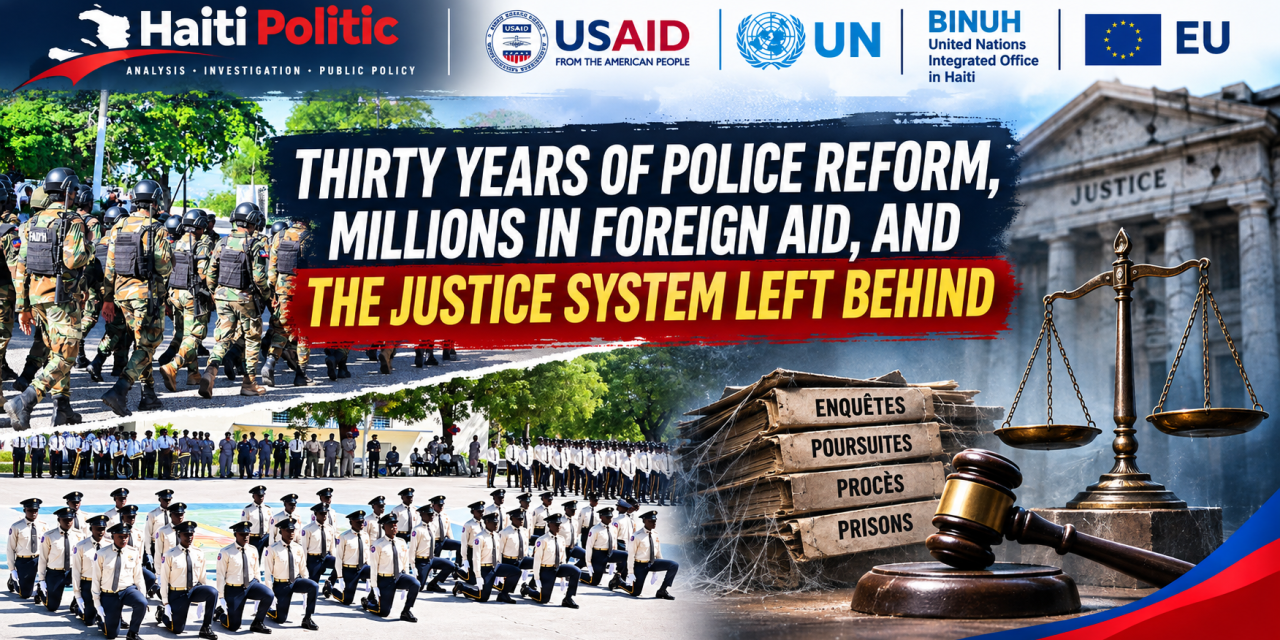
THIRTY YEARS OF POLICE REFORM, MILLIONS IN FOREIGN AID, AND THE JUSTICE SYSTEM LEFT BEHIND
From the PNH’s creation in 1995 to P4000 in 2026, Haiti has repeatedly received international assistance to recruit, train, and equip police officers. Why does the country still struggle to build a functioning criminal justice system—and who is accountable for the money and results?
HAITI POLITIC | INVESTIGATIVE ANALYSIS
November 4, 2026
INTRODUCTION: ANOTHER POLICE PROGRAM, ANOTHER PROMISE
In 1995, Haiti established the Haitian National Police (PNH) with substantial assistance from the United States and the United Nations.
The objective was to create a professional civilian police force capable of protecting the population, enforcing the law, and operating independently of political interference.
More than three decades later, Haiti is once again implementing an internationally supported police recruitment initiative.
This time, the program is called P4000+.
The initiative aims to recruit and train approximately 4,000 additional police officers to strengthen the PNH’s operational capacity.
The Haitian government presents the program as part of its strategy to confront armed gangs and restore public security.
The United States, through the State Department’s Bureau of International Narcotics and Law Enforcement Affairs (INL), has provided financial support.
Yet the fundamental question remains:
How many times can Haiti recruit thousands of new police officers before confronting the institutional problems that have repeatedly weakened the force?
Since 1995, international partners have financed police training, recruitment, infrastructure, professionalization, equipment, and institutional development.
The United Nations has operated successive missions intended, in part, to strengthen Haiti’s security institutions.
The United States has invested in police recruitment and specialized training.
Canada and other donors have contributed to security-sector assistance.
Nevertheless, Haiti continues to face severe institutional weaknesses, organized criminal violence, judicial dysfunction, and political instability.
The problem cannot be explained by police recruitment numbers alone.
It requires examining the relationship between the police, prosecutors, courts, prisons, political authorities, and the international institutions financing reform.
The central issue is not simply whether Haiti needs more police officers. It is whether the country is building a justice system capable of supporting them.
PART I — THE FIRST P4000: HAITI’S POLICE-BUILDING EXPERIMENT BEGAN IN 1994
The modern PNH emerged from Haiti’s political transition following the restoration of President Jean-Bertrand Aristide in 1994.
The United States played a significant role in establishing the institution through the Department of Justice’s International Criminal Investigative Training Assistance Program (ICITAP).
The initial police-development plan envisioned recruiting approximately 4,000 officers by early 1996.
That target was subsequently expanded.
The similarities between the original recruitment initiative and today’s P4000 program are striking.
Both emerged during periods of profound political and security instability.
Both relied on international assistance.
Both emphasized increasing the number of trained police personnel.
And both were presented as important steps toward strengthening Haiti’s capacity to maintain public order.
However, the original police-building effort also encountered difficulties.
Recruitment and training were only part of the challenge.
The new institution required experienced leadership, reliable financial management, functioning disciplinary procedures, effective criminal investigations, and cooperation with judicial authorities.
These challenges would become recurring themes in subsequent reform programs.
Thirty years later, Haiti is still attempting to resolve many of the institutional weaknesses identified during the PNH’s earliest years.
Source: Washington Office on Latin America, Policing Haiti: Reforming the Police; U.S. Department of Justice, ICITAP historical program records.
PART II — EIGHT MAJOR PHASES OF INTERNATIONAL POLICE ASSISTANCE
There is no single public inventory establishing the exact number of internationally financed police-development programs implemented in Haiti since 1995.
Nevertheless, the historical record identifies at least eight major phases of police reform and international assistance.
1994–1996: Establishing the PNH
International assistance focused on recruitment, basic training, institutional organization, and the establishment of a civilian police force.
The United States and UNMIH played significant roles.
1996–2000: Consolidating the new police institution
Successive UN missions—including UNSMIH, UNTMIH, and MIPONUH—supported police professionalization and institutional development.
The objective was to strengthen the newly created PNH and improve its ability to operate independently.
2004–2006: Rebuilding after political upheaval
Following the 2004 political crisis, MINUSTAH and international partners became heavily involved in supporting the PNH.
The emphasis returned to recruitment, institutional restructuring, and operational capacity.
2006–2011: The five-year PNH reform plan
The Haitian government adopted a reform strategy that included an ambitious personnel expansion.
The plan sought to increase the force toward approximately 14,000 officers while improving training, equipment, administrative management, and accountability.
Historical research indicates that PNH staffing increased from approximately 7,500 officers in 2006 to nearly 9,500 by late 2009.
Progress occurred, but the force remained below its long-term recruitment objective.
The January 2010 earthquake subsequently devastated Haiti’s infrastructure and disrupted police operations.
2012–2016: Another major development plan
Haiti again pursued police expansion.
The objective included increasing the force toward approximately 15,000 officers.
According to the U.S. State Department, INL-supported programs helped train 5,713 new Haitian police officers between the 2010 earthquake and March 2017.
By March 2017, the PNH had approximately 14,650 officers.
This was a significant numerical achievement.
However, the same U.S. reporting acknowledged that the institution continued to face administrative and operational weaknesses.
2017–2019: MINUJUSTH and institutional consolidation
Following MINUSTAH, the UN established MINUJUSTH.
The mission focused on strengthening the rule of law, supporting police development, and improving human rights institutions.
Its mandate reflected the recognition that police reform could not be separated from judicial reform.
2019–2024: BINUH and donor-financed police assistance
BINUH replaced MINUJUSTH as a political mission.
Its original responsibilities included advising on police professionalization, institutional development, accountability, and coordination.
International donors also established financing mechanisms to support police equipment, training, and institutional strengthening.
2025–2026: P4000+
The Haitian government introduced another major police recruitment initiative.
On October 20, 2026, the PNH reported that 2,069 new officers had joined the force through the 35th and 36th promotions.
The program receives U.S. financial assistance through INL.
The immediate objective is to increase the PNH’s operational capacity during Haiti’s security crisis.
But the historical record raises a question that cannot be answered by graduation figures alone.
What institutional reforms will make P4000 more sustainable than previous recruitment initiatives?
PART III — THE RECRUITMENT PARADOX: HAITI HAS TRAINED THOUSANDS OF OFFICERS BEFORE
One of the most revealing findings comes from U.S. government reporting in 2017.
By that time, international assistance had helped Haiti expand the PNH to nearly 15,000 officers.
Thousands of recruits had completed training.
Specialized units had received assistance.
Police infrastructure and equipment had been improved.
Yet the U.S. government continued to identify serious weaknesses in the institution’s administrative and operational capacity.
It also acknowledged the importance of judicial reform, prison conditions, and prolonged pretrial detention.
This creates a fundamental distinction between two different measures of success.
Recruitment success: How many officers graduate from the police academy?
Institutional success: Can the police investigate crimes, protect communities, maintain professional standards, and work effectively with prosecutors and courts?
These are not interchangeable.
A recruitment program can meet its numerical targets without producing a sustainable improvement in public security.
Likewise, a police force can become larger while remaining vulnerable to political interference, inadequate equipment, poor management, and judicial dysfunction.
This does not mean previous recruitment programs achieved nothing.
Historical records show measurable improvements during certain periods.
The problem is that those improvements were not consistently sustained.
The relevant question for P4000 is whether Haiti has established the institutional conditions necessary to preserve its results.
PART IV — THE MISSING LINK: WHAT HAPPENS AFTER THE PNH ARRESTS A GANG MEMBER?
Consider a hypothetical police operation.
PNH officers enter a gang-controlled neighborhood and arrest several suspected criminals.
The operation is successful.
Weapons are recovered.
Suspects are detained.
The government announces progress.
But what happens next?
The judicial police must collect evidence.
Prosecutors must prepare cases.
Judges must examine the evidence and determine legal responsibility.
Courts must conduct proceedings consistent with due process.
Prisons must securely and lawfully hold individuals awaiting trial or serving sentences.
Financial investigators must identify the networks supporting criminal organizations.
If these institutions cannot perform their responsibilities, police operations alone cannot produce lasting justice.
This is particularly serious in Haiti.
UNDP reported that approximately 84% of detainees were awaiting trial in 2024.
Such a high proportion of pretrial detainees reflects profound problems in judicial case processing and detention management.
It also creates significant pressure on prison infrastructure.
Why recruit thousands of additional police officers without establishing corresponding targets for prosecutors, judges, investigators, courtrooms, and correctional facilities?
This question deserves a direct response from the Haitian government and international donors.
The PNH does not operate in isolation.
It is one component of a criminal justice system.
Strengthening that component without adequately strengthening the others risks creating an institutional imbalance.
PART V — BINUH: POLICE ADVISER, INTERNATIONAL COORDINATOR, OR FINANCIAL GATEKEEPER?
The United Nations Integrated Office in Haiti, known as BINUH, was established in 2019.
Unlike MINUSTAH, BINUH is not a traditional peacekeeping force.
It is a political mission with advisory and coordination responsibilities.
Its original mandate included support for police professionalization, institutional development, accountability, human rights, and the rule of law.
BINUH does not possess legal authority to command the PNH.
Haitian authorities retain responsibility for police leadership and operations.
However, BINUH’s role in international assistance deserves closer examination.
The police-support financing mechanism
In 2022, BINUH and the United Nations Development Programme (UNDP) worked with Haitian authorities and international partners to establish a multi-donor police-support fund.
The fund was intended to strengthen the PNH through equipment, training, professionalization, and institutional development.
UNDP was designated as the fund manager.
BINUH participated in coordination and advocacy.
That distinction matters.
The organization coordinating a program is not necessarily the organization authorizing its payments.
However, coordination can still influence priorities, implementation arrangements, and the allocation of international assistance.
A proper investigation must therefore distinguish among:
-
Donors providing the money.
-
Organizations managing the funds.
-
Institutions determining program priorities.
-
Agencies approving procurement.
-
Contractors receiving payments.
-
Haitian authorities responsible for implementation.
-
Auditors evaluating expenditures.
Without examining these relationships, it is impossible to determine who exercises effective financial control over a particular program.
What do the financial records show?
A UN budget document reported that, by December 31, 2024, approximately $14.1 million had been disbursed or committed, including advances, against an initial allocation of approximately $25.5 million for the UNDP-managed police-support fund.
That represented roughly 55% of the initial allocation.
The UN identified implementation difficulties, including insecurity and logistical disruptions.
These figures demonstrate that implementation challenges existed.
They do not, by themselves, establish financial misconduct or intentional program failure.
Nevertheless, they raise legitimate questions about procurement, project management, expenditure verification, and the relationship between money spent and institutional results.
If international assistance is intended to strengthen Haiti’s police, the public should be able to trace the money from the donor to the final expenditure—and evaluate what was delivered.
PART VI — WHY DOES THE UN KEEP RENEWING BINUH’S MANDATE?
BINUH began operating in 2019.
Since then, Haiti has experienced worsening insecurity, political instability, and significant institutional disruption.
Yet the UN Security Council has repeatedly renewed the mission.
On January 29, 2026, the Council adopted Resolution 2814, extending BINUH’s mandate until January 31, 2027.
The resolution also revised and narrowed the mission’s responsibilities.
Its priorities include political dialogue, elections, community violence reduction, justice, human rights, and coordination with other international actors.
The Security Council’s stated justification is that Haiti continues to face serious political and institutional challenges requiring international assistance.
But renewal raises an important accountability question.
If institutional weakness repeatedly justifies the continuation of an international mission, how does the UN measure whether that mission is actually helping reduce the weakness?
There is an important distinction between a mission remaining necessary and a mission demonstrating measurable success.
A Security Council renewal authorizes continued operations.
It does not automatically establish that previous objectives have been achieved.
Nor does Haiti’s continued insecurity prove that BINUH caused the crisis.
The mission does not control Haiti’s government, police, courts, or political parties.
Its performance should be assessed against its actual mandate.
Nevertheless, after years of international engagement, the Security Council should be able to explain what measurable institutional improvements have occurred and what conditions would allow BINUH to complete its mission.
The question of an exit strategy
What would a successful conclusion to BINUH’s mission look like?
Would it require credible elections?
A functioning judiciary?
Improved police accountability?
Reduced gang violence?
A sustainable Haitian security budget?
Or a combination of these conditions?
Without clear benchmarks, repeated mandate renewals risk becoming disconnected from measurable institutional progress.
PART VII — THE INTERNATIONAL FINANCING QUESTION: WHO CONTROLS THE MONEY?
International police assistance involves several different organizations.
They should not be treated as a single financial institution.
The United States has supported police recruitment and training through INL.
UNDP has managed the multi-donor police-support basket fund.
BINUH has participated in institutional coordination and advisory activities.
Canada has financed police and justice-sector initiatives.
UNSOH, established in 2025, provides specified logistical and operational support to international security arrangements in Haiti.
These organizations have different responsibilities, funding sources, and financial-management systems.
What about P4000?
Public reporting identifies U.S. INL financial assistance for P4000.
However, the available documentation does not establish that BINUH directly controls P4000 expenditures.
Nor does it establish that USAID is the program’s principal financier.
That distinction is essential for financial accountability.
A serious investigation must identify the precise financing arrangements rather than attributing every internationally supported security program to the same institution.
The questions are straightforward.
Who authorizes P4000 purchases?
Who selects suppliers?
Who approves training contracts?
Who verifies deliveries?
Who audits expenditures?
Who determines whether the program has achieved its objectives?
And how much of the program’s total cost is financed by Haitian taxpayers?
These questions should be answered through contracts, budgets, financial statements, procurement records, and independent audits.
PART VIII — IS INTERNATIONAL ASSISTANCE FINANCING POLICE RECRUITMENT FASTER THAN JUSTICE REFORM?
The available evidence does not support the claim that international donors have completely ignored Haiti’s justice system.
Canada, for example, has committed CAD $8 million to a Justice Support Basket Fund covering 2024 through 2029.
The program is intended to strengthen judicial institutions, improve cooperation between prosecutors and police, and support investigations.
UNDP has also supported judicial training, institutional inspections, and justice-sector infrastructure.
Nevertheless, the existence of separate judicial assistance programs does not establish that police and justice investments are adequately coordinated.
That is the central issue.
If police recruitment expands faster than the judicial system’s capacity to process criminal cases, Haiti could end up with more arrests but insufficient capacity to deliver timely justice.
The Haitian government and international partners should therefore publish comparable data on police and judicial capacity.
For example:
How many new police officers have been trained?
How many additional prosecutors and judges have been trained?
How many courtrooms are functioning?
How many criminal cases are processed annually?
How many investigations lead to prosecutions?
How many prosecutions lead to convictions?
How many detainees remain in prolonged pretrial detention?
How many criminal financing networks have been investigated?
These indicators would provide a more complete picture of institutional progress.
Without them, security programs risk being evaluated primarily through spending announcements, equipment deliveries, and graduation ceremonies.
PART IX — WHY HAS THE PNH REMAINED INSTITUTIONALLY WEAK?
The historical record identifies several interconnected causes.
Political interference
The PNH has operated through repeated political transitions and crises.
Political interference can undermine professional appointments, promotions, disciplinary procedures, and investigations.
A police institution requires leadership selected through transparent professional standards rather than political loyalty.
Weak judicial institutions
Police operations depend on functioning prosecutors, courts, and prisons.
Without effective judicial institutions, arrests do not necessarily translate into successful prosecutions or lasting public security.
Inadequate administrative capacity
Recruitment creates continuing financial obligations.
Police officers need salaries, equipment, vehicles, communications, fuel, medical support, maintenance, and supervision.
A larger force without sustainable operating resources may struggle to maintain effectiveness.
Institutional instability
Political crises, the 2010 earthquake, and subsequent security emergencies disrupted long-term reform.
Frequent changes in leadership and policy priorities can weaken institutional continuity.
Accountability problems
The PNH has repeatedly required improved vetting, disciplinary procedures, internal investigations, and oversight.
Professionalization cannot succeed without credible mechanisms for addressing misconduct.
Dependence on external assistance
International programs can provide valuable expertise and resources.
However, reliance on external financing may create sustainability problems when projects end or donor priorities change.
Haiti must eventually be capable of financing, managing, and evaluating its own police institution.
Organized criminal networks
Armed groups have expanded their access to weapons, financing, and territory.
These networks place enormous pressure on the PNH.
Police recruitment alone cannot dismantle criminal financing, weapons trafficking, corruption, or political protection networks.
Each requires specialized investigations and functioning judicial institutions.
The weakness of the PNH is therefore not simply a shortage of police officers. It reflects weaknesses across the institutions responsible for maintaining the rule of law.
PART X — WHAT ABOUT THE POLITICIANS AND BUSINESSPEOPLE WHO FINANCE GANGS?
International security programs frequently emphasize operations against armed criminal groups.
But sustainable security also requires investigations into the people and networks that finance, equip, and protect those groups.
This includes examining potential connections involving political figures, business interests, arms traffickers, corrupt officials, and organized criminal networks.
Such investigations must be based on evidence.
No individual should be treated as guilty merely because of political affiliation, business activity, or unverified allegations.
However, the principle remains important:
A security strategy that targets armed gang members without investigating their financial and logistical networks risks leaving the underlying criminal infrastructure intact.
That creates the possibility that new groups will replace those dismantled by police operations.
The relevant question is not simply how many gang members have been arrested.
It is whether the institutions responsible for criminal investigations can identify and prosecute the networks that sustain organized violence.
This requires financial intelligence, international cooperation, prosecutorial capacity, judicial independence, and effective protection for witnesses.
PART XI — THE MISSING ACCOUNTING: HOW MUCH HAS THE WORLD SPENT ON HAITI’S POLICE SINCE 1995?
After more than three decades of international assistance, a comprehensive financial accounting is necessary.
However, the publicly available sources reviewed for this analysis do not establish a verified consolidated total for expenditures specifically devoted to PNH development between 1995 and 2026.
It would be misleading to add together the full budgets of UN peacekeeping missions and present the resulting amount as police-reform spending.
Peacekeeping budgets cover many activities beyond police development.
A credible financial investigation must separate:
Police recruitment: Academy operations, instructors, training materials, and cadet support.
Equipment: Vehicles, communications, protective equipment, weapons, and maintenance.
International personnel: Advisers, consultants, travel, accommodation, and technical assistance.
Institutional reform: Management systems, professional standards, vetting, and internal oversight.
Justice reform: Prosecutors, judges, court infrastructure, prisons, and criminal investigations.
It must also distinguish money pledged from money actually disbursed.
The ultimate accounting should identify who received the funds, what services or equipment were delivered, and whether the investments produced sustainable improvements.
The absence of a consolidated public accounting makes it harder for Haitian citizens to evaluate the long-term effectiveness of international police assistance.
PART XII — TEN QUESTIONS FOR THE UNITED NATIONS, THE UNITED STATES, AND HAITI’S GOVERNMENT
1. How many internationally financed PNH reform programs have been implemented since 1995?
The public deserves a complete inventory, including each program’s objectives, duration, financing, and results.
2. How much money has been spent specifically on police development?
International partners should distinguish police-related expenditures from broader peacekeeping and political mission budgets.
3. Why have recruitment programs repeatedly required new international financing?
What measures have been implemented to establish sustainable domestic financing and institutional management?
4. What measurable improvements resulted from earlier PNH reform plans?
How did the 2006–2011 and 2012–2016 initiatives perform against their original targets?
5. Why does P4000 emphasize recruitment without publishing corresponding judicial capacity targets?
How many additional prosecutors, judges, investigators, and functioning courtrooms will be needed?
6. Who controls P4000 expenditures?
Which institutions approve procurement, authorize payments, verify deliveries, and audit financial transactions?
7. What is BINUH’s measurable contribution to institutional reform?
What documented improvements can be attributed to its advisory and coordination responsibilities since 2019?
8. What explains the repeated renewal of BINUH’s mandate?
Which performance indicators does the Security Council use, and what conditions would allow the mission to conclude?
9. How are international security programs addressing gang financing?
What measurable progress has been achieved in investigating arms trafficking, financial networks, and alleged official complicity?
10. What is the long-term plan for Haitian institutional independence?
When will the PNH, courts, prosecutors, and correctional institutions be capable of operating without recurring externally financed reform programs?
CONCLUSION — HAITI DOES NOT NEED ANOTHER RECRUITMENT TARGET WITHOUT AN INSTITUTIONAL STRATEGY
The historical record establishes that P4000 is not Haiti’s first major internationally supported police recruitment initiative.
Since the PNH’s creation in 1995, successive Haitian governments and international partners have pursued repeated programs intended to expand, professionalize, and strengthen the institution.
Some initiatives produced measurable results.
Thousands of officers were trained.
Police staffing increased.
Infrastructure improved.
Specialized capabilities were developed.
But those achievements did not resolve the broader institutional weaknesses affecting Haiti’s criminal justice system.
Political instability, inadequate resources, judicial dysfunction, accountability problems, and organized criminal networks have repeatedly undermined progress.
The United Nations and international donors have acknowledged many of these problems for years.
They have also financed separate justice-sector initiatives.
The unanswered question is whether those initiatives have been sufficiently coordinated, implemented, and sustained.
Haiti cannot build lasting security through police recruitment alone.
It needs professional investigators.
It needs independent prosecutors.
It needs functioning courts.
It needs secure and lawful correctional facilities.
It needs credible investigations into criminal financing.
It needs transparent public spending.
And it needs institutions capable of operating without permanent dependence on international assistance.
P4000 may increase the number of officers available to the PNH.
But the number of graduates should not become the principal measure of success.
The real measure is whether Haiti can investigate crimes, prosecute offenders, protect victims, maintain public security, and hold powerful criminal networks accountable.
After more than 30 years of international police assistance, Haitian citizens have legitimate reasons to demand a complete accounting of what has been financed, what has been delivered, and what remains unfinished.
The same accountability must apply to successive Haitian governments, whose decisions have shaped the institution’s development.
THE QUESTION HAITI DESERVES ANSWERED
IF THE INTERNATIONAL COMMUNITY HAS BEEN HELPING HAITI REFORM ITS POLICE SINCE 1995, WHY ARE SO MANY OF THE SAME INSTITUTIONAL PROBLEMS STILL PRESENT IN 2026?
And perhaps more importantly:
WHAT WILL MAKE P4000 DIFFERENT FROM THE PROGRAMS THAT CAME BEFORE IT?
Until Haitian authorities and international partners can answer those questions with verifiable evidence, recruitment figures and funding announcements will provide only a partial measure of progress.
HAITI POLITIC
Independent analysis of public policy, governance, international assistance, and institutional accountability in Haiti.
SOURCES AND DOCUMENTARY REFERENCES
1. United Nations Security Council — Resolution 2814 (2026)
Renewal and revision of BINUH’s mandate through January 31, 2027.
https://mandates.un.org/mandate/S/RES/2814%282026%29
2. United Nations — BINUH Mandate
Historical advisory responsibilities concerning police professionalization, institutional development, justice, and human rights.
https://www.unmissions.org/en/binuh/mandate
3. United States Department of State — Supplemental Assistance Provided to Haiti Through March 31, 2017
Documentation of INL-supported police training, recruitment, institutional capacity, and judicial challenges.
https://2021-2025.state.gov/reports/report-on-supplemental-assistance-provided-to-haiti-since-2010-through-march-31-2017/
4. United Nations Development Programme — Rule of Law and Human Rights Annual Report 2024: Haiti
Information on judicial assistance, detention conditions, and institutional challenges.
https://rolhr.undp.org/annualreport/2024/impact/latin-america-caribbean/haiti.html
5. United Nations — BINUH Secretary-General Report, June 2022
Information on international police-support financing arrangements.
https://binuh.unmissions.org/sites/default/files/2022-06-13_-_sg_report_on_binuh.pdf
6. United Nations — Proposed Programme Budget, A/80/6 (Sect. 3)/Add.4
Information on police-support fund implementation and expenditure figures.
https://digitallibrary.un.org/record/4086441/files/A_80_6_%28Sect._3%29_Add.4-EN.pdf
7. Government of Canada — Justice Support Basket Fund
Canadian contribution to judicial institutional strengthening, 2024–2029.
https://search.open.canada.ca/grants/record/dfatd-maecd%2C064-2024-2025-Q2-00730%2Ccurrent
8. Washington Office on Latin America — Policing Haiti
Historical analysis of the PNH’s establishment, recruitment, and institutional challenges.
https://www.wola.org/sites/default/files/downloadable/Haiti/Past/haiti_policing_haiti.pdf
9. United Nations Support Office in Haiti — Background
Historical overview of international security missions in Haiti.
https://unsoh.unmissions.org/en/unsoh/background
10. Le Nouvelliste — P4000+ Police Recruitment Report, October 2026
Reported recruitment figures and program developments.
https://lenouvelliste.com/en/article/273110/p4000-plus-de-2-000-nouveaux-policiers-integres-au-sein-de-la-pnh