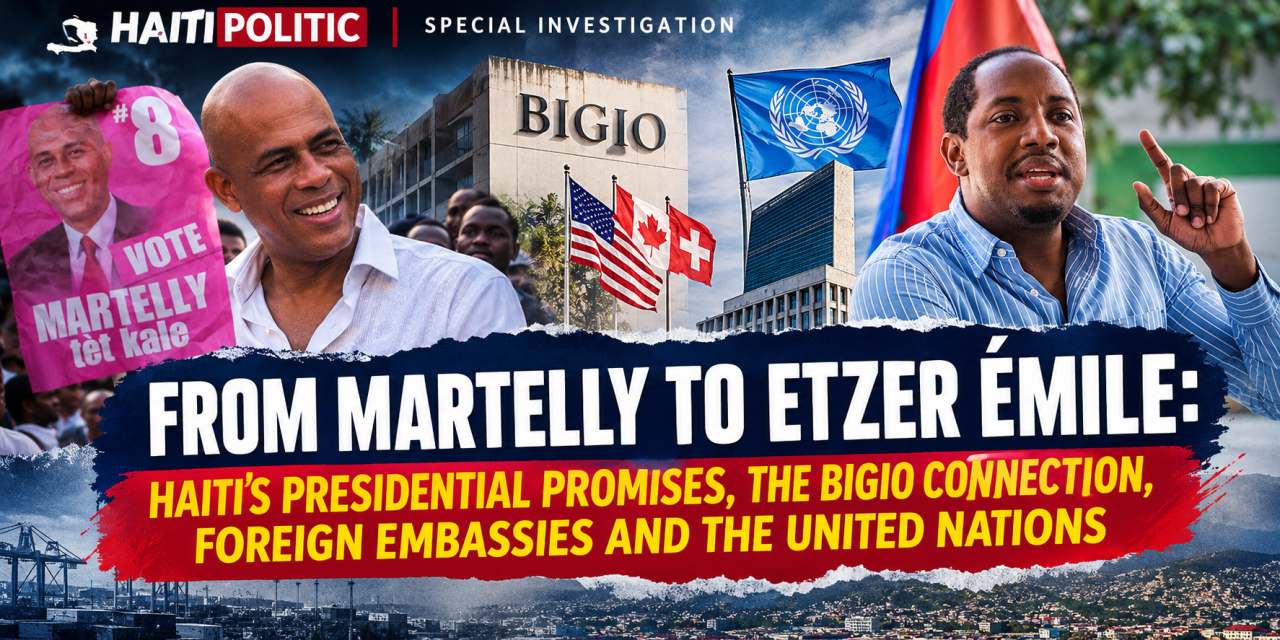
Sixteen years after Michel Martelly entered Haiti’s presidential race promising reconstruction and economic renewal, economist Etzer Émile is proposing a $30 billion national transformation. An examination of their political programs, business relationships and international connections raises questions about campaign financing, institutional independence and who ultimately influences Haiti’s development priorities.
HAITI POLITIC | SPECIAL POLITICAL INVESTIGATION
November 2, 2026
THE ECONOMIST, THE ENTERTAINER AND HAITI’S UNFINISHED POLITICAL TRANSFORMATION
In 2010, Haiti was emerging from one of the most devastating earthquakes in its history.
The country faced enormous reconstruction needs, widespread unemployment, weak public institutions and growing dependence on international assistance.
Into that political environment stepped Michel Joseph Martelly, a popular musician better known by his stage name, Sweet Micky.
Martelly promised a different approach to governing Haiti.
His campaign emphasized education, economic opportunity, agricultural development, reconstruction and the restoration of state authority.
Sixteen years later, another well-known Haitian public figure is seeking the presidency.
But Etzer Émile is not a musician.
He is an economist, professor, entrepreneur and business consultant whose public reputation has developed around his criticism of Haiti’s economic policies and institutional failures.
On October 31, 2026, Émile announced his presidential candidacy under the banner of Gwoupman Solèy.
His campaign presents an ambitious program for 2027–2032, including a proposed $30 billion investment target, expanded national security, infrastructure development, employment creation and education reform.
The candidates have different backgrounds, and the country faces different immediate challenges.
Yet the comparison reveals several recurring questions.
Who finances Haiti’s presidential campaigns?
What relationships exist between candidates and the country’s most influential business interests?
What role do foreign embassies and international institutions play in Haiti’s political and economic decisions?
And perhaps most importantly:
How can Haitian citizens distinguish genuine institutional reform from promises that depend on the same political, financial and international structures that previous governments struggled to reform?
These questions do not establish that Martelly and Émile share the same political sponsors or financial backers.
They establish a framework for comparing two campaigns separated by sixteen years.
PART I — TWO PRESIDENTIAL CAMPAIGNS, TWO NATIONAL CRISES
1. MICHEL MARTELLY’S 2010 CAMPAIGN: REBUILDING HAITI AFTER THE EARTHQUAKE
When Michel Martelly entered the 2010 presidential election, Haiti’s political agenda was dominated by reconstruction.
The January 12 earthquake had destroyed government buildings, homes, schools, hospitals and essential infrastructure.
International donors pledged substantial assistance.
Foreign governments, international organizations and nongovernmental organizations became deeply involved in reconstruction activities.
Martelly’s campaign presented national recovery as an opportunity to rebuild institutions and stimulate economic development.
His published October 2010 political program addressed education, public administration, agriculture, employment, healthcare and the restoration of state authority.
He also advocated reestablishing Haiti’s armed forces, which had been disbanded in 1995.
Martelly’s campaign was therefore not limited to entertainment-based popularity.
It included proposals concerning government organization, economic recovery and national development.
However, the political environment presented a major challenge.
Much of Haiti’s reconstruction financing depended on international donors.
The Haitian government also faced limited administrative capacity and serious weaknesses in public financial management.
The central question was how a new administration would coordinate reconstruction resources while strengthening Haitian institutions.
That question remained important throughout Martelly’s presidency.
2. ETZER ÉMILE’S 2026 CAMPAIGN: A $30 BILLION TRANSFORMATION PLAN
Émile’s campaign takes place in a different national emergency.
Haiti now faces widespread armed violence, territorial control by criminal groups, displacement, economic contraction and severe disruption of public services.
His official campaign website organizes its priorities around four major areas.
Security throughout the national territory.
Infrastructure that supports production.
Domestic production and employment creation.
Education focused on practical skills.
The campaign proposes mobilizing $30 billion over five years.
That represents an average of $6 billion annually.
Among the program’s stated objectives are expanding the Haitian National Police, creating formal employment, increasing electricity availability, developing industrial activity and raising education spending.
The campaign also proposes reforms to public procurement, taxation, financial oversight and government administration.
In its first-100-days agenda, Émile proposes recruiting and training an additional 1,000 to 2,000 police officers with international support.
He also proposes establishing a specialized judicial mechanism to investigate financial crimes and organized criminal activity.
His economic proposals include a national public-works program intended to create 50,000 temporary jobs, financing for productive small businesses and measures to encourage diaspora investment.
Unlike many broad political declarations, the published program includes numerical targets and proposed indicators.
But numerical targets are not the same as secured financing.
The $30 billion objective raises questions about the respective contributions of the Haitian government, private investors, international donors, lenders and the diaspora.
The central issue is not simply how much money Émile proposes to mobilize. It is who would provide that money, under what conditions, and who would control its use.
3. COMPARING THE TWO PRESIDENTIAL PROGRAMS
Despite their different political backgrounds, Martelly and Émile have emphasized several similar development priorities.
Education
Martelly promoted expanded access to education and subsequently implemented the Programme de Scolarisation Universelle Gratuite et Obligatoire, commonly known as PSUGO.
Émile proposes increasing education’s share of the national budget and expanding school infrastructure, vocational training and teacher development.
The historical comparison raises questions about financial accountability.
How would a future administration verify that education funding reaches functioning schools and produces measurable improvements?
Employment
Martelly campaigned on economic recovery and investment.
Émile proposes specific employment targets, productive lending, industrial development and special economic zones.
The question for both approaches is how to distinguish temporary economic activity from sustainable formal employment.
Infrastructure
Martelly entered office during an international reconstruction effort.
Émile proposes new investments in electricity, transportation, water, sanitation and productive infrastructure.
Both approaches require substantial financing and effective procurement systems.
Security
Martelly supported restoring the Haitian armed forces.
Émile proposes expanding the police force and strengthening coordination between the PNH and the Armed Forces of Haiti.
The security environment is now considerably different.
Émile’s program must address armed groups controlling territory, weapons trafficking, criminal financing and the restoration of judicial institutions.
International cooperation
Both programs emerged in a country where foreign financing and international assistance played important roles.
This creates a recurring accountability question:
How does Haiti obtain international assistance without allowing external financial arrangements to substitute for democratic control over national policy?
PART II — THE PRIVATE SECTOR AND HAITI’S PRESIDENTIAL POLITICS
4. THE 2010 ELECTION: WHEN BUSINESS INTERESTS AND FOREIGN DIPLOMACY INTERSECTED
One of the most consequential events in Martelly’s political career occurred before he became president.
Haiti’s November 2010 presidential election produced disputed preliminary results.
The initial results placed Mirlande Manigat first, Jude Célestin second and Michel Martelly third.
Under those results, Martelly would not have advanced to the presidential runoff.
The announcement triggered demonstrations and accusations of electoral irregularities.
The United States Embassy publicly questioned the preliminary results.
The Organization of American States subsequently conducted an electoral verification mission.
The final first-round ranking was revised, placing Martelly ahead of Célestin.
Martelly advanced to the runoff against Manigat and ultimately won the presidency.
The verification process became the subject of considerable controversy.
Critics questioned the OAS methodology and the influence of foreign governments.
Supporters of the verification process argued that irregularities in the original vote tabulation required corrective action.
But the most revealing historical evidence came from diplomatic communications released years later.
The Kenneth Merten emails
In 2015, the Center for Economic and Policy Research published an examination of emails released from Hillary Clinton’s tenure as U.S. secretary of state.
The reporting described communications involving U.S. Ambassador Kenneth Merten, American officials and Haitian private-sector representatives during the disputed election.
One December 2010 communication discussed businessman Reginald Boulos and private-sector efforts to persuade President René Préval to accept a political solution to the electoral crisis.
The emails also documented contact between Ambassador Merten and Martelly’s campaign.
The correspondence provides evidence that foreign diplomatic officials and Haitian business representatives were communicating about the political crisis and the electoral outcome.
It does not mean that every private-sector participant had the same objectives.
Nor does it establish that all major Haitian business families participated in those communications.
But it demonstrates that the 2010–2011 electoral crisis involved more than public campaign speeches and ordinary vote counting.
Private-sector influence and foreign diplomatic engagement were part of the documented political environment.
5. REGINALD BOULOS IS NOT THE BIGIO FAMILY
This distinction is essential to understanding the historical record.
Reginald Boulos was a prominent businessman associated with Haiti’s organized private-sector community.
The released diplomatic correspondence specifically identifies Boulos in discussions concerning the 2010 electoral crisis.
Gilbert Bigio and the wider Bigio business interests represent a separate business network.
Although both names are associated with Haiti’s influential commercial sector, they should not be treated as interchangeable.
Evidence that Boulos communicated with U.S. diplomats does not establish that Bigio participated in the same communications.
Likewise, evidence of private-sector support for an electoral process does not establish that every major business family financed a particular candidate.
For Martelly’s original campaign, the records examined here do not establish a verified direct campaign contribution from Gilbert Bigio, Reuven Bigio or a Bigio-controlled company.
That does not settle the question of whether such contributions occurred.
It means the available evidence is insufficient to make that claim.
A definitive investigation would require campaign-finance records, corporate documents, authenticated correspondence and other relevant financial evidence.
PART III — ETZER ÉMILE AND THE BUSINESS NETWORKS
6. HAÏTI EFFICACE: THE CONSULTING FIRM BEHIND THE ECONOMIST
Émile’s professional background provides a different starting point for investigating relationships with business and international institutions.
His consulting firm, Haïti Efficace, operates under the registered business name EMILE & CO.
According to its official website, the firm began operating in Haiti in 2014 and became a société en nom collectif in 2017.
The firm states that it has provided consulting services to approximately 100 companies, organizations and public institutions.
Its published client directory includes businesses, financial institutions, Haitian government agencies, foreign embassies and international organizations.
Among the listed clients are:
Financial institutions: Banque de l’Union Haïtienne, Banque de la République d’Haïti, Banque Nationale de Crédit, Banque Populaire Haïtienne and other financial organizations.
Government institutions: Haiti’s Ministry of Economy and Finance and Ministry of Commerce and Industry.
Private companies: DINASA, BRANA, Auto Plaza, Haïti Énergie Renouvelable and other enterprises.
Foreign diplomatic institutions: The U.S., Canadian and Swiss embassies.
International organizations: UN Women, the International Labour Organization and the United Nations Conference on Trade and Development.
The directory is significant because it identifies institutions with which the firm publicly claims professional relationships.
However, it does not disclose the precise dates, contract values, scope of work or current status of individual engagements.
The directory therefore cannot establish whether any client currently maintains a financial relationship with Émile or his firm.
It also does not establish that any client supports his presidential campaign.
Nevertheless, it creates a legitimate basis for examining how Émile would manage potential conflicts of interest if elected president.
7. THE DINASA CONNECTION: PETROLEUM POLICY AND PROFESSIONAL RELATIONSHIPS
One particularly relevant entry in Haïti Efficace’s client directory is DINASA.
DINASA operates in Haiti’s petroleum distribution industry.
The petroleum sector has been central to disputes over fuel imports, pricing, subsidies, taxation and the concentration of economic power.
During Jovenel Moïse’s presidency, Haiti experienced repeated petroleum-related controversies.
Fuel shortages, subsidy pressures, changes in import arrangements and questions about private-sector participation became major political issues.
Émile publicly commented on Haiti’s economic policies during this period.
His consulting firm’s listing of DINASA therefore raises a specific question.
Did Haïti Efficace provide consulting services to DINASA during periods when Émile was publicly analyzing petroleum policies affecting the company?
The published directory does not provide enough information to answer.
It would be inappropriate to assume that DINASA influenced his economic commentary.
But the timing and scope of the professional relationship are relevant to understanding potential conflicts of interest.
A useful disclosure would identify the dates of the assignments, the general services performed and whether any financial relationship remains active.
8. THE BIGIO CONNECTION: BANDARI AND ÉMILE’S FAMILY
A separate issue involves the professional background of Émile’s wife, Shelda Francillon.
In a previous Haiti Politic investigation, professional-profile material attributed to Francillon identified employment at BANDARI HAITI S.A.
The material described an earlier fuel-card support position and a subsequent business-consulting role.
Bandari has been described in the investigation as associated with the Bigio business network.
This creates a potential connection through family employment rather than through documented campaign financing.
That distinction matters.
An individual’s employment at a company does not establish that the company supports the individual’s spouse politically.
Nor does it establish that the company’s shareholders influence the spouse’s policy positions.
The available material does not prove that Bigio interests finance or direct Émile’s campaign.
The previously reported employment details and Bandari’s current ownership structure also require updated independent verification.
Nevertheless, the relationship raises a legitimate question concerning presidential conflict-of-interest rules.
If Émile becomes president, his administration could make decisions involving fuel imports, petroleum taxation, commercial licensing, subsidies and energy regulation.
Those decisions could affect companies with which he or members of his household have had professional relationships.
The relevant issue is whether a future administration would adopt clear disclosure and recusal procedures.
Two separate relationships
The investigation identifies two different reported professional connections:
Haïti Efficace → DINASA
This relationship is supported by the consulting firm’s published client directory.
Shelda Francillon → Bandari Haiti S.A. → Bigio-associated business interests
This relationship was reported from professional-profile and corporate material examined in the earlier investigation, but its current details require additional verification.
These relationships should not be combined into a claim that DINASA and Bandari jointly support Émile.
No such joint political arrangement has been established.
PART IV — FOREIGN EMBASSIES AND THE QUESTION OF POLITICAL INDEPENDENCE
9. MARTELLY’S CAMPAIGN AND THE UNITED STATES EMBASSY
The role of the United States during Haiti’s 2010–2011 electoral crisis is extensively documented.
After preliminary election results placed Martelly third, the U.S. Embassy publicly raised concerns about the announced outcome.
Diplomatic correspondence later revealed communications involving American officials, Haitian private-sector representatives and Martelly’s campaign.
The OAS verification process subsequently changed the official ranking of the second- and third-place candidates.
Former Haitian officials and researchers have challenged the degree of international pressure applied during the process.
The United States maintained that its objective was to support an electoral outcome reflecting the will of Haitian voters.
These competing interpretations remain part of the historical debate.
But the underlying diplomatic engagement is not merely speculative.
It is documented.
The issue for historical accountability is whether external pressure affected decisions that should have remained under Haitian electoral authority.
That question is particularly important because Haiti’s constitution and electoral institutions establish the legal framework for determining presidential results.
Foreign governments may express concerns about electoral integrity.
But the legitimacy of electoral decisions depends on lawful procedures, credible evidence and public confidence.
10. ÉMILE’S CONSULTING RELATIONSHIPS WITH FOREIGN EMBASSIES
Émile’s documented professional connections are different.
Haïti Efficace publicly lists the following diplomatic institutions among its clients:
-
United States Embassy.
-
Canadian Embassy.
-
Swiss Embassy.
These are professional relationships claimed by a private consulting firm.
They do not establish that the embassies endorse his candidacy.
They do not establish that foreign governments finance his campaign.
They also do not establish that Émile has agreed to implement policies on behalf of foreign governments.
However, the client directory raises questions that the campaign could answer through voluntary disclosure.
What services did Haïti Efficace provide?
When were those assignments performed?
Were contracts awarded through competitive procurement?
Were the services funded directly by the embassies or through implementing partners?
Did the work involve economic development, entrepreneurship, training or public-policy research?
Are any assignments still active?
Would Émile continue receiving income from the consulting firm if elected?
The answers would allow citizens to distinguish ordinary professional work from relationships that might create financial conflicts.
A consulting relationship is not proof of foreign political control. But transparency about such relationships becomes particularly important when a consultant seeks the presidency.
PART V — THE UNITED NATIONS: FROM MINUSTAH TO INTERNATIONAL TECHNICAL COOPERATION
11. MARTELLY’S ELECTION AND THE UN PRESENCE
The United Nations was deeply involved in Haiti during the 2010–2011 electoral period.
MINUSTAH, the UN Stabilization Mission in Haiti, provided technical, logistical, administrative and security assistance for the electoral process.
The mission operated within a broader international framework involving the Haitian government, the OAS and foreign diplomatic partners.
The disputed presidential election unfolded while international security personnel were present in Haiti.
The UN’s participation therefore formed part of the institutional environment in which Martelly reached the presidency.
However, several institutions played different roles.
MINUSTAH supported election logistics and security.
The OAS conducted the controversial verification exercise.
Foreign embassies pursued their own diplomatic engagement.
These functions should not be treated as a single unified decision-making authority.
Nevertheless, their combined presence raises a historical question.
How much practical control did Haitian institutions exercise over the electoral process when major international actors were simultaneously providing technical assistance, financing, diplomatic pressure and security support?
This remains an important subject for examining Haiti’s political sovereignty.
12. ÉMILE’S PROFESSIONAL RELATIONSHIPS WITH UN ORGANIZATIONS
Haïti Efficace’s published client directory includes:
UN Women.
International Labour Organization.
United Nations Conference on Trade and Development.
These organizations operate in areas involving gender equality, employment, labor policy, economic development and international trade.
Their appearance in the directory establishes that Haïti Efficace publicly identifies them as consulting clients.
It does not establish that the United Nations supports Émile’s presidential candidacy.
Nor does it establish that the UN has financed his campaign.
His presidential program separately proposes cooperation with UNICEF and nongovernmental organizations on the reintegration of children recruited by armed groups.
That proposal concerns a possible future government partnership.
It is not evidence of an existing electoral alliance.
The distinction between professional services, development cooperation and political sponsorship is essential.
Questions concerning a future Émile administration
Would his government continue relying on UN organizations for technical assistance?
How would it evaluate the cost and effectiveness of international development projects?
Would it publish the amounts paid to international consultants?
Would Haitian institutions gradually assume responsibility for programs currently implemented by foreign organizations?
And what conditions would the administration establish for foreign security missions operating in Haiti?
These are policy questions that can be asked without alleging improper conduct.
PART VI — THE $30 BILLION QUESTION
13. HOW WOULD ÉMILE FINANCE HIS NATIONAL TRANSFORMATION?
Émile’s $30 billion investment target is one of the most significant financial commitments in his presidential program.
But the total needs to be examined in relation to Haiti’s economic and fiscal capacity.
A five-year target of $30 billion represents approximately $6 billion annually.
The financing could involve different categories of resources.
Public expenditure.
Private domestic investment.
Foreign direct investment.
Development grants.
International loans.
Public-private partnerships.
Diaspora investment.
Each source has different implications.
Grants generally do not create repayment obligations.
Loans do.
Private investment may generate economic activity without becoming part of the government’s budget.
Public-private partnerships may create long-term contractual commitments.
Diaspora bonds may provide capital but also create obligations to investors.
The campaign should therefore publish a financing matrix identifying the expected contribution from each source.
It should also distinguish financing already committed from financing the administration hopes to attract.
Without that information, citizens cannot fully evaluate the financial feasibility of the program.
14. THE LESSON OF HAITI’S RECONSTRUCTION EXPERIENCE
Martelly’s presidency began amid substantial international reconstruction commitments.
But pledged assistance, actual disbursements and spending controlled by the Haitian government were not the same thing.
Many reconstruction activities were implemented through international organizations, nongovernmental organizations and private contractors.
This created continuing debates about accountability and the development of Haitian institutional capacity.
The comparison with Émile’s program is therefore important.
If international financing forms a major part of the proposed $30 billion, the public should know whether the funds would be managed by Haitian institutions or external implementing organizations.
It should also know whether projects would create lasting public assets and institutional capacity.
The central question is not whether international assistance should exist.
It is whether financing arrangements would allow Haitian institutions and citizens to exercise effective oversight.
PART VII — BUSINESS POWER, PUBLIC CONTRACTS AND CONFLICTS OF INTEREST
15. WOULD A PRESIDENT ÉMILE REGULATE HIS FORMER CLIENTS?
Émile’s consulting firm has publicly identified clients across banking, petroleum, commerce, government and international development.
A president could make decisions affecting all those sectors.
Examples include:
Petroleum importation and fuel subsidies.
Banking regulation.
Customs taxation.
Public infrastructure contracts.
Industrial incentives.
Investment guarantees.
Government procurement.
International development agreements.
These decisions may have direct financial consequences for private companies.
A president’s previous professional relationships do not automatically prevent impartial decision-making.
But they create a reason to establish conflict-of-interest safeguards.
Possible safeguards include comprehensive financial disclosures, independent ethics review, transparent procurement procedures and clear rules governing personal involvement in decisions affecting former clients.
The same standards should apply to family business interests and major campaign contributors.
For Émile, the issue is especially relevant because his professional career has involved advising organizations affected by public economic policy.
For Martelly, the historical investigation concerns the relationships between political supporters, business interests and government contracting during his administration.
Both questions can be examined through documentary evidence rather than assumptions about personal motives.
16. THE BIGIO QUESTION REMAINS OPEN
The Bigio business network is relevant to an investigation of Haiti’s economic and political institutions because of its longstanding commercial interests.
But a serious investigation must distinguish three separate questions.
First: Business ownership.
Which companies are owned, controlled or affiliated with Bigio interests?
Second: Professional relationships.
Have the candidates, their businesses or immediate family members worked for those companies?
Third: Political financing and influence.
Have those companies or their executives financed campaigns, obtained preferential government treatment or influenced specific public-policy decisions?
The available evidence is not equally strong in all three categories.
The previously reported Bandari relationship provides a lead concerning Émile’s household.
The Haïti Efficace directory establishes a consulting relationship claimed with DINASA, which is a separate company.
The historical diplomatic record establishes private-sector involvement in the 2010 electoral crisis, particularly through communications involving Reginald Boulos.
None of these findings, individually or collectively, establishes that the Bigio family financed both presidential campaigns.
That specific allegation would require additional evidence.
PART VIII — QUESTIONS BOTH POLITICAL ERAS MUST ANSWER
17. TEN QUESTIONS FOR ETZER ÉMILE
1. THE $30 BILLION PLAN
Will you publish a detailed financing schedule identifying the amounts expected from government revenue, private investors, loans, grants and diaspora financing?
2. THE BIGIO BUSINESS NETWORK
Have you or Haïti Efficace ever provided consulting services directly to Bandari, GB Group or another company controlled by Bigio interests?
3. DINASA
When did your consulting firm’s relationship with DINASA begin, and what was the general nature of the work?
4. FAMILY BUSINESS RELATIONSHIPS
What conflict-of-interest rules would apply to presidential decisions affecting companies with which members of your immediate family have professional relationships?
5. THE UNITED STATES EMBASSY
What services did Haïti Efficace provide to the U.S. Embassy, and are any related financial arrangements still active?
6. OTHER FOREIGN EMBASSIES
What services did your firm provide to the Canadian and Swiss embassies?
7. UNITED NATIONS ORGANIZATIONS
What assignments did your firm perform for UN Women, the ILO and UNCTAD?
8. CAMPAIGN FINANCING
Will you publish the identities of major campaign contributors, consistent with applicable law, and disclose contributions from businesses with government interests?
9. NATIONAL SOVEREIGNTY
What legal and political conditions would you establish for foreign security forces operating on Haitian territory?
10. PUBLIC ACCOUNTABILITY
Would you support independent investigations into the conduct of your administration, including investigations involving former clients, campaign contributors or members of your political organization?
18. FIVE QUESTIONS FOR MICHEL MARTELLY AND HIS FORMER POLITICAL NETWORK
1. PRIVATE-SECTOR FINANCING
Which companies and business executives financed Martelly’s first presidential campaign?
2. THE BIGIO CONNECTION
Did any companies associated with Gilbert or Reuven Bigio contribute financially or materially to the 2010–2011 campaign?
3. FOREIGN DIPLOMATIC COMMUNICATIONS
What communications occurred between Martelly’s campaign and U.S. diplomatic officials during the disputed first-round electoral process?
4. PUBLIC CONTRACTS
How did the Martelly administration select companies participating in major reconstruction, infrastructure and development projects?
5. RECONSTRUCTION ACCOUNTABILITY
What public records demonstrate how the administration implemented and evaluated its original reconstruction commitments?
These questions should be addressed through official documents, authenticated financial records and responses from the individuals and institutions involved.
PART IX — WHAT THE EVIDENCE SHOWS
19. DOCUMENTED CONNECTIONS AND UNRESOLVED CLAIMS
The investigation identifies several different categories of evidence.
Established historical facts
Michel Martelly participated in Haiti’s 2010 presidential election and advanced to the runoff after a disputed electoral verification process.
The United States Embassy publicly questioned the preliminary results.
The OAS conducted a verification mission.
MINUSTAH provided electoral assistance.
Released diplomatic correspondence documents contacts involving U.S. officials, Haitian private-sector representatives and Martelly’s campaign.
Documented professional disclosures
Haïti Efficace publicly identifies DINASA, Haitian banks, government institutions, foreign embassies and UN organizations among its clients.
Émile’s campaign publicly proposes a $30 billion investment target and reforms involving security, infrastructure, employment and education.
Previously reported relationships requiring additional verification
Professional-profile material previously examined by Haiti Politic identified employment by Émile’s wife at Bandari Haiti S.A.
The current employment status, relevant corporate ownership records and precise implications for potential conflicts of interest require further confirmation.
Claims not established by the reviewed evidence
The available records do not establish that the Bigio family financed Martelly’s first presidential campaign.
They do not establish that Bigio interests finance Émile’s current campaign.
They do not establish that the United States Embassy or UN organizations sponsor Émile’s candidacy.
They do not establish that consulting relationships have improperly influenced his political positions.
These distinctions are necessary to prevent legitimate investigative questions from being presented as proven misconduct.
CONCLUSION — SIXTEEN YEARS LATER, THE QUESTION IS STILL WHO CONTROLS HAITI’S FUTURE
Michel Martelly entered presidential politics during an extraordinary period of international reconstruction.
Etzer Émile is entering presidential politics during a profound security and institutional crisis.
Their political programs reflect different circumstances.
Martelly emphasized rebuilding after the earthquake.
Émile emphasizes restoring security, expanding productive infrastructure and mobilizing substantial investment.
Yet the comparison reveals recurring institutional questions.
Haiti’s development depends on public financing, private investment, effective administration and international cooperation.
Those relationships can provide resources and technical expertise.
They can also create conflicts of interest and accountability problems if they operate without adequate transparency.
The 2010–2011 electoral record shows how foreign diplomatic engagement and Haitian private-sector activity intersected during a disputed presidential election.
Émile’s professional record shows that his consulting firm has served organizations across Haiti’s business, governmental and international sectors.
The two situations are not identical.
But both demonstrate why citizens need access to campaign-finance records, government contracts, professional disclosures and reliable information about international agreements.
A presidential candidate’s promises should be evaluated alongside the financial arrangements and institutions required to implement them.
For Émile, the immediate questions concern the financing of his $30 billion program, the management of previous professional relationships and the independence of future government decisions.
For Martelly, the historical questions concern the 2010–2011 electoral process, private-sector participation and the administration’s record of reconstruction and development.
Neither candidate’s relationships should be judged solely by association.
They should be examined through verifiable records and accountable public decisions.
THE QUESTION HAITI POLITIC LEAVES WITH ITS READERS
If Haiti’s next president promises to transform the country, what safeguards will ensure that the money, contracts and policy decisions serve the Haitian public rather than any particular political, business or foreign institutional interest?
That question applies not only to Martelly’s historical record and Émile’s current campaign.
It applies to every political organization seeking to govern Haiti.
HAITI POLITIC — INDEPENDENT POLITICAL INVESTIGATION
Editorial disclosure: This investigation distinguishes documented historical events, publicly disclosed professional relationships and allegations requiring further verification. Inclusion of an individual or organization does not establish wrongdoing. The candidate, relevant companies and institutions should be given an opportunity to respond to questions concerning their relationships before publication.