Haiti Politic | Accountability Analysis
The disappearance of four Salvadoran aviation technicians has exposed more than a security emergency. It has raised questions about how Haiti’s government, international security partners and private emergency-response providers divide authority—and who explains their decisions to the public.
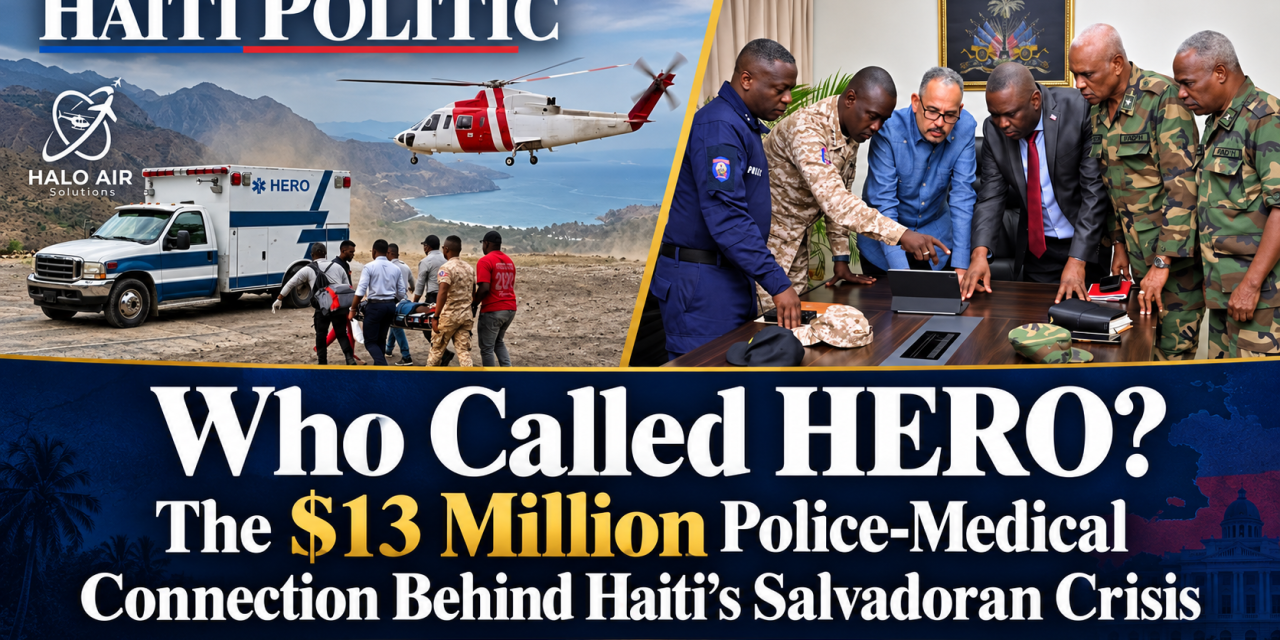
At the center is HERO Client Rescue, reportedly called to collect human remains during the search. Behind it is an interconnected medical, flight and security operation involving HALO, a separate Florida nonprofit listing Philippe Arthur among its officers, and substantial U.S.-funded medical contracts.
Those connections warrant examination. They do not establish that anyone in the network caused the disappearance, knowingly misidentified remains or acted unlawfully.
The government said it was coordinating
On October 21, the Primature announced that recovering the Salvadorans was an absolute priority. Its communiqué described a high-level meeting under Prime Minister Alix Didier Fils-Aimé and coordination with the international Gang Repression Force.
Describing the government’s response as complete silence therefore overlooks its public announcement. But announcing coordination creates an expectation of accountability. The communiqué did not explain the role of private contractors or identify who would authorize and supervise a recovery operation.
The question now is how that declared government leadership connected to HERO’s reported intervention three days later.
A recovery operation and a disputed identification
An October 25 New York Times report, republished in Spanish by Infobae, quoted Scott Reece, described as a former State Department security official, about the recovery. HERO Client Rescue said it had been called on Saturday afternoon, October 24, to collect remains. The report described the remains as badly burned and under examination to determine whether they belonged to the missing men.
President Nayib Bukele disputed that identification. He said the remains delivered at the airport did not belong to the Salvadoran technicians and described apparent discrepancies in age, height and clothing.
These accounts make the handover record essential. Recovering remains is different from certifying their identity. The public evidence reviewed does not establish who first identified them as potentially Salvadoran, what HERO communicated at handover, or what forensic findings supported either account.
The necessary records include the initial request, recovery instructions, custody log, accompanying identification information and forensic examination results. The identities and families of every person whose remains were recovered also deserve consideration.
HALO and HERO: shared operations, unresolved ownership
The organizations’ own materials document a relationship extending beyond occasional charitable support.
HERO’s website sends flight-booking customers to HALO and presents rescue memberships, flights and training together. HALO identifies Dr. Coralie Caze as country director of both HALO Solutions Firm and HERO Client Rescue. It describes HALO, HERO and SafeRide as programs under its team’s oversight.
HALO also lists Aaron Dankers as security director. His company biography describes previous work as a State Department INL contractor, a United Nations police adviser and a professional working alongside the Haitian National Police. That is a company-published employment history, not proof of a current government appointment.
A HALO Air Solutions Facebook post supplied for this review explicitly says its flights help fund HERO Client Rescue S.A. Another advertisement offers helicopter seats between Pétion-Ville and Cap-Haïtien for $660 one way or $1,200 round trip per person.
Together, these materials support describing coordinated services, shared leadership and an advertised financing relationship. They do not establish that HALO and HERO are one legal company or reveal their complete ownership.
They also do not establish that HALO aircraft or personnel participated in the disputed recovery.
What the $13 million actually represents
USAspending award records identify HERO Client Rescue S.A. as recipient of two federal medical-service contracts:
| Award | Recorded obligations | Description |
|---|---|---|
| 191NLE24C0018 | $6,493,570.46 | Medical services for the Haitian National Police |
| 191NLE26C0004 | $6,493,570.00 | Haiti emergency medical services |
Together, these total $12,987,140.46—approximately $13 million. They are separate awards, and obligations are not the same as money already disbursed. The records are available through the 2024 award data and 2026 award data.
These records establish a funded medical-service relationship. They do not demonstrate that the remains-recovery operation fell under either contract or that the awards were improper.
The Haitian registry screenshot supplied for this review identifies HERO Client Rescue S.A. as an active société anonyme providing health services, with an initial registration dated January 13, 2016. It does not disclose shareholders. Registration during Michel Martelly’s presidency establishes timing, not political sponsorship.
The Arthur question: records versus allegations
Florida corporate records identify a separate entity: HERO Foundation Inc., incorporated August 15, 2017. The supplied filing lists Philippe Arthur as an officer/director and registered agent, Stacy Librandi as a director, and Anne Arthur as a director and secretary. Public tax-return data also identify the three as foundation officers.
These records establish nonprofit governance roles. They do not establish ownership of the Haitian company or HALO.
The politically significant allegations appear in Haitian-Truth articles by Michael Collins. A February 26, 2024 article identifies an INL-associated Philippe Arthur and alleges an attempt to redirect police procurement, inflate prices and share profits with PNH logistics director Marjory St. Jean and others.
A February 22, 2025 article alleges interference with an August 2024 weapons order and says Arthur approached Fils-Aimé to seek Rameau Normil’s replacement as police chief by Alain Auguste.
These are serious allegations, not established findings. The articles do not supply the correspondence, procurement documents, named witnesses or official investigative findings needed to substantiate them. Two articles from the same outlet are not independent corroboration. Their references to procurement episodes in different years also require clarification.
The essential unresolved steps are confirming Arthur’s exact INL role, establishing whether he is the same person named in the foundation records, and documenting any financial interests in the Haitian businesses. Only then can overlapping duties, procurement involvement and any required disclosures or recusals be assessed reliably.
Client logos and gang statements require separate verification
HERO’s displayed business logos raise additional questions about client screening. Canada has sanctioned prominent Haitian businessmen, including Gilbert Bigio, Reynold Deeb, Sherif Abdallah and Marc Antoine Acra, over alleged conduct enabling gangs or fueling instability.
But a logo is not an ownership record. The evidence reviewed does not justify describing all pictured businesses as sanctioned entities or claiming that the United States and Canada imposed identical measures. Any match requires the exact company, ownership, applicable designation and service dates.
Likewise, a circulating screenshot attributes to a gang figure an accusation against Chen Mechan. Without the full authenticated recording and corroboration, that remains an attributed allegation. It does not establish the missing men’s fate or connect HERO to their alleged captors.
The questions Fils-Aimé’s government should answer
The prime minister’s office publicly claimed a coordinating role. It should therefore explain:
- Who requested HERO’s intervention, and under what authority?
- Which Haitian institution supervised the recovery and handover?
- Who supplied the suggested identification of the remains?
- What custody records and forensic findings exist?
- Did HALO provide aircraft, personnel or logistical support?
- Did anyone involved hold overlapping official responsibilities and private financial interests?
HERO should clarify the precise legal entity involved, its instructions and its communications at handover. The relevant U.S. authorities should clarify any verified overlap between contracting responsibilities and private organizational interests.
These answers can be provided without publishing live tactical information. The families need reliable identification. Haitians need a clear account of who exercised authority on their territory. And the public needs records explaining how government responsibilities and privately delivered services intersected during this crisis.