Haiti Politic | Reported analysis | October 24, 2026
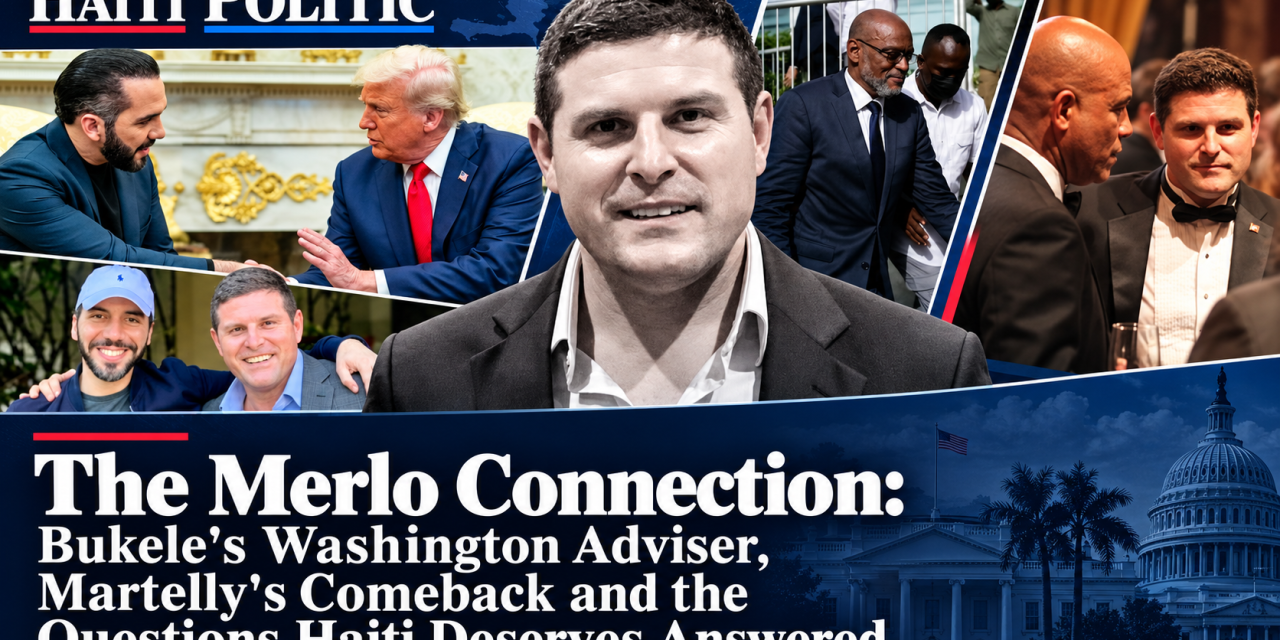
Michel Martelly’s presidential comeback brings several documented relationships into the same frame. Damián Merlo worked on the campaigns of Martelly and Jovenel Moïse. Ariel Henry served as a minister during Martelly’s presidency. Merlo’s firm later represented Haiti’s embassy during Henry’s administration while also representing El Salvador’s presidency. In October 2022, Merlo publicly defended Henry and called for foreign military intervention in Haiti. [1][19][20][24][25]
Those relationships give voters a concrete basis for questioning political continuity, paid advocacy and potential conflicts of interest. Martelly’s October 23, 2026 candidacy filing makes the questions immediate: what role, if any, do these networks play in his return, and how will foreign security assistance remain separate from Haitian electoral competition? [3][4]
The strongest evidence establishes overlapping relationships and interests. It does not establish that Haiti’s gang crisis was engineered to return Martelly to office, that Bukele endorses him, or that Merlo works on his current campaign. This article examines what the records show and identifies the evidence still needed to reach those further conclusions.
A filing, not a final electoral decision
Le Nouvelliste reported that Martelly submitted documents supporting his presidential candidacy on October 23, 2026, under the Debloke platform, at the BED Ouest 1 office in Pétion-Ville. EFE separately reported the filing and noted that electoral authorities still had to validate his documentation. [3][4]
That distinction matters. A public procession demonstrates an ability to mobilize supporters. Filing a dossier demonstrates an intention to compete. Neither establishes final acceptance, legal eligibility or the electorate’s wider support.
The supplied social-media account describes a triumphant return. The substantive issue is what record and program Martelly is asking voters to endorse.
Who is Damián Merlo?
Jake Johnston’s original post draws attention to the campaign connection without naming the adviser. In a follow-up exchange shown in a supplied screenshot, Bettinna asked, “Damian Merlo or Antonio Sola?” Johnston replied, “the former,” identifying Merlo as the person he meant. That clarification establishes the intended subject of his post; independent reporting and lobbying records substantiate the professional connections. [17][18]
In July 2021, New York Times reporting republished by The Indian Express described Merlo as a lobbyist and consultant who worked on both Martelly’s and Moïse’s presidential campaigns. It also reported that he accompanied Martelly to Washington that June to interview lobbyists. [1]
The campaign hierarchy deserves precision. In a 2011 PR Noticias interview, Antonio Sola identified himself as the head of Martelly’s campaign and described Merlo as his deputy. Later reporting has described Merlo as a campaign manager. The defensible conclusion is that Merlo held a significant campaign role; presenting him as the sole architect erases the wider team. [5]
Merlo’s own published author biography also acknowledges work on both Haitian campaigns. [6]
For the Bukele relationship, El Faro documented his advisory and lobbying activity as early as 2021. More recent reporting placed him in Bukele’s delegation at the April 2025 White House meeting with Donald Trump. That supports describing him as a well-connected adviser and lobbyist; the exact ranking implied by “one of the closest” is harder to establish independently. [7][8]
The paper trail reaches into 2026
U.S. Justice Department FARA records provide a stronger foundation than political commentary alone.
The public filing index for Latin America Advisory Group, registration number 6898, identifies repeated filings for the Office of the President of El Salvador and short-form registrations for Merlo. A contract filed on March 3, 2026, covers government-relations consulting for the 2026 calendar year. [2][9]
The contract, executed through Compañía de Luz Eléctrica de Ahuachapán, or CLEA, sets fees at $780,000, payable in $65,000 monthly installments. Its stated services include relationships with U.S. executive and congressional officials, official visits, international media engagement and communications strategy for the Salvadoran government. [9]
A July 30, 2026 supplemental filing reports $389,790 received for El Salvador-related services during January–June and lists contacts with U.S. officials. Those are the registrant’s reported receipts and activities; the contract amount should not be confused with proof that its full annual value had already been paid. [10]
This establishes an active professional connection extending into 2026. The reviewed filings do not establish a role in directing military operations in Haiti.
Henry’s earlier service under Martelly—and Merlo’s paid government work
Ariel Henry’s connection to Martelly was institutional: he served in Prime Minister Evans Paul’s government during Martelly’s presidency. Le Nouvelliste reported his installation as minister of the Interior and Territorial Communities on January 21, 2015. A September 7, 2015 reshuffle appointed him minister of Social Affairs and Labor. His ministerial service therefore preceded his later leadership of the government. [20][21]
Henry entered that cabinet as a representative of INITE in a negotiated political arrangement. That background should not be erased by presenting him simply as a lifelong member of Martelly’s political camp. [22]
Merlo’s later involvement also extended beyond personal advocacy. FARA records identify Haiti’s embassy as a client of Latin America Advisory Group from a November 2020 agreement. Contemporary O’Dwyer’s reporting described that original engagement as a one-year, $96,000 account overseen by Merlo, whom it identified as a former special assistant to Martelly and Laurent Lamothe. That figure is a reported contract value, not proof that $96,000 had already been paid to Merlo personally. The initial FARA disclosure separately records a $24,000 embassy retainer received December 3, 2020. [23][26]
The original services described by O’Dwyer’s included congressional outreach, media strategy, talking points and drafting or placing opinion pieces. This makes the client relationship particularly relevant to assessing Merlo’s later public commentary, but does not establish that his October 2022 column was commissioned under the agreement. [26]
A January 2022 addendum set firm compensation at $25,000 monthly for February 2022–January 2023. A subsequent disclosure reports $150,000 received from the embassy during the second half of 2022, alongside representation of El Salvador’s presidency. [24][25]
These records establish former cabinet service and overlapping paid government representation. They do not establish a common command structure or coordination of Martelly’s 2026 campaign.
Merlo’s own argument for intervention
In an October 11, 2022 Diario Las Américas opinion column, Merlo described Moïse as a friend, defended Ariel Henry and advocated foreign military intervention coordinated by the UN or OAS. He portrayed Martelly’s 2011 election as a break with an entrenched political power structure and dismissed sovereignty-based objections from political elites. These are Merlo’s arguments, not independently established findings. [19]
The column adds a policy dimension to his campaign history: Merlo was publicly advocating a direction for Haiti’s security response while his firm held a paid Haitian-embassy engagement. Readers assessing that advocacy should know about the contemporaneous client relationship. The records do not establish that Haiti’s government commissioned the column. His favorable portrayal of Martelly also predates Canada’s November 2022 sanctions and the later U.S. and EU actions. [19][24]
Martelly should explain whether he shares that intervention policy and how he would preserve Haitian control and political neutrality.
What the combined record shows
The chronology connects three kinds of activity: campaign consulting, public service and paid international advocacy. Sola and Merlo helped run Martelly’s electoral operation; Henry later held cabinet portfolios under his presidency; and Merlo’s firm subsequently represented the Haitian state across the Moïse and Henry periods. During 2022, the firm’s disclosed Haitian and Salvadoran engagements overlapped. Its El Salvador-related work is documented into 2026. [1][5][9][20][23][24][25]
This is evidence of professional and institutional continuity across administrations. It supports asking whether relationships built around earlier Haitian governments continue to influence access, messaging or policy. It does not establish that every participant shared the same objectives or acted under common direction.
Martelly should disclose whether Merlo or associated firms currently advise him, raise funds, arrange introductions or provide communications services. Merlo and Salvadoran authorities should explain whether Haiti-related work includes contact with candidates and what safeguards separate government representation from private electoral interests. Current contracts, client lists and disclosed meetings would help answer those questions.
A comeback under sanctions
Martelly is seeking office with a materially different international profile from the candidate marketed in 2010–2011.
Canada sanctioned him in November 2022. On August 20, 2024, U.S. Treasury imposed sanctions under its illicit-drug-trade authority, stating that he facilitated cocaine trafficking, laundered proceeds, worked with traffickers and sponsored Haiti-based gangs. These are the U.S. government’s stated grounds for its action, rather than criminal findings independently established by this article. [11][12]
The U.S. action placed him on the Non-SDN Menu-Based Sanctions List and imposed specified financial prohibitions. It should not be casually described as identical to every other sanctions regime. [11]
In December 2025, the Council of the European Union also sanctioned Martelly, stating that he armed and financed gangs for political, territorial and personal interests. The EU measures include an asset freeze and travel restrictions. [13]
These official actions make his security platform an accountability issue. Voters deserve his substantive response to the allegations, records supporting his position, and an explanation of how his campaign is financed and advised.
The sanctions do not themselves constitute criminal convictions. Nor does this review determine whether they disqualify him under Haiti’s electoral rules. That requires the applicable rules and the competent authorities’ decisions.
Was the gang crisis engineered for a political comeback?
The evidence reviewed does not establish that theory. It is necessary to distinguish three propositions: that gangs have received political support; that a politician may seek electoral advantage from insecurity; and that a coordinated plan deliberately created or escalated the crisis to return a particular politician to power.
The official sanctions statements make serious allegations relevant to the first proposition. Martelly’s candidacy makes the second a legitimate subject for questioning. Neither establishes the third. A claim about a planned return requires evidence connecting decisions, resources and intent to that specific objective—not simply a sequence of events or shared advisers. [11][13]
Such evidence might include authenticated instructions, financial transfers tied to armed operations and electoral objectives, corroborated testimony from people with direct knowledge, or findings supported by an investigated record. None of that specific evidence was established in this review.
The gang violence itself is real. The unresolved question concerns the motives and coordination of those accused of enabling it. The article therefore asks whether Martelly is seeking political benefit from insecurity and demands answers about the official allegations against him, without presenting an engineered-comeback theory as a proven explanation for Haiti’s crisis.
Why did he live abroad after leaving office?
Martelly’s presidency ended on February 7, 2016, without an elected successor immediately taking office. Contemporary VOA reporting documented that institutional rupture. [14]
Later sources establish residence abroad and subsequent visits. Associated Press reporting in July 2026 described him as living in the United States and returning for a rare visit, with an earlier visit roughly three years before. Le Nouvelliste confirmed his July 15, 2026 return to Port-au-Prince. [15][16]
Those facts support asking why he chose to live abroad after his presidency. They do not establish that he left permanently on the day his term ended, remained absent for ten uninterrupted years, or departed to escape a specific proceeding.
No verified personal explanation for his relocation was established in this review. His departure date, periods of residence, reasons and political activities abroad remain questions for him.
For a returning candidate, the public-interest issue is direct: what responsibility did he continue to exercise toward the country after leaving office, and why should voters trust his commitment now? Residence abroad alone proves neither indifference nor wrongdoing. His explanation and record should supply the answer.
The residency question requires documents and a reasoned decision
The published 1987 constitutional text sets separate conditions for a presidential return. Article 134.3 permits another term after a five-year interval and bars a third. Article 135(e) requires five consecutive years of residence in Haiti before the election. A former president’s ability to seek a second term does not settle whether he satisfies the residence requirement. [27]
Martelly’s reported residence abroad therefore raises a substantive eligibility question. His actual residence history, supporting documents, the applicable constitutional and electoral provisions, and any interpretation on which he relies must be examined. A July 2026 return or an October candidacy filing cannot, by itself, demonstrate compliance.
This review has not examined his complete electoral dossier or established a final eligibility ruling. It therefore does not conclude that he has violated the law or presume why he expects acceptance. Martelly should publish the evidence supporting his eligibility, and the competent electoral authorities should explain their decision under the applicable rules, applying the same standard to every candidate.
Ten questions for Michel Martelly
-
Why did you choose to live abroad after your presidency? When did you establish your principal residence outside Haiti, and what personal, professional, security or political reasons explain that decision?
-
How do you satisfy the presidential residence requirement? Will you publish a chronology of your residence in Haiti and abroad, the documents supporting it, and the legal provision or interpretation on which you rely for eligibility?
-
Why seek the presidency again now? What did you do for Haiti while living abroad, what results can you document, and what commitments would demonstrate that this return extends beyond an election campaign?
-
Does Damián Merlo currently work for you or your campaign? Have he or any associated firms provided advice, fundraising, lobbying, introductions or communications services, paid or unpaid, since you began considering this candidacy?
-
Have you discussed your candidacy with Bukele or his representatives? If so, when, through whom and for what purpose, and will you disclose any commitments or assistance offered?
-
What safeguards would prevent insecurity or foreign security assistance from being exploited for your campaign? Will you disclose any contacts by your campaign or intermediaries with armed groups or foreign security representatives, and reject the use of violence, coercion, public resources or privileged foreign access for electoral advantage?
-
What is your substantive response to the sanctions against you? Which allegations by Canada, the United States and the European Union do you contest, what evidence supports your response, and what review or challenge proceedings have you initiated?
-
What responsibility do you accept for the institutional crisis at the end of your presidency? Why did your mandate end without an elected successor in place, and what would you do differently to protect elections, oversight and constitutional government?
-
Who finances your comeback? Will you publish campaign donors, expenditure reports, consultants’ contracts and relevant business interests, with arrangements that allow independent verification?
-
Will you accept an independently reasoned eligibility decision, and what security program should voters assess if you qualify? Will you commit to respecting the electoral dispute process and publish a costed plan with civilian safeguards, oversight and measurable goals?
The documented relationships put a specific burden of explanation on a returning candidate: Martelly must account for his own government record, his years abroad, the allegations underlying sanctions, his advisers and his campaign financing. Merlo’s dual government engagements and intervention advocacy belong in that examination. So does Henry’s earlier cabinet service. Voters need the records and responses that establish what those connections mean for the present campaign.
Reporting note: This article distinguishes documented appointments and filings, attributed official allegations, opinion and unproven hypotheses. The reviewed material does not establish Merlo’s involvement in Martelly’s 2026 campaign, a Salvadoran endorsement, or a coordinated plan to engineer Haiti’s gang crisis for Martelly’s return. No requests for comment were sent in preparing this draft; it does not imply that Martelly, Merlo or Bukele declined to respond.
Source guide
[1] Kenneth P. Vogel and Natalie Kitroeff, New York Times reporting republished by The Indian Express, July 22, 2021:
https://indianexpress.com/article/world/battle-for-power-in-haiti-extends-to-lobbying-in-washington-7416373/lite/
[2] U.S. Justice Department, FARA public filing index, Latin America Advisory Group, registration 6898:
https://efile.fara.gov/ords/fara/f?p=1381:201:0:::RP,201:P201_REG_NUMBER:6898
[3] Le Nouvelliste, October 23, 2026, candidacy dossier:
https://lenouvelliste.com/article/273248/election-michel-martelly-depose-ses-pieces-au-bed-ouest-1
[4] EFE via Infobae, October 23, 2026:
https://www.infobae.com/america/agencias/2026/10/23/expresidente-haitiano-michel-martelly-inscribe-candidatura-pese-a-sanciones-de-eeuu-y-ue/
[5] PR Noticias, interview with Antonio Sola, April 15, 2011:
https://prnoticias.com/2011/04/15/sola-tet-kale-se-convirtio-en-el-grito-de-liberacion-de-millones-de-haitianos-1/
[6] Miami Herald, Merlo author biography, July 21, 2021:
https://www.miamiherald.com/opinion/op-ed/article252920043.html
[7] El Faro, “Para congraciarse con Biden, Bukele depende de cabilderos republicanos,” February 2021:
https://beta.elfaro.net/el-salvador/elfaro.net/es/202102/el_salvador/25236/para-congraciarse-con-biden-bukele-depende-de-cabilderos-republicanos
[8] El Faro, “Bukele Pays for MAGA Lobbying through Opaque Public Electricity Company”:
https://beta.elfaro.net/en/el-salvador-en/bukele-trump-maga-lobbying-merlo
[9] FARA Exhibit AB filed March 3, 2026; 2026 services contract and English translation:
https://efile.fara.gov/docs/6898-Exhibit-AB-20260303-1.pdf
[10] FARA supplemental statement filed July 30, 2026:
https://efile.fara.gov/docs/6898-Supplemental-Statement-20260730-13.pdf
[11] U.S. Treasury, August 20, 2024:
https://home.treasury.gov/news/press-releases/jy2542
[12] Canada Gazette, SOR/2022-231, registered November 17, 2022:
https://gazette.gc.ca/rp-pr/p2/2022/2022-12-07/html/sor-dors231-eng.html
[13] Council of the European Union, December 15, 2025:
https://www.consilium.europa.eu/en/press/press-releases/2025/12/15/haiti-council-lists-three-individuals-and-one-entity-over-gang-violence-and-related-human-rights-abuses/
[14] VOA, February 7–8, 2016:
https://www.voanews.com/a/haitian-president-leaves-office-without-a-successor/3181216.html
[15] Associated Press, July 15, 2026:
https://apnews.com/article/0d37464e467f66a789f5de099527199d
[16] Le Nouvelliste, July 15, 2026:
https://lenouvelliste.com/article/269903/lancien-president-michel-martelly-de-retour-a-port-au-prince
[17] User-supplied screenshots: Jake Johnston’s post and commentary on Martelly’s October 23 appearance.
[18] User-supplied screenshot of Bettinna’s question, “Damian Merlo or Antonio Sola?” and Jake Johnston’s reply, “the former.” The embedded earlier post contains separate allegations that this article does not adopt as established facts.
[19] Damián Merlo, “La crisis en Haití, un análisis,” Diario Las Américas, opinion, October 11, 2022:
https://www.diariolasamericas.com/opinion/la-crisis-haiti-un-analisis-n4258416
[20] Le Nouvelliste, January 21, 2015, Henry’s installation as interior minister:
https://lenouvelliste.com/article/140633/ariel-henry-5e-ministre-de-linterieur-sous-la-presidence-de-martelly
[21] HaitiLibre, September 2015, appointments by September 7 order:
https://www.haitilibre.com/article-15083-haiti-flash-nouveaux-ministres-au-gouvernement.html
[22] Métropole, January 19, 2015, opposition participation in Evans Paul’s cabinet:
https://metropole.ht/lopposition-radicale-integre-le-gouvernement/
[23] FARA, original Haiti embassy engagement filed December 9, 2020:
https://efile.fara.gov/docs/6898-Exhibit-AB-20201205-1.pdf
[24] FARA, January 2022 Haiti embassy contract addendum filed February 8:
https://efile.fara.gov/docs/6898-Exhibit-AB-20220208-4.pdf
[25] FARA, supplemental statement filed January 30, 2023:
https://efile.fara.gov/docs/6898-Supplemental-Statement-20230130-4.pdf
[26] Kevin McCauley, “Haiti Hires Latin America Advisory Group,” O’Dwyer’s, December 23, 2020:
https://www.odwyerpr.com/story/public/15397/2020-12-23/haiti-hires-latin-america-advisory-group.html
[27] Published 1987 Constitution, government-hosted copy, Articles 134.3 and 135, PDF page 29. Cited for the text of these provisions; a final assessment requires the applicable constitutional text, current electoral rules and the competent authorities’ interpretation:
https://www.omrh.gouv.ht/Media/Publications/1-Constitution/Constitution1987.pdf