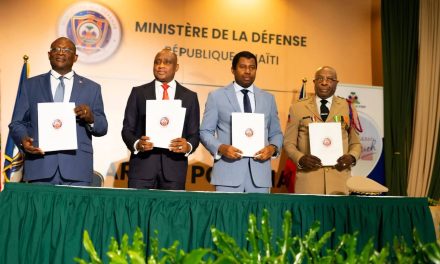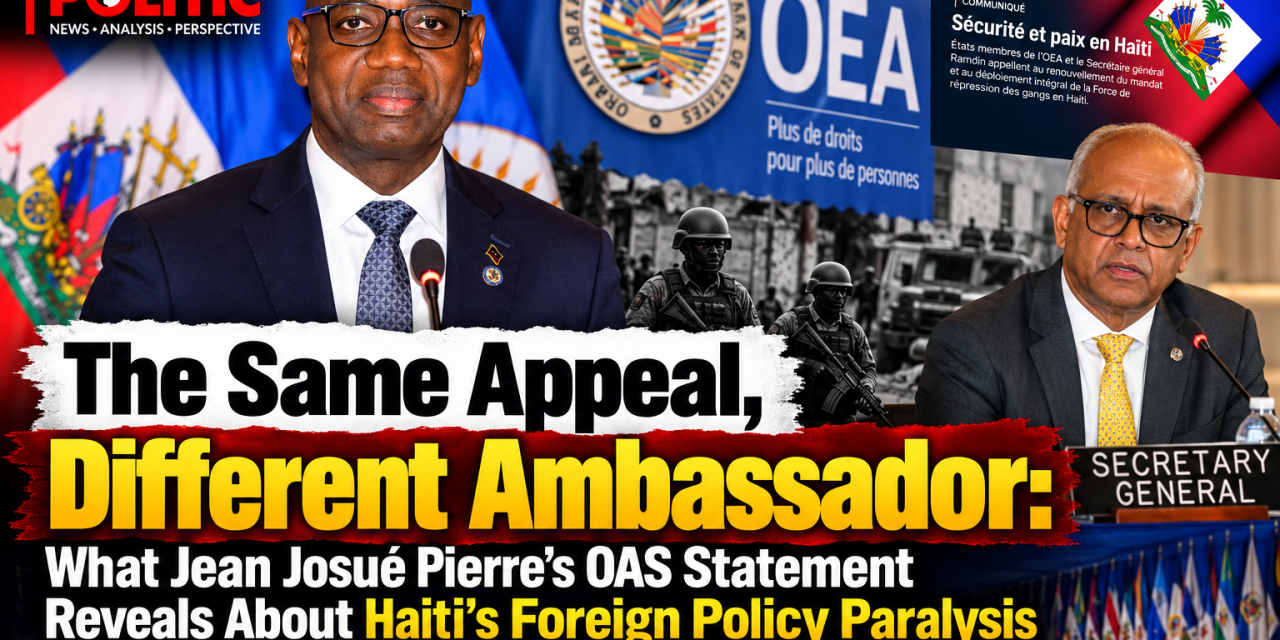
At a conference to unveil a joint declaration in support of Haiti, Ambassador Jean Josué Pierre delivered the message that has now become the standing script of Haitian diplomacy: renew the Gang Suppression Force’s mandate, ensure its full deployment, strengthen security institutions, and create the conditions for credible elections. It’s a reasonable, even urgent ask on its face. It’s also, almost word for word, the same appeal Haiti’s representatives have made to international bodies every year since 2022 — and that repetition is itself the story worth examining.
Who Is Jean Josué Pierre?
Pierre is a career diplomat who entered his current role gradually rather than all at once. Haitian OAS records show he was appointed Alternate Representative — effectively a deputy ambassador — on March 3, 2025, serving under then-Permanent Representative Myrtha Désulmé. When Désulmé’s tenure ended, Pierre was elevated to Permanent Representative in his own right, presenting his credentials to OAS Secretary-General Albert Ramdin on January 21, 2026. In that ceremony, Ramdin called it “a pivotal moment for your country and for the hemisphere” — a phrase that, six years into Haiti’s post-2016 electoral drought, has been said about nearly every Haitian diplomatic milestone since.
Pierre now represents Haiti at an institution that has spent the last several years fielding the same request from a rotating cast of Haitian officials: Foreign Minister Raina Forbin made the identical appeal for GSF renewal at the OAS General Assembly in Panama City in June 2026, and again before the UN Security Council in September, just weeks before this latest declaration. The message hasn’t changed. What’s changed is who’s delivering it — a pattern that says something important about the durability, or lack of it, in Haiti’s diplomatic leadership.
Why Haitian Foreign Policy Keeps Repeating Itself
There’s a real, structural reason this appeal keeps recurring rather than resolving: Haiti’s foreign policy over the last four years has been built almost entirely around requesting external rescue, not building the domestic capacity that would make the requests unnecessary.
A revolving door at the top. Since the 2021 assassination of Jovenel Moïse, Haiti has cycled through multiple foreign ministers in rapid succession — Dominique Dupuy left the post in November 2024 after roughly five months, replaced by Jean-Victor Harvel Jean-Baptiste, who was in turn succeeded by Raina Forbin. Each transition resets institutional memory and relationships with international counterparts just as they’re being built. A foreign policy that changes its chief messenger this often struggles to sustain any position long enough for it to be taken as a durable national strategy rather than a temporary talking point.
Security outsourced, not rebuilt. Haiti’s own 2022 request for an “international specialized force” led, nine months later, to a Kenyan-led Multinational Security Support mission that officials themselves later admitted “lacked the scale, scope and resources needed” and collapsed under-resourced. Its successor, the Gang Suppression Force, was authorized in September 2025 with a ceiling of 5,550 personnel — and its first troops, an advance group from Chad, didn’t arrive until April 2026, seven months later. Two consecutive international missions, each requiring the same renewal fight at the OAS and UN, is not evidence of a coherent Haitian security strategy — it’s evidence of a policy that treats outside intervention as the whole plan rather than a bridge to one.
Diplomacy without an elected mandate. Every appeal Haiti’s ambassadors have made since 2022 has come from transitional, unelected governance — the Transitional Presidential Council, its rotating chairmanships, and now whatever government has succeeded it. That’s not a criticism of any individual diplomat; it’s a genuine structural problem. It’s difficult for the international community to treat a request for “credible elections” as fully authoritative when it’s being made by a government that itself lacks an electoral mandate — a bind Haiti’s diplomats didn’t create, but one their messaging doesn’t fully reckon with either.
The Case for the Other Side
To be fair to Pierre and to the broader Haitian diplomatic position: this isn’t simply a story of Haitian failure. CARICOM, the OAS, and the U.S. State Department have all independently pressed for the same GSF renewal, arguing — with real justification — that the mission has “yet to be fully deployed” through no fault of Haiti’s own government, and that further delay risks “widespread instability and anarchy.” China and Russia, for their part, have accused Washington of failing to control the flow of illegal arms into Haiti, much of it smuggled from South Florida, and of under-delivering on funding commitments to the first mission — a reminder that the international side of this partnership has its own record of falling short. Haiti’s repeated appeals can also be read less as strategic failure and more as the rational response of a state whose police and army were never resourced to fight an alliance of armed groups controlling roughly 85% of the capital on their own.
What “Credible Elections” Actually Requires
Pierre’s closing line — that renewing the GSF mandate should help “create the conditions for Haiti to progress toward credible elections” — is the right goal stated in the right order: security first, then elections. But it’s worth remembering that Haiti’s own Transitional Presidential Council held power for nearly two years with full international backing and still expired without delivering a single vote, undone as much by internal corruption allegations and infighting as by the security crisis around it. Renewing an international force is necessary. It has never, on its own, been sufficient. Until Haiti’s own institutions — not just its foreign ministry’s talking points — show the same continuity and discipline being asked of the international community, this same appeal, from whichever ambassador is delivering it next year, is likely to sound very familiar.