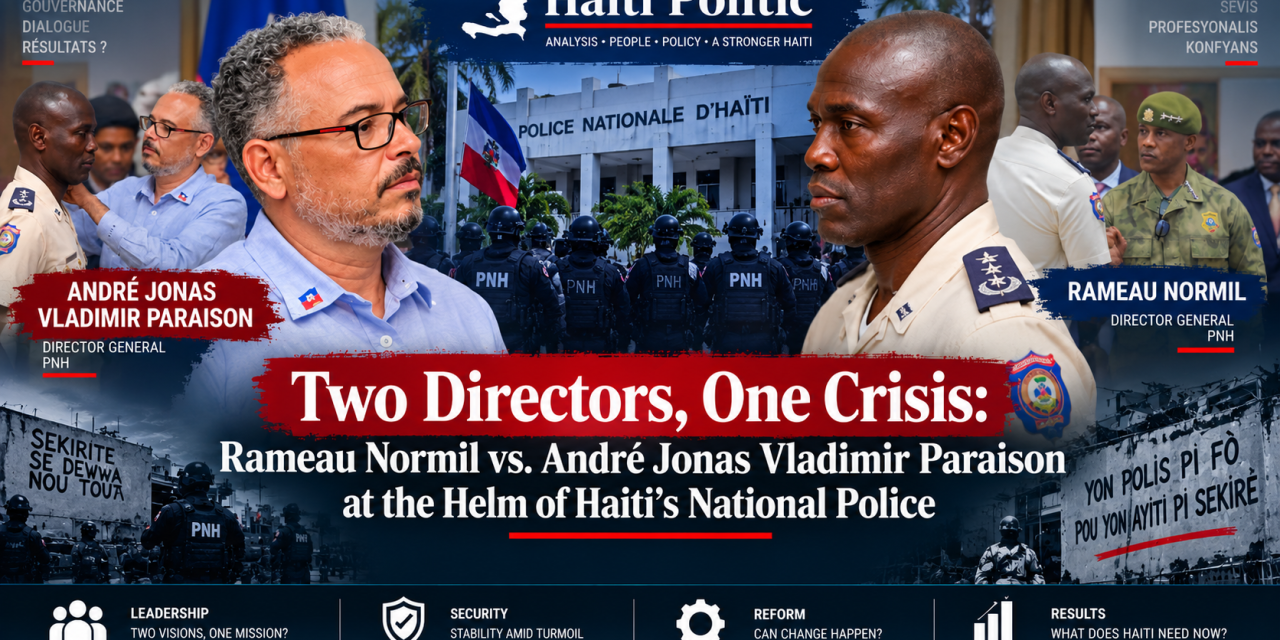
Since 2020, the Haitian National Police (PNH) has cycled through director generals at a pace that mirrors the speed of the country’s collapse: Léon Charles, Frantz Elbé, Rameau Normil (twice), and now André Jonas Vladimir Paraison. Each change has been sold, at the moment of appointment, as a fresh start against the gangs. Each has ended — so far — without one. A close look at the two most recent men to hold the post, Rameau Normil and Vladimir Paraison, offers a useful case study in what leadership of the PNH has actually meant during Haiti’s worst security crisis in generations, and what, if anything, distinguishes a “better” tenure from a merely different one.
Rameau Normil: the institutional insider, twice recalled, twice removed
Normil is, on paper, one of the most experienced men ever to lead the PNH. A member of the police academy’s fourth graduating class, he studied military infantry in Chile in 1999 and rose steadily through the institution’s technical and investigative branches — heading the Direction Centrale de la Police Judiciaire (DCPJ), Haiti’s main criminal investigation body, from 2012 to 2018, before overseeing the PNH’s financial and economic affairs division (BAFE).
His first stint as Director General came in August 2019, under the Moïse-Jouthe government, replacing Michel-Ange Gédéon. That tenure lasted just over a year: he was named acting director general on August 27, 2019, replacing Michel-Ange Gédéon, and by November 2020 he had handed command to Léon Charles — removed, by most contemporary accounts, for failing to produce results against rising gang violence at a moment when armed groups were beginning their consolidation into the coalitions that dominate Port-au-Prince today.
Normil returned to the post nearly four years later, in June 2024, appointed by Prime Minister Garry Conille to replace Frantz Elbé, whose own tenure had been widely criticized for its inability to curb the gang violence plaguing the country. His second term ran 13 months and 20 days, ending abruptly on August 8, 2025 — the very first decision taken by the Transitional Presidential Council under its new coordinator, Laurent Saint-Cyr, in the wake of an open conflict between Normil and Prime Minister Alix Didier Fils-Aimé.
Accomplishments: During his second term, Normil presided over specialized-unit strategy sessions and publicly emphasized more targeted operations against criminal groups, and his reappointment in 2024 was initially welcomed by some, including the police union SYNAPOHA, which called for him to “get to work.” Beyond rhetorical commitments, however, independent assessments of this period consistently describe continued territorial losses to gangs rather than reversal.
Controversies and failures: Normil’s record is defined less by operational results than by two recurring criticisms: an inability, across two separate mandates, to arrest the country’s territorial slide into gang control, and — far more seriously — a corruption scandal that has followed him into retirement. In February 2026, Normil was summoned before Haiti’s Chambre d’instruction criminelle by investigating judge Walter Wesser Voltaire to answer serious accusations, including criminal conspiracy and the illegal sale of police-owned ammunition to armed gangs. A companion case implicated Philippe Jovin, former head of the PNH’s central administrative services directorate, in the same alleged scheme, and a formal summons (mandat de comparution) was issued against Normil in early 2026. These allegations remain under judicial investigation — Normil has not been convicted — but if substantiated, they would represent one of the gravest possible institutional betrayals for a police chief: arming, rather than fighting, the very gangs terrorizing the population his office was sworn to protect.
Vladimir Paraison: the specialist operator inheriting a near-total collapse
Paraison’s career path runs through Haiti’s most operationally focused police units rather than through investigative or administrative posts. Before becoming Director General, he twice served as Security Coordinator at the National Palace, was PNH’s Departmental Director for the West, and — significantly — led specialized intervention units, including the BOID (Brigade d’Opération et d’Intervention Départementale) and USGPN, where he built a reputation for tactical results that his supporters hoped would translate to the top job.
He was installed as acting Director General on August 8, 2025, appointed by the newly reconfigured Transitional Presidential Council under Laurent Saint-Cyr, replacing Normil in a move that human rights organizations greeted with open ambivalence. The Plateforme des organisations haïtiennes de droits humains (POHDH) questioned the nomination, which came amid open conflict and division within the transitional council, and worried the change reflected political proximity between Paraison and the new leadership rather than merit — while conceding he possessed the prerequisites for the role. His appointment was paired with a three-month state of emergency declared across the West, Artibonite, and Centre departments, underscoring the severity of the moment: gangs controlled an estimated 90% of Port-au-Prince at the time he took office, and the Kenya-led multinational security support mission deployed to assist the PNH was struggling to reach its planned operational capacity amid funding and logistical problems. AlterpresseGazetteuniv
Controversies: Paraison’s record carries its own legal shadow, predating his appointment. In November 2018, an investigating judge in Saint-Marc issued an arrest warrant against him, accusing him of involvement in a 2016 arms-trafficking case; he has also been named in cases involving forgery, money laundering, and criminal conspiracy. Unlike Normil’s 2026 case, these allegations are older and have not, to public knowledge, resulted in prosecution — but they were cited explicitly by human rights groups as a reason for caution about his nomination.
Accomplishments and failures: Paraison has been considerably more visible and communicative than his predecessor, holding regular press briefings, publicly inviting gang members to surrender, and framing his mandate around reclaiming territory. In January 2026, he told reporters that more than 85% of the West department — and of the country as a whole — was under gang control when he took office, a baseline he has used to argue that any stabilization represents progress. But by the numbers, the trajectory under his leadership has continued in the wrong direction. A June 2026 report by the Réseau National de Défense des Droits Humains (RNDDH), covering his first year in office, documented that the PNH faced constant operational pressure as new areas of the Artibonite, Centre, West, and Southeast departments fell under the control of armed groups, worsening forced displacement and the broader humanitarian crisis, and separately found 35 police officers killed over that same period. By late August 2026, an offensive in Kenscoff left dozens dead, including BOID and SWAT officers, and by September 2026 a follow-up report noted armed groups advancing into rural areas, developing new activities such as kidnappings, cattle theft, and roadblocks, even as internal displacement — recorded by the IOM — reached roughly 1.5 million people. A commentator writing in May 2026 captured the gap between rhetoric and results pointedly, noting that Paraison had promised, on his installation, that he would not sleep so the population could finally sleep in peace — a line that, months later, resonated painfully as gangs continued massacring the population with impunity. Even sympathetic analysts have noted a structural tension in his own record: the tactics that made him effective commanding a single specialized unit like BOID have proven harder to replicate at the head of the entire police apparatus, which requires operations to translate into durable state presence rather than one-off raids.
Side-by-side comparison
| Rameau Normil | Vladimir Paraison | |
|---|---|---|
| Background | Career investigator/administrator; DCPJ director 2012–2018; PNH 4th promotion | Career tactical operator; led BOID/USGPN specialized units; twice National Palace security coordinator |
| Tenure(s) | Aug 2019–Nov 2020; June 2024–Aug 2025 | Aug 2025–present |
| Security trend during tenure | Gang territorial gains continued through both terms | Gang control expanded from ~85–90% of West/capital into new rural areas of Artibonite, Centre, Southeast |
| Major controversy | Under criminal investigation (2026) for conspiracy and alleged illegal sale of PNH ammunition to gangs | Pre-appointment arrest warrant (2018) for arms trafficking, forgery, money laundering allegations |
| How removed/left office | Both terms ended in abrupt dismissal amid political conflict | Still in office as of September 2026 |
| Public/institutional perception | Seen as competent technocrat but repeatedly ineffective against gangs; scandal has damaged legacy | Seen as tactically credible but overwhelmed by scale of the crisis; criticized for unmet promises |
Who did the better job?
Neither man can honestly claim to have improved Haiti’s security situation — that is the uncomfortable baseline against which both records have to be judged. Gang territorial control, displacement, and civilian and police casualties all worsened, not improved, across both of Normil’s terms and continue to worsen under Paraison. In an environment this degraded, “better” cannot mean “successful”; it can only mean less damaging, or more honest about the limits of the office.
On that narrower standard, Paraison’s tenure — while operationally unsuccessful by every available metric — has not (yet) produced evidence that he personally facilitated the gangs he is fighting. Normil’s, by contrast, ended under formal judicial investigation for allegedly doing exactly that: supplying police ammunition to the armed groups terrorizing the population. That accusation is still working through Haiti’s courts and must be treated as an allegation, not a proven fact. But its gravity is qualitatively different from operational underperformance. Losing ground to gangs is a failure of capacity; allegedly arming them is a failure of loyalty to the institution itself, and it is the kind of allegation that, if substantiated, would retroactively taint even Normil’s more competent-seeming moments in office.
Weighed this way, Paraison — despite presiding over a further year of territorial loss, rising displacement, and dead officers, and despite his own older legal baggage — comes out as the marginally less compromised of the two, chiefly because his failures to date appear to be failures of scale and strategy rather than (as alleged against Normil) failures of integrity. That is a low bar to clear, and it says less about Paraison’s success than about how thoroughly the office itself has been hollowed out by Haiti’s compounding institutional and security collapse. Until a Director General of the PNH can point to territory actually held rather than merely contested, the honest answer to “who did the better job” may simply be: neither, yet.