The weight of history behind a thin institution
To judge this report fairly, you have to start from an uncomfortable fact the document itself only gestures at: the Forces Armées d’Haïti is not really a 100-year-old institution being modernized — it is a nine-year-old reconstruction project sitting on top of a century of trauma. The original FAd’H was demobilized by Jean-Bertrand Aristide in 1995 after decades in which the army had been the country’s primary instrument of coups, political violence, and Duvalierist repression. For 22 years Haiti had no army at all; security was nominally the job of the Haitian National Police (HNP), a force that itself never reached the size or capability its mandate required. Jovenel Moïse revived the FAd’H by decree in 2017, but revival on paper did not translate into a functioning force: independent reporting has repeatedly put its active strength somewhere between 750 and 1,300 personnel — a rounding error next to the roughly 15,000-strong HNP, and minuscule next to the scale of Haiti’s security crisis.
That is the institution Mario Andrésol inherited on March 4, 2026, and it is the baseline against which his “cent premiers jours” report should be read — not as the record of a mature ministry course-correcting, but as the record of an attempt to build an institution almost from scratch while the country burns around it.
What the report actually claims
Stripped of its institutional-communications gloss, the document makes five substantive claims:
1. Infrastructure assessment and rehabilitation. Andrésol personally visited six bases (Grand Quartier Général, Clercine, Vertières, Anacaona, Malpasse, Marion, and the Corps du Génie) between March and June, triggering rehabilitation work meant to roughly double accommodation capacity at several sites — from about 300 to 600–700 places.
2. Recruitment. A graduating class of 339 soldiers (“Capois La Mort”), a new national recruitment campaign that registered 17,722 candidates (25% women) over five days in June, and a stated goal of integrating roughly 2,000 new recruits over the following four months.
3. A new military doctrine. A commission of specialists (geopoliticians, jurists, criminologists, security experts) drafted a doctrine document addressing “asymmetric and hybrid threats,” which was finalized and submitted to the government by early June, with a public forum planned to follow.
4. International cooperation. Continued training cohorts with France (SABRE program, 25 troops), Mexico, and forthcoming placements with Argentina (6 candidates) and a prospective partnership with Brazil; meetings with the U.S. military attaché tied to a new $5 million U.S. appropriation for the FAd’H under H.R. 7148 — described as the first direct U.S. support to the Haitian military in decades.
5. Operational deployment. About 200 FAd’H troops deployed since April in support of the “consolidation de l’espace” strategy, backing HNP operations that recovered occupied public buildings (FASCH, INAGHEI, IERAH/ISERSS, the former CSCCA building) on Avenue Christophe, plus roughly 30 troops attached to a “Task Force” fighting armed groups.
Reading between the lines
A few things stand out once you set the report against what’s independently verifiable and against the scale of Haiti’s crisis.
The recruitment numbers are the strongest part of the document — and also the most carefully hedged. 17,722 applications for what will realistically be a few thousand slots is a genuinely striking figure, and the report is honest that this reflects “un contexte où l’institution militaire a fait l’objet de débats, d’interrogations et parfois de critiques” — an acknowledgment, however oblique, that the FAd’H’s legitimacy is not settled among Haitians who remember its coup history. But note what isn’t in the document: attrition rates, vetting standards for candidates in a security environment saturated with gang infiltration risk, or a timeline showing recruits actually reaching deployable status. “2,000 new recruits over four months” is an intake target, not a trained-and-fielded number.
The doctrine process is procedurally serious but strategically vague. Assembling jurists, geopoliticians and security specialists to write a doctrine addressing “hybrid threats” and civil-military relations in a democratic society is exactly the kind of institution-building exercise a professionalizing military should undertake. But the report never states what the doctrine actually concludes about the FAd’H’s core, contested question: what is this army for, when the country’s actual security emergency is armed criminal groups controlling most of the capital, not a foreign military threat? Haiti has not fought an external war in over a century. The doctrine’s necessity is really about defining the army’s domestic role — and on that, the bilan offers process (a commission, a forum) rather than substance.
The operational deployment numbers are small relative to the crisis, and the document is candid about that only implicitly. Roughly 200 troops on “consolidation” duty and 30 in the Task Force is a modest commitment set against a capital where armed groups control the large majority of territory. The report frames this as appropriate — the FAd’H supporting the HNP “dans le respect des attributions propres à chaque institution” — which is constitutionally correct (Haiti’s police-primacy model long predates this crisis) but also means the ministry is not really claiming the army is solving the security emergency. It’s claiming the army is present and useful at the margins.
The report is silent on cost, corruption risk, and coordination with the international security architecture it depends on. There’s a section on financial “transparence” (two audits, a patrimony declaration, a 10.7 billion gourde budget), but no mention of the UN Gang Suppression Force (GSF) that has become the central pillar of Haiti’s security response since October 2025, nor of the private military contractor Vectus Global, whose drone strikes and casualty toll have drawn UN and human-rights criticism this year. Given that the FAd’H’s own document describes troops “in support of” HNP operations conducted “avec l’appui d’unités spécialisées” without naming them, the reader is left unable to assess how FAd’H operations relate to — or are constrained by — the broader, controversial multinational effort.
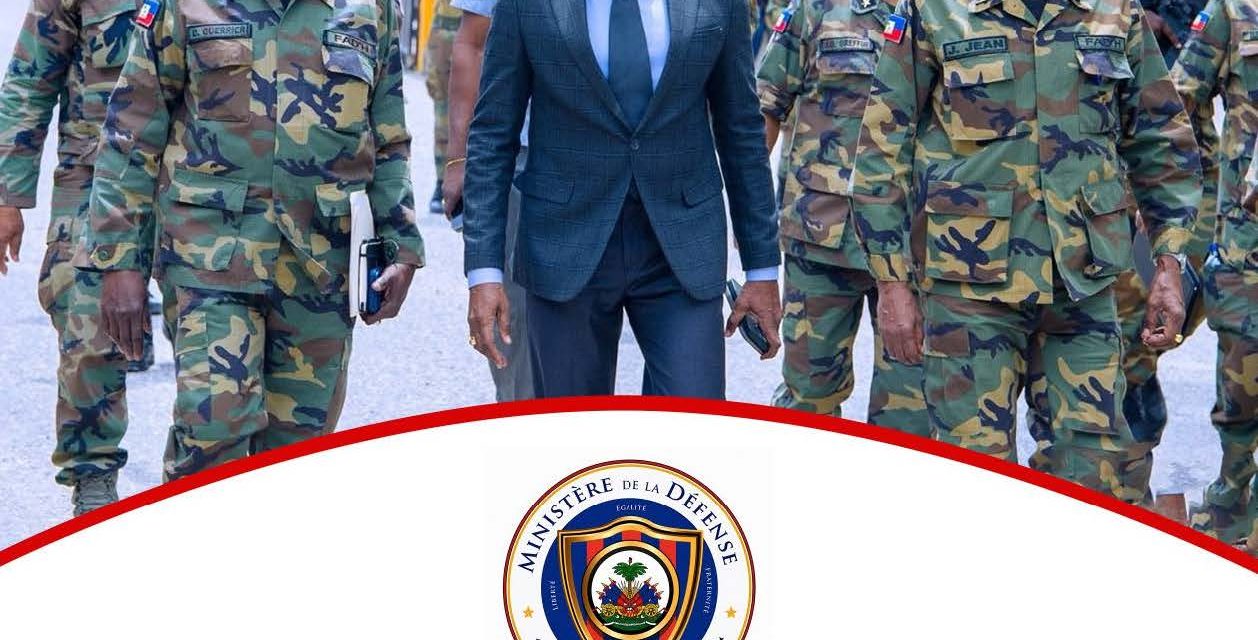
This is a communications document as much as an accountability one. It’s polished, image-heavy, and structured to accumulate an impression of momentum (six base visits! 17,722 candidates! a finalized doctrine! five international partnerships!) without ever stating the plainest fact about the institution: it remains, even after this “reinforcement,” a force of at most a few thousand personnel in a country where armed gangs control an estimated 80-90% of Port-au-Prince. Measured against that gap, “doubling base capacity to 600-700 places” is a rounding correction, not a transformation. Rescue.org
Where Haiti actually stands on national security right now
The bilan was published in July 2026 covering March–June; it’s worth updating the picture to September 2026, because the trajectory since has not been reassuring.
Haiti’s security emergency remains, by any measure, one of the world’s worst. Over 1,400 people were killed between April and June 2026 alone, and the humanitarian response plan is among the least funded in the world, with only 24% of needed funding secured by the end of 2025. UNICEF’s August 2026 update put internal displacement at roughly 1.5 million people, including 751,000 children. In September alone, gang attacks on the rural community of Kenscoff displaced over 2,600 people, with 50 kidnapped and at least 47 killed. Haiti’s gang violence crisis: What to know and how to help | The IRC +3
The international security response has also grown more fraught. The UN-authorized Gang Suppression Force (GSF), which succeeded the Kenyan-led Multinational Security Support mission, was first authorized for 12 months on September 30, 2025, and the US and Panama were expected to seek renewal before the Security Council at the end of September 2026 — a vote whose outcome was uncertain enough that Haiti’s own foreign minister publicly urged the UN to renew and fully deploy the force. Even proponents of extending the mission conceded ground: an estimated 1,300 gang leaders and members were killed in HNP operations aided by rifts within the gang coalition, but a February 2026 deadline for the dissolution of Haiti’s transitional government loomed over the whole effort. That deadline was not extended: the Transitional Presidential Council dissolved on schedule on February 7, 2026, handing sole executive power to Prime Minister Alix Didier Fils-Aimé — the same prime minister the Andrésol report credits with appointing him — without a clear succession or electoral plan in place. Elections, last held in 2016, remain unscheduled. Haiti, September 2026 Monthly Forecast : Security Council Report +4
Compounding the picture, UN and human rights reporting has documented a high rate of casualties during operations by Haitian security forces and by Vectus Global, a US private military company hired by the Haitian government to fight gangs — including civilian casualties from explosive drones. This is the operating environment the FAd’H’s 200-troop “consolidation” deployment sits inside, and it is precisely the kind of accountability question — chain of command, rules of engagement, coordination with a controversial armed contractor — that a genuinely transparent “bilan” would need to address and does not. Security Council Report
The bottom line
Andrésol’s report documents real, verifiable activity: visits happened, recruits enrolled, a doctrine was drafted, foreign partnerships continued. As institution-building goes, six months in, that is not nothing — particularly given how battered the FAd’H’s legitimacy has been since the coup era. But the document’s framing — cent premiers jours, chiffres clés, a glossy cover photo of the minister flanked by generals — asks to be read as evidence of a security response, and on that test it falls short. Haiti’s security crisis in September 2026 is, by every external measure, deeper than it was in March: more displaced people, a comparable or worse death toll, a lapsed political transition, an unrenewed international mandate hanging in the balance, and a controversial private contractor now part of the kinetic response. A few thousand troops, however professionalized, cannot close that gap alone, and the report’s own operational numbers — 200 deployed, 30 in the Task Force — implicitly concede as much. The real test of this ministry won’t be the next “100 days” report; it will be whether the doctrine, the recruits, and the partnerships translate into a FAd’H capable of doing more than supplementing a police force and a foreign coalition that are both, by their own accounts, still losing ground.