What Happened
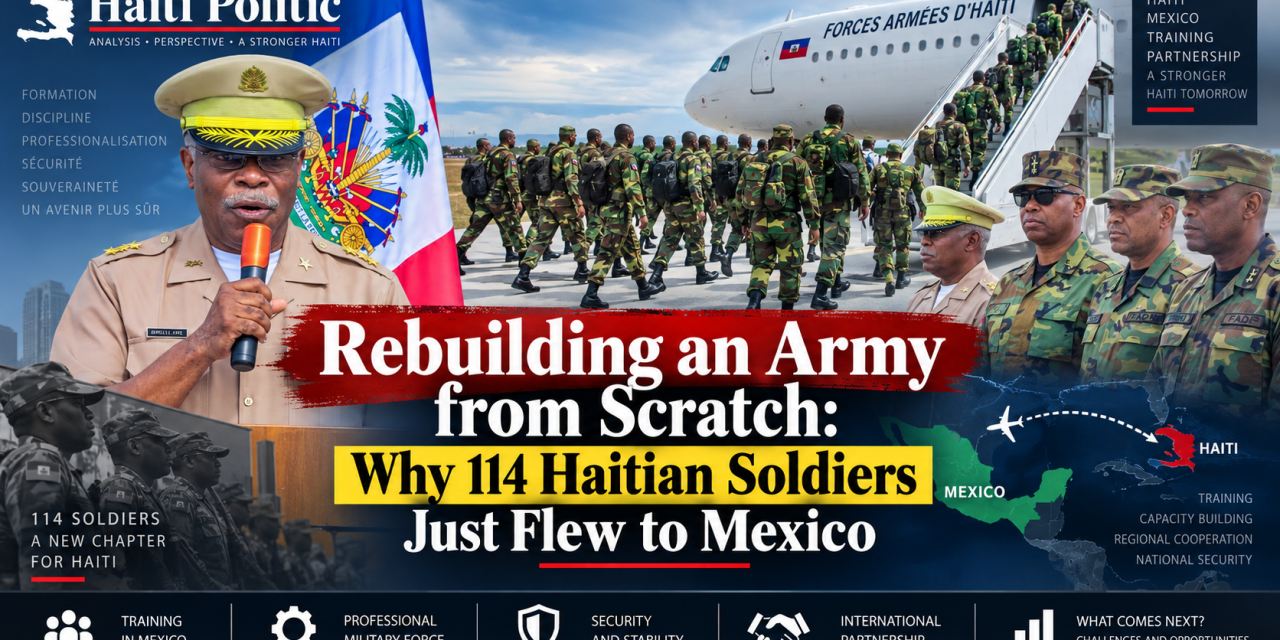
On September 18, 2026, the General Staff Secretariat of the Forces Armées d’Haïti (FAd’H) issued an official Notice of Information confirming what Haitian outlet Passion Info Plus had already captured on camera: a contingent of 114 military personnel departed Port-au-Prince for Mexico that day, bound for a training mission. The image accompanying the earlier report showed uniformed personnel descending the stairs of a “Fuerza Aérea Mexicana” jet on a Haitian tarmac; the FAd’H’s own statement now supplies the institutional framing behind it.
According to the communiqué, the departure falls under “bilateral cooperation agreements and technical and tactical training programs concluded with the Mexican armed forces,” with the stated aim of improving the operational skills of FAd’H personnel while “strengthening the requirements for discipline, rigor, and professionalism within the institution.” The FAd’H High Command framed the mission as part of its “unwavering commitment to modernization, empowerment, and continued professionalization of the Haitian Armed Forces” — language notable for what it does not say: the statement offers no operational detail on which units are being trained, in what specific disciplines, for how long, or toward what immediate deployment, leaving outside observers to infer those details from the pattern of past cohorts.
This is not an isolated event. It is the newest installment of a bilateral training program between Haiti and Mexico that has been running since 2022, one of the clearest threads connecting Haiti’s broader effort to rebuild an army that, until 2017, did not exist at all.
The Haiti-Mexico Training Pipeline: A Pattern, Not a One-Off
Tracing the record of Haitian military cohorts sent to Mexico shows a steady, expanding rhythm:
- 2022: An initial group of roughly 30 soldiers traveled to Mexico for special-operations training with the Cuerpo de Fuerzas Especiales, becoming the first special-forces unit of the reconstituted FAd’H. Separately that year, 29 non-commissioned officers trained at the Centro de Adiestramiento de Fuerzas Especiales in Temamatla, Mexico, to become drill instructors — tasked with building Haiti’s own domestic training capacity — while a company of roughly 150 soldiers received Mexican Army and National Guard instruction in drone warfare, guerrilla warfare, sniper tactics, and demolition, subsequently forming the FAd’H’s new National Guard Unit (Unité de Garde Nationale).
- 2023: Roughly 100 soldiers trained in Mexico, followed by a cohort of 113 who departed August 26, 2023, and returned September 23, 2023, after training in “special intervention” tactics, according to Haiti’s Ministry of Defense.
- Under the current bilateral agreement, Haiti and Mexico have committed to training a total of 700 soldiers, part of what Haitian officials have explicitly framed as “a historic milestone in the reconstruction of the Haitian Armed Forces” and a policy of strengthening national security capacity.
- September 2026: The newest cohort — 114 soldiers — departed for Mexico this week, continuing the same pipeline toward that 700-soldier target.
Why Mexico, Specifically?
Several practical and strategic factors explain why Mexico has become Haiti’s primary foreign partner for rebuilding its army, rather than, say, the United States or a European power taking the lead role:
- Directly relevant counter-gang expertise. Mexico has decades of hard-won institutional experience fighting heavily armed cartels — expertise in urban counter-insurgency, special operations, and paramilitary-style organized crime that maps far more directly onto Haiti’s current gang crisis than conventional state-on-state warfare training would.
- Specialized skill transfer. The specific disciplines Haitian soldiers have trained in — drone warfare, sniper tactics, demolition, special intervention — are precisely the capabilities a security force needs to contest territory from armed groups embedded in dense urban neighborhoods, which is exactly the challenge facing Haiti’s own security forces in Port-au-Prince.
- Building a domestic training capacity. By training Haitian non-commissioned officers as drill instructors in Mexico, the program is explicitly designed to let Haiti eventually train its own recruits on Haitian soil, rather than remaining permanently dependent on foreign training pipelines.
- A politically lower-friction partner. Given Haiti’s fraught history with direct U.S. military intervention (including the 1915–1934 occupation) and past foreign interventions more broadly, a Latin American, non-occupying partner offers a way to rebuild military capacity with less of the historical baggage that a large-scale U.S. or European training mission might carry politically.
Where Haiti’s Army Actually Stands Right Now
To understand why this training pipeline matters, it helps to understand just how recent — and how small — Haiti’s army still is.
A 22-year gap. Haiti’s armed forces were disbanded entirely in 1995 by President Jean-Bertrand Aristide, following the FAd’H’s long history of coups and human-rights abuses. For more than two decades, Haiti had no standing military at all — only the National Police (PNH). A process to reconstitute the armed forces began around 2011 and culminated in the formal remobilization of the FAd’H, under its old name, on November 18, 2017, under President Jovenel Moïse.
Still a small force. As of July 2025, the FAd’H — encompassing the Haitian Army, Navy, and Aviation Corps — had approximately 1,300 active personnel, a fraction of the size of the police force it operates alongside, and a fraction of what would be needed to meaningfully contest gang-controlled territory across a country of roughly 11 million people.
Steady, incremental growth. The Mexico pipeline is one part of a broader domestic expansion. In April 2026, the FAd’H graduated 339 new soldiers at home, with roughly 200 assigned to reinforce an internal “task force,” about 100 sent to a new National Guard unit responsible for securing the perimeter of the international airport in Clercine, and around 50 deployed as reinforcements to Artibonite — one of the departments hardest hit by gang expansion beyond Port-au-Prince.
New leadership, new doctrine. The Ministry of Defense is currently led by Mario Andrésol, a former FAd’H captain and former Director General of the National Police who also served as Secretary of State for Public Security — giving him an unusually direct institutional memory of both the army’s pre-1995 collapse and the police force built to replace it. In April 2026, Prime Minister Alix Didier Fils-Aimé announced a new doctrine for the FAd’H during an official visit to the United States, explicitly tied to U.S. legislation (H.R. 7148) authorizing Haiti to acquire American defense equipment and services — signaling that Washington, alongside Mexico, is now also positioning itself as a material partner in the army’s modernization, even if Mexico remains the primary hands-on training partner for troops themselves.
A force increasingly focused inward. Unlike the FAd’H’s pre-1995 constitutional design — under Haiti’s 1987 Constitution, the army was meant to handle external defense while the police handled domestic order — the reconstituted FAd’H is being built and deployed overwhelmingly for internal security operations against armed gangs, working in coordination with the National Police and the UN-backed Gang Suppression Force that succeeded the earlier Kenya-led security mission. That is a significant departure from the army’s originally intended role, reflecting the reality that Haiti’s most urgent security threat is not a foreign adversary but the armed groups controlling most of its capital.
The Bigger Picture
Set against the scale of Haiti’s security crisis — armed groups controlling an estimated 90 percent of Port-au-Prince and parts of several other departments — a training cohort of 114 soldiers, or even the full 700-soldier target under the Mexico agreement, remains modest. But it represents something Haiti has not had in decades: a deliberate, internationally supported, incrementally expanding effort to rebuild a standing army from a starting point of essentially zero. Whether that rebuilt force can meaningfully contribute to reversing gang control — or whether, as critics of Haiti’s coup-prone military history might reasonably ask, a reconstituted army introduces its own long-term risks to civilian governance — will depend on how these newly trained units are actually deployed, resourced, and overseen in the months ahead.
Sources: Forces Armées d’Haïti, General Staff Secretariat, official Notice of Information, September 18, 2026