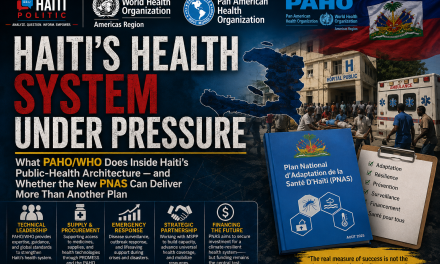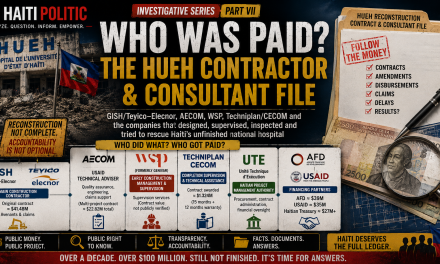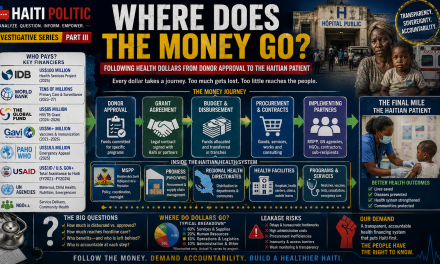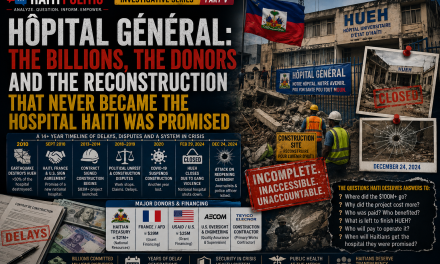
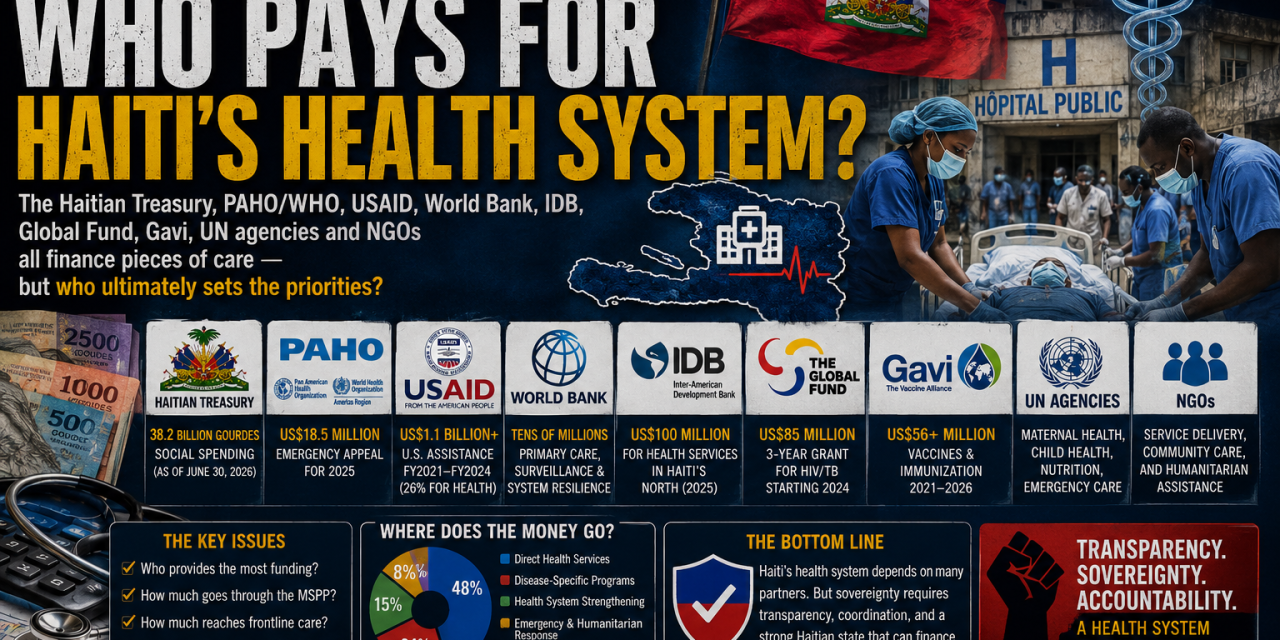
The Haitian Treasury, PAHO/WHO, USAID, World Bank, IDB, Global Fund, Gavi, UN agencies and NGOs all finance pieces of care — but who ultimately sets the priorities?
Health financing. Donor influence. Public hospitals. Vaccines. HIV/TB. Humanitarian response. Primary care. Sovereignty. Accountability.
Haiti’s health system is often described as “underfunded.” That is true, but incomplete.
The deeper problem is that Haiti does not have one unified health-financing system.
It has a financing mosaic.
The Haitian Treasury pays salaries, operating costs and part of public infrastructure. Multilateral banks finance health-system strengthening and major projects. The Global Fund finances HIV and tuberculosis programs. Gavi finances vaccines and immunization systems. PAHO/WHO coordinates technical assistance, emergency response and procurement support. USAID and other U.S. agencies have historically financed large parts of basic health and humanitarian programming. UN agencies finance maternal health, nutrition, children’s health and emergencies. NGOs often deliver the actual services.
The result is a paradox:
The MSPP is legally responsible for Haiti’s health system, but large parts of the money, expertise, logistics and implementation capacity sit outside the ministry.
That makes one question central to this investigation:
WHO REALLY CONTROLS THE HEALTH AGENDA — THE HAITIAN STATE, OR THE ORGANIZATIONS THAT FINANCE THE PROGRAMS?
There is no evidence that a single donor “controls” Haiti’s health system. But financing clearly creates influence over what can be implemented, where, and at what scale.
💰 THE DONOR MONEY MAP: WHAT CAN CURRENTLY BE DOCUMENTED?
A warning before comparing numbers: these amounts cover different years, purposes and accounting categories. They should not simply be added together as though they constitute one annual Haitian health budget. Some are project approvals; some are multi-year grants; some are emergency appeals; some are amounts approved rather than fully disbursed.
| Financier | Documented amount / commitment | Main purpose |
|---|---|---|
| Haitian State / Treasury | Health and education together accounted for about 38.2 billion gourdes of social spending executed by June 30, 2026; the 2025–26 budget also includes 2.14 billion gourdes for a hard-to-reach primary-care network | Salaries, public institutions, operations, national programs, capital projects |
| IDB | US$100 million grant approved in 2025 for Rebuilding Access to Essential Health Services | Greater North primary and essential healthcare, facilities, health-system management |
| IDB technical cooperation | US$400,000 in 2025 + US$500,000 in 2026 | Planning, health-system capacity, infrastructure supervision, financing sustainability |
| World Bank | PROSYS financing schedule shows tens of millions across 2023–27; a separate US$20 million additional financing was approved in 2022 | Primary care, surveillance, cholera, system resilience |
| Global Fund | US$85 million three-year grant beginning Jan. 2024 + over US$1.8 million emergency funding | HIV, TB, GBV-related HIV risk, displaced populations |
| Gavi | 2021–26 approvals include US$15.0M targeted assistance, US$15.1M pentavalent vaccine support, US$11.3M COVAX, US$7.95M cold-chain equipment, plus other programs | Vaccines, cold chain, immunization systems, equity |
| PAHO/WHO | US$18.5 million Haiti emergency appeal for 2025; separate US$10 million humanitarian-health project announced in 2026 | Emergency services, surveillance, medicines, displaced populations, system support |
| USAID / U.S. assistance | U.S. government committed more than US$1.1 billion in total assistance to Haiti FY2021–24; USAID OIG says health represented 26% of programming by area in that period | Basic healthcare, humanitarian health, HIV, maternal-child health, development programs |
Sources: Haitian government budget and expenditure reporting; IDB; World Bank; Global Fund; Gavi; PAHO/WHO; USAID OIG.
PART I — THE HAITIAN TREASURY: THE OWNER OF THE SYSTEM, BUT NOT YET ITS DOMINANT FINANCIER
Haiti’s government remains the constitutional center of public-health responsibility.
For fiscal year 2025–26, Haiti’s revised national budget totals about 360.3 billion gourdes, including roughly 290.2 billion gourdes in domestic resources and 70.1 billion gourdes in external resources.
By June 30, 2026, the Ministry of Economy and Finance reported 41.5 billion gourdes in social expenditures across Education, Health, Social Affairs and Agriculture. Education and health together represented about 38.2 billion gourdes, or roughly 92% of those social expenditures.
The government’s citizen budget also identifies a 2.14-billion-gourde MSPP project to establish a primary-healthcare network in difficult-access areas.
Those figures matter because they challenge the idea that Haiti contributes nothing to its health system.
It does.
But the bigger question is whether domestic financing is sufficient to pay for a modern national system without constantly depending on projects funded outside the Treasury.
Historically, it has not been.
The World Bank has previously estimated Haiti’s public health spending at only about US$13 per person annually, below the low-income-country average at the time of its analysis.
That structural weakness remains central.
PART II — IDB: A US$100 MILLION BET ON REBUILDING THE NORTH
The Inter-American Development Bank is currently one of the clearest examples of large-scale institutional health financing.
In October 2025, the IDB approved a US$100 million non-reimbursable grant for the project “Rebuilding Access to Essential Health Services.”
Its objective is to improve essential care in Haiti’s Greater North: the Nord-Ouest, Nord and Nord-Est departments.
The program targets:
health-system management;
integrated care networks;
expanded essential services;
community participation;
and improved facility capacity.
This is not a small NGO project.
It is a major health-system investment.
The IDB also approved:
US$400,000 in August 2025 for planning and institutional capacity-building;
and
US$500,000 in July 2026 specifically to help supervise health infrastructure and calculate the recurring fiscal costs required to keep new services operating after construction.
That last piece may be more important than it looks.
Haiti has repeatedly faced the “build it, then who pays to run it?” problem.
A donor can finance a hospital.
But who pays afterward for:
doctors;
nurses;
electricity;
oxygen;
maintenance;
laboratories;
ambulances;
medicine;
security?
The IDB’s 2026 technical-cooperation program explicitly examines whether Haiti can absorb those recurring costs into national public expenditure.
That is exactly the sustainability question Haiti needs to ask.
PART III — WORLD BANK: PRIMARY CARE, SURVEILLANCE AND POLICY DESIGN
The World Bank has also been deeply involved.
Its Strengthening Primary Health Care and Surveillance in Haiti project—often associated with PROSYS—has financed primary care and disease surveillance.
In 2022, the Bank approved US$20 million in additional financing. The program was intended to increase use of primary healthcare in targeted areas and strengthen disease surveillance, particularly around cholera.
World Bank documentation also shows project financing scheduled across multiple years, including substantial planned expenditures between 2023 and 2027.
The Bank’s influence is not limited to writing checks.
It also produces:
health-financing studies;
facility-performance analysis;
maternal-health studies;
resource mapping;
universal-health-coverage recommendations;
and pandemic preparedness analysis.
In 2025, the World Bank said its UHC and pandemic-preparedness work had helped inform Haitian health policy.
That creates another form of influence:
the power to define the problem.
A donor that finances research, designs performance indicators, helps formulate policy and then finances projects possesses influence at several stages of the policy cycle.
That is not necessarily improper.
But it should be visible.
PART IV — GLOBAL FUND: AN US$85 MILLION DISEASE-SPECIFIC POWERHOUSE
The Global Fund to Fight AIDS, Tuberculosis and Malaria operates differently.
Rather than financing Haiti’s entire public-health system, it concentrates large amounts of money around specific diseases and health-system capabilities.
In June 2024, the Global Fund announced more than US$1.8 million in emergency financing for Haiti.
That was added to a three-year US$85 million grant that began January 1, 2024.
The emergency component was intended to protect:
displaced populations;
victims and survivors of gender-based violence;
and other vulnerable groups facing elevated HIV and TB risks.
This creates what health economists sometimes describe as vertical financing.
Money arrives for a specific disease or intervention.
That can produce excellent outcomes.
But it can also create a health system where:
one laboratory program is well financed;
one category of medicine has a dedicated supply chain;
one disease has extensive monitoring;
while another basic service remains chronically underfunded.
Haiti therefore needs to ensure that disease-specific money also strengthens the broader public-health infrastructure.
PART V — GAVI: WHO PAYS FOR HAITI’S VACCINES?
Gavi provides one of the clearest examples of the mixed-financing model.
Its Haiti portfolio for 2021–2026, as reported in March 2026, includes approved funding such as:
US$15.0 million in targeted country assistance;
US$15.06 million for pentavalent vaccines;
US$11.31 million through COVAX;
US$7.95 million for cold-chain equipment;
US$7.49 million in COVID-related support;
US$4.16 million through the immunization-equity accelerator;
and additional funding for measles-rubella, injection safety and other programs.
But Gavi also requires countries to contribute.
And Haiti has continued meeting its co-financing obligations despite enormous political and economic pressure.
That is important.
The Gavi model essentially says:
We will help finance your vaccination system—but the Haitian government must gradually carry more of the cost.
That is closer to a sustainability model than indefinite donor substitution.
PART VI — PAHO/WHO: NOT JUST A DONOR
PAHO/WHO occupies a different position.
It is simultaneously:
technical adviser;
health-cluster coordinator;
emergency operator;
procurement facilitator;
disease-surveillance partner;
policy adviser;
and resource mobilizer.
For 2025, PAHO sought US$18.5 million to sustain emergency-health operations in Haiti. It reported that roughly 40% of inpatient health structures had closed and another 33% were only partially functioning amid insecurity.
In June 2026, PAHO announced a separate humanitarian initiative funded through the Regional Humanitarian Fund for Latin America and the Caribbean, with US$10 million allocated to Haiti, the largest country share in that five-country program.
That Haiti project targets more than 524,000 people and includes emergency and essential healthcare.
PAHO also signed a formal 2026–2028 Country Cooperation Strategy with Haiti in 2025 covering health-system strengthening, universal access, disease control and emergency preparedness.
This is why PAHO’s influence cannot be measured only in dollars.
Its influence comes from coordination power.
PART VII — USAID AND U.S. HEALTH FUNDING: LARGE, BUT IN FLUX
The U.S. government has historically been one of Haiti’s most important external health financiers.
A February 2025 USAID Inspector General report stated that the United States committed more than US$1.1 billion in total foreign assistance to Haiti from FY2021 through FY2024.
The same report’s program-area breakdown shows health accounting for 26% of USAID programming during that period.
That is a major footprint.
It has historically supported:
basic health services;
maternal-child care;
HIV programs;
nutrition;
humanitarian medicine;
health NGOs;
and emergency assistance.
But the U.S. aid environment changed substantially after the 2025 foreign-assistance review and widespread award terminations.
USAID OIG reported in 2026 that many foreign-assistance awards had been terminated globally and that it was auditing the disposition of USAID-funded assets in Haiti.
That creates a serious vulnerability for Haiti:
What happens when a national health function has been built around an external program and that program suddenly stops?
This is not theoretical anymore.
It is a fundamental health-security issue.
PART VIII — THE UN SYSTEM: SEVERAL AGENCIES, DIFFERENT HEALTH FUNCTIONS
The UN health footprint should not be treated as one giant organization.
Different agencies specialize in different areas.
UNICEF is heavily involved in childhood vaccination, nutrition, WASH and maternal-child services.
UNFPA focuses heavily on reproductive health, maternal health and gender-based violence.
UNAIDS coordinates HIV policy.
WHO/PAHO handles technical health coordination and standards.
OCHA coordinates humanitarian response.
Other agencies can finance or implement related social and emergency programs.
MSPP’s own 2026–2030 maternal, newborn, child, adolescent and older-person strategy identifies major technical and financial partners including PAHO/WHO, UNICEF, UNFPA, UNAIDS, PEPFAR/CDC/USAID, the World Bank, Global Fund, IDB and others.
That sentence from an official Haitian health strategy effectively illustrates the entire system:
Haiti’s health planning table is crowded with outside financiers.
PART IX — NGOs: THE MONEY DOES NOT ALWAYS FLOW THROUGH MSPP
This is where financing becomes especially difficult to follow.
A donor may announce:
“US$10 million for health in Haiti.”
But that does not necessarily mean the MSPP receives a US$10 million Treasury transfer.
The money might flow:
Donor → UN agency → international NGO → local NGO → clinic
or
Donor → multilateral bank → project management unit → contractor
or
Global Fund → Principal Recipient → sub-recipient → facility
or
USAID → contractor/NGO → implementing partner → community
This means two very different questions must always be asked:
How much money is being spent for Haiti?
and
How much money is flowing through Haitian state institutions?
Those numbers are not the same.
And that distinction may be one of the most important measures of health sovereignty.
🗺️ DONOR-INFLUENCE MAP
Here is a simplified view of how power currently flows.
That diagram makes one point obvious:
The MSPP sits at the center legally—but it does not necessarily sit at the center financially.
PART X — WHO HAS THE MOST INFLUENCE?
Influence comes in several different forms.
Haitian Treasury — Sovereign authority
It pays civil servants, owns facilities and ultimately carries responsibility for the system.
Its weakness is limited fiscal capacity.
PAHO/WHO — Technical and coordination influence
It helps establish standards, coordinates emergencies and assists MSPP with policy and implementation.
World Bank / IDB — Structural investment influence
They finance large-scale system reforms, facilities and long-term institutional programs.
USAID / U.S. agencies — Programmatic influence
Historically large financing, particularly across basic health, humanitarian assistance and HIV-related programming.
Global Fund — Disease-program influence
Large concentrated financing means enormous importance for HIV and TB.
Gavi — Vaccine-system influence
It helps determine the financial and operational architecture supporting immunization.
UN agencies — Sector-specific influence
Maternal health, children, nutrition, reproductive health and emergency populations.
NGOs — Last-mile implementation influence
Often the actor actually running the clinic, mobile team or community program.
None of these entities alone runs Haiti’s health system.
But together they create what might be described as a parallel financing architecture surrounding the MSPP.
PART XI — THE MOST IMPORTANT FINANCING QUESTION
The size of a donor commitment is not enough.
Consider the US$100 million IDB health grant.
The headline is impressive.
But Haiti Politic would want to know:
How much has been disbursed?
How much went to construction?
How much went to international consultants?
How much went to Haitian contractors?
How much reached hospitals?
What portion eventually becomes a recurring obligation of the Haitian Treasury?
What happens when the grant ends?
The same questions should apply to every donor.
PART XII — APPROVED IS NOT DISBURSED
This is one of the most common mistakes in reporting international aid.
There are at least four different numbers:
announced;
approved;
committed;
and
disbursed.
They are not interchangeable.
Gavi’s Haiti data illustrates this clearly. For targeted country assistance in the 2021–26 period, about US$15.0 million was approved, while roughly US$12.88 million had been disbursed as of March 2026. For cold-chain optimization, about US$7.95 million was approved, with roughly US$6.75 million disbursed.
That is exactly the kind of accounting Haiti needs across the entire sector.
PART XIII — WHAT DOES HAITI ACTUALLY PAY ITSELF?
Gavi provides a useful example of domestic ownership because Haiti is required to contribute toward vaccines and has continued doing so.
The broader health system should move increasingly in the same direction.
Haiti does not necessarily need to eliminate international assistance.
A poor country facing severe humanitarian insecurity will continue needing external resources.
The goal should be:
External money finances expansion and exceptional needs while domestic revenue increasingly finances the permanent core of the system.
That core includes:
salaries;
essential medicines;
primary care;
ambulances;
maintenance;
public-health laboratories;
surveillance;
electricity;
oxygen;
and basic hospital operations.
A sovereign health system cannot have those functions permanently dependent upon annual donor negotiations.
PART XIV — THE REAL RISK: DONOR PRIORITIES CAN FRAGMENT THE SYSTEM
Imagine ten donors.
One finances HIV.
One finances vaccines.
One finances maternal health.
One finances cholera.
One finances climate resilience.
One builds hospitals.
One finances nutrition.
One finances emergency response.
One finances reproductive health.
One finances data systems.
Every project might be individually worthwhile.
Yet the overall system can still be dysfunctional.
Why?
Because Haiti may end up with ten strong projects rather than one strong health system.
That is the fragmentation problem.
The MSPP’s job should therefore be to force donor money into one coherent national architecture rather than allowing the architecture to be built around the donors.
PART XV — PNAS MAKES THE FINANCING QUESTION EVEN MORE URGENT
The Plan National d’Adaptation de la Santé 2025–2029 now adds climate-health financing to an already complicated environment.
PNAS will require money for:
resilient hospitals;
surveillance;
water and sanitation;
emergency systems;
climate-health data;
workforce training;
disease prevention;
and disaster preparedness.
But the PNAS launch documentation emphasizes resource mobilization, including development of proposals for mechanisms such as the Green Climate Fund.
That means substantial PNAS financing still has to be mobilized rather than assumed to exist automatically.
The question becomes:
Will PNAS financing strengthen MSPP—or create another donor-managed funding lane beside it?
That should be tracked from the beginning.
📊 THE HAITI POLITIC HEALTH FINANCING DASHBOARD
| Question | Current answer |
|---|---|
| Does Haiti finance part of its health system domestically? | Yes |
| Is domestic financing sufficient for the entire system? | No evidence that it is |
| Are major external donors financing essential services? | Yes |
| Is IDB currently financing a major health-system project? | Yes — US$100M |
| Does Global Fund have a major active Haiti grant? | Yes — US$85M over three years, plus emergency funding |
| Does Gavi finance vaccines and health-system infrastructure? | Yes |
| Does Haiti contribute to vaccine purchases? | Yes |
| Does PAHO directly support emergency health operations? | Yes |
| Is U.S. assistance historically a major health-financing source? | Yes |
| Does all donor money pass through the Haitian Treasury? | No |
| Can published sources yet provide one consolidated real-time picture of all health financing? | Not from the sources reviewed |
🔥 20 QUESTIONS MSPP AND ITS PARTNERS SHOULD ANSWER
- What is Haiti’s total annual health expenditure from all sources?
- How much comes directly from the Haitian Treasury?
- How much comes from foreign governments?
- How much comes from multilateral banks?
- How much flows through UN agencies?
- How much goes directly to NGOs?
- How much donor money actually enters MSPP-controlled accounts?
- How much is spent on international consultants and administration?
- How much reaches frontline facilities?
- Which donor finances each major hospital and health program?
- Who pays healthcare workers whose salaries are externally funded?
- What happens to those jobs when a grant ends?
- Which medicines are donor-financed rather than Treasury-financed?
- Which programs would stop within 90 days if international funding disappeared?
- How much of PNAS 2025–2029 is actually financed?
- How much of the IDB US$100 million has actually been disbursed?
- What percentage of Global Fund financing strengthens systems outside HIV/TB programs?
- How much does Haiti itself contribute annually to Gavi-supported vaccines?
- Will MSPP publish a single national donor-financing dashboard?
- What percentage of recurrent health expenditure does Haiti intend to finance domestically by 2030?
THE INVESTIGATIVE CONCLUSION
There is no credible argument that Haiti can simply remove PAHO, WHO, USAID, the World Bank, IDB, Global Fund, Gavi, UNICEF, UNFPA and NGOs tomorrow and expect the health system to function normally.
Too many essential functions currently depend upon those relationships.
But the opposite extreme is equally dangerous:
accepting permanent donor dependence as the natural architecture of Haitian healthcare.
The purpose of international assistance should ultimately be to make Haiti more capable, not permanently more dependent.
The success of the IDB’s US$100 million project should therefore be measured not only in buildings but in whether Haiti can operate those facilities afterward.
The success of Gavi should eventually be measured by whether Haiti can finance more vaccination independently.
The success of PAHO should be measured partly by whether MSPP acquires stronger permanent technical capacity.
The success of the Global Fund should include whether HIV and TB investments leave stronger laboratories, supply chains and data systems behind.
And the success of U.S. assistance should be measured not simply in dollars spent but in durable Haitian institutions that remain functional after American financing changes.
That leads to the central question of Part II:
HAITI HAS MANY HEALTH DONORS. DOES IT HAVE ONE NATIONAL HEALTH FINANCING STRATEGY STRONG ENOUGH TO CONTROL THEM?
Until Haitians can open a public dashboard and see:
who gave the money;
who received it;
what it financed;
how much was actually disbursed;
what results were produced;
and
who will pay when the project ends—
the public still does not have a complete answer to the most basic question in healthcare:
Who pays for Haiti’s health system?
And without knowing who pays, it is difficult to know who holds the real leverage.