
In 1984, on a business trip to China, a young Sun Microsystems researcher named John Gage watched an audience interact with a demonstration screen and had a realization that would define the next four decades of computing: the real power wasn’t in the box in front of them. It was in the network behind it. He coined a phrase that became Sun’s company motto and, eventually, an industry maxim: “The Network Is the Computer.”
Four decades later, artificial intelligence is the clearest proof of that idea the tech industry has ever produced. A chatbot answering a question, an AI agent booking a flight, a coding assistant refactoring a codebase — none of it happens on a single machine. It happens across a stack of physical cables, silicon chips, data centers, and software protocols that most users never see and never think about. To understand how AI actually works — not the model weights, but the infrastructure — it helps to go back to one of networking’s oldest and most durable frameworks: the OSI model.
The OSI Model, Briefly
The Open Systems Interconnection (OSI) model, standardized in the early 1980s, breaks network communication into seven layers, from the physical wires at the bottom to the software applications at the top:
- Physical — cables, radio waves, optical fiber, electrical signals, hardware
- Data Link — how devices on the same local network talk to each other (Ethernet, MAC addresses)
- Network — routing data between networks (IP addresses, routers)
- Transport — reliable delivery of data (TCP, UDP)
- Session — establishing, managing, and ending connections
- Presentation — translating, encrypting, and formatting data
- Application — the layer users actually interact with (HTTP, APIs, apps)
Every piece of data that moves across the internet — including every prompt sent to an AI model and every token sent back — passes through all seven layers, twice: once going out, once coming back.
Why AI “Lives” at Layer 7 — But Can’t Survive Without the Other Six
When most people interact with AI, they’re interacting with Layer 7. A chat interface, a REST API call to a model provider, a voice assistant, a coding tool inside an IDE — these are all Application Layer experiences. This is where prompts are formatted, where responses are rendered, where authentication tokens are checked, and where the actual “conversation” with an AI system takes place. In a very real sense, AI is a Layer 7 phenomenon from the end user’s point of view: it’s software talking to software, wrapped in an interface a person can understand.
But that framing is incomplete, and pretending otherwise is exactly the kind of illusion Gage’s slogan was written to puncture. A large language model’s “intelligence” is not self-contained in the device in front of you — it depends entirely on a chain of infrastructure running underneath that Application Layer interaction:
- Layer 6 (Presentation) handles encryption (TLS) so your prompt isn’t readable in transit, and handles serialization — turning your text into the JSON payloads models actually consume.
- Layer 5 (Session) keeps a persistent connection alive during a long conversation or a multi-step agent task, so context isn’t lost mid-request.
- Layer 4 (Transport) — almost always TCP for AI workloads — guarantees that the millions of data packets carrying a model’s response arrive complete and in order, which matters enormously when a single inference request might stream thousands of tokens.
- Layer 3 (Network) routes your request across the internet to whichever data center is actually hosting the model — which might be thousands of miles away.
- Layer 2 (Data Link) and Layer 1 (Physical) move that request across the actual physical infrastructure: switches, routers, fiber-optic cables, and — increasingly, for AI specifically — highly specialized interconnects between chips that never existed before this generation of computing.
Take away any one of those six layers, and Layer 7 stops working. The chatbot interface is the tip of an iceberg that is mostly physics and plumbing.
Where AI Hardware Actually Lives: Layer 1
This is where AI diverges most sharply from “normal” internet traffic, and where Gage’s 1984 insight becomes almost eerily literal. Training and running frontier AI models requires physical infrastructure of a scale and specificity that didn’t exist even a decade ago:
- GPUs and AI accelerators (NVIDIA H100s and B200s, Google TPUs, AWS Trainium, custom silicon) are the compute engines — but a single chip is nearly useless for training a large model. What matters is how many of them can be wired together.
- NVLink and NVSwitch connect GPUs within a server at extremely high bandwidth, letting dozens of chips function almost as one.
- InfiniBand and specialized Ethernet fabrics connect entire racks and clusters of servers together, because a single frontier model’s training run can require tens of thousands of GPUs working in near-perfect synchronization.
- Optical fiber backbones move data between data centers and across continents, since AI companies often train across multiple facilities.
- Power and cooling infrastructure — transformers, liquid cooling systems, dedicated substations — is now treated as core “compute infrastructure” in its own right, because AI-scale data centers can draw as much electricity as a mid-sized city.
In other words: the Physical Layer of the OSI model, for AI, isn’t just a cable running to your laptop. It’s a purpose-built industrial facility. The “computer” that Gage’s slogan referred to has become, quite literally, buildings full of specialized machines connected by a network engineered specifically for AI traffic.
Beyond OSI: The Networking Layers Being Built for Multi-Agent AI
The OSI model was designed in an era when “communication” meant humans and applications exchanging data. It was never built with the idea that autonomous AI agents would need to negotiate, delegate tasks to each other, and coordinate in real time. As multi-agent AI systems — networks of specialized AI agents that hand off work to one another — have become a serious engineering reality, the industry has begun sketching out something like new layers on top of Layer 7, rather than replacing OSI outright.
A few emerging examples worth watching:
- Model Context Protocol (MCP), introduced by Anthropic in late 2024, standardizes how an AI model connects to external tools, data sources, and services — effectively creating a shared “language” for AI systems to discover and use capabilities beyond their own training, in a way roughly analogous to how HTTP standardized how browsers talk to web servers.
- Agent-to-Agent (A2A) protocols, an approach championed by Google and an emerging multi-vendor coalition, aim to let independently built AI agents — potentially made by different companies, running different models — discover each other’s capabilities and collaborate on a task without a human manually wiring the connection.
- Industry discussion has increasingly floated the idea of an “Agent Layer” or “Cognitive Layer” sitting conceptually above Layer 7: not a new physical or transport layer, but a semantic layer concerned with intent, trust, and task delegation between autonomous systems, rather than just data delivery.
None of this is standardized the way TCP/IP or HTTP are — it’s the Wild West era of a protocol layer still being invented, roughly where web protocols were in the early-to-mid 1990s. But the direction is clear: as AI systems increasingly talk to other AI systems rather than only to humans, the industry is discovering it needs new shared conventions for that conversation, layered on top of — not replacing — the seven-layer foundation that’s carried internet traffic since the 1980s.
Who Actually Owns “The Computer”
If AI infrastructure is the modern expression of “the network is the computer,” it’s worth asking directly: who owns it? The answer is more fragmented — and more consequential — than most users realize.
Hyperscalers (Tech Giants). The largest, most powerful data centers on Earth are owned outright by the companies that use them to run their own clouds and models: Amazon Web Services (AWS), Microsoft, Google, Meta, and Oracle. These companies build to their own specifications because AI workloads increasingly demand infrastructure no off-the-shelf landlord can provide.
Colocation and Wholesale Landlords. A second tier of companies builds data centers not to use themselves, but to lease out — space, power, and cooling — to other businesses, including the hyperscalers themselves when they need capacity fast. Equinix, Digital Realty, QTS (owned by private equity firm Blackstone), NTT Global Data Centers, and CyrusOne dominate this space.
Private Equity and Financial Giants. Increasingly, the physical real estate underneath AI is owned not by tech companies at all, but by Wall Street. Blackstone holds major stakes in QTS and AirTrunk; BlackRock, through its Global Infrastructure Partners arm, has become one of the largest infrastructure investors in the world. For these firms, a data center is fundamentally a real asset class — closer to a toll road or a power plant than to a piece of software.
Private Enterprise and Government. A smaller, older category of data centers exists purely for internal operational use — banks, hospitals, and government or defense agencies running facilities that never lease space to anyone.
Ownership, in other words, splits along two very different lines: companies that build data centers to use, and companies that build them to rent out. Both categories are increasingly financialized, with private capital treating “compute” the way it once treated office towers and toll bridges.
The Uncomfortable Bottom Line for Countries Without a Seat at the Table
No single country owns artificial intelligence. But the infrastructure that AI runs on is owned by an identifiable, concentrated set of corporations and investment funds — and that infrastructure is not evenly distributed across the globe. Some nations host dozens of hyperscale facilities and sit at the center of the fiber-optic backbone. Others host none at all.
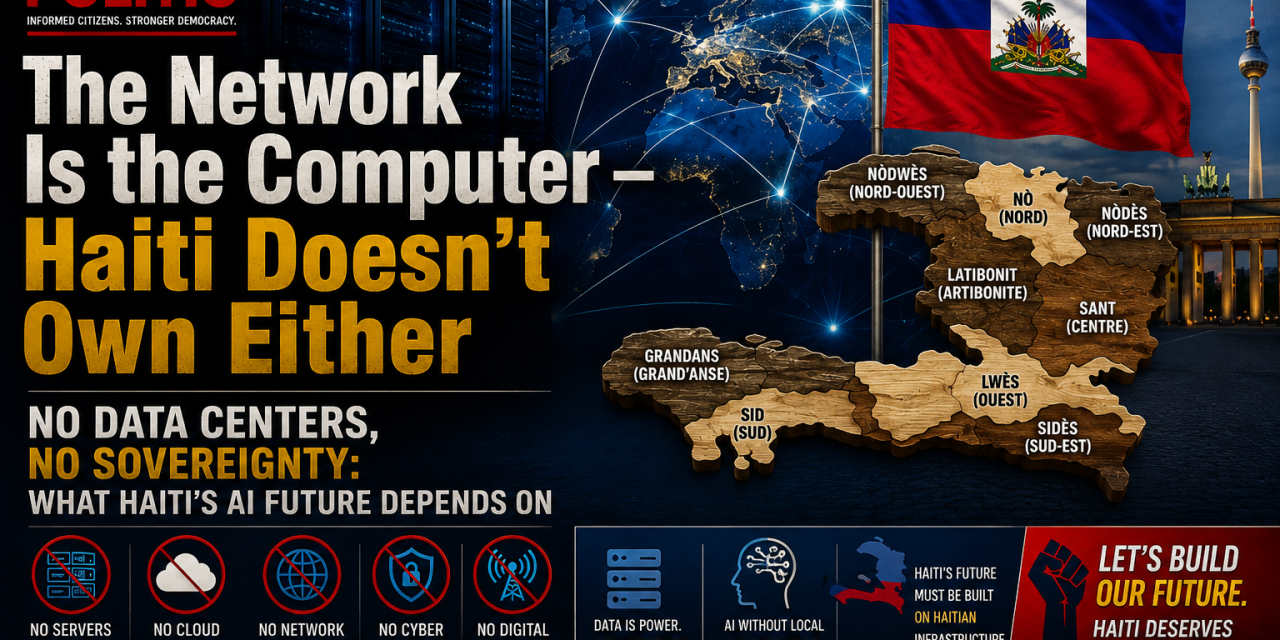
Haiti is one of the countries with none. The Haitian government does not own a data center. No private Haitian company owns one either. Every layer of the OSI model that Haitian internet users, businesses, and government agencies depend on for AI, cloud storage, or basic digital services — Layer 1 through Layer 7 — currently runs on infrastructure owned and controlled entirely outside the country.
That’s not a uniquely Haitian problem — dozens of nations face the same gap — but it is a strategic one. Data sovereignty starts at the Physical Layer. A country that owns no compute, no storage, and no network infrastructure has no independent claim over where its citizens’ and institutions’ data physically resides, who can access it, or under what legal jurisdiction it sits. As AI becomes core infrastructure for banking, healthcare, education, and government administration worldwide, that gap compounds rather than shrinks on its own.
If the Haitian people want a real claim to their own data — not just access to AI services built and hosted elsewhere, but actual sovereignty over where that data lives — it starts exactly where John Gage’s insight points: the network. That means Haiti’s government and private sector building real network infrastructure inside the country: fiber backbones, local data facilities, reliable power to run them, and the technical talent to operate them. Cloud services rented from a hyperscaler are useful, but they are not the same as ownership. As long as the infrastructure lives elsewhere, so does the leverage.
The network is the computer. The question every country now has to answer is whether it owns any of the network at all.
This piece is intended as a general technical explainer. Company ownership details reflect publicly known corporate structures and are subject to change as data center assets are bought, sold, and refinanced.