🇭🇹🌍 Geneva is not only a center of human-rights diplomacy. It is also one of the places where the rules governing tariffs, exports, customs, intellectual property, trade preferences and economic development are negotiated.
For Haiti, those negotiations matter.
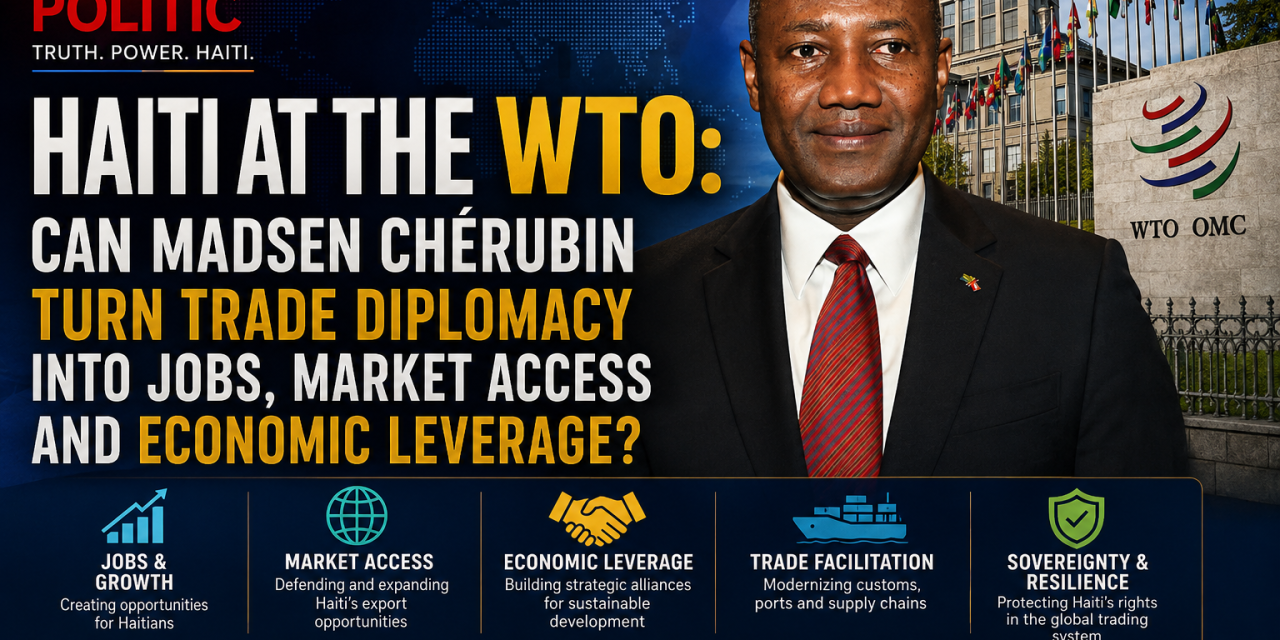
At the center of that portfolio is Ambassador Madsen Chérubin, whom Haiti’s Ministry of Foreign Affairs currently identifies as Ambassador Extraordinary and Plenipotentiary at Haiti’s Permanent Mission to the World Trade Organization (WTO/OMC) in Geneva.
His mission should therefore be judged by an economic question:
WHAT IS HAITI GETTING FROM ITS SEAT AT THE GLOBAL TRADE TABLE?
Not simply meetings.
Not communiqués.
Not diplomatic photographs.
But:
💰 Trade-related financing
📦 Greater Haitian exports
🏭 Productive investment
⚓ Better trade logistics
🧾 Modernized customs
🌎 Preferential market access
🤝 Stronger CARICOM bargaining power
🎓 Technical assistance
⚖️ Protection of Haiti’s special rights as a Least Developed Country
And ultimately:
JOBS AND ECONOMIC OPPORTUNITY FOR HAITIANS.
The public record shows that Chérubin has obtained a position of regional diplomatic responsibility.
But it also exposes major unanswered questions about measurable results.
👤 WHO IS MADSEN CHÉRUBIN?
Publicly available biographical information on Chérubin is considerably thinner than it should be for someone occupying such an important economic-diplomacy position.
What can be independently established?
A Haitian government record from 2018 lists Madsen Chérubin among candidates considered in connection with Haiti’s Corps d’administrateurs civils d’État.
By December 2023, a UN Economic Commission for Europe participant record identified him as:
“Ambassador, Advisor of the Minister of Foreign Affairs”
representing Haiti at an international workshop on financing transboundary water cooperation.
Today, Haiti’s Foreign Ministry officially lists him as its Ambassador Extraordinary and Plenipotentiary at the WTO mission in Geneva.
That establishes experience within Haiti’s public administration and foreign-affairs apparatus.
But an important transparency problem immediately appears:
WHERE IS THE COMPLETE PROFESSIONAL BIOGRAPHY?
What degrees does he hold?
What is his specialization in international trade?
Which ministries has he served?
What negotiating experience did he possess before taking over the WTO mission?
Has he worked in customs, trade law, economics, investment, commercial diplomacy or regional integration?
Those details should not require investigative reconstruction.
The Ministry of Foreign Affairs should publish complete professional biographies for Haiti’s senior diplomats.
🌎 ACCOMPLISHMENT #1 — HAITI CHAIRED THE CARICOM GROUP IN GENEVA
Here we find a clearly documented leadership role.
On July 29, 2026, Haiti formally transferred the chairmanship of the CARICOM Group in Geneva to Dominica/OECS during a ceremony at Haiti’s mission.
The OECS announcement specifically identifies Ambassador Madsen Chérubin as Haiti’s Permanent Representative to the WTO.
The Geneva CARICOM Group brings together diplomatic missions representing:
The Bahamas
Barbados
Belize
Dominica
Guyana
Haiti
Jamaica
Suriname
OECS
Trinidad and Tobago.
This is significant.
A small economy like Haiti cannot realistically maximize influence at the WTO by negotiating alone.
Coalition diplomacy is essential.
CARICOM can potentially transform multiple small economies into a negotiating bloc capable of demanding attention from much larger trading powers.
Chérubin’s chairmanship therefore gave Haiti an opportunity to help coordinate the Caribbean voice in Geneva.
That is a legitimate diplomatic achievement.
But—
CHAIRING A GROUP IS NOT THE SAME AS CHANGING TRADE POLICY.
So what did Haiti accomplish with the chair?
📑 QUESTION #1 — WHERE IS THE CARICOM CHAIRMANSHIP REPORT?
The public deserves a closing report documenting Haiti’s chairmanship.
During Chérubin’s tenure:
How many CARICOM negotiating positions were coordinated?
How many joint submissions were produced?
Which WTO committees received them?
Which proposals originated with Haiti?
Which Caribbean priorities were incorporated into WTO decisions?
Which trade disputes required coordinated Caribbean intervention?
What positions were developed regarding agriculture, fisheries, digital commerce, services or trade facilitation?
The July 29 handover proves Haiti occupied the chair.
Now publish what the chairmanship produced.
🤝 CARICOM DIPLOMACY SHOULD BE ABOUT COLLECTIVE LEVERAGE
This matters especially because Haiti is not operating in an easy international trade environment.
WTO monitoring shows that global trade-policy activity accelerated sharply during 2025–26, amid increasing tariff and geopolitical tensions.
Small economies are particularly vulnerable to decisions taken elsewhere.
That means Caribbean states need coordinated positions on:
food security
shipping costs
climate vulnerability
digital trade
tourism
agriculture
services
trade finance
and
preferential market access.
If Haiti’s CARICOM chairmanship generated concrete strategies in those areas, publish them.
💰 THE BIG ECONOMIC OPPORTUNITY: AID FOR TRADE
The WTO’s Aid for Trade initiative exists specifically to help developing economies overcome obstacles preventing them from participating effectively in international trade.
According to the WTO, approximately US$730 billion was disbursed globally under Aid for Trade between 2006 and 2023.
Around 97% went toward infrastructure and productive capacity.
Think about what that mandate means for Haiti.
Haiti desperately needs:
⚓ functioning trade corridors
🚚 reliable logistics
🧾 modern customs systems
💻 customs digitization
🏭 productive capacity
🌾 export development
📦 certification infrastructure
🔬 laboratories
⚡ reliable energy for industry
🌐 digital trade infrastructure
This should make Haiti an obvious candidate for aggressive Aid-for-Trade diplomacy.
💵 ACCOMPLISHMENT #2 — OR A MAJOR UNANSWERED QUESTION?
Here the public record becomes much less clear.
In reviewing publicly available WTO and related sources, I could not establish a quantified package of new Aid-for-Trade financing personally negotiated by Chérubin’s mission for Haiti’s damaged ports or domestic supply chains.
That does not establish that no work occurred.
Nor does it mean Haiti received no trade-related development assistance.
It means something narrower—and important:
THE ATTRIBUTABLE RESULT IS NOT CLEAR FROM THE PUBLIC RECORD.
So Ambassador Chérubin should answer:
How much Aid-for-Trade financing has Haiti received during his tenure?
Not pledged globally.
Not allocated to the Caribbean.
Specifically Haiti.
And what role did his mission play in securing it?
⚓ QUESTION #2 — WHERE IS THE SUPPLY-CHAIN PACKAGE?
Haiti’s security crisis has severely disrupted normal commerce.
So what has the WTO mission done about it?
Did Chérubin’s office mobilize assistance for:
port modernization?
customs technology?
trade-route resilience?
warehousing?
cargo tracking?
electronic documentation?
export certification?
trade finance?
small exporters?
women-owned businesses?
If yes:
SHOW THE PROJECTS.
For each one, disclose:
Donor
Amount
Approval date
Implementing institution
Project objective
Money disbursed
Implementation status
Measurable result
That would transform diplomatic claims into a performance record.
🧾 CUSTOMS MODERNIZATION MAY BE EVEN MORE IMPORTANT
Haiti’s customs administration occupies a strategic position.
The country needs customs systems capable of simultaneously:
accelerating legitimate commerce
and
reducing opportunities for illicit trade and corruption.
The WTO’s own historical Trade Policy Review of Haiti documented significant structural and institutional trade-policy challenges, including an outdated legal framework.
And the WTO’s current quantitative-restrictions profile reports no notifications submitted by Haiti in that area.
That should raise a broader administrative question:
IS HAITI FULLY MEETING ITS WTO TRANSPARENCY AND NOTIFICATION OBLIGATIONS?
A modern trade mission should not only negotiate externally.
It should help Haiti’s ministries comply internally.
🚨 QUESTION #3 — SHOW US THE CUSTOMS REFORM
What agreements has Chérubin’s mission facilitated with:
WTO
World Customs Organization
UNCTAD
International Trade Centre
World Bank
IDB
European Union
or bilateral donors?
Has Haiti obtained technical assistance for:
single-window customs systems?
electronic declarations?
risk-based cargo inspection?
valuation systems?
rules-of-origin verification?
anti-corruption controls?
authorized economic operators?
cargo traceability?
And how much did those programs cost?
A meeting discussing customs modernization is not modernization.
IMPLEMENTATION IS THE RESULT.
🇭🇹 HAITI’S MOST VALUABLE WTO ASSET MAY BE ITS LDC STATUS
Haiti remains classified by the United Nations as a Least Developed Country (LDC).
The UN’s Haiti profile shows that Haiti entered the category in 1971.
This status gives vulnerable economies access to important international support measures, including special treatment in trade.
And here we need to correct an important premise in the proposed oversight questions.
⚠️ HAITI IS NOT CURRENTLY ON THE WTO LIST OF LDCS APPROACHING GRADUATION.
The WTO currently identifies 14 LDCs on the path toward graduation.
Haiti is not among them.
Therefore, asking what Chérubin is negotiating to protect Haiti from an imminent loss of LDC status risks creating a false impression.
There is currently no such imminent Haitian graduation identified by the WTO.
But the underlying policy question remains important.
🛡️ WHAT IS HAITI DOING WITH THE ADVANTAGES IT ALREADY HAS?
The WTO’s database shows Haiti benefiting from preferential arrangements offered by multiple partners, including:
United Kingdom
Canada
European Union
Australia
and others.
Haiti also participates in regional trade arrangements involving CARICOM, CARIFORUM-EU and CARIFORUM-UK.
The important question is therefore not simply:
“Does Haiti have preferences?”
It is:
IS HAITI ACTUALLY USING THEM?
A trade preference that Haitian companies cannot exploit because of electricity shortages, security problems, certification barriers, logistics failures or lack of financing has little practical value.
📦 QUESTION #4 — SHOW THE PREFERENCE UTILIZATION RATE
For every major preferential market:
How much could Haiti export duty-free?
How much does it actually export?
Which tariff lines are underutilized?
Which Haitian products could qualify but currently do not reach those markets?
What are the barriers?
Rules of origin?
Quality certification?
Production capacity?
Shipping?
Financing?
Sanitary requirements?
Security?
That analysis should exist inside a serious commercial-diplomacy strategy.
👕 TEXTILES CANNOT BE THE ENTIRE STRATEGY
Haiti’s preferential access for apparel is economically important.
But Haiti cannot build a resilient export economy around one sector alone.
The WTO itself emphasizes that developing economies need stronger productive capacity and diversification. Aid for Trade is explicitly designed to address those constraints.
So where is the strategy for:
☕ Haitian coffee
🍫 cacao
🥭 processed agricultural products
🌿 essential oils
🥃 specialty products
🎨 handicrafts
💻 digital services
🎵 creative industries
👕 higher-value textile production
📦 regional manufacturing?
Trade diplomacy should connect Haitian producers with markets.
🌍 ACP/OACPS: ANOTHER POTENTIAL SOURCE OF LEVERAGE
Haiti also belongs to the wider African-Caribbean-Pacific diplomatic architecture.
That creates opportunities for coalition building with developing economies whose trade concerns overlap with Haiti’s.
But again:
WHAT DID HAITI INITIATE?
Which ACP/OACPS proposals did Chérubin help draft?
Which did Haiti co-sponsor?
Which addressed fragile states?
Which dealt with infrastructure?
Which addressed food-import dependence?
Which expanded trade-related technical assistance?
Which produced measurable benefits?
These should be disclosed.
💡 THEN THERE IS INTELLECTUAL PROPERTY
Chérubin’s portfolio intersects with another major Geneva institution:
WIPO — THE WORLD INTELLECTUAL PROPERTY ORGANIZATION.
In 2026, Haiti did something unusually ambitious.
It nominated Haitian intellectual-property specialist Dr. Johanny Stanley Joseph to become Director General of WIPO.
WIPO confirms that only two candidates were nominated:
Daren Tang — Singapore
and
Johanny Stanley Joseph — Haiti.
For a country with Haiti’s limited diplomatic resources, putting forward a candidate for leadership of a major UN specialized agency was a bold institutional move.
But the result was decisive.
🗳️ WIPO RESULT: 81–2
On February 12, 2026, WIPO’s 83-member Coordination Committee voted.
Daren Tang received:
81 VOTES
Johanny Stanley Joseph received:
2 VOTES.
Tang was subsequently nominated for another term.
This result deserves analysis—not ridicule.
Haiti had every right to present a qualified candidate.
Joseph’s submitted résumé describes him as a lawyer specializing in intellectual property, including geographical indications and appellations of origin, and notes previous service as Haiti’s Director of Industrial Property and Legal Affairs at the Ministry of Commerce and Industry.
But a 2–81 result creates a legitimate diplomatic question:
WHAT WAS HAITI’S COALITION STRATEGY?
🔎 QUESTION #5 — WHAT DID HAITI LEARN FROM THE WIPO CAMPAIGN?
Before presenting Joseph:
How many countries had Haiti secured?
Which regional blocs were approached?
Did CARICOM commit?
Did African states commit?
Did Francophone states commit?
Did LDC partners commit?
Which governments initially expressed support but voted differently?
Was Haiti running primarily to win?
To raise Haiti’s institutional profile?
To negotiate concessions?
To establish future candidacies?
All are potentially legitimate diplomatic strategies.
But the government should explain which strategy it pursued.
Because the final vote is measurable:
2 OUT OF 83.
A results-oriented diplomatic service studies both its victories and its defeats.
🧠 BUT WIPO SHOULD NOT END WITH AN ELECTION
This could become one of Chérubin’s most important tests.
What did Haiti obtain after the campaign?
Did WIPO commit:
technical assistance?
training for Haitian IP officials?
digitization of patent and trademark administration?
support for Haitian geographical indications?
protection of Haitian cultural products?
support for artists and musicians?
technology-transfer programs?
university partnerships?
IP training for entrepreneurs?
If the candidacy generated relationships that later produced institutional benefits, the 81–2 defeat may still have strategic value.
If nothing followed, the government should explain why.
🌿 HAITI COULD USE INTELLECTUAL PROPERTY AS ECONOMIC POLICY
Imagine international protection strategies for Haitian products and cultural assets.
Haitian coffee
Haitian cacao
clairin
vetiver
artisan products
creative works
music
fashion
geographical indications
collective trademarks
These are areas where WIPO expertise could intersect with WTO market access.
That is the kind of cross-institutional diplomacy Haiti should expect from a Geneva trade mission.
📊 SO WHAT CAN WE VERIFY ABOUT CHÉRUBIN’S RECORD?
Based on the authoritative and publicly available sources reviewed:
✔️ Haiti’s Foreign Ministry officially identifies Madsen Chérubin as Ambassador Extraordinary and Plenipotentiary at its WTO mission in Geneva.
✔️ He previously appears in public records connected to Haiti’s state administration and later as an ambassador/adviser to the Foreign Minister.
✔️ Haiti held the chairmanship of the CARICOM Group in Geneva before formally handing it to Dominica/OECS on July 29, 2026.
✔️ That chairmanship placed Haiti in a genuine regional coordinating role.
✔️ Haiti nominated Johanny Stanley Joseph for WIPO Director General in 2026.
✔️ The candidacy received two votes against Daren Tang’s 81.
But several things could not be established from the public sources reviewed:
❓ A quantified Chérubin-negotiated Aid-for-Trade package for Haiti
❓ A documented WTO-linked port rehabilitation package attributable to his mission
❓ A quantified customs-modernization agreement attributable to his mission
❓ Published Haitian-authored CARICOM trade papers produced during his chairmanship
❓ Measurable increases in preference utilization attributable to mission intervention
❓ Concrete WIPO institutional concessions resulting from Haiti’s 2026 campaign
That is not proof of inactivity.
IT IS A TRANSPARENCY GAP.
And that gap should be filled with documentation.
📋 SEVEN QUESTIONS AMBASSADOR MADSEN CHÉRUBIN SHOULD ANSWER
1️⃣ CARICOM — WHAT DID HAITI’S CHAIRMANSHIP PRODUCE?
Publish every major declaration, negotiating position and joint initiative coordinated during Haiti’s chairmanship.
What did Haiti propose?
What did CARICOM adopt?
What changed at the WTO?
2️⃣ ACP/OACPS — WHERE IS HAITI’S COALITION?
Which developing-country coalitions has Haiti mobilized around:
fragile economies
trade infrastructure
food security
special and differential treatment
and
productive capacity?
Show the documents and co-sponsors.
3️⃣ AID FOR TRADE — SHOW THE MONEY
How much Aid-for-Trade assistance was committed to Haiti during Chérubin’s tenure?
How much was disbursed?
For which projects?
Which donors?
Which Haitian institutions?
What did the Geneva mission specifically do to obtain it?
4️⃣ CUSTOMS — SHOW THE MODERNIZATION
What technical assistance has Haiti secured for customs?
How many officials were trained?
What systems were installed?
What procedures were digitized?
How much financing was obtained?
What measurable reduction in clearance time resulted?
5️⃣ MARKET ACCESS — SHOW THE EXPORTS
Which Haitian products gained improved market access?
How much did exports increase?
What is Haiti’s utilization rate for available tariff preferences?
Which obstacles has the mission successfully removed?
6️⃣ LDC STATUS — MAXIMIZE TODAY’S ADVANTAGE
Because Haiti is not currently listed among countries approaching LDC graduation, the immediate challenge is not protecting against an imminent graduation.
The question should instead be:
WHAT IS HAITI DOING TO MAXIMIZE ITS EXISTING LDC RIGHTS BEFORE CONDITIONS EVENTUALLY CHANGE?
Which preferences remain underused?
Which technical-assistance opportunities remain untapped?
Which flexibilities could Haiti use more effectively?
7️⃣ WIPO — WHAT DID THE 81–2 CAMPAIGN PRODUCE?
After Haiti’s candidate received two votes:
What lessons were documented?
Which alliances survived?
What technical assistance was negotiated?
What positions inside WIPO structures are Haiti now pursuing?
What is the next Haitian candidacy?
Diplomatic ambition is valuable.
But ambition should eventually produce leverage.
⚠️ ANOTHER IMPORTANT DISTINCTION: THE WTO IS NOT A DEVELOPMENT BANK
Accountability must also be institutionally fair.
The WTO mission cannot simply order the WTO to finance a Haitian port.
Aid for Trade is part of the broader official-development-assistance architecture; the WTO helps mobilize, coordinate and monitor it, while bilateral donors, development banks and other organizations provide much of the actual financing.
So it would be misleading to ask:
“Why hasn’t Ambassador Chérubin made the WTO rebuild Haiti’s ports?”
A better question is:
HOW EFFECTIVELY HAS THE MISSION USED THE WTO PLATFORM TO MOBILIZE THE DONORS THAT CAN?
That is measurable.
🇭🇹 CAN MADSEN CHÉRUBIN BRING SOMETHING NEW TO HAITIAN FOREIGN POLICY?
The opportunity exists.
His CARICOM chairmanship gave Haiti regional visibility.
His WTO posting gives Haiti access to the center of global trade negotiations.
And Haiti’s LDC status gives its delegation legal and political tools that richer countries do not possess.
But Haiti’s traditional diplomatic model needs a different measurement system.
A trade ambassador should not primarily be evaluated by ceremonial activity.
Evaluate the mission by:
💰 Dollars mobilized
📈 Exports increased
🌎 Markets opened
🧾 Customs systems modernized
🏭 Businesses supported
📦 Trade barriers removed
🤝 Coalitions constructed
📑 WTO proposals adopted
🎓 Technical assistance secured
⚖️ LDC rights defended
💡 Intellectual-property capacity strengthened
Those are trade-diplomacy KPIs.
📊 HAITI NEEDS A WTO PERFORMANCE DASHBOARD
Every quarter, the Geneva mission could publish:
Aid-for-Trade commitments: $___
Aid-for-Trade disbursements: $___
Technical-assistance projects secured: ___
Haitian officials trained: ___
CARICOM initiatives coordinated: ___
WTO submissions sponsored/co-sponsored: ___
Export barriers resolved: ___
Preference utilization by major market: ___%
New exporters assisted: ___
Customs projects implemented: ___
WIPO/IP projects secured: ___
Pledges converted into completed projects: ___%
Suddenly, Haitians would not have to argue about whether diplomacy works.
THE NUMBERS WOULD ANSWER.
🔎 THE PRELIMINARY ASSESSMENT
There is enough evidence to say that Madsen Chérubin occupies a strategically important position and that Haiti obtained a meaningful regional leadership role through its recent chairmanship of the CARICOM Group in Geneva.
There is also evidence of Haiti attempting unusually ambitious institutional diplomacy through the WIPO Director-General candidacy.
But the public record reviewed does not yet provide enough information to declare his tenure an economic-diplomacy success.
The central missing evidence is downstream delivery:
WHERE ARE THE DOLLARS?
WHERE ARE THE PROJECTS?
WHERE ARE THE EXPORT GAINS?
WHERE ARE THE CUSTOMS REFORMS?
WHERE ARE THE NEW MARKET-ACCESS RESULTS?
WHERE ARE THE CARICOM POLICY DELIVERABLES?
Those questions deserve answers.
📢 PUBLISH THE PERFORMANCE REPORT
Ambassador Chérubin should be given the opportunity to answer with evidence.
Not speculation.
Not political attacks.
Not diplomatic public relations.
DOCUMENTATION.
Publish:
the WTO submissions
the CARICOM papers
the donor agreements
the Aid-for-Trade amounts
the customs projects
the market-access negotiations
the preference-utilization statistics
the WIPO strategy
the successes
and
the initiatives that failed.
Because unsuccessful diplomacy can also teach Haiti how to negotiate better next time.
Then—
🇭🇹 LET THE HAITIAN PEOPLE DECIDE.
Is Madsen Chérubin building a more economically focused Haitian diplomacy?
Did Haiti’s CARICOM chairmanship create genuine negotiating leverage?
Is the WTO mission connecting Haiti to trade financing?
Is it defending the country’s special treatment?
Is it helping Haitian businesses use market preferences that already exist?
And most importantly:
CAN HAITI TRANSFORM DIPLOMATIC ACCESS INTO ECONOMIC OPPORTUNITY AT HOME?
Because for a trade mission, the ultimate result is not a seat in Geneva.
It is whether a farmer, factory, entrepreneur, exporter or worker in Haiti gains something because Haiti occupied that seat.
THE MEETING IS NOT THE RESULT.
THE CHAIRMANSHIP IS NOT THE RESULT.
THE CANDIDACY IS NOT THE RESULT.
ECONOMIC IMPACT IS THE RESULT.
#Haiti #MadsenCherubin #WTO #OMC #HaitianDiplomacy #CARICOM #AidForTrade #TradeDiplomacy #WIPO #JohannyStanleyJoseph #HaitiTrade #Customs #MarketAccess #EconomicDiplomacy #ForeignPolicy #Accountability #Transparency #HaitiPolitic