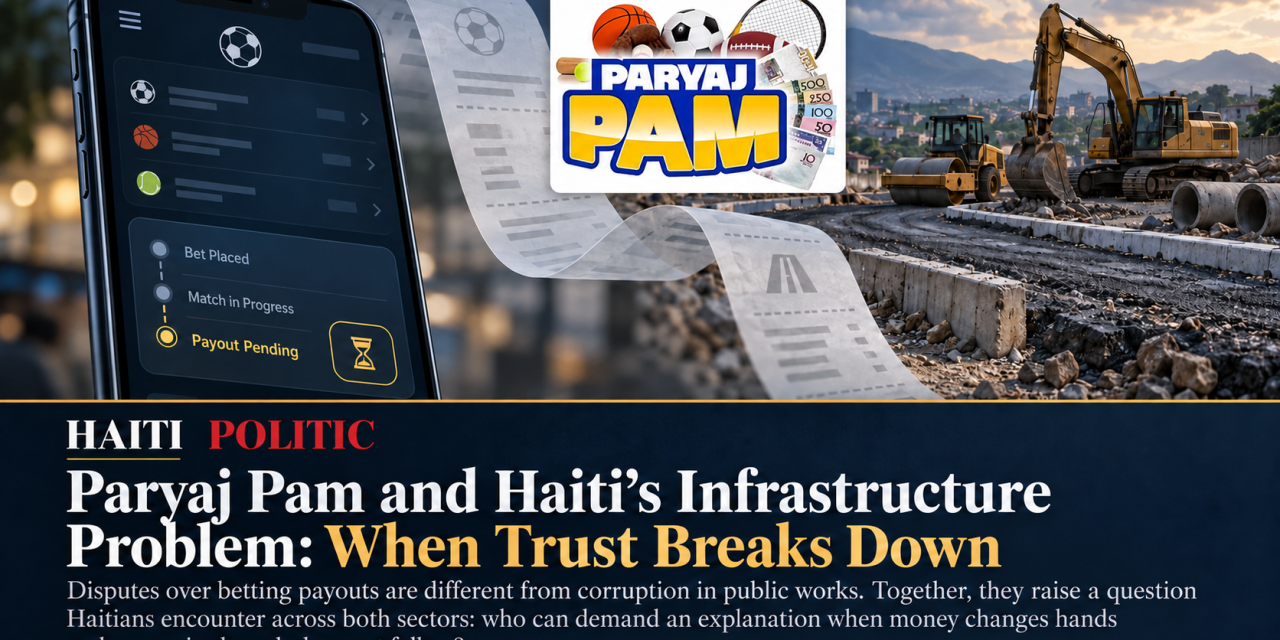
Disputes over betting payouts are different from corruption in public works. Together, they raise a question Haitians encounter across both sectors: who can demand an explanation when money changes hands and a promised result does not follow?
Haiti Politic — Analysis
Paryaj Pam is a private betting company, not a public infrastructure project. Its own website identifies PARYAJ PAM S.A. as a joint-stock company registered on November 15, 2018, with an address in Pétion-Ville. The platform offers sports betting and games; its website also describes deposits and withdrawals through mobile payment services including MonCash and Natcash. Its business depends on digital connections, payment systems and customers’ confidence that a recorded wager will be settled fairly.
That confidence has been tested in public. In December 2020, bettors in Carrefour accused Paryaj Pam of refusing to pay winning wagers after citing a technical error. Haïti Standard reported that protesters erected burning-tire barricades and that local offices closed while awaiting a decision from the company’s central office. Representatives of some offices acknowledged an error affecting certain bets; a notice reported by the outlet said the affected wagers would be refunded. Those accounts document a dispute and the company’s stated explanation. They do not establish that the company deliberately manipulated results.
A second confrontation reached the courts in October 2023. Haïti Standard reported that the government commissioner in Les Cayes ordered eight Paryaj Pam offices sealed after complaints from bettors who said they had not been paid. The commissioner described the measure as a way to press the company to address those complaints. The outlet said company representatives declined to comment at the time. The sealing order and the complaints are newsworthy; neither, by itself, is a finding of fraud.
A private dispute with a public lesson
A betting slip and a road contract are different promises. One concerns the settlement of a wager under a company’s rules. The other concerns the use of public funds to deliver a service. Paryaj Pam’s customers’ complaints cannot be used as evidence that the company took part in the misuse of infrastructure money.
The comparison is about accountability. If a bettor disputes a payout, can they obtain the original odds, a transaction history, the rule applied and a decision they can challenge? If a publicly funded road or utility project stalls, can citizens obtain the contract, payment records, completion reports and an independent audit? In both settings, an explanation is difficult to test when the records or the route for appealing a decision are unclear.
Haiti’s public auditors have identified concrete reasons for concern in the second setting. In a 2025 review of a public works program, the Cour Supérieure des Comptes et du Contentieux Administratif (CSCCA) reported problems including projects that had not been carried out, missing detailed accounts of allocated funds and substantial implementation delays. The public works ministry offered clarifications and undertook to provide further documentation. That is an audit finding and an ongoing exchange about public spending, separate from the allegations against Paryaj Pam.
The CSCCA has also published a multi-part audit of projects financed through the PetroCaribe fund. That record warrants close scrutiny of how projects were approved, contracted, executed and received. It should not be reduced to an unsupported assertion that a particular dollar amount was “stolen,” or used to imply a financial connection to Paryaj Pam.
Business in a country under strain
Paryaj Pam’s history also reflects the danger of operating in an insecure environment. In January 2019, Patrick Nara, identified in reporting at the time as the company’s owner, was shot and killed in Pétion-Ville. In September 2022, Haïti Standard reported that a Russian national then described as the owner was abducted from his beach residence on the Côte des Arcadins and released after a ransom was paid. The report said armed men arrived by boat; it did not disclose the ransom amount. These were acts of violence against people associated with the business, not evidence of wrongdoing by the company. The available reports do not establish a complete ownership history between the two events.
The infrastructure around everyday commerce remains fragile as well. The World Bank has described poor performance at Haiti’s national electricity utility and recurrent fuel shortages as constraints on households, businesses and essential services. An online betting platform can continue to market its services through phones and payment apps, but it operates within those same national constraints.
The question for regulators
The public interest is served by answers that can be checked. For the betting sector, that means accessible wagering rules, preserved records of disputed bets, clear reasons for voided wagers, a reliable complaints process and transparent regulatory decisions. For public works, it means published contracts, traceable payments, inspections and follow-up when auditors identify failures.
Paryaj Pam’s payout disputes mirror Haiti’s larger accountability problem in that limited transparency can leave people struggling to verify what happened to their money. They do not prove the same misconduct, or a connection between private betting and public infrastructure corruption. Keeping that distinction clear makes the comparison stronger: whether the promise is a winning payout or a completed public project, Haitians deserve records, reasons and a meaningful way to challenge the result.