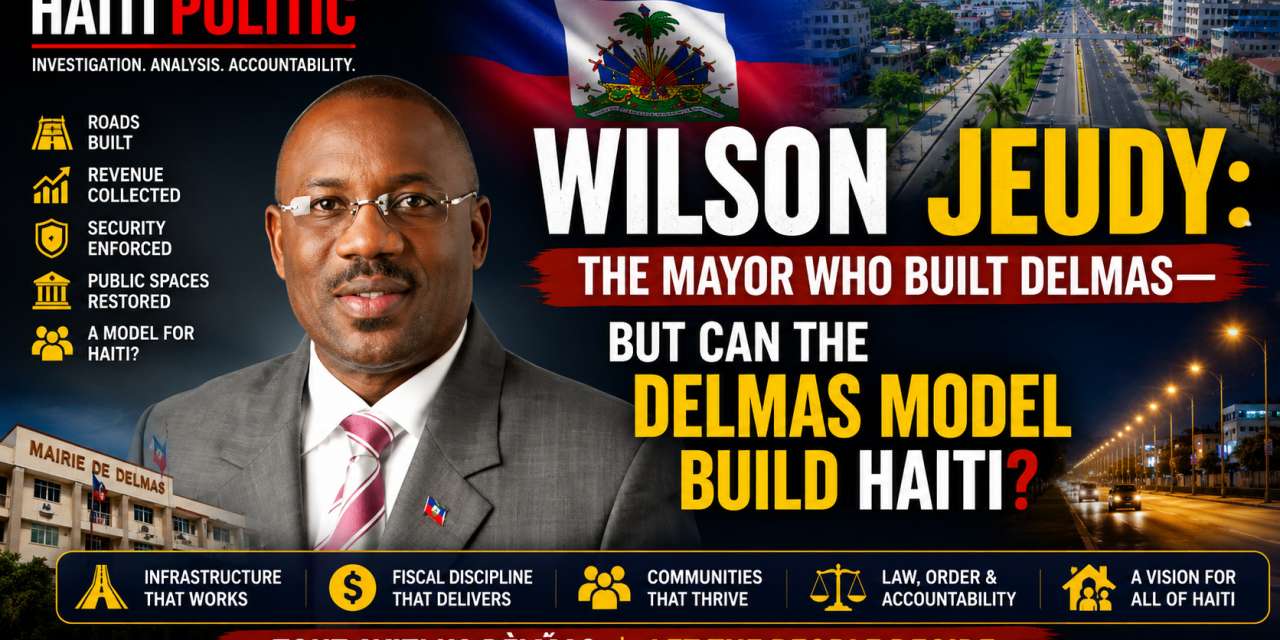
🇭🇹 Mayor. Lawyer by training. Former customs official. Public administrator. Urban manager. Former presidential candidate.
Wilson Jeudy presents Haitian voters with a political proposition that is unusually easy to understand:
Judge me by what I have managed.
For years, his political identity has been tied to Delmas—one of Haiti’s most commercially important communes—and to the argument that stronger municipal administration, tax collection, infrastructure, discipline and enforcement can produce visible results even when the national state is dysfunctional.
His résumé predates the mayor’s office. A 2010 candidate biography described him as an accountant and former customs officer with legal studies, who had also worked as a justice of the peace, customs director, project supervisor at the Ministry of Public Works and in other public-administration positions. He subsequently entered the 2010 presidential race under Fòs 2010. Because that biography originated from campaign material, its more promotional claims should be treated as such, but the career history helps explain the administrative brand Jeudy has cultivated.
Today, that brand confronts a much bigger question:
CAN “TOUT AYITI KA DÈLMA” BECOME A NATIONAL GOVERNING MODEL?
Or does Delmas represent a special case—a dense commercial municipality whose revenue base, geography and administrative conditions cannot simply be reproduced across an impoverished, predominantly informal country?
And there is another side of Jeudy’s record that cannot be ignored: human-rights organizations documented serious allegations concerning forced removals of earthquake-displaced residents in Delmas in 2011.
So this investigation must examine both records.
The administrator.
And the enforcer.
The revenue collector.
And the mayor accused of going too far.
Then—
🇭🇹 LET THE HAITIAN PEOPLE DECIDE.
🏛️ CHAPTER ONE — THE CASE FOR WILSON JEUDY
Jeudy has something many Haitian presidential aspirants struggle to demonstrate:
a government institution he has actually managed.
That matters.
It is much easier to promise efficient government than to administer payrolls, collect taxes, maintain roads, manage employees, regulate businesses and answer directly to residents.
And recent financial figures deserve attention.
In October 2025, Delmas announced a one-billion-gourde projected municipal budget for fiscal year 2025–2026. Mayor Jeudy said the municipality had collected nearly 800 million gourdes during 2024–2025.
That is not evidence that every aspect of the municipality is successful.
But it gives voters something measurable to investigate.
FOLLOW THE MONEY.
💰 TEST #1 — OPEN THE DELMAS BOOKS
Jeudy’s strongest campaign argument may become his municipal finances.
Then the standard should be exceptionally high.
If Delmas collected approximately 800 million gourdes:
Where did every gourde come from?
Property taxes?
Business permits?
Patentes?
Construction permits?
Municipal fees?
Transfers from the central government?
Penalties?
Other revenue?
And where did it go?
Publish:
five years of audited financial statements;
municipal procurement contracts;
winning bidders;
beneficial owners;
capital expenditures;
payroll totals;
tax arrears;
uncollected taxes;
and project-by-project spending.
Because a billion-gourde budget is impressive only if taxpayers can independently verify how the money is managed.
🧮 TEST #2 — CAN DELMAS TAXATION WORK IN THE COUNTRYSIDE?
This may be the biggest economic weakness in the slogan “Tout Ayiti Ka Dèlma.”
Delmas has businesses, banks, offices, warehouses, residences, commercial corridors and relatively valuable property.
Many Haitian communes do not.
A rural municipality cannot collect Delmas-level property revenue from subsistence farmers who possess little cash income.
So President Jeudy would need something more sophisticated than:
“Collect taxes like Delmas.”
The real questions are:
How would poor communes finance themselves?
Would richer municipalities transfer revenue to poorer ones?
Would departments receive fixed percentages of national taxes?
Would property taxes remain local?
Would customs revenue be shared regionally?
Would municipalities receive predictable block grants?
Would mayors gain independent borrowing authority?
That is what genuine decentralization requires.
🛣️ TEST #3 — THE ROAD-BUILDER TEST
Infrastructure is central to Jeudy’s political image.
But national infrastructure is radically different from municipal roadwork.
A president must confront:
bridges;
national highways;
ports;
irrigation;
electricity;
airports;
water systems;
drainage;
digital infrastructure;
public transportation;
and agricultural roads.
So give voters numbers.
WHAT WOULD PRESIDENT JEUDY BUILD IN HIS FIRST FIVE YEARS?
How many kilometers of roads?
Which corridors?
At what cost?
Who maintains them?
Would construction go through MTPTC?
Municipalities?
Private contractors?
Public-private partnerships?
International development banks?
Diaspora infrastructure bonds?
A builder’s campaign should have the most detailed capital-investment plan in the race.
⚠️ CHAPTER TWO — THE OTHER SIDE OF THE DELMAS RECORD
Administrative efficiency cannot be evaluated separately from civil liberties.
And this is where Jeudy faces difficult historical questions.
Following Haiti’s catastrophic 2010 earthquake, hundreds of thousands of people lived in displacement camps.
In 2011, rights advocates reported forced evictions in Delmas involving municipal authorities and police.
A submission to the Inter-American Commission on Human Rights alleged that on May 23, 2011, Jeudy entered the Carrefour Aéroport camp with police and security personnel and that residents reported beatings, destruction of tents and a gunshot injury. The submission also alleged that displaced residents had received inadequate notice.
A later RNDDH report said Jeudy and then-Port-au-Prince mayor Jean-Yves Jason were actively involved in forced camp removals during 2011 and said violence and human-rights violations occurred during forced-eviction operations nationally.
Members of the U.S. Congress also publicly criticized the destruction of Delmas camps at the time.
These are serious allegations and findings from advocacy and political sources—not criminal convictions against Jeudy.
His side of the record matters too.
Contemporary reporting quoted Jeudy arguing that public squares could not permanently become tent settlements and claiming that some empty tents were being used for gang activity.
That sets up the legitimate investigative question:
WHEN DOES RESTORING PUBLIC ORDER BECOME ABUSE OF PUBLIC POWER?
🏚️ TEST #4 — WOULD PRESIDENT JEUDY EVICT FIRST OR REHOUSE FIRST?
Haiti now faces another displacement catastrophe—this time driven heavily by armed violence.
So Jeudy should explain what he learned from 2011.
Suppose 5,000 displaced people occupy a national park.
The state needs the property back.
What happens?
Written notice?
Court authorization?
Housing assessment?
Relocation assistance?
Rental subsidies?
Transportation?
Independent observers?
Compensation?
Appeals?
Protection for children and disabled residents?
Would a Jeudy administration establish a national rule that:
NO FORCED EVICTION OCCURS WITHOUT A DOCUMENTED REHOUSING PROCESS?
His answer would reveal how his law-and-order philosophy has evolved.
🛒 TEST #5 — WHAT HAPPENS TO THE MADAN SARA?
Clean sidewalks sound attractive.
Until the person occupying that sidewalk is feeding five children from a basket of merchandise.
This is Haiti’s central urban-planning contradiction.
Informal commerce creates congestion.
But informal commerce also keeps families alive.
President Jeudy would therefore need more than demolition equipment.
Why not create:
municipal markets;
low-cost vendor permits;
designated vending corridors;
night markets;
sanitary facilities;
microcredit;
storage facilities;
digital merchant registration;
and simplified taxation?
FORMALIZE BEFORE YOU CRIMINALIZE.
That could transform aggressive municipal enforcement into economic reform.
👮🏾 TEST #6 — DELMAS SECURITY IS NOT NATIONAL SECURITY
A mayor manages a municipality.
A president inherits Haiti’s security catastrophe.
The scale changes completely.
The presidency must deal with:
gang coalitions;
kidnapping networks;
arms trafficking;
corrupt police;
ports;
borders;
customs;
drug trafficking;
money laundering;
prisons;
intelligence;
prosecutors;
and international security partners.
So Jeudy needs to answer:
How many PNH officers does Haiti need?
What should they earn?
How should recruitment change?
Where should officers be deployed?
How should weapons enter the country?
Who finances gangs?
How will gang assets be seized?
How will witnesses be protected?
How will police corruption be investigated?
Urban discipline is not yet a national-security doctrine.
🚨 TEST #7 — MUNICIPAL POLICE OR ONE NATIONAL POLICE?
This is an important constitutional question.
Should Haiti’s mayors possess stronger municipal enforcement powers?
There is an argument for decentralization.
Local governments understand their neighborhoods.
But there is also enormous danger.
Imagine dozens of mayors controlling armed municipal forces.
In a polarized electoral system, those forces could become:
political militias;
private security organizations;
electoral intimidation units;
or rivals of the PNH.
So Jeudy should draw a bright line.
WHO GETS TO CARRY A STATE GUN?
And who commands them?
🧑🏾⚖️ TEST #8 — THE LAW GRADUATE MUST DEFINE THE RULE OF LAW
Jeudy’s legal training could become an asset.
But rule of law means something more demanding than enforcing regulations.
It also means restraining the government.
A strong state can remove illegal construction.
A lawful state must provide due process.
A strong state can arrest criminals.
A lawful state must produce evidence.
A strong state can collect taxes.
A lawful state must allow appeals.
A strong state can regulate public space.
A lawful state must respect constitutional rights.
HAITI NEEDS BOTH AUTHORITY AND RESTRAINT.
Can Jeudy provide both?
🏗️ TEST #9 — “TOUT AYITI KA DÈLMA” NEEDS A PRICE TAG
Suppose Jeudy proposes replicating Delmas nationally.
Excellent.
Price it.
How much for:
10,000 kilometers of rehabilitated roads?
municipal sanitation?
regional markets?
street lighting?
drainage?
schools?
clinics?
water?
administrative buildings?
digital tax systems?
waste collection?
The Haitian electorate has heard enough infrastructure promises without financing.
For every project, voters should demand:
COST + FUNDING SOURCE + DEADLINE + CONTRACTOR + AUDIT.
🌾 TEST #10 — DELMAS DOESN’T GROW HAITI’S FOOD
A national administration cannot simply become a bigger city hall.
Agriculture requires an entirely different governing philosophy.
What is Jeudy’s program for:
Artibonite irrigation?
rice?
coffee?
cacao?
mangoes?
livestock?
fertilizer?
farm credit?
agricultural insurance?
land titles?
cold storage?
farm-to-market roads?
food processing?
A president promising to replicate urban management nationally must demonstrate that he understands rural economics.
🏭 TEST #11 — CAN INFRASTRUCTURE PRODUCE JOBS?
Roads alone do not create development.
Roads connecting factories, farms, ports and markets can.
A Jeudy industrial strategy should answer:
Which industries does Haiti target?
Garments?
Food processing?
Construction materials?
Business-process outsourcing?
Tourism?
Pharmaceutical manufacturing?
Renewable energy?
Digital services?
Agricultural exports?
And where?
Cap-Haïtien?
Fort-Liberté?
Gonaïves?
Saint-Marc?
Hinche?
Les Cayes?
Jacmel?
DECENTRALIZATION MUST CREATE ECONOMIC CENTERS OUTSIDE PORT-AU-PRINCE.
🌎 TEST #12 — WHAT IS WILSON JEUDY’S FOREIGN POLICY?
This is perhaps the least developed part of the mayoral brand.
Fixing roads does not tell voters how Jeudy would deal with:
Washington;
Santo Domingo;
CARICOM;
Canada;
France;
the United Nations;
Taiwan;
China;
the IMF;
World Bank;
IDB;
or the Haitian diaspora.
Foreign policy cannot simply mean asking foreigners for money.
A Jeudy administration would need a doctrine.
🇩🇴 TEST #13 — THE DOMINICAN REPUBLIC
A mayor can focus inward.
A president cannot.
Haiti and the Dominican Republic share:
an island;
watersheds;
migration;
trade;
contraband routes;
labor markets;
security risks;
and environmental problems.
What would Jeudy negotiate?
Integrated customs technology?
Joint anti-trafficking operations?
Border markets?
Agricultural agreements?
Migration protocols?
Water management?
Documentation?
Arms interdiction?
Nationalism without negotiation accomplishes little.
Diplomacy without defending Haitian interests accomplishes little either.
🇺🇸 TEST #14 — WASHINGTON WITHOUT DEPENDENCY
Successive Haitian governments have struggled with the imbalance between sovereignty and dependence.
Jeudy should explain:
What should Haiti ask from the United States?
Not vague “assistance.”
Specific interests.
Weapons-interdiction cooperation?
Trade preferences?
Diaspora investment?
Police technology?
Anti-money-laundering enforcement?
Infrastructure finance?
Deportation protocols?
Agricultural access?
And equally important:
WHAT SHOULD HAITI STOP ASKING FOREIGN GOVERNMENTS TO DO FOR ITSELF?
That could become the foundation of a serious foreign-policy doctrine.
🌐 TEST #15 — TURN THE DIASPORA INTO INVESTORS
Municipal management offers an interesting starting point.
Imagine diaspora residents financing hometown infrastructure directly through audited municipal bonds.
A Haitian living in Miami could invest in:
a Jacmel wastewater project;
a Les Cayes market;
a Cap-Haïtien parking facility;
a Gonaïves solar project;
an Artibonite irrigation network.
But the money would require transparent accounts and enforceable contracts.
Could Jeudy’s municipal-government experience produce a credible Haiti Municipal Infrastructure Bond system?
That would be genuinely innovative.
📲 TEST #16 — PUT EVERY MUNICIPAL GOURDE ONLINE
Jeudy could strengthen his national case immediately without waiting for an election.
Publish Delmas government finances online.
Not summaries.
The data.
Every:
contract;
payment;
supplier;
tax category;
project;
salary scale;
construction permit;
procurement award;
and municipal asset.
Updated monthly.
If the Delmas model is supposed to become Haiti’s model—
LET HAITI AUDIT DELMAS.
🗳️ TEST #17 — A MAYOR’S MACHINE IS NOT A NATIONAL PARTY
Jeudy entered the 2010 presidential race, but running nationally requires an organization very different from administering Delmas.
A serious national campaign requires:
communal sections;
departmental coordinators;
poll watchers;
lawyers;
candidate recruitment;
women’s organizations;
youth organizers;
rural networks;
diaspora fundraising;
and legislative candidates.
So:
What is Jeudy’s national political organization?
Who are his allies?
Who finances it?
How many communes have permanent offices?
Who would govern with him in Parliament?
A president without a legislative coalition can quickly become another prisoner of Haiti’s political system.
🏛️ TEST #18 — CAN A MAN ACCUSTOMED TO MUNICIPAL CONTROL SHARE NATIONAL POWER?
This question may be more important than roads.
Mayoral government concentrates considerable operational authority.
The Haitian presidency does not exist in a vacuum.
A president must coexist with:
a prime minister;
Parliament;
judges;
mayors;
departmental institutions;
independent agencies;
political parties;
and civil society.
Would Jeudy decentralize authority when decentralization means giving power to other mayors?
Would he give municipalities guaranteed revenue?
Would he tolerate opposition mayors?
Would he allow them to criticize him?
THE TRUE TEST OF A DECENTRALIZER IS WHETHER HE DECENTRALIZES POWER AWAY FROM HIMSELF.
📊 THE WILSON JEUDY ASSESSMENT
| AREA | RECORD / POTENTIAL STRENGTH | QUESTION VOTERS SHOULD TEST |
|---|---|---|
| Municipal administration | Long experience managing Delmas | Can municipal administration scale nationally? |
| Revenue collection | Delmas reported nearly 800M gourdes collected in FY2024–25 and projected a 1B-gourde 2025–26 budget. | Are the accounts independently audited and replicable elsewhere? |
| Public administration | Background reported in customs, justice and public works before the mayoralty. | What measurable results came from each position? |
| Infrastructure | Public brand strongly associated with municipal works | What is the national financing model? |
| Law and order | Appeals to voters seeking functional public spaces | How are enforcement and due process balanced? |
| Human rights | — | Rights groups documented serious allegations surrounding forced IDP evictions in 2011. |
| Presidential experience | Entered the 2010 presidential contest. | Has he built a viable nationwide political coalition? |
| Decentralization | Municipal background gives him practical local-government experience | Will he actually transfer money and authority away from the presidency? |
| Foreign policy | Municipal experience could inform city-to-city and diaspora partnerships | A comprehensive national diplomatic doctrine still needs to be demonstrated. |
| Security | Local administrative experience | National gang warfare requires capabilities far beyond municipal enforcement. |
⚖️ THE CASE SUPPORTERS CAN MAKE
Jeudy’s supporters can make a straightforward argument:
Haiti has spent decades electing national politicians who talk. Jeudy can point to an institution he has actually administered.
Delmas’s reported municipal revenue performance gives voters a measurable indicator to investigate. The municipality reported collecting nearly 800 million gourdes in 2024–25 and entered the next fiscal year targeting a billion-gourde budget.
His background also includes multiple areas of public administration before becoming mayor, according to his 2010 campaign biography.
For citizens exhausted by failed central government, the appeal is obvious:
START WITH WHAT WORKS LOCALLY AND SCALE IT.
That is the strongest version of the Jeudy argument.
🚨 THE CASE CRITICS CAN MAKE
Critics can answer just as forcefully.
Delmas is not Haiti.
Its commercial density and taxable property cannot simply be reproduced in poor agricultural communes.
Municipal management does not demonstrate competence in monetary policy, diplomacy, national defense, agricultural policy or management of an entire constitutional system.
And Jeudy’s law-and-order record raises serious human-rights questions.
Contemporary documentation from rights organizations alleged violent and inadequately noticed forced evictions involving Delmas municipal authorities after the earthquake.
The criticism therefore becomes:
DOES “ORDER” UNDER WILSON JEUDY SOMETIMES COME AT TOO HIGH A HUMAN COST?
That question deserves an answer from Jeudy himself.
🔥 30 QUESTIONS WILSON JEUDY SHOULD ANSWER
1. Will you release five years of complete audited Delmas financial statements?
2. Can independent auditors verify the municipality’s reported revenue collections?
3. How much of Delmas’s revenue comes from property and commercial taxes?
4. Why should that model work in Haiti’s poorest communes?
5. Would you guarantee municipalities a percentage of national revenue?
6. Would opposition-controlled municipalities receive exactly the same treatment?
7. What are the five most important infrastructure projects completed under your leadership?
8. What did each cost?
9. Who received the contracts?
10. Will you publish the beneficial owners of municipal contractors?
11. What responsibility do you accept for the 2011 IDP eviction controversies?
12. Were residents provided adequate notice and alternative accommodation?
13. Do you dispute the allegations documented by rights organizations?
14. What would you do differently today?
15. Would your presidency prohibit eviction without due process and relocation safeguards?
16. How would you formalize street vendors without destroying their livelihoods?
17. Would municipalities receive armed police forces?
18. If yes, how would you prevent them from becoming political militias?
19. What is your national anti-gang strategy?
20. How would you stop weapons entering Haitian ports and borders?
21. What is your agricultural program?
22. What is your industrial policy?
23. What is your plan for electricity?
24. How would you finance nationwide infrastructure?
25. What is your policy toward the Dominican Republic?
26. What would change in Haiti’s relationship with Washington?
27. What role should CARICOM play?
28. How would you transform diaspora remittances into investment capital?
29. Who finances your national political organization?
And finally:
30. IF “TOUT AYITI KA DÈLMA,” WHAT EXACTLY IS THE DELMAS MODEL—AND CAN YOU PROVE IT WITH AUDITED NUMBERS?
🇭🇹 THE CENTRAL QUESTION
Wilson Jeudy offers Haiti a different kind of political résumé.
Not primarily the diplomat.
Not primarily the senator.
Not primarily the academic.
Not primarily the revolutionary.
THE MAYOR.
That can be a significant advantage.
Haiti desperately needs leaders who understand that government ultimately means collecting revenue and turning it into services citizens can see.
But a municipality is not a republic.
A president must manage things no mayor can test locally:
foreign policy;
national security;
monetary stability;
agriculture;
international finance;
constitutional conflict;
national justice;
and geopolitical pressure.
And administrative effectiveness cannot excuse violations of individual rights.
That is why Jeudy’s record deserves neither automatic celebration nor automatic condemnation.
It deserves scrutiny.
Pa sèlman mande konbyen wout Wilson Jeudy fè.
Mande konbyen yo koute.
Pa sèlman mande konbyen lajan Delmas ranmase.
Mande kote chak goud ale.
Pa sèlman mande si li mete lòd.
Mande si lòd la respekte dwa moun.
Pa sèlman mande si tout Ayiti ka Dèlma.
Mande si modèl Dèlma a ka mache nan Okay, Okay? Okay typo. Let’s correct: Okay.
Actually final should not include mistake. Need craft clean ending.