As early voting opens in Miami-Dade County, a dispute over how the mayor paid his qualifying fees has upended North Miami’s mayoral race. The central issue is the legal difference between using campaign money and submitting a check drawn directly on a campaign account.
By Haiti Politic | October 20, 2026
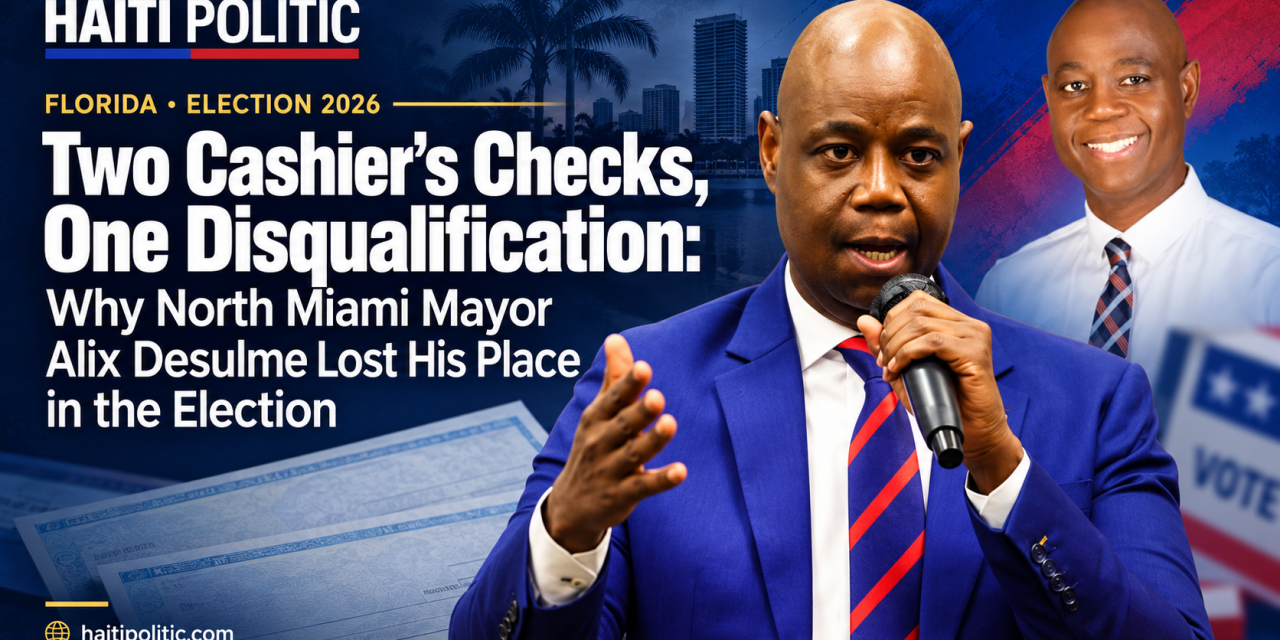
North Miami Mayor Alix Desulme’s reelection campaign has encountered a potentially decisive legal setback: a judge ruled Monday, October 19, that he should be disqualified as a candidate because of the cashier’s checks used to pay his qualifying fees.
Circuit Judge Beatrice Butchko Sanchez ruled in favor of challenger George E. Duell Morgan, who filed an emergency lawsuit questioning whether Desulme had properly qualified for the November 3 election.
The decision arrived on the first day of early voting in Miami-Dade County. County election information lists the early-voting period as October 19 through November 1, ahead of Election Day on November 3.
At the center of the case is a distinction that can sound minor outside election law but carry enormous consequences inside it: money originating in a campaign account is not necessarily the same thing as a check drawn directly on that account.
What Desulme submitted
Morgan’s complaint identifies two TD Bank official checks dated August 10, 2026, submitted with Desulme’s qualifying paperwork:
| Payment | Amount | Payee |
|---|---|---|
| Qualifying fee | $4,494.00 | City of North Miami |
| Election assessment | $898.80 | Election Trust Fund |
| Total | $5,392.80 |
Copies attached to the complaint identify TD Bank as the drawer and bear a bank-authorized signature. Morgan argued that these were cashier’s checks issued by the bank, rather than qualifying checks drawn on Desulme’s campaign account and signed by his designated campaign treasurer.
The complaint identified a qualifying period running from August 10 until noon on August 20. Morgan’s position was that Desulme had not submitted the required payment instruments before that deadline.
Why the type of check matters
Florida Statutes Section 99.061(7)(a)1 requires a qualifying candidate, unless using an applicable alternative, to submit a properly executed check drawn on the candidate’s campaign account by the qualifying deadline.
The statute provides a limited cashier’s-check replacement procedure when a candidate’s original check is returned by the bank. That provision does not make a cashier’s check interchangeable with an ordinary campaign-account check for every initial qualifying payment.
Section 106.11 separately specifies information required on campaign checks, including the signature of the campaign treasurer or deputy treasurer.
A cashier’s check works differently. A customer supplies money to a bank, and the bank issues its own payment instrument. Morgan argued that this additional step meant the instruments Desulme delivered did not satisfy the campaign-account check requirement.
Under that argument, proving where the purchase money originated would not cure the problem with the instrument itself.
Desulme’s defense: the money came from the campaign
Desulme contested that interpretation.
In his October 16 supplemental opposition, his attorneys argued that North Miami’s own election provisions allowed the payment method he used. They maintained that the city’s requirement differed materially from the state statute and should govern the municipal qualifying process.
His filing also cited a declaration from his campaign treasurer, Emmanuella Fleurimont, stating that she arranged for the bank checks to be issued using campaign funds and signed the withdrawal authorizing their purchase.
The defense’s position was that these records satisfied the city’s requirement for payment from the campaign account.
Desulme also challenged whether he had been properly served with the lawsuit and argued that Morgan waited too long to bring a challenge after ballots had already been distributed. Those were defenses advanced by his legal team; they should not be confused with findings by the court.
Why treating it as a harmless mistake did not save the candidacy
The judge rejected the argument that substantial compliance could excuse the payment defect. Desulme’s attorney, Ben Kuehne, said the mayor planned to appeal.
That explains the severity of the result. The question was whether the candidate completed a mandatory qualifying requirement in the required manner and within the required time.
A campaign can have sufficient money, submit documents that election staff initially accept, and still face a successful legal challenge over compliance.
The state statute describes the filing officer’s review as ministerial: officials check whether required items have been filed and are complete on their face. Initial administrative acceptance therefore does not eliminate the possibility of a later court challenge.
The dispute concerns candidate qualification. It does not, by itself, establish theft, corruption, or misuse of campaign funds.
The separate allegation involving Morgan’s 80 cents
Desulme’s legal team also challenged Morgan’s own qualifications, arguing that Morgan underpaid his election assessment and therefore lacked standing to bring the lawsuit.
Public reporting identifies the alleged shortage as 80 cents. That allegation is a separate issue; it should not be presented as an established judicial finding disqualifying Morgan.
The amount may appear negligible, but the underlying legal argument follows the same logic: if a qualifying requirement is mandatory, a candidate may argue that even a small deficiency matters.
Whether that claim succeeds requires its own judicial determination.
What happens if Desulme’s name is already printed?
Disqualification does not necessarily mean election officials can physically remove a name from every ballot already printed or mailed.
Section 99.0211 provides a procedure for that situation. Following the qualifying final court order, election officials must remove the candidate’s name or, if ballots have already been printed, provide the prescribed notices explaining that votes for the disqualified candidate will not count. The law also provides for expedited appellate consideration.
In her October 13 response, Miami-Dade Supervisor of Elections Alina Garcia took no position on whether Desulme qualified. Her office instead asked the court to avoid disrupting the broader election.
The filing explained that, if Desulme were disqualified and Morgan remained the sole qualified candidate, the applicable state guidance would treat the remaining candidate as elected without opposition. It also acknowledged a separate pending ballot-access case involving another prospective mayoral candidate.
That makes the consequences substantial, while leaving the ultimate outcome dependent on subsequent court action and election administration.
What voters should understand
A printed name and a legally qualified candidacy are not always the same thing. When a court changes a candidate’s status after ballot production, official notices become particularly important.
North Miami voters should follow current instructions from the Miami-Dade Supervisor of Elections and any updated court orders. A dispute affecting the mayoral contest does not eliminate their opportunity to participate in the other races on their ballot.
Desulme’s case illustrates the weight election law places on the qualifying process. The campaign’s argument focused on the source of the money and North Miami’s local rules. Morgan’s challenge focused on the required payment instrument and its execution.
For now, that difference has cost the incumbent his status as a qualified candidate at the trial-court level. Whether it ultimately decides who becomes North Miami’s next mayor will depend on what happens next in court.