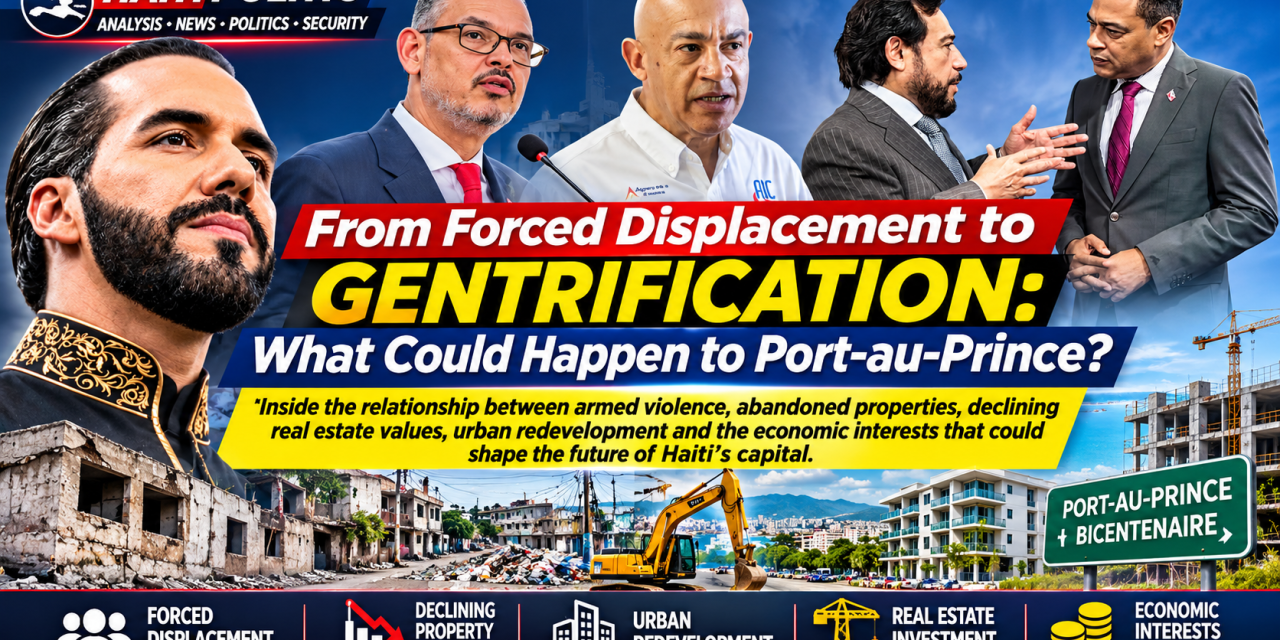
Inside the relationship between armed violence, abandoned properties, declining real estate values, urban redevelopment and the economic interests that could shape the future of Haiti’s capital.
HAITI POLITIC | INVESTIGATIVE ANALYSIS
November 25, 2026
For years, the deterioration of security in Port-au-Prince has been presented primarily as a humanitarian, political and criminal justice crisis. However, another dimension deserves considerably more attention: the transformation of the capital’s real estate market and the potential redistribution of urban wealth following the forced displacement of its population.
Entire neighborhoods have been abandoned. Businesses have closed, families have lost access to their homes, commercial buildings have deteriorated, and public infrastructure has suffered from years of neglect.
Meanwhile, discussions surrounding the restoration of security, rehabilitation of public spaces, foreign investment and reconstruction are beginning to emerge.
On November 25, 2026, the Haitian Prime Minister’s Office announced ongoing cleaning and drainage operations around the Bicentenaire roundabout, presenting these interventions as part of the government’s efforts to restore public spaces and gradually revive economic and community life in downtown Port-au-Prince.
Although these initiatives are necessary, they raise a fundamental question that extends beyond public sanitation and security:
Who will ultimately own, control and benefit from the reconstruction of Port-au-Prince?
Understanding Displacement and Gentrification
In real estate economics and urban planning, displacement occurs when residents or businesses are forced to leave an area because of violence, economic hardship, rising housing costs, government policies or redevelopment projects.
Gentrification, meanwhile, generally describes the transformation of historically lower-income neighborhoods through new investment, infrastructure improvements, rising property values and the arrival of wealthier residents or businesses.
Although redevelopment can generate employment, improve infrastructure and stimulate economic activity, it can also make neighborhoods unaffordable for their original inhabitants.
Port-au-Prince presents a potentially different scenario from traditional gentrification.
Instead of redevelopment initially causing residents to leave, armed violence has already forced numerous families and businesses out of their communities. Future redevelopment could then create economic conditions that prevent those same residents from returning.
This phenomenon could eventually become a form of post-conflict gentrification or crisis-driven urban redevelopment.
The distinction is important. Forced displacement has already occurred, while widespread development-induced gentrification remains a potential future outcome.
The First Stage: Violence Forces Residents and Businesses to Leave
Over the past several years, armed groups have expanded their territorial control across metropolitan Port-au-Prince, disrupting residential communities, commercial activities and essential public services.
Neighborhoods and communities such as Carrefour-Feuilles, Bel-Air, Solino, Martissant, Bas-Delmas, La Saline, Cité Soleil and parts of Croix-des-Bouquets have experienced significant insecurity and displacement.
For many families, leaving their homes was not a voluntary economic decision. It was a matter of survival.
Property owners have lost rental income. Merchants have abandoned businesses. Families have been separated from properties accumulated over generations.
Some buildings have been destroyed, while others have been occupied without the authorization of their legal owners.
This creates an extraordinary situation in which substantial amounts of urban real estate become inaccessible to the people who legally own or occupy them.
However, being forced to abandon a property because of armed violence does not automatically extinguish ownership rights.
That legal distinction will become increasingly important as the government attempts to recover and redevelop affected neighborhoods.
The Second Stage: Urban Blight and the Destruction of Property Value
In real estate terminology, urban blight refers to the deterioration of neighborhoods resulting from abandonment, inadequate infrastructure, economic decline and insufficient public services.
Port-au-Prince displays many characteristics associated with urban blight:
-
Abandoned residential and commercial buildings;
-
Accumulation of garbage and debris;
-
Deteriorating roads and drainage systems;
-
Reduced commercial activity;
-
Inadequate sanitation services;
-
Destruction of public infrastructure;
-
Loss of rental income;
-
Increased security risks;
-
Population displacement.
These conditions can significantly reduce the marketability of real estate.
A commercial building that once generated substantial rental income may become economically unproductive when tenants cannot safely access it.
A residential property that once represented a family’s principal financial asset may become extremely difficult to sell.
Property owners facing financial hardship may eventually feel compelled to accept offers substantially below the property’s potential long-term value.
This creates opportunities for investors with sufficient capital, political access and the ability to wait for security conditions to improve.
In real estate, purchasing assets from financially vulnerable owners is commonly described as distressed property acquisition.
Acquiring and holding strategically located properties in anticipation of future development is known as land banking.
Neither practice is inherently illegal. However, both deserve scrutiny when they occur in areas affected by forced displacement, armed violence and weak institutional protections.
The Rent Gap: The Economic Opportunity Behind Urban Redevelopment
One of the most relevant concepts for understanding the potential transformation of Port-au-Prince is the rent gap theory, associated with urban geographer Neil Smith.
The theory examines the difference between the economic returns currently generated by a property and the potential returns that could be generated following redevelopment.
When this difference becomes sufficiently large, investors may have a strong financial incentive to acquire and redevelop deteriorated properties.
Port-au-Prince could eventually present such conditions.
Consider the following hypothetical commercial real estate transaction:
| Stage | Illustrative property value |
|---|---|
| Property value before the security crisis | $500,000 |
| Distressed value during prolonged insecurity | $100,000 |
| Acquisition by a private investor | $100,000 |
| Potential value after security restoration and redevelopment | $750,000 |
| Potential gross appreciation | $650,000 |
| Gross appreciation relative to acquisition price | 650% |
These figures are illustrative and do not represent verified property transactions in Port-au-Prince. They also exclude construction expenses, financing costs, taxes, legal expenses and other development costs.
Nevertheless, they demonstrate why investors might become interested in strategically located properties before the full restoration of security and infrastructure.
The greater the difference between distressed property values and potential redevelopment values, the greater the possible financial incentive.
This is why the relationship between security policy and real estate development deserves serious examination.
Bicentenaire: More Than a Street-Cleaning Operation
The government’s announcement regarding the cleaning of Bicentenaire must also be examined within the broader context of urban planning and economic development.
Bicentenaire occupies a strategically important area near the Port-au-Prince waterfront.
With adequate infrastructure, security and investment, the surrounding area could potentially accommodate hotels, commercial complexes, restaurants, residential developments, tourism facilities, government buildings and public recreational spaces.
Waterfront redevelopment has become an important component of urban revitalization strategies in numerous cities around the world.
However, the economic benefits of such projects are not always distributed equally.
Publicly financed infrastructure improvements can substantially increase the value of surrounding private properties.
When the government restores roads, improves drainage, provides security and rehabilitates public spaces, nearby property owners and developers may become significant financial beneficiaries.
This does not mean that cleaning Bicentenaire is inappropriate. On the contrary, restoring sanitation and public infrastructure is a fundamental responsibility of the Haitian state.
But the public deserves to know whether these interventions are isolated rehabilitation efforts or the preliminary stages of a broader urban redevelopment strategy.
Is there an official master plan for the waterfront?
Have private developers already expressed interest in the area?
Have significant property transfers occurred since the beginning of the security crisis?
Who owns the land surrounding proposed redevelopment zones?
These questions should be answered before major construction projects begin.
Could Port-au-Prince Experience a Second Wave of Displacement?
The greatest danger facing displaced Haitian families may not end with the defeat of armed groups.
A second wave of displacement could emerge through economic forces.
The first displacement occurs when armed violence forces residents to leave their communities.
The second could occur when redevelopment, rising property values, higher rents, property acquisitions or government expropriations prevent them from returning.
The potential sequence can be summarized as follows:
STAGE 1 — Armed violence: Residents and businesses are forced to leave.
STAGE 2 — Urban abandonment: Buildings deteriorate and economic activity declines.
STAGE 3 — Property devaluation: Insecurity reduces demand for real estate.
STAGE 4 — Distressed acquisitions: Investors potentially acquire properties at discounted prices.
STAGE 5 — Security restoration: Police and military operations make neighborhoods accessible again.
STAGE 6 — Public investment: Roads, sanitation systems and public infrastructure are rehabilitated.
STAGE 7 — Private redevelopment: New commercial and residential projects emerge.
STAGE 8 — Property appreciation: Real estate values and rental prices increase.
STAGE 9 — Economic displacement: Original residents may find themselves unable to return.
This is a possible economic scenario, not an established description of an organized operation currently taking place in Haiti.
Nevertheless, it represents a serious urban planning risk that the Haitian government should address proactively.
The Political Economy of Garbage and Urban Deterioration
The deterioration of Port-au-Prince cannot be attributed exclusively to armed violence.
For years, inadequate sanitation services, uncollected garbage, poor drainage and insufficient infrastructure maintenance have contributed to declining living conditions throughout the capital.
Haiti has also received international financing for debris removal, waste management and urban rehabilitation.
Previous Haiti Politic research identified more than $50 million in historical allocations across selected debris removal and solid waste management initiatives associated with UNDP programs. These allocations covered different projects and geographic areas and should not be interpreted as money spent exclusively on garbage collection in Port-au-Prince.
Despite these historical interventions, environmental deterioration remains a major challenge.
Reported criminal interference with waste collection and allegations involving former leadership of the Service National de Gestion des Résidus Solides (SNGRS) introduce additional questions about institutional accountability.
Could the deterioration of public spaces have contributed to the economic abandonment of certain neighborhoods?
Were sanitation institutions adequately funded?
Were public resources properly administered?
Did armed groups financially benefit from obstructing waste collection?
Were international donors adequately monitoring the implementation of their programs?
These questions require financial audits, procurement records, operational reports and judicial investigations.
There is currently insufficient evidence to establish that environmental deterioration was deliberately engineered as part of a real estate acquisition strategy.
However, the economic consequences of prolonged environmental neglect should not be ignored.
The Lessons of Haiti’s 2010 Earthquake
The January 12, 2010, earthquake demonstrated how a national catastrophe can fundamentally reshape urban development, land ownership and population distribution.
Following the earthquake, reconstruction efforts generated difficult questions concerning land expropriation, property titles, compensation, relocation and the development of new communities.
The development of Corail-Cesselesse and the subsequent expansion of Canaan illustrated the long-term consequences of population relocation without adequate infrastructure, employment opportunities, public services and effective land administration.
More than a decade later, Haiti continues to confront many of the structural problems associated with that period.
The reconstruction of Port-au-Prince following the current security crisis must not repeat those mistakes.
Displaced families should not be permanently relocated to peripheral communities while strategically valuable urban land is redeveloped exclusively for wealthier investors.
A successful reconstruction strategy must prioritize the rights and economic participation of the population that suffered through the crisis.
The Salvadoran Connection: Security, Political Power and Real Estate Investment
The involvement of El Salvador in Haiti’s security efforts introduces another dimension to the discussion.
President Nayib Bukele has internationally promoted the relationship between improved security, tourism, foreign investment and economic development.
The experience of El Salvador demonstrates how a reduction in violence can create new opportunities in the real estate sector.
However, investigative reporting concerning the Bukele family’s property acquisitions has also raised questions about potential conflicts of interest between public redevelopment policies and private investment.
According to investigations published by El Faro, Redacción Regional and El País, members of the Bukele family have acquired millions of dollars in real estate since Nayib Bukele assumed office in 2019.
A February 2026 investigation reported approximately $12.2 million in family real estate investments.
The acquisitions reportedly include beachfront properties, agricultural estates, luxury residences and commercial buildings.
Particularly relevant to Haiti is the reported acquisition of properties by Bukele’s brothers in the historic center of San Salvador, an area benefiting from government-led revitalization and tax incentives.
These transactions have generated questions about the relationship between political power, public investment, urban redevelopment and private financial interests.
The Bukele family has maintained that its wealth predates Nayib Bukele’s presidency and that property acquisitions have been financed through existing family resources and mortgage loans.
The reported acquisitions do not, by themselves, establish criminal corruption.
Furthermore, Haiti Politic has not established that Nayib Bukele personally owns property in Haiti or has entered into private real estate agreements concerning the reconstruction of Port-au-Prince.
Nevertheless, the Salvadoran experience provides a relevant case study for examining the economic opportunities that can emerge after the restoration of public security.
Haitian Real Estate Developers and Relations With El Salvador
The potential involvement of Haitian entrepreneurs in future reconstruction projects also deserves examination.
Particular attention should be given to discussions between Haitian business leaders, real estate developers and Salvadoran authorities.
Jerry Tardieu, a Haitian political figure with experience in the real estate sector, is among those whose engagement with Salvadoran officials warrants greater public explanation.
The relevant questions concern the scope and objectives of these discussions.
Were they exclusively focused on political cooperation and security?
Were economic development, investment opportunities or urban reconstruction also discussed?
Are Haitian developers exploring partnerships with Salvadoran businesses?
Could future reconstruction initiatives involve joint ventures between Haitian and Salvadoran investors?
These are legitimate questions of public interest. They should not be interpreted as accusations of criminal conduct or evidence that a private investment agreement already exists.
The publication of relevant meeting records, investment agreements and proposed development plans would help clarify the nature of these relationships.
The Constitutional Rights of Haitian Property Owners
The reconstruction of Port-au-Prince must comply with Haiti’s constitutional protections concerning private property.
Article 36 of the 1987 Haitian Constitution recognizes and guarantees private property rights.
Article 36-1 establishes conditions governing expropriation for public purposes, including compensation under the applicable legal framework.
These protections become particularly important when thousands of property owners have been forcibly separated from their homes and businesses.
The government must not treat abandoned neighborhoods as unclaimed territory simply because their inhabitants fled armed violence.
A comprehensive reconstruction policy must establish mechanisms to protect:
-
Legal property owners;
-
Families with inherited properties;
-
Residential and commercial tenants;
-
Small business owners;
-
Individuals whose property records have been destroyed;
-
Owners whose buildings have been illegally occupied;
-
Informal residents and other vulnerable communities;
-
Displaced families seeking to return.
Property restitution, independent valuations, compensation mechanisms and affordable housing policies should form part of the reconstruction strategy.
Without these protections, the restoration of security could unintentionally facilitate another form of dispossession.
Fifteen Questions the Haitian Government Must Answer
Before large-scale redevelopment begins, Haiti Politic believes the Haitian government should publicly address the following questions:
-
Is there an official master plan for the reconstruction of downtown Port-au-Prince and its waterfront?
-
Which government institutions will administer and supervise reconstruction projects?
-
Has the government conducted a comprehensive inventory of abandoned and damaged private properties?
-
How many real estate transactions have occurred in affected neighborhoods since the beginning of the security crisis?
-
Who are the beneficial owners of companies acquiring strategically located properties?
-
Have Haitian authorities negotiated real estate development agreements with Salvadoran or other foreign investors?
-
Will foreign companies participate in the redevelopment of Bicentenaire and the Port-au-Prince waterfront?
-
Will private developers receive special tax exemptions, public land concessions or other government incentives?
-
Which international financial institutions will finance reconstruction?
-
Will reconstruction contracts and financing agreements be made available to the public?
-
What protections will prevent distressed property owners from being subjected to fraudulent or coercive transactions?
-
How will property owners be compensated if their land is expropriated for public purposes?
-
Will displaced families have access to affordable housing in redeveloped neighborhoods?
-
What safeguards will prevent public officials from personally benefiting from government-financed reconstruction projects?
-
Will the government guarantee that original residents can safely return to their communities and participate in the economic revival of the capital?
The answers to these questions will help determine whether reconstruction becomes an instrument of national recovery or a mechanism for concentrating urban wealth.
What an Inclusive Reconstruction Strategy Should Look Like
Haiti needs investment. It needs modern infrastructure, functioning sanitation systems, secure neighborhoods, commercial development and employment opportunities.
Foreign investment should not automatically be viewed as a threat. Private capital can play an important role in rebuilding the country.
However, investment must operate within a transparent legal and regulatory framework that protects Haitian citizens.
An inclusive reconstruction strategy should incorporate a comprehensive property registry, mechanisms for resolving ownership disputes, transparent public procurement, independent financial audits, disclosure of beneficial ownership, affordable housing programs and meaningful consultation with displaced communities.
Government officials involved in reconstruction decisions should also be subject to appropriate financial disclosure and conflict-of-interest requirements.
Publicly financed development should generate measurable benefits for the population, not exclusively for investors positioned to acquire valuable assets during a national crisis.
The success of reconstruction should be measured not only by the amount of foreign capital invested, but also by the number of displaced families able to return home, the businesses restored and the employment opportunities created for Haitian citizens.
Conclusion: Liberating Port-au-Prince for Its People
The security crisis in Port-au-Prince has already produced devastating humanitarian, social and economic consequences.
The next chapter will determine who benefits from the recovery.
Will reconstruction restore the rights and economic opportunities of displaced Haitian families?
Or will it transform historically accessible neighborhoods into commercial and residential developments that their original inhabitants can no longer afford?
The possibility of crisis-driven gentrification does not establish that armed violence was deliberately organized to facilitate real estate acquisitions. Such an allegation would require substantial documentary and judicial evidence.
But the absence of proof of an organized conspiracy does not eliminate the need for transparency, investigation and preventive public policy.
Haiti cannot afford to wait until major property transfers, development agreements and construction contracts have already been finalized before examining their consequences.
The country must establish the rules of reconstruction now.
The restoration of security should allow Haitian families to recover their homes, rebuild their businesses and reclaim their communities.
It should not become an opportunity to permanently exclude them from the economic future of their own capital.
The people of Port-au-Prince must not be displaced first by armed gangs and then displaced a second time by economic development.
Haiti must liberate Port-au-Prince for its residents—not simply make its real estate available to investors.
Security for whom? Reconstruction for whom? Prosperity for whom?
Haiti Politic — Independent analysis of Haitian politics, public finance, governance, national sovereignty and economic development.