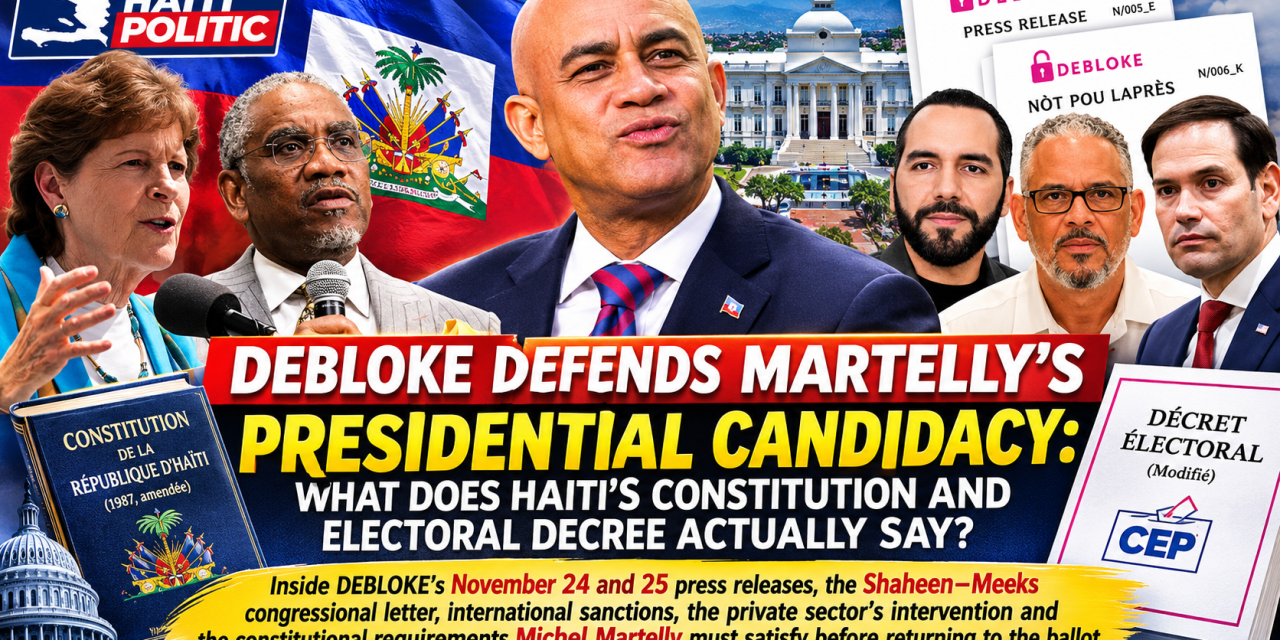
Inside DEBLOKE’s November 24 and 25 press releases, the Shaheen–Meeks congressional letter, international sanctions, the private sector’s intervention and the constitutional requirements Michel Martelly must satisfy before returning to the presidential ballot.
HAITI POLITIC | Legal and Political Analysis
November 26, 2026
The controversy surrounding former Haitian President Michel Joseph Martelly’s presidential candidacy has entered a new phase, exposing a fundamental tension between Haiti’s electoral framework, international efforts to combat gang financing and the constitutional responsibility of Haitian institutions to protect the integrity of elections.
In two consecutive press releases, issued on November 24 and 25, 2026, the DEBLOKE political coalition defended its presidential candidate following allegations raised by two influential American lawmakers and a subsequent intervention by four Haitian private-sector organizations.
DEBLOKE’s central argument is that neither foreign governments nor private-sector organizations have the authority to determine who can participate in Haitian elections.
On that narrow legal point, DEBLOKE has a legitimate argument. However, its interpretation of the electoral decree does not resolve all the constitutional and legal questions surrounding Martelly’s candidacy.
Not being sanctioned by the United Nations is not the same as satisfying every constitutional requirement to become president of Haiti.
The November 23 Congressional Letter: What Triggered DEBLOKE’s Response?
On November 23, 2026, U.S. Senator Jeanne Shaheen, ranking member of the Senate Foreign Relations Committee, and Representative Gregory Meeks, ranking member of the House Foreign Affairs Committee, addressed a letter to three senior members of the Trump administration:
-
Marco Rubio, Secretary of State.
-
Scott Bessent, Secretary of the Treasury.
-
Pete Hegseth, Secretary of Defense.
The lawmakers questioned the administration’s implementation of the Haiti Criminal Collusion Transparency Act, enacted on December 18, 2025, under Section 8319 of the National Defense Authorization Act for Fiscal Year 2026.
The legislation requires the American administration to identify Haitian political and economic actors with significant connections to criminal gangs and provides for sanctions against qualifying individuals.
According to the lawmakers, the first annual report submitted to Congress on June 30, 2026, largely repeated previously announced sanctions without adequately identifying additional networks supporting criminal activities in Haiti.
The lawmakers also criticized the administration for failing to meet the September 28, 2026, sanctions deadline and requested a classified congressional briefing.
Michel Martelly was specifically named in the letter in connection with alleged gang relationships and his presidential candidacy.
However, the primary purpose of the congressional letter was to demand accountability from the American executive branch—not to issue a legally binding instruction to Haiti’s Provisional Electoral Council (CEP).
That distinction is essential to understanding the controversy.
DEBLOKE’s November 24 Press Release: A Strategy of Demanding Evidence
In press release N/005, dated November 24, DEBLOKE confirmed that Michel Joseph Martelly is its presidential candidate.
The coalition stated that it supports investigations into networks financing and arming Haitian gangs but insists that allegations against individuals must be supported by specific and verifiable facts.
DEBLOKE announced its intention to formally contact Senator Shaheen and Representative Meeks to request clarification concerning the allegations against Martelly.
The coalition’s defense rests on several legitimate legal principles:
-
A congressional letter is not a judicial ruling.
-
The November 23 letter does not itself impose new sanctions.
-
American lawmakers cannot directly invalidate a Haitian presidential candidacy.
-
Allegations should be supported by verifiable evidence.
-
Haitian institutions are responsible for determining electoral eligibility under Haitian law.
These arguments deserve recognition.
However, Martelly’s international sanctions did not originate with the November 23 congressional letter. They existed before DEBLOKE announced his presidential candidacy.
Demanding clarification from two American lawmakers does not eliminate the existing sanctions or resolve the allegations underlying them.
Furthermore, the absence of a criminal conviction does not automatically establish that a candidate satisfies every constitutional requirement for the presidency.
Martelly’s International Sanctions: The Problem Existed Before DEBLOKE
Michel Martelly has been subjected to sanctions by Canada, the United States and the European Union.
| Jurisdiction | Date of designation | Stated basis |
|---|---|---|
| Canada | November 17, 2022 | Alleged involvement with or support for armed gang networks |
| United States | August 20, 2024 | Alleged facilitation of drug trafficking and support for gangs |
| European Union | December 15, 2025 | Alleged financial and material support for armed gangs |
| United Nations Security Council | No designation identified as of November 26, 2026 | No listing identified under the Haiti sanctions regime |
These measures arise from separate legal frameworks and should not be represented as criminal convictions.
Nevertheless, their existence raises serious political and institutional questions for a candidate seeking to return to Haiti’s highest elected office.
The U.S. Treasury’s August 2024 Decision
On August 20, 2024, the U.S. Treasury Department’s Office of Foreign Assets Control (OFAC) imposed sanctions against Martelly pursuant to Executive Order 14059.
American authorities accused the former president of using his influence to facilitate narcotics trafficking and supporting Haitian gangs.
The resulting restrictions include limitations on credit from American financial institutions, certain foreign exchange transactions and particular investments involving Martelly.
DEBLOKE is entitled to contest these allegations.
However, requesting evidence from members of Congress is not equivalent to successfully challenging an OFAC designation.
An important question remains: Has Michel Martelly formally pursued the available administrative procedures to challenge or seek removal of the sanctions imposed against him?
DEBLOKE’s November 25 Press Release: The Electoral Decree Becomes Its Principal Defense
In press release N/006, dated November 25, DEBLOKE adopted a more explicitly legal position under the title:
« La loi électorale est la seule boussole du CEP. »
The coalition was responding to four Haitian private-sector organizations that had encouraged candidates facing international sanctions or serious documented integrity concerns to consider withdrawing from the electoral process.
The organizations were:
-
Chambre de Commerce et d’Industrie de l’Ouest (CCIO).
-
Institut Macaya.
-
Chambre de Commerce et d’Industrie Haïtiano-Canadienne (CCIHC).
-
Association des Industries d’Haïti (ADIH).
Although their collective statement did not explicitly name Michel Martelly, DEBLOKE responded by invoking six provisions of the revised electoral decree.
| Electoral decree | Office concerned |
|---|---|
| Article 76 | President of the Republic |
| Article 84 | Senator |
| Article 95 | Deputy |
| Article 107 | Municipal Council |
| Article 113 | CASEC |
| Article 119 | ASEC |
DEBLOKE argues that these provisions expressly identify sanctions imposed by the United Nations Security Council, rather than sanctions independently imposed by foreign governments.
But does this interpretation establish Martelly’s eligibility?
The answer requires examining both the electoral decree and Haiti’s Constitution.
Article 76: Is DEBLOKE’s Interpretation Legally Correct?
The revised electoral decree was published in Le Moniteur, Special Issue No. 50, on October 6, 2026.
Article 76 establishes eight additional conditions for presidential candidates, supplementing Article 135 of the Haitian Constitution.
The eighth condition states:
« Ne pas être l’objet de sanctions du Conseil de Sécurité des Nations-Unies. »
In English, a presidential candidate must not be subject to sanctions imposed by the United Nations Security Council.
The provision does not expressly identify sanctions independently imposed by Canada, the United States or the European Union as automatic grounds for disqualification.
Therefore, DEBLOKE’s interpretation of Article 76(8) is substantially correct.
If a candidate is sanctioned by foreign governments but not by the United Nations Security Council, those foreign sanctions alone do not appear to trigger this particular disqualification provision.
However, Article 76 begins with another equally important phrase:
« Outre les conditions prévues à l’article 135 de la Constitution… »
This means that the electoral decree’s requirements apply in addition to those established by Article 135 of the Constitution.
DEBLOKE cannot isolate Article 76(8) from the remaining provisions of Haitian law.
The absence of United Nations sanctions is one eligibility condition—not a certificate of presidential eligibility.
The Eight Additional Requirements Under Article 76
The electoral decree establishes several requirements beyond international sanctions.
Presidential candidates must satisfy conditions concerning:
-
Possession of a valid national identification card.
-
Registration on the electoral register.
-
Compliance with tax obligations.
-
Required asset declarations for individuals who previously managed public funds.
-
Absence of qualifying findings of electoral fraud.
-
Absence of applicable administrative measures imposed by the CEP.
-
Absence of qualifying dismissal from public administration.
-
Absence of United Nations Security Council sanctions.
Article 153 also establishes documentary requirements for candidate registration, including relevant tax records, property documentation, asset declarations and, where applicable, a certificate of discharge for the management of public funds.
The CEP must examine the complete candidacy file.
A political coalition cannot establish its candidate’s eligibility merely by demonstrating compliance with one of these conditions.
The Constitution—Not Just the Electoral Decree—Is the CEP’s Ultimate Legal Compass
DEBLOKE’s assertion that electoral law must guide the CEP is reasonable but constitutionally incomplete.
The electoral decree remains subordinate to the Constitution.
It cannot override the constitutional qualifications for the presidency.
Article 135 of Haiti’s amended 1987 Constitution establishes six fundamental requirements.
| Constitutional provision | Presidential eligibility requirement |
|---|---|
| Article 135(a) | Haitian nationality of origin, never having renounced Haitian nationality, and no other nationality at registration |
| Article 135(b) | At least 35 years of age on election day |
| Article 135(c) | Enjoyment of civil and political rights and absence of specified serious criminal convictions |
| Article 135(d) | Ownership of real property and habitual residence in Haiti |
| Article 135(e) | Five consecutive years of residence in Haiti before the election |
| Article 135(f) | Discharge for management of public funds, where applicable |
For Michel Martelly, several of these constitutional requirements deserve particular public attention.
The Five-Year Residency Requirement: Where Has Michel Martelly Lived?
Article 135(e) requires presidential candidates to have resided in Haiti for at least five consecutive years before the election.
For a former president who has spent considerable time traveling internationally, the CEP must determine whether the constitutional residency requirement has been satisfied.
International travel alone does not establish a violation of the residency requirement. Similarly, ownership of foreign property does not necessarily prove that a candidate has abandoned habitual residence in Haiti.
Nevertheless, the constitutional requirement cannot simply be ignored.
The CEP should establish the factual residency history of every presidential candidate through appropriate documentation and apply the same standard to all applicants.
Has Michel Martelly supplied sufficient documentation demonstrating compliance with Article 135(e)?
Has the CEP established the location of his habitual residence during the constitutionally required period?
These questions remain unanswered in the two DEBLOKE press releases.
The Constitutional Discharge Requirement: What About Martelly’s Previous Administration?
Article 135(f) establishes a requirement concerning discharge for the management of public funds.
Article 153 of the electoral decree also addresses discharge documentation for candidates who have managed public money.
Michel Martelly served as president from 2011 to 2016, during a period in which his administration oversaw significant public expenditure, including spending associated with the PetroCaribe program.
Holding the presidency does not automatically establish personal financial liability for every expenditure made by an administration.
However, the CEP must determine whether Martelly was subject to the applicable public-fund accounting requirements and, if so, whether he possesses a legally valid discharge.
The absence of a functioning Haitian Parliament raises additional institutional questions concerning the issuance and recognition of such documentation.
DEBLOKE should explain how its presidential candidate satisfies this constitutional requirement.
A press release defending Martelly against international allegations cannot substitute for legally required financial documentation.
Asset Declarations and Tax Compliance
The electoral decree also requires relevant candidates to present asset declarations and demonstrate compliance with tax obligations.
The CEP must verify whether Martelly has supplied the documents required under Articles 76 and 153.
The Haitian public has a legitimate interest in knowing whether all presidential candidates have been subjected to the same level of financial scrutiny.
However, several documents must not be confused with one another:
-
An asset declaration identifies declared assets and financial interests.
-
A tax certificate establishes compliance with applicable tax requirements.
-
A financial audit examines financial transactions and accounting records.
-
A discharge addresses accountability for the management of public funds under the applicable legal framework.
Possession of one document does not necessarily satisfy the requirements associated with the others.
Each must be examined separately.
Civil and Political Rights: International Sanctions Are Not Criminal Convictions
Article 135(c) establishes constitutional conditions relating to civil and political rights and qualifying criminal convictions.
International administrative sanctions do not automatically constitute criminal convictions under Haitian constitutional law.
Consequently, it would be legally questionable to treat a Canadian, American or European administrative designation as though it were a final criminal judgment issued by a competent court.
This distinction protects due process and the presumption of innocence.
However, it does not mean that Haitian judicial authorities should disregard credible evidence of criminal activity.
Where allegations are supported by evidence, the competent Haitian institutions have a responsibility to investigate independently and pursue appropriate legal proceedings.
Presumption of innocence is a legal protection. It is not immunity from investigation or public accountability.
Can Michel Martelly Constitutionally Serve a Second Presidential Term?
Article 134-3 of the Haitian Constitution permits a former president to seek another presidential mandate after the required five-year interval but prohibits a third presidential term.
Martelly completed his first presidency in February 2016.
More than ten years have elapsed since his departure from office.
Therefore, the constitutional interval does not, by itself, appear to prevent him from seeking a second presidential mandate.
However, this provision does not exempt a former president from the other constitutional qualifications.
Martelly must still satisfy the requirements concerning nationality, residency, civil and political rights, financial accountability and electoral documentation.
The constitutional interval permits a possible return to office. It does not guarantee eligibility.
The ADIH Contradiction: DEBLOKE Challenges the Private Sector’s Credibility
One of the most politically significant elements of DEBLOKE’s November 25 statement is its reference to a July 8, 2023, press release issued by the Association des Industries d’Haïti (ADIH).
In that document, ADIH expressed concerns about international sanctions and emphasized that such measures should result from a transparent and equitable process.
ADIH argued that sanctions could negatively affect individual reputations, investments and the national economy.
The association stated:
« Toute mesure de sanction soit le résultat d’un processus transparent et équitable avant l’application. »
More than three years later, ADIH joined other private-sector organizations in encouraging candidates facing international sanctions or documented integrity concerns to consider withdrawing from the electoral process.
DEBLOKE has identified an apparent tension between these positions.
In 2023, ADIH emphasized procedural fairness and the economic consequences of international sanctions.
In November 2026, it joined a collective appeal encouraging sanctioned candidates to reconsider their political ambitions.
There is a legitimate question of consistency.
However, these positions are not necessarily legally incompatible. An organization can defend procedural fairness while also believing that a sanctioned individual should voluntarily withdraw from a presidential race to protect institutional credibility.
The more important question is whether Haiti’s private-sector organizations apply the same standards to their own members, political partners and preferred candidates.
Who Finances Haiti’s Political Parties?
If Haiti’s private sector demands integrity from presidential candidates, it should also support transparency concerning the financing of political parties and electoral campaigns.
The issue of political accountability cannot be limited to individuals seeking elected office.
It must also extend to the individuals and organizations financing their campaigns.
The Haitian public deserves greater transparency concerning:
-
Major campaign contributors.
-
Corporate donations to political parties.
-
Business relationships between candidates and campaign financiers.
-
Potential conflicts of interest.
-
Government contracts awarded to politically connected businesses.
-
Any unlawful financial support provided to armed groups.
DEBLOKE’s demand for consistent standards is legitimate.
However, the same transparency requirements must apply to DEBLOKE itself.
If the coalition demands that the private sector disclose its political interests, it should also be prepared to disclose its own sources of campaign financing.
Did the October 6 Electoral Decree Create a Legal Opening for Sanctioned Politicians?
The October 6 revision of the electoral decree deserves particular scrutiny.
The June 2, 2026, electoral decree already contained a prohibition specifically referring to United Nations Security Council sanctions.
However, the October revision removed a separate documentary requirement involving certification of the absence of foreign asset sanctions.
This distinction is important.
The earlier framework contained an additional administrative obstacle for candidates subjected to foreign asset sanctions. The revised framework removed that documentary requirement while retaining the prohibition concerning United Nations Security Council sanctions.
| Legal issue | Earlier framework | October 6 revision |
|---|---|---|
| UN Security Council sanctions | Disqualifying condition | Retained |
| Foreign asset-sanctions certification | Additional documentary requirement | Removed |
| U.S., Canadian and EU sanctions | Potential documentary obstacle | Not independently listed as an automatic exclusion under Article 76(8) |
| Constitutional qualifications | Mandatory | Remain mandatory |
The revision raises several legitimate questions.
Who proposed removing the certification requirement?
What was the official justification?
Did the CEP conduct an assessment of how the change would affect internationally sanctioned candidates?
Were political parties, private-sector organizations or other interested parties consulted?
There is no evidence established in this analysis that the October 6 revision was specifically designed to accommodate Michel Martelly.
Nevertheless, its practical consequences for internationally sanctioned politicians deserve public examination.
Can Haiti’s Private Sector Ask Martelly to Withdraw?
Yes.
Article 28 of the Haitian Constitution protects freedom of expression.
Private-sector organizations have the right to express political opinions, raise concerns about electoral integrity and call for the voluntary withdrawal of candidates.
However, they do not possess the institutional authority to legally disqualify a presidential candidate.
The distinction between political advocacy and legal authority is fundamental.
The U.S. Congress exercises American legislative oversight. The U.S. Treasury administers applicable American sanctions. The United Nations Security Council administers its international sanctions framework.
Haitian private-sector organizations may engage in public advocacy, while Haitian judicial institutions investigate and adjudicate matters within their jurisdiction.
The CEP and competent electoral bodies are responsible for examining candidacies and resolving electoral eligibility matters under Haitian law.
Finally, Haitian voters are responsible for choosing among legally qualified candidates.
None of these institutions should exercise powers belonging exclusively to another.
The CEP must remain independent of political parties, business organizations and foreign diplomatic pressure.
Could Washington Indirectly Affect Martelly’s Presidential Candidacy?
Although American authorities cannot directly determine Haitian electoral eligibility, they possess mechanisms that could influence the broader legal and political situation.
The United States could impose additional sanctions under applicable legislation, provide relevant information to Haitian judicial authorities or support a designation through the United Nations sanctions framework.
Under United Nations Security Council Resolution 2653, individuals supporting criminal networks or threatening Haiti’s peace, security and stability can be considered for targeted sanctions.
A subsequent United Nations designation could potentially activate the exclusion contained in Article 76(8), depending on its timing and the applicable electoral procedures.
This possibility makes the distinction between American and United Nations sanctions particularly important for DEBLOKE.
Martelly’s position under the sanctions provision depends on his applicable designation status.
It is not an unconditional exemption from future electoral scrutiny.
Ten Questions Haiti Politic Poses to DEBLOKE and Michel Martelly
In the interest of constitutional compliance, transparency and equal treatment of presidential candidates, Haiti Politic poses the following questions:
1. Constitutional compliance: Has Michel Martelly submitted all the documentation necessary to establish his compliance with Article 135 of the Haitian Constitution?
2. Residency: Can Martelly demonstrate five consecutive years of residency in Haiti before the presidential election?
3. Discharge: Has he obtained any legally required discharge for the management of public funds during his previous administration?
4. Asset declarations: Have his asset declarations been submitted in accordance with applicable Haitian legislation?
5. Tax compliance: Has he satisfied the tax-compliance requirements established by Articles 76 and 153 of the electoral decree?
6. American sanctions: Has Martelly formally challenged the August 20, 2024, OFAC sanctions or requested administrative reconsideration?
7. Canadian and European sanctions: Has he pursued available procedures to challenge the sanctions imposed by Canada and the European Union?
8. Campaign financing: Will DEBLOKE disclose information concerning the financing of its presidential campaign and the identities of its major financial contributors?
9. Electoral decree revision: Did DEBLOKE or any of its representatives participate in consultations concerning the October 6, 2026, revision of the electoral decree?
10. Judicial cooperation: Will DEBLOKE cooperate fully with independent Haitian judicial investigations into allegations concerning its presidential candidate?
These questions do not presume criminal guilt.
They concern transparency, constitutional eligibility and the responsibilities associated with seeking the highest office in the Republic.
Haiti Must Avoid Two Different Forms of Injustice
The Martelly controversy exposes two fundamental dangers.
The first is allowing foreign governments to effectively determine who can become president of Haiti without regard to Haitian law, constitutional sovereignty or due process.
The second is allowing Haitian political actors to invoke sovereignty and due process as a means of avoiding legitimate scrutiny concerning corruption, public finances and alleged relationships with criminal networks.
Neither approach serves Haiti’s democratic interests.
A credible electoral process requires independent institutions, transparent political financing, functioning judicial mechanisms, constitutional compliance and equal treatment of candidates.
Haiti cannot build a functioning democracy if electoral eligibility depends on the preferences of Washington, international organizations, powerful business families or politically connected individuals.
The solution is not to replace Haitian sovereignty with foreign sanctions.
Nor is it to replace accountability with political protection.
Conclusion: DEBLOKE Has a Legal Argument, but It Has Not Answered Every Constitutional Question
DEBLOKE’s November 24 and November 25 press releases represent a coordinated legal and political defense of its presidential candidate.
The coalition is correct that a congressional letter is not a criminal conviction, foreign sanctions do not automatically trigger Article 76(8), and private-sector organizations cannot legally invalidate a presidential candidacy.
It is also correct that Haitian electoral institutions must apply Haitian law independently and that candidates are entitled to procedural fairness.
However, none of these arguments establishes that Michel Martelly has satisfied every constitutional requirement for the presidency.
The central issue is not whether Senator Jeanne Shaheen, Representative Gregory Meeks, ADIH or Institut Macaya wants Martelly to participate in Haiti’s presidential election.
The central issue is whether Michel Joseph Martelly satisfies Article 135 of the Haitian Constitution, Article 76 of the electoral decree and every applicable legal and documentary requirement.
DEBLOKE is right to demand transparency from Washington and consistency from the Haitian private sector.
But the Haitian people have an equal right to demand transparency from DEBLOKE and its presidential candidate.
The Constitution must remain above political coalitions, business interests, foreign governments and administrative decrees.
Haiti should neither allow Washington to choose its president nor allow its political and economic elites to place themselves above Haitian law.
Primary Sources and Legal References
-
DEBLOKE Political Coalition — Press Release N/005, November 24, 2026.
-
DEBLOKE Political Coalition — Press Release N/006, November 25, 2026.
-
Association des Industries d’Haïti (ADIH) — Press Release, July 8, 2023.
-
Haitian Constitution of 1987, as amended — Articles 28, 134-3 and 135.
-
Haitian Electoral Decree — June 2, 2026.
-
Revised Haitian Electoral Decree — October 6, 2026, Le Moniteur, Special Issue No. 50.
-
Provisional Electoral Council (CEP) — Articles 76, 84, 95, 107, 113, 119 and 153 of the electoral decree.
-
U.S. Senate Foreign Relations Committee — Shaheen–Meeks congressional letter, November 23, 2026.
-
Haiti Criminal Collusion Transparency Act — Section 8319, National Defense Authorization Act for Fiscal Year 2026.
-
U.S. Department of the Treasury — OFAC sanctions against Michel Joseph Martelly, August 20, 2024.
-
United Nations Security Council — Resolution 2653 and the Haiti Sanctions Committee.
Editorial Verification Note
This article distinguishes constitutional eligibility, administrative sanctions, criminal convictions and political demands for voluntary withdrawal.
Michel Martelly’s complete candidacy file, residency records, tax certificates and discharge documentation have not been independently examined by Haiti Politic.
Consequently, Haiti Politic cannot presently establish whether he satisfies all presidential eligibility requirements. This article constitutes legal and political analysis, not a finding of criminal guilt or a definitive determination of electoral eligibility.
© 2026 Haiti Politic | Legal Analysis, Investigative Journalism and Public Accountability