Haiti Politic — Analysis
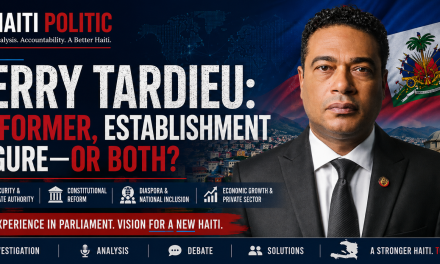
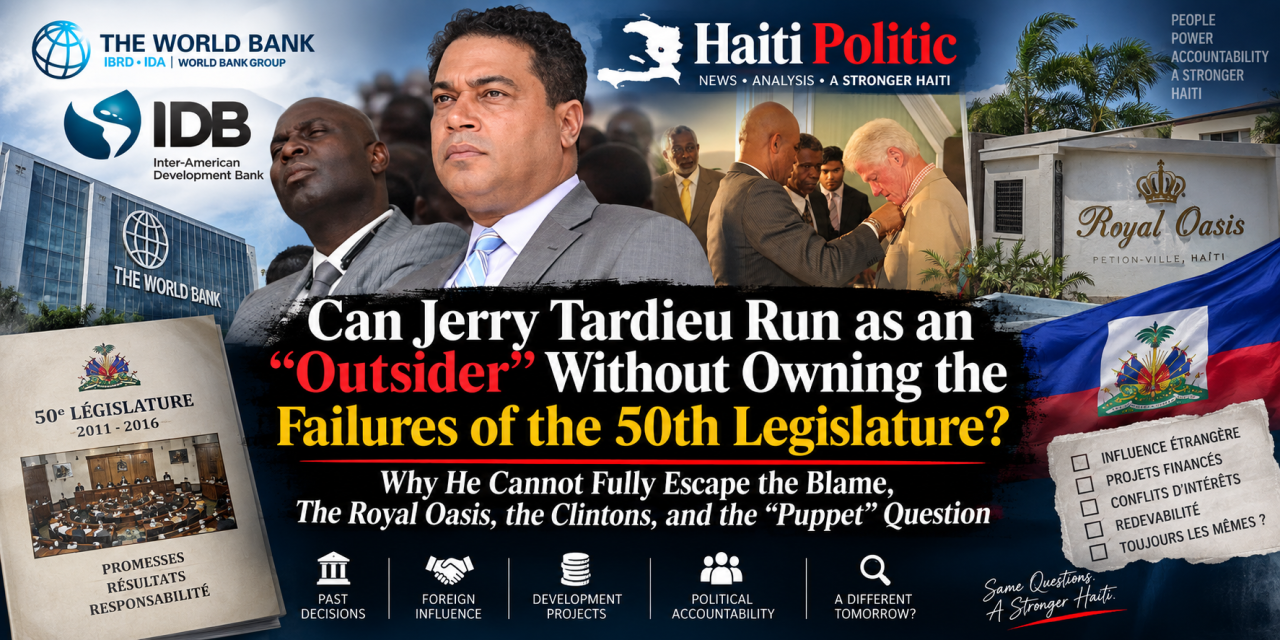
As Haiti edges toward its next electoral cycle, Jerry Tardieu — the Pétion-Ville entrepreneur-turned-lawmaker who built the Royal Oasis Hotel and later chaired the Chamber of Deputies’ constitutional reform commission — is positioning himself as a technocratic reformer offering a clean break from the political class blamed for Haiti’s institutional collapse. The pitch has an obvious problem: Tardieu was not a bystander to that collapse. He was a sitting deputy, and a committee chairman, inside the very 50th Legislature (2016–2020) whose expiration without successor elections plunged Haiti into rule by decree. Whether he can credibly run as an “outsider” is less a question of biography than of what, specifically, he can and cannot disclaim.
The Legislature That Disappeared
The 50th Legislature’s failure was not a single scandal but a slow institutional death. Parliamentary elections due in October 2019 were never held. When the terms of the entire Chamber of Deputies and two-thirds of the Senate expired on January 13, 2020, Haiti was left with a rump Senate and no functioning lower chamber at all — a vacuum President Jovenel Moïse used to govern by decree until his assassination in July 2021. The Chamber’s own leadership has since drawn direct accusations of wrongdoing: Gary Bodeau, who presided over the Chamber of Deputies for the bulk of that legislature (2017–2020), was sanctioned by the U.S. Treasury in 2023 for conduct U.S. officials tied to enabling armed gangs through interference in public procurement. Tardieu held no such leadership post and has not been named in those sanctions.
What Tardieu Actually Did: The Constitutional Reform Commission
From 2017 to 2019, Tardieu chaired the Chamber’s nine-member Special Commission on Constitutional Amendment, alongside Vice-President Louis Marie Bonhomme and seven other deputies. Its mandate was to gather prior expert work — including the 1987 presidential reform commission’s findings — and produce recommendations for constitutional amendment.
Key proposals associated with the commission’s work included:
- Streamlining the amendment process itself, seen as needlessly rigid and a driver of the governability crises that recur between elected branches
- Addressing the chronic desynchronization of Haiti’s electoral calendar — the same defect that would go on to void the legislature Tardieu sat in
- Proposals aimed at strengthening executive-legislative balance, in the name of a “constitutional governability pact” Tardieu invoked publicly, one meant to bind elected officials, parties and civil society to a shared institutional framework
The outcome: the commission produced a formal report, but Haiti never adopted a resulting amendment. Tardieu resurfaced its findings in a September 2019 address in Montreal — timing that, in retrospect, undercuts any outsider framing: he was still promoting the commission’s unfinished work weeks before the very Chamber that commissioned it ceased to exist for lack of an election. Years later, when Moïse pushed his own controversial constitutional referendum in 2021, Tardieu publicly broke with it, warning it concentrated power in the presidency and shielded former officials, including presidents, from prosecution. That opposition burnishes his reform credentials after the fact — but it does not erase his multi-year tenure inside the institution whose paralysis made an extra-constitutional referendum thinkable in the first place.
Why He Cannot Fully Escape the Blame
Three facts complicate any clean “outsider” narrative:
- He was there. Tardieu served the full run of the 50th Legislature as an elected deputy and chaired one of its most consequential committees. A committee chairmanship is not a bystander role; it is institutional authorship, even if the final product never became law.
- His reform effort did not fix the defect that killed the legislature. The commission he led identified the electoral-calendar dysfunction as a structural problem — yet no amendment was passed, and it was precisely that dysfunction, not a scandal, that allowed the Chamber’s mandate to lapse in 2020. Diagnosing a disease you also die of is not the same as having cured it.
- Voters rarely parse committee-level distinctions. Even though Tardieu was not the Chamber’s president and has not been implicated in the corruption sanctions leveled at Bodeau, an opponent’s simplest attack line — “he was a deputy when parliament failed” — does not require proving personal wrongdoing to be politically effective.
What Tardieu can credibly claim is a narrower, more defensible version of independence: he did not hold the leadership post most associated with alleged corruption, and he broke publicly with Moïse’s post-legislature constitutional maneuvering. That is a case for limited distance, not full outsider status.
The Royal Oasis, the Clintons, and the “Puppet” Question
Tardieu’s pre-political career adds a second, distinct vulnerability. As co-founder and CEO of the Royal Oasis Hotel, he secured a $2 million equity investment from the Clinton Bush Haiti Fund and financing from the World Bank’s International Finance Corporation to complete the project after the 2010 earthquake devastated its original investor base.
This is where “scandal” needs precise framing. No corruption charge or personal financial-wrongdoing allegation against Tardieu himself surfaced in the reporting on the Royal Oasis. What did surface, repeatedly, was a broader critique of the entire Clinton-era reconstruction apparatus — of which Tardieu’s hotel became a recurring symbol. Journalists and commentators, including in The Nation, Politico, and The Washington Post, cited the Royal Oasis — with its $200-a-night rooms and designer boutiques — as an example of earthquake-recovery capital flowing toward projects serving elites and foreigners rather than the displaced. The Council on Hemispheric Affairs and other critics went further, framing the entire Clinton Bush Haiti Fund/IHRC period, co-chaired by Bill Clinton, as reconstruction aid disconnected from ordinary Haitians’ needs. Tardieu was never personally accused of diverting funds; his hotel was cited as an example of where the system’s priorities landed.
That distinction — “symbol of misallocated priorities” versus “personal scandal” — matters, but it may not matter much on the campaign trail, where opponents are likely to compress it into a single, simpler charge: that Tardieu’s defining private-sector achievement exists because Washington-aligned institutions built it for him.
Is Tardieu a “puppet” of the IFC and IDB? The case critics make rests on two pillars:
- Financial dependency: the Royal Oasis was completed only with IFC financing and Clinton-Bush equity, after the earthquake wiped out most of his original private investors — meaning his signature project’s survival is inseparable from foreign development finance.
- Technocratic alignment: a Harvard Kennedy School degree and an openly pro-market, institutionalist governing philosophy give critics an easy frame — that Tardieu would default to the policy preferences of the lenders who saved his hotel, prioritizing investor protection and structural-adjustment-style orthodoxy over grassroots demands, in a political culture that treats “internationally credentialed” as a euphemism for “unaccountable to Haitians.”
The countervailing case is straightforward, if less viscerally satisfying: receiving IFC project financing for a single hotel two decades ago is not the same as policy capture, foreign development banks routinely finance private hospitality projects across the Caribbean without installing political control over recipients, and Tardieu’s public break with Moïse’s 2021 referendum is itself evidence of a politician willing to defy Washington-adjacent consensus when it suited his own institutionalist convictions rather than a foreign patron’s. Voters, not this analysis, will decide which reading is more persuasive.
The Bottom Line
Jerry Tardieu can plausibly argue he was not the architect of the 50th Legislature’s collapse and was not implicated in the corruption allegations that followed its leadership. What he cannot plausibly argue is that he was absent from it, or that his committee’s reform effort resolved the structural flaw that ultimately dissolved the body he served in. Layered on top of that is a pre-political business record that, fairly or not, has become shorthand in Haitian political discourse for foreign-backed elite capture. An “outsider” campaign built on those two facts will likely face sustained, specific challenges — not because the record proves corruption or puppetry, but because it hands opponents the material to make the accusation stick regardless.
Haiti Politic will continue tracking the 2026 electoral field as candidacies are formalized.