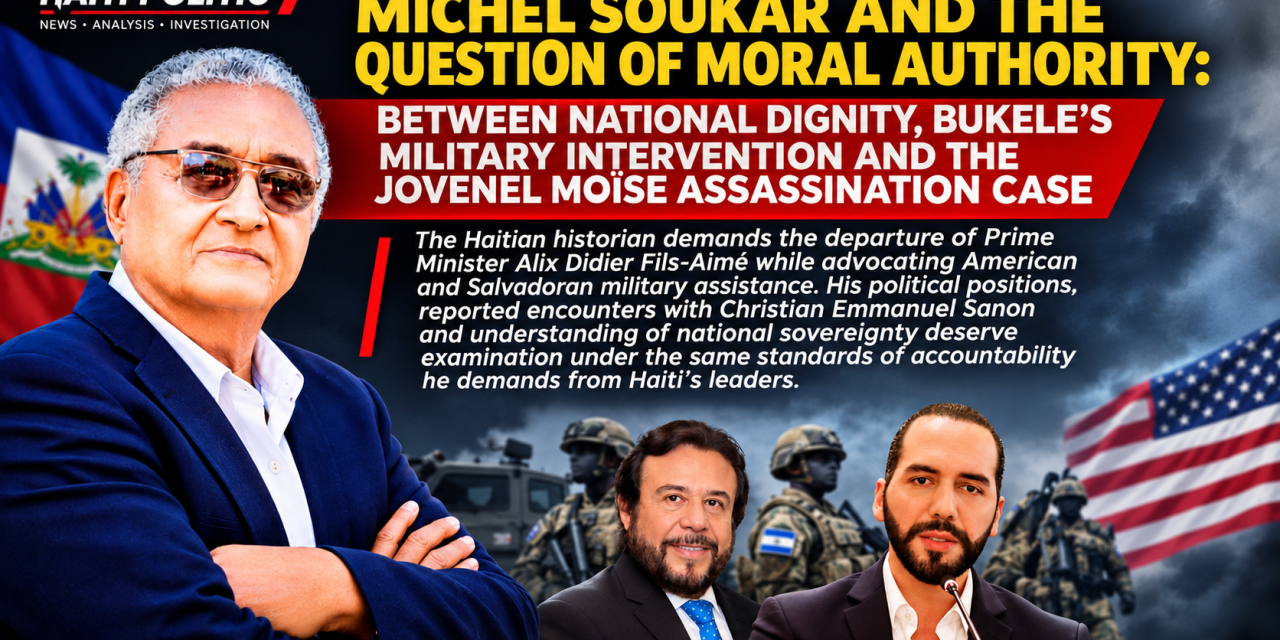
The Haitian historian demands the departure of Prime Minister Alix Didier Fils-Aimé while advocating American and Salvadoran military assistance. His political positions, reported encounters with Christian Emmanuel Sanon and understanding of national sovereignty deserve examination under the same standards of accountability he demands from Haiti’s leaders.
HAITI POLITIC | SPECIAL INVESTIGATION & POLITICAL ANALYSIS
November 27, 2026
Who has the moral authority to lecture Haiti’s political leaders about national dignity, sovereignty, political legitimacy and institutional accountability?
In an open letter dated November 2026 and addressed to Prime Minister Alix Didier Fils-Aimé, Haitian historian, author and political commentator Michel Soukar demands a change of government.
He denounces the deterioration of Haiti’s international image, refers to accusations reportedly published in the Salvadoran press and argues that the prime minister’s departure has become a national necessity.
Yet his proposed solution includes continued dependence on foreign security forces, particularly those of the United States and El Salvador.
The letter comes only days after a federal jury in Miami convicted Christian Emmanuel Sanon for his role in the conspiracy that resulted in the assassination of President Jovenel Moïse.
Soukar himself had previously been identified in media reporting as a potential defense witness in Sanon’s federal trial. He also acknowledged having met Sanon during the months preceding the assassination.
These are separate matters. Neither Soukar’s advocacy of foreign intervention nor his encounters with Sanon establishes criminal wrongdoing.
Nevertheless, both subjects are relevant to an examination of his public positions, his understanding of political legitimacy and the standards of accountability he advocates.
1. WHAT MICHEL SOUKAR IS DEMANDING
Soukar’s open letter, titled Lettre ouverte au Premier Ministre Alix D. Fils-Aimé — Pour la sauvegarde de la dignité nationale et le sursaut de l’État, begins with a declaration:
« Halte à la honte, Monsieur Fils-Aimé : notre dignité vaut plus qu’un job. »
The historian proposes four principal objectives for a replacement government:
-
Install a credible government capable of restoring public confidence and the integrity of public office.
-
Eliminate gangs with assistance from foreign forces, particularly the United States and El Salvador.
-
Prepare the country for credible elections.
-
Open Haiti to domestic and foreign investment.
The complete letter, published on November 27, confirms these four objectives.
Although these proposals address legitimate national concerns, the letter does not provide a detailed institutional, constitutional, financial or operational framework for achieving them.
Soukar is demanding more than the resignation of a prime minister. He is proposing a new political direction for Haiti.
That proposal deserves scrutiny.
2. NATIONAL DIGNITY BEGINS INSIDE HAITI
On page 2, Soukar argues that a nation’s image is shaped not only within its borders but also through the way other populations perceive it.
International reputation undoubtedly matters.
However, Haiti’s national dignity should not be evaluated exclusively through the opinions of foreign journalists, diplomats, governments or international organizations.
The conditions under which Haitians live are equally fundamental.
Can Haitian children attend school safely?
Can families travel freely between departments?
Can businesses operate without extortion?
Can victims obtain justice?
Can citizens participate in credible elections?
Can the Haitian state exercise authority over its national territory?
These are substantive measures of national dignity.
Improving Haiti’s international image without addressing these domestic realities would produce a communications achievement rather than a genuine national recovery.
The central question is not simply how foreigners perceive Haiti, but whether Haitian institutions serve and protect the Haitian population.
3. THE SALVADORAN PRESS AND THE ACCUSATIONS AGAINST FILS-AIMÉ
Soukar’s letter relies substantially on accusations he attributes to the Salvadoran press concerning alleged connections between Prime Minister Fils-Aimé and criminal gangs.
The historian acknowledges that these accusations may reflect the interpretation of a foreign observer. Nevertheless, he considers them part of a broader deterioration of public confidence.
The seriousness of such allegations requires a clear distinction between political criticism and established criminal responsibility.
The letter does not identify the specific documentary evidence supporting the alleged connections.
It does not establish whether the claims were independently corroborated or whether a competent judicial authority has determined that the prime minister participated in criminal activities.
The accusations should therefore be investigated rather than automatically accepted as fact.
A foreign newspaper’s account is not inherently more credible than that of a Haitian journalist.
Its claims must be evaluated through the same standards of evidence, verification and fairness.
If Soukar’s argument is that the government has lost public confidence because of its performance, that is a legitimate political debate.
If the argument is that the prime minister is criminally associated with gangs, that is a different proposition requiring evidence.
4. MICHEL SOUKAR’S SUPPORT FOR SALVADORAN MILITARY INTERVENTION
The most consequential passage concerning Haiti’s security strategy appears on page 10 of the letter.
Soukar explicitly advocates foreign assistance from the United States and El Salvador to eliminate gangs and criminal violence.
His position is therefore established by his own written words, independently of his earlier media appearances.
This raises an important question about his conception of national dignity.
Does Soukar view Salvadoran intervention as temporary assistance intended to strengthen Haitian institutions, or does he regard foreign military intervention as the principal solution to Haiti’s security crisis?
There is a significant difference between the two approaches.
International security cooperation can be compatible with national sovereignty when it operates under a clear legal framework, defined objectives, effective oversight and an established exit strategy.
However, a policy that relies indefinitely on foreign security forces presents different institutional and political challenges.
Soukar’s letter does not establish how his proposed intervention would ultimately restore Haiti’s capacity to provide its own security.
5. HAS MICHEL SOUKAR ADEQUATELY EXAMINED THE BUKELE MODEL?
Supporters of Salvadoran President Nayib Bukele frequently emphasize the dramatic reduction in recorded homicides in El Salvador.
That achievement forms an important part of the international debate concerning his administration.
However, the broader discussion also includes concerns about prolonged emergency powers, mass arrests, judicial protections, allegations of human rights violations and the concentration of political authority.
The question is not whether Haiti should learn from successful security measures adopted elsewhere.
The question is whether those measures can be transferred responsibly to a country with substantially different institutions, geography, political conditions and criminal networks.
Before promoting Salvadoran intervention, Haitian public figures should explain the legal, institutional and financial implications of the policy.
In particular, Soukar should clarify:
-
Whether he supports Salvadoran participation through an internationally authorized mission or a separate bilateral military arrangement.
-
Which Haitian authority would control and supervise foreign personnel.
-
Who would finance an extended military operation.
-
Which courts would have jurisdiction over alleged misconduct.
-
What conditions would trigger the withdrawal of foreign forces.
-
How the intervention would contribute to the long-term independence of Haitian security institutions.
Supporting an intervention is a political position. Demonstrating its sustainability requires a much more comprehensive analysis.
6. REPLACING FILS-AIMÉ WHILE PRESERVING HIS SECURITY STRATEGY
One of the most important tensions within Soukar’s letter concerns the relationship between its demand for political change and its proposed security policy.
Soukar wants Fils-Aimé removed, yet he advocates international security cooperation involving the same countries associated with the current debate over Haiti’s foreign military assistance.
What fundamental policy change would a replacement government introduce?
Would it renegotiate the terms of Salvadoran participation?
Would it establish a different security command structure?
Would it publish existing international agreements?
Would it redirect resources toward the Haitian National Police?
Would it strengthen the judiciary and reinforce constitutional oversight?
Or would a different prime minister simply administer substantially the same security strategy?
Soukar may have substantive disagreements with the current government’s conduct that justify his call for political change. However, those disagreements need to be articulated beyond concerns about the prime minister’s international reputation.
Replacing an individual and reforming a political system are not the same undertaking.
7. MICHEL SOUKAR’S NAME IN THE JOVENEL MOÏSE ASSASSINATION PROCEEDINGS
The discussion of moral authority also provides an opportunity to revisit a separate matter that attracted public attention earlier this year.
On September 29, 2026, media reporting concerning Christian Emmanuel Sanon’s federal trial identified Michel Soukar as a potential defense witness.
Former prime ministers Claude Joseph and Ariel Henry were also reportedly identified among potential witnesses.
Sanon’s defense sought to distinguish his political ambitions from criminal responsibility for the assassination of President Jovenel Moïse.
Soukar’s inclusion attracted attention because of his prominence as a historian and political commentator, as well as his acknowledged encounters with Sanon before the assassination.
However, several distinctions are necessary.
| Question | Status |
|---|---|
| Was Soukar reportedly identified as a potential defense witness? | Yes |
| Did Soukar acknowledge meeting Sanon? | Yes |
| Did their discussions concern Haitian history and politics? | According to Soukar’s account, yes |
| Was Soukar formally employed as Sanon’s political adviser? | Not established |
| Did Soukar know about the assassination conspiracy? | Not established; Soukar denied such knowledge |
| Was Soukar charged in connection with the assassination? | No such charge identified |
| Did Soukar participate in the assassination conspiracy? | No evidence reviewed establishes this |
The importance of the distinction cannot be overstated.
A potential defense witness is not automatically a suspect, political ally, accomplice or participant in a criminal conspiracy.
8. APRIL–MAY 2021: WHEN CHRISTIAN EMMANUEL SANON APPROACHED SOUKAR
During a September 30, 2026 interview on Télé Métropole’s program Le Point, Soukar reportedly explained the circumstances of his encounters with Christian Emmanuel Sanon.
According to his account, their meetings occurred during the spring of 2021, approximately two or three months before Jovenel Moïse’s assassination.
Soukar described Sanon as someone interested in Haitian history and political affairs.
Sanon reportedly purchased some of Soukar’s historical publications, and the historian recommended additional reading, including Placide David’s L’Héritage colonial.
Their discussions reportedly extended to Haiti’s political leadership and institutional future.
Soukar denied that Sanon discussed an assassination plan with him.
That denial must be included in any responsible account of their relationship.
The available evidence supports describing Soukar as a historian with whom Sanon discussed history and politics. It does not establish that Soukar accepted a formal position in Sanon’s political organization or knowingly supported an unlawful operation.
9. NOVEMBER 19, 2026: THE CONVICTION OF CHRISTIAN EMMANUEL SANON
The legal context surrounding Sanon’s political activities has changed substantially since Soukar gave his September interview.
On November 19, 2026, the U.S. Department of Justice announced that a federal jury had convicted Christian Emmanuel Sanon of multiple federal offenses connected to the assassination of Jovenel Moïse.
Sanon faces a maximum sentence of life imprisonment.
According to the Justice Department, evidence presented at trial established that Sanon pursued a conspiracy to remove Moïse violently and position himself as Haiti’s next president.
The prosecution also established that anticipated government infrastructure contracts were used to secure support for the conspiracy and that Sanon falsely represented himself as having American government backing.
This last finding is especially important to Haiti’s broader political debate.
It demonstrates how claims of foreign political support can be used to manufacture credibility.
However, the verdict establishes Sanon’s criminal responsibility. It does not establish that every person who previously met him knew of his criminal activities.
Nothing in the Justice Department’s November 19 announcement establishes criminal responsibility on the part of Michel Soukar.
10. WHAT DID SOUKAR KNOW ABOUT SANON’S POLITICAL PROJECT?
Soukar’s acknowledged encounters with Sanon provide a legitimate opportunity to document the political environment preceding the assassination.
What did Sanon explain about his political ambitions?
Did he describe a constitutional path to power?
Did he discuss a proposed transitional government?
Did he claim to have international support?
Did he identify political associates or financial backers?
Did Soukar offer general historical observations or more specific political guidance?
Did their conversations continue after the spring of 2021?
These questions could help clarify the historical record.
But they must not be transformed into accusations unsupported by evidence.
A historian can meet and advise someone on political or historical matters without knowing that the individual is involved in criminal activities.
Sanon’s conviction does not invalidate Soukar’s explanation of their encounters.
It does, however, reinforce the importance of accurately documenting the political conversations that occurred during that period.
11. THE 2019 WARNING TO PRESIDENT JOVENEL MOÏSE
In a previously discussed interview with Team Roudy, Soukar reportedly recalled advising Jovenel Moïse in 2019 to leave office because remaining in power could endanger his life.
That statement deserves to be examined in its original context.
Haiti was experiencing serious political instability, and a commentator might reasonably have interpreted the deteriorating situation as presenting risks to the president.
A political warning is not evidence of advance knowledge of an assassination.
Nevertheless, Soukar could help historians better understand that period by explaining the basis of his assessment.
Was his warning a general conclusion drawn from Haiti’s political circumstances?
Was it based on specific information?
Did he communicate his concerns privately to the president or other responsible authorities?
Did he believe that constitutional succession was possible at the time?
The full interview and surrounding circumstances are important to answering these questions accurately.
12. SIGNAL FM AND THE INFORMATION SURROUNDING THE ASSASSINATION
Soukar has also reportedly described receiving information concerning the assassination from someone associated with Radio Signal FM.
Previous Haiti Politic investigations raised questions about the circulation of information following the president’s death.
Clarifying the source of that information could contribute to a more complete historical chronology.
Who communicated the information to Soukar?
What was the original source?
What information was communicated?
Are relevant records still available?
Receiving news of a major political event through professional media contacts is entirely consistent with the activities of a journalist or political commentator.
It is not evidence of criminal involvement.
The purpose of examining these accounts should be historical clarification, not insinuation.
13. FROM JOVENEL MOÏSE TO ALIX DIDIER FILS-AIMÉ: THE POLITICAL QUESTION OF RESIGNATION
Soukar’s reported recommendation that Jovenel Moïse leave office in 2019 and his November 2026 demand for the departure of Fils-Aimé raise a broader question about his understanding of political transitions.
The two situations are not identical.
Moïse was an elected president. Fils-Aimé exercises authority within a transitional political arrangement.
The constitutional and political circumstances governing their respective departures are therefore different.
Nevertheless, both cases illustrate the importance of specifying what happens after a political leader resigns.
Who assumes authority?
What is the legal basis of the succession?
Who determines the composition of the replacement government?
What limitations apply to the new administration?
What prevents a temporary government from becoming an indefinite transition?
What guarantees the restoration of democratic institutions?
A demand for resignation can be a legitimate instrument of political accountability, but it should be accompanied by a credible explanation of the proposed succession.
14. THE MORAL AUTHORITY OF HAITIAN PUBLIC INTELLECTUALS
Public intellectuals perform an important role in democratic societies.
They interpret history, criticize government conduct, expose institutional weaknesses and challenge political narratives.
Their credibility depends partly on whether they apply consistent standards when evaluating public affairs.
Soukar’s letter invites examination of several such standards.
| Principle | Question for Michel Soukar |
|---|---|
| National dignity | How should Haiti balance international reputation with domestic institutional independence? |
| Sovereignty | What limits should govern foreign military intervention? |
| Evidence | When does a public accusation justify a political demand for resignation? |
| Transparency | How should public figures explain their relevant political relationships? |
| Constitutional legitimacy | How should replacement governments acquire authority? |
| Intellectual consistency | Are the same standards applied to political allies and opponents? |
| Accountability | What measurable results should determine the success of government policies? |
These criteria should apply to every influential public figure, regardless of political affiliation, academic standing or professional reputation.
Soukar’s right to criticize the government does not require him to demonstrate personal perfection.
Similarly, public scrutiny of his positions does not justify imputing criminal responsibility to him without evidence.
15. THE FOREIGN INFLUENCE QUESTION: SECURITY, ELECTIONS AND INVESTMENT
The last three objectives of Soukar’s proposed government are particularly significant when considered together:
Foreign-assisted security, credible elections and international investment.
Each can contribute to Haiti’s recovery.
However, each also requires institutional safeguards.
International security arrangements must remain accountable to lawful authorities.
Electoral assistance should not become foreign determination of the country’s leadership.
Foreign investment should benefit Haiti’s economy without compromising public assets or national sovereignty.
The Sanon verdict illustrates the danger of allowing political ambitions, foreign relationships and anticipated government contracts to become intertwined without adequate oversight.
That historical example does not establish any comparable arrangement involving Soukar, Bukele or the current Haitian government.
It does demonstrate why Haiti’s political class should demand transparency whenever international security cooperation is accompanied by discussions about political transitions and economic opportunities.
Foreign investors, military partners, political advisers and international institutions may have legitimate interests. Those interests should nevertheless be disclosed and evaluated against Haiti’s national priorities.
16. WHAT WOULD A HAITIAN-LED SECURITY STRATEGY REQUIRE?
The debate should extend beyond the personalities of Fils-Aimé, Soukar and Bukele.
A sustainable security strategy would need to address multiple interconnected problems, including institutional weakness, corruption, criminal financing, judicial deficiencies, unemployment and territorial governance.
Its essential components could include:
-
Proper funding, training and equipment for the Haitian National Police.
-
Strengthening judicial independence and investigative capacity.
-
Effective prosecution of criminal networks and their financiers.
-
Improved border, customs and maritime controls.
-
Protection of displaced populations and vulnerable communities.
-
Restoration of public services in areas affected by insecurity.
-
A national political dialogue addressing institutional instability.
-
Transparent and time-limited international security cooperation where necessary.
-
Measurable security objectives and public reporting.
Foreign assistance may contribute to immediate stabilization, but the long-term question remains whether Haitian institutions will acquire the ability to maintain security independently.
Soukar’s proposed replacement government should be evaluated against that objective.
17. FIFTEEN QUESTIONS HAITI POLITIC IS ASKING MICHEL SOUKAR
National dignity and foreign intervention
1. How do you reconcile your defense of national dignity with your advocacy of American and Salvadoran military assistance?
2. What independent assessment demonstrates that Salvadoran military intervention can produce sustainable results under Haiti’s particular conditions?
3. Do you support Salvadoran military participation exclusively within an internationally authorized mission, or also through separate bilateral agreements?
4. Who should exercise command, financial oversight and judicial authority over foreign military personnel operating in Haiti?
5. What is your proposed exit strategy for foreign security forces, and how would Haitian institutions assume their responsibilities?
Political legitimacy and government accountability
6. What independently verified evidence supports the allegations concerning Fils-Aimé and criminal gangs referenced in your letter?
7. Should accusations published by a foreign journalist be sufficient to establish criminal responsibility or justify a government’s removal?
8. What fundamental security policy would change under your proposed replacement government?
9. Who should select the next government, and what constitutional or legal authority would support that process?
10. What safeguards would prevent foreign security assistance and international investment from compromising Haiti’s political and economic independence?
Christian Emmanuel Sanon and Jovenel Moïse
11. Beyond discussions about historical publications, what political subjects did you discuss with Christian Emmanuel Sanon in the spring of 2021?
12. Did Sanon describe how he expected to become Haiti’s president or claim to possess international political support?
13. Have Sanon’s attorneys explained why they identified you as a potential defense witness?
14. What information formed the basis of your reported 2019 warning concerning the danger facing Jovenel Moïse?
15. Can you clarify your reported account concerning the information you received from someone associated with Signal FM following the assassination?
These questions are submitted in the interest of public accountability and historical accuracy. They do not constitute allegations of criminal conduct.
CONCLUSION: NATIONAL DIGNITY, MORAL AUTHORITY AND THE SAME STANDARD OF ACCOUNTABILITY
Michel Soukar’s open letter raises important questions about the credibility of Haiti’s government, public confidence, insecurity and the country’s international reputation.
It also raises questions about his own proposed solutions.
His call for the departure of Fils-Aimé must be examined alongside his advocacy of American and Salvadoran military assistance, his understanding of constitutional succession and his proposals concerning foreign investment.
Separately, his reported encounters with Christian Emmanuel Sanon remain part of the historical record surrounding the political environment preceding Jovenel Moïse’s assassination.
Sanon’s November 2026 conviction makes it particularly important to distinguish established criminal responsibility from ordinary political and professional contacts.
There is no evidence presented in this investigation establishing that Michel Soukar participated in the assassination conspiracy.
The central principle of this analysis is consistency.
The evidentiary standards applied to the historian should be the same as those applied to the prime minister.
National dignity should encompass both the country’s international reputation and the ability of its institutions to protect its citizens.
A credible government, whether under Fils-Aimé or another leader, must demonstrate transparency, constitutional legitimacy, effective governance and measurable progress toward security.
Michel Soukar has the right to demand accountability from Haiti’s political leaders.
The Haitian public has the same right to examine his arguments, question his proposals and request clarification of his relevant public statements.
Historical expertise does not place anyone above public scrutiny. Political accusations do not place anyone beneath the protection of evidence and due process.
Both principles are essential to a democratic Haiti.
HAITI POLITIC
Independent Journalism | Political Accountability | Financial Transparency | National Sovereignty
Inform. Analyze. Verify. Demand Accountability.
#HaitiPolitic #MichelSoukar #AlixDidierFilsAime #JovenelMoise #ChristianEmmanuelSanon #NayibBukele #ElSalvador #Haiti #GSF #PNH #SouverainetéNationale #DignitéNationale #PoliticalAccountability #Justice #Transparency