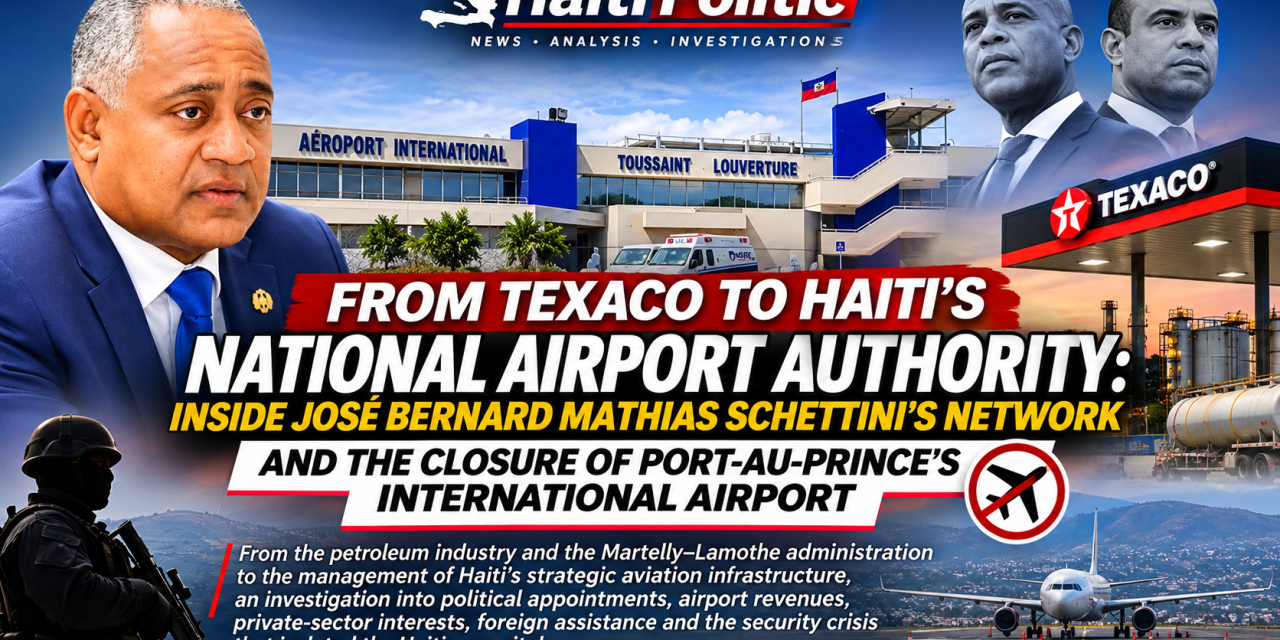
From the petroleum industry and the Martelly–Lamothe administration to the management of Haiti’s strategic aviation infrastructure, an investigation into political appointments, airport revenues, private-sector interests, foreign assistance and the security crisis that isolated the Haitian capital.
HAITI POLITIC | SPECIAL INVESTIGATION | NOVEMBER 28, 2026
INTRODUCTION — WHO CONTROLS HAITI’S GATEWAY TO THE WORLD?
For decades, Toussaint Louverture International Airport has represented more than Haiti’s principal international aviation facility.
It has served as a commercial gateway connecting Haiti to its diaspora, international businesses, humanitarian organizations, diplomatic missions and foreign governments. It is also an important source of public revenue and private-sector economic activity.
Yet despite years of international assistance, infrastructure investments and successive security initiatives, Haiti has struggled to guarantee the safety of its principal international airport.
The closure of Port-au-Prince’s airport in 2024 exposed the consequences of a security crisis that had gradually expanded into the country’s most important economic and strategic institutions.
Against this background, the reported appointment of José Bernard Mathias Schettini to lead the Autorité Aéroportuaire Nationale (AAN) in March 2026 deserves closer examination.
Who is Schettini? What were his responsibilities in the petroleum industry? What positions did he occupy during the Martelly–Lamothe administration? What experience qualifies him to manage Haiti’s national airport infrastructure?
And perhaps most importantly, what relationship exists between his appointment and the government’s strategy for restoring international commercial aviation?
To understand the present airport crisis, it is necessary to examine three interconnected subjects:
-
Schettini’s professional and political background.
-
The financial and institutional structure of Haiti’s airport industry.
-
The security failures that led to the suspension of commercial aviation in Port-au-Prince.
The investigation must distinguish documented professional relationships from speculation concerning political influence or financial interests.
PART I — BACKGROUND INVESTIGATION: WHO IS JOSÉ BERNARD MATHIAS SCHETTINI?
José Bernard Mathias Schettini’s reported professional background places him at the intersection of Haiti’s petroleum industry, industrial infrastructure and public administration.
Previous background research conducted for this dossier identified three principal areas requiring examination.
| Sector | Reported professional connection |
|---|---|
| Petroleum industry | Texaco |
| Industrial development | Société Nationale des Parcs Industriels (SONAPI) |
| Public administration | Martelly–Lamothe administration |
| Aviation infrastructure | Autorité Aéroportuaire Nationale (AAN) |
| International business | Possible commercial connections between Haiti and Florida |
This trajectory is noteworthy because the petroleum, industrial and aviation sectors depend heavily on infrastructure, international financing, government regulation and public-private commercial relationships.
However, important details concerning Schettini’s employment history, academic qualifications, corporate interests and previous administrative responsibilities remain to be documented through original records.
A BACKGROUND CHECK THAT GOES BEYOND A PROFESSIONAL BIOGRAPHY
The management of Haiti’s national airports requires more than a general business background.
A comprehensive public assessment of Schettini’s qualifications should examine his experience in:
-
Aviation management and international safety standards.
-
Public procurement and financial administration.
-
Infrastructure development.
-
Petroleum and energy supply.
-
International commercial negotiations.
-
Airport security coordination.
-
Crisis management.
-
Management of publicly owned assets.
The government should make available his official curriculum vitae, appointment instrument, legally required financial disclosures and professional qualifications relevant to the position.
At present, the available material does not provide a complete, independently authenticated professional history.
PART II — THE TEXACO CONNECTION: FROM PETROLEUM TO STRATEGIC INFRASTRUCTURE
Schettini’s reported professional history with Texaco represents an important starting point.
Petroleum companies occupy a particularly influential position in economies such as Haiti’s, where transportation, electricity production, communications, manufacturing and aviation depend heavily on imported fuel.
A senior professional background in the petroleum sector could potentially provide experience in logistics, commercial operations, procurement and infrastructure management.
However, the exact nature of Schettini’s Texaco responsibilities remains important.
Was he responsible for commercial distribution, financial management, airport fuel operations, government relations or general administration?
When did his employment begin and end?
Did he maintain financial interests or business relationships within the petroleum industry after entering public administration?
These questions are especially relevant because aviation fuel represents one of the commercial activities associated with airport operations.
TEXACO, NATIONAL AND RUBIS: UNDERSTANDING THE DISTINCTIONS
Haiti’s petroleum market has evolved through acquisitions, changes in distribution arrangements and the participation of international energy companies.
The different petroleum brands and operating companies should not be treated as a single corporate entity without documentary evidence.
Previous research identified Distribution Nationale S.A. (DINASA), associated with the National brand and the Rubis group, as a significant participant in Haiti’s fuel distribution and aviation fuel sector.
The relevant question is whether Schettini’s previous petroleum-sector relationships have any connection to current airport commercial agreements.
No evidence presently establishes that he personally owns, controls or receives compensation from any current aviation fuel concession.
That distinction must be maintained throughout the investigation.
PART III — SONAPI AND THE MARTELLY–LAMOTHE ADMINISTRATION
Schettini’s reported association with the Société Nationale des Parcs Industriels, commonly known as SONAPI, introduces another important dimension.
SONAPI occupies a strategic position within Haiti’s industrial development framework.
Its activities involve industrial facilities, infrastructure management, relationships with private-sector enterprises and the country’s manufacturing environment.
During the administration of Michel Martelly and Prime Minister Laurent Lamothe, industrial expansion was presented as an important component of Haiti’s economic development strategy.
The period was characterized by significant involvement from international development institutions, foreign governments and private investors.
Industrial infrastructure and export-oriented manufacturing formed part of the broader effort to attract investment following the January 2010 earthquake.
WHY SONAPI MATTERS TO THE AIRPORT INVESTIGATION
Industrial parks and airports share several administrative characteristics.
Both involve publicly owned infrastructure, private-sector concessionaires, maintenance contracts, commercial rental arrangements, utility services, security obligations and substantial financial transactions.
An official moving from industrial infrastructure management into airport administration could bring relevant administrative experience.
However, the public deserves to examine the measurable outcomes of that previous experience.
What projects did Schettini supervise? What budgets were placed under his authority? Which contracts were awarded during his tenure? Were the accounts independently audited?
Were his previous responsibilities subject to any investigations or administrative proceedings?
These are standard accountability questions for someone entrusted with an important national public institution.
Until the appointment instruments, employment records and financial documentation are obtained, it would be premature to make definitive claims about his exact authority within SONAPI.
PART IV — FROM THE MARTELLY YEARS TO THE FILS-AIMÉ ADMINISTRATION
Schettini’s reported movement from the private sector into public administration during the Martelly–Lamothe period and subsequently into airport leadership raises questions about continuity within Haiti’s administrative establishment.
Successive governments frequently inherit personnel, institutional arrangements, contracts and commercial relationships established by previous administrations.
Such continuity is not inherently improper. Experienced administrators can contribute to institutional stability.
However, continuity without transparency can make it difficult for citizens to determine whether appointments are based on professional qualifications, political relationships or commercial interests.
The following chronology illustrates the broader political environment.
| Period | Political or institutional development |
|---|---|
| January 2010 | Earthquake damages Haiti’s infrastructure and disrupts airport operations. |
| May 2011 | Michel Martelly assumes the presidency. |
| May 2012 | Laurent Lamothe becomes prime minister. |
| 2011–2016 | Industrial development and infrastructure investment remain major government priorities. |
| February 2017 | Jovenel Moïse assumes the presidency. |
| July 2021 | Moïse is assassinated. |
| March 2024 | Armed violence forces the suspension of commercial aviation in Port-au-Prince. |
| May 2024 | Commercial operations partially resume. |
| November 2024 | Gunfire damages commercial aircraft, triggering another airport closure. |
| November 2024 | Alix Didier Fils-Aimé becomes prime minister. |
| March 2026 | Schettini reportedly assumes leadership of AAN. |
| November 2026 | Questions remain concerning airport recovery, financial accountability and commercial aviation. |
The chronology establishes an important distinction: the major airport closures of 2024 preceded Schettini’s reported appointment in 2026.
Consequently, the relevant question is not whether Schettini caused the original closure, but how his administration intends to address its consequences.
PART V — WHO ACTUALLY CONTROLS HAITI’S AIRPORTS?
One of the most important misconceptions surrounding Haiti’s aviation industry is the assumption that a single official or institution controls every aspect of airport operations.
In reality, authority is distributed among several public institutions and private companies.
THE AUTORITÉ AÉROPORTUAIRE NATIONALE
The AAN is responsible for the administration and operation of national airport infrastructure.
Its responsibilities generally concern airport facilities, terminal administration, commercial concessions, infrastructure maintenance and airport-related financial management.
The director general occupies an important administrative position, but does not automatically possess authority over every aspect of civil aviation, immigration, customs, commercial flight authorization or national security.
THE OFFICE NATIONAL DE L’AVIATION CIVILE
The Office National de l’Aviation Civile (OFNAC) is responsible for civil aviation regulation and aviation navigation functions.
Its responsibilities differ from those of the AAN.
International aviation safety involves regulatory assessments, airspace management, aviation certifications and compliance with applicable international standards.
THE OTHER INSTITUTIONS INVOLVED
| Institution | Principal area of responsibility |
|---|---|
| AAN | Airport infrastructure and administration |
| OFNAC | Civil aviation regulation and air navigation |
| MTPTC | Government oversight of the transportation and infrastructure sector |
| PNH | Law enforcement and public security |
| FAd’H | National defense and assigned security responsibilities |
| AGD | Customs administration and import/export controls |
| Immigration authorities | Passenger immigration and border controls |
| Private security and ground-handling companies | Contracted airport services |
| Airlines | Aircraft operations, commercial schedules and operational risk assessments |
| Foreign aviation regulators | Restrictions applicable to operators within their jurisdiction |
The airport’s problems therefore cannot be resolved exclusively through the replacement of an AAN director general.
Airport recovery requires institutional coordination extending beyond the airport administration itself.
PART VI — THE BUSINESS BEHIND HAITI’S AIRPORTS
An international airport is not simply a terminal where passengers board aircraft.
It is an economic ecosystem generating numerous categories of public revenue and private commercial income.
The financial activities associated with Toussaint Louverture International Airport include:
| Revenue or commercial activity | Financial questions |
|---|---|
| Aircraft landing charges | Applicable rates and revenue allocation |
| Passenger-related charges | Collection mechanisms and beneficiaries |
| Aircraft parking fees | Tariffs and payment records |
| Aviation fuel concessions | Suppliers, concession terms and royalties |
| Commercial terminal leases | Rental agreements and beneficiaries |
| Duty-free operations | Operating licenses and commercial payments |
| Ground-handling services | Contract terms and service fees |
| Cargo handling | Revenue collection and private operator arrangements |
| Security services | Procurement contracts and operating expenses |
| Advertising | Concession agreements and annual income |
| Vehicle parking | Management arrangements and revenue collection |
| Maintenance and construction | Contractors, financing and public procurement |
Each category represents a potential source of revenue or expenditure.
However, determining the financial condition of AAN requires access to its audited financial statements, tariff schedules, commercial contracts and government budget records.
A list of airport charges does not establish the amount of revenue actually collected.
Similarly, commercial activity inside a publicly owned airport does not mean that all associated income belongs to AAN.
PART VII — WHO SUPPLIES AVIATION FUEL IN HAITI?
The aviation fuel market represents one of the most commercially important components of airport operations.
Aircraft fuel supply requires specialized equipment, storage infrastructure, logistics, quality-control procedures and compliance with aviation standards.
Previous research identified DINASA, operating within the Rubis corporate network, as a supplier associated with Haiti’s aviation fuel sector.
However, the precise concession arrangements and current contractual relationships require further documentation.
Among the questions requiring answers are whether aviation fuel suppliers pay AAN concession fees, royalties, volume-based charges or facility rentals.
A historical aviation tariff document identified a fuel-related airport charge of approximately US$0.20 per gallon.
The current validity of that rate and the entity entitled to collect it have not been independently established.
For illustration, a charge of $0.20 per gallon would generate the following theoretical annual revenue.
| Annual fuel volume | Hypothetical revenue at $0.20 per gallon |
|---|---|
| 1 million gallons | $200,000 |
| 5 million gallons | $1 million |
| 10 million gallons | $2 million |
| 20 million gallons | $4 million |
| 50 million gallons | $10 million |
These figures are illustrative calculations, not AAN’s actual fuel-related earnings.
The actual financial value depends on fuel volumes, applicable contracts, current tariffs, exemptions and collection records.
DOES SC HETTINI’S TEXACO BACKGROUND CREATE A CONFLICT OF INTEREST?
A professional history in the petroleum industry does not automatically constitute a conflict of interest.
The question becomes relevant if an airport administrator retains financial interests, business relationships or decision-making responsibilities involving petroleum companies benefiting from airport concessions.
Transparency would require disclosure of any such relationships and appropriate procedures to prevent conflicts of interest.
No evidence currently establishes an improper financial arrangement involving Schettini and Haiti’s aviation fuel suppliers.
PART VIII — HAMASERCO AND THE PRIVATE AIRPORT SERVICES INDUSTRY
Another important component of Haiti’s airport economy is the private ground-handling industry.
Previous research identified the Haytian American Aviation Services Company, known as HAMASERCO S.A., as a longstanding private aviation services provider.
The company traces its establishment to January 4, 1971.
Its reported activities involve ground handling, baggage-related services, cargo operations and other aviation support functions.
Such companies occupy important positions within the commercial airport ecosystem.
Nevertheless, private ground-handling services should not be confused with sovereign government responsibilities.
Customs inspections, immigration decisions, civil aviation regulation and public law enforcement remain matters governed by applicable public authority.
The relevant financial questions include:
-
What agreements authorize private companies to operate at national airports?
-
How are operating concessions awarded?
-
What are the applicable fees and financial obligations?
-
Are contracts publicly disclosed?
-
Are services subject to independent performance and financial audits?
No evidence has been obtained establishing a personal financial relationship between Schettini and HAMASERCO.
The company’s relevance arises from its role within the airport industry, not from an established connection to Schettini personally.
PART IX — THE 2010 EARTHQUAKE: DID FOREIGN GOVERNMENTS TAKE CONTROL OF HAITI’S AIRPORT?
Following the devastating earthquake of January 12, 2010, Haiti’s principal airport became essential to the international humanitarian response.
The disaster damaged aviation infrastructure and disrupted Haiti’s capacity to coordinate the enormous volume of incoming humanitarian traffic.
The United States military temporarily assisted with airport operations and air traffic management.
American military personnel helped coordinate flights carrying humanitarian assistance, medical supplies, rescue teams and relief workers.
However, temporary American operational assistance should not be confused with the permanent transfer of airport ownership.
Haiti’s national airport infrastructure remained Haitian public property.
The episode nevertheless demonstrated the country’s vulnerability when its institutions lacked the capacity to independently manage a major national emergency.
The question more than sixteen years later is whether reconstruction investments produced resilient aviation infrastructure capable of operating during security and humanitarian crises.
WHERE DID THE AIRPORT RECONSTRUCTION MONEY GO?
International financial institutions and donor governments have supported various Haitian aviation and transportation infrastructure initiatives.
A comprehensive financial investigation must distinguish among:
-
Announced projects.
-
Approved financing.
-
Signed financing agreements.
-
Actual disbursements.
-
Contracts awarded.
-
Physical construction completed.
-
Equipment installed and functioning.
These categories are frequently confused in public discussions concerning international assistance.
The existence of a multimillion-dollar project does not establish that the full amount was disbursed or that all promised infrastructure was successfully completed.
An independent accounting of Haiti’s airport reconstruction investments since 2010 would help determine which projects strengthened airport resilience and which commitments remain unfinished.
PART X — WHY DID PORT-AU-PRINCE’S INTERNATIONAL AIRPORT CLOSE?
The financial and administrative dimensions of airport management are important.
However, the immediate reason for the major closures in 2024 was neither a petroleum shortage nor an ordinary commercial dispute.
It was the deterioration of Haiti’s security environment and the resulting threat to civil aviation.
The airport could no longer be considered independently from the broader security crisis affecting metropolitan Port-au-Prince.
An airport terminal may remain structurally intact while the surrounding security environment makes commercial flight operations unacceptable to airlines and aviation regulators.
That distinction is central to understanding what happened.
PART XI — MARCH 2024: THE FIRST MAJOR AIRPORT CLOSURE
In early March 2024, Haiti experienced a dramatic escalation in armed violence.
The government struggled to maintain control of strategic infrastructure and restore public security.
Prime Minister Ariel Henry was outside the country during the deterioration of the security situation.
Commercial airline operations were suspended as the risk to civil aviation increased.
The Associated Press documented major armed violence affecting the airport and other important government institutions.
The consequences extended beyond passenger transportation.
International humanitarian operations, commercial imports, business travel and diaspora movements were disrupted.
The humanitarian logistics sector reported that security conditions affected access to essential supplies, fuel and transportation infrastructure.
MAY 2024 — A PARTIAL REOPENING
Commercial aviation gradually resumed in May 2024 following nearly three months of disruption.
However, the reopening did not mean that Haiti’s broader security crisis had been permanently resolved.
The return of commercial flights depended on continued security improvements and airline assessments.
The events of November 2024 would subsequently demonstrate the fragility of that recovery.
PART XII — NOVEMBER 11, 2024: THE SECOND AIRPORT CRISIS
On November 11, 2024, as Haiti entered another phase of political transition, gunfire damaged commercial aircraft operating in Port-au-Prince.
Aircraft operated by Spirit Airlines, American Airlines and JetBlue were affected.
The incidents prompted airline suspensions and renewed restrictions on civil aviation.
The crisis coincided with the installation of Alix Didier Fils-Aimé as prime minister following the departure of Garry Conille.
The Associated Press documented the airport closure and the resulting disruption of airline operations.
The commercial aviation industry consequently faced a security risk that could not be resolved merely through improvements to airport terminal operations.
Airlines had to consider passenger safety, flight crew security, aircraft damage, regulatory compliance, operational liability and insurance obligations.
The result was another major interruption of Haiti’s international connectivity.
PART XIII — THE FAA RESTRICTIONS: DID THE UNITED STATES CLOSE HAITI’S AIRPORT?
On November 12, 2024, the United States Federal Aviation Administration issued a Notice to Air Mission restricting specified aviation operations in Haiti because of the deteriorating security environment.
The original restriction prohibited affected operators from conducting flights below 10,000 feet within the designated territory and airspace.
Its application covered U.S. commercial operators and other qualifying aviation operations under American regulatory jurisdiction.
However, this decision must be properly understood.
The FAA did not acquire ownership of Haiti’s airport.
Nor did it replace Haiti’s civil aviation institutions.
It exercised its authority to restrict aviation operations subject to United States regulation.
The Haitian government could announce the reopening of its airport, but it could not independently compel American airlines to resume flights in violation of FAA restrictions.
THREE DIFFERENT DECISIONS
| Decision | Responsible authority |
|---|---|
| Administrative reopening of the airport | Haitian authorities |
| Restrictions on American aviation operations | FAA |
| Commercial service resumption | Airlines, subject to regulatory requirements and risk assessments |
This distinction explains why an airport may be officially reopened without recovering its previous commercial flight schedules.
PART XIV — DECEMBER 2024: THE AIRPORT REOPENED, BUT WHERE WERE THE AIRLINES?
On December 11, 2024, Haitian authorities announced the reopening of Toussaint Louverture International Airport.
The government presented improvements in security as part of an effort to restore economic activity.
However, the FAA simultaneously extended restrictions affecting commercial aviation in Port-au-Prince.
Reuters documented the reopening announcement and the continued American flight restrictions.
The situation demonstrated an important reality.
An officially reopened airport is not necessarily an operationally viable international commercial airport.
The return of regular commercial traffic requires confidence from carriers, aviation regulators, insurers and passengers.
Government announcements alone cannot create that confidence.
PART XV — THE ECONOMIC COST OF AN AIRPORT WITHOUT REGULAR INTERNATIONAL TRAFFIC
The consequences of reduced aviation activity extend throughout Haiti’s economy.
For the diaspora, the loss of direct international connectivity can increase travel costs and create substantial logistical difficulties.
For businesses, it complicates international travel, trade relationships and cargo transportation.
For hotels, restaurants, transportation companies, travel agencies and airport-service providers, reduced passenger traffic can undermine commercial income and employment.
For AAN itself, lower aviation activity potentially reduces several categories of operating revenue.
HOW MUCH MONEY COULD THE AIRPORT LOSE?
Without independently audited financial statements, it is impossible to establish the exact revenue lost by AAN following the closures.
However, hypothetical passenger-related revenue scenarios illustrate the size of the financial exposure.
| Annual passenger volume lost | Assumed net revenue per passenger | Illustrative annual revenue loss |
|---|---|---|
| 250,000 | $25 | $6.25 million |
| 500,000 | $25 | $12.5 million |
| 750,000 | $25 | $18.75 million |
| 1 million | $25 | $25 million |
| 1 million | $50 | $50 million |
These figures are not verified estimates of AAN’s losses. They demonstrate how revenue depends on passenger volumes and the amount of each passenger-related charge actually retained by the airport authority.
They also exclude several other possible losses, including landing fees, concessions, commercial leases, parking, advertising and aviation-related services.
The government should publish the actual figures rather than leave the population dependent on hypothetical calculations.
PART XVI — CAP-HAÏTIEN: A SHIFT IN HAITI’S AVIATION ECONOMY
The disruption of commercial aviation in Port-au-Prince increased the strategic importance of Cap-Haïtien International Airport.
As restrictions evolved, aviation operations in northern Haiti were treated differently from those in the capital.
Commercial and humanitarian travelers increasingly depended on alternative transportation arrangements.
This raises another economic question.
When passengers and services shift from Port-au-Prince to Cap-Haïtien, how are airport revenues, commercial opportunities and infrastructure investments redistributed?
Do existing fuel suppliers and ground-handling companies benefit from changes in passenger and aircraft activity?
Are new commercial concessions being awarded?
Are additional transportation services emerging to connect passengers with other regions of Haiti?
These are legitimate matters for public financial oversight.
However, the movement of aviation activity toward Cap-Haïtien does not independently establish that any company or official deliberately sought the closure of Port-au-Prince’s airport.
PART XVII — LES CAYES AND THE DEVELOPMENT OF ALTERNATIVE AIRPORT INFRASTRUCTURE
Haiti’s efforts to strengthen regional aviation infrastructure have also included projects involving Antoine-Simon Airport in Les Cayes.
Previous research identified Inter-American Development Bank financing initiatives involving airport development and transportation connectivity in southern Haiti.
These included a reported $70 million program framework and a separate reported $69 million grant involving Les Cayes airport and related transportation infrastructure.
Those figures should not automatically be added together as distinct expenditures without reviewing the project and financing agreements for possible overlap.
They also should not be interpreted as funds already fully disbursed.
The development of alternative airports may improve Haiti’s transportation resilience and reduce excessive dependence on the capital.
Nevertheless, regional airport development cannot substitute for the restoration of security in Port-au-Prince.
Nor should airport development contracts escape the same transparency requirements applicable to other publicly financed infrastructure.
PART XVIII — FOREIGN SECURITY MISSIONS AND THE AIRPORT QUESTION
Since 2024, Haiti’s international security assistance has been presented as an important component of efforts to restore public order.
The initial Kenya-led Multinational Security Support mission and subsequent international security arrangements have raised substantial expectations concerning the restoration of Haiti’s strategic infrastructure.
The country’s airports, seaports, transportation networks and government facilities represent important indicators of institutional recovery.
However, the effectiveness of a security mission cannot be measured exclusively through the number of personnel deployed, equipment delivered or operations announced.
The public should also be able to evaluate measurable civilian outcomes.
For the aviation sector, those outcomes include the safe movement of passengers, reliable commercial flights, regulatory confidence, operational continuity and the restoration of economic activity.
The relevant question for the government and its international partners is straightforward:
What measurable improvements in aviation security have resulted from the international security assistance provided to Haiti?
If commercial aviation remains restricted, the authorities should explain the remaining regulatory and security obstacles and identify the conditions necessary for sustained recovery.
PART XIX — WHAT IS JOSÉ BERNARD MATHIAS SCHETTINI’S MANDATE?
Schettini’s reported appointment in March 2026 places him in an institution confronting significant financial, administrative and operational challenges.
His responsibilities must be understood within the limits of AAN’s legal authority.
He cannot independently eliminate the country’s armed violence, remove restrictions imposed by foreign regulators or compel airlines to resume service.
Nevertheless, his administration can potentially contribute to recovery through transparent airport management, infrastructure improvements, commercial negotiations, regulatory coordination and financial accountability.
The government should establish publicly identifiable performance objectives for AAN leadership.
| Performance area | Public accountability indicator |
|---|---|
| Financial management | Publication of independently audited annual accounts |
| Commercial aviation | Verified passenger and aircraft movement statistics |
| Infrastructure | Public reporting on completed projects |
| Procurement | Disclosure of contract awards and expenditures |
| Airport security | Publication of appropriate non-sensitive compliance assessments |
| Commercial concessions | Transparent records of agreements and revenues |
| International coordination | Documented engagement with aviation authorities and carriers |
| Institutional recovery | Progress reports against defined reopening objectives |
These indicators would provide a stronger basis for evaluating Schettini’s administration than political statements or professional affiliations alone.
PART XX — THE FLORIDA BUSINESS CONNECTION: WHAT HAS ACTUALLY BEEN VERIFIED?
Previous background research also explored possible connections between José Bernard Mathias Schettini and business or property records in Florida.
Such research can be relevant when examining the financial disclosures and potential conflicts of interest of officials responsible for strategic public assets.
However, the appearance of a similar name in an American business directory or property database does not establish identity or ownership.
A reliable investigation requires matching corporate registration records, ownership documents and other legally available identifying information.
At present, the available material does not establish a verified portfolio of Florida businesses or real estate attributable to Schettini.
It would therefore be inappropriate to assign him ownership of specific properties, companies or financial assets without corroborating records.
The relevant institutional issue is whether public officials responsible for major government assets comply with applicable financial disclosure and conflict-of-interest requirements.
PART XXI — WHO BENEFITS FINANCIALLY FROM HAITI’S AIRPORT INDUSTRY?
The answer cannot be obtained simply by identifying the director general of AAN.
Airport-related economic activity involves numerous participants.
| Participant | Potential source of income |
|---|---|
| AAN | Airport fees, rental income and concession revenue |
| OFNAC | Applicable regulatory and aviation-related charges |
| Fuel suppliers | Aviation fuel sales |
| Ground-handling companies | Contracted aviation services |
| Construction companies | Infrastructure and maintenance contracts |
| Security contractors | Contracted security services |
| Commercial tenants | Retail and hospitality activity |
| Airlines | Ticket sales and cargo transportation |
| Transportation companies | Passenger and commercial transport |
| Financial institutions | Financing and transaction services |
The financial participation of these entities is not inherently improper.
The question is whether commercial arrangements are transparent, fairly awarded, properly audited and consistent with the public interest.
A complete accounting would require the publication of revenue distribution arrangements throughout the aviation sector.
Until those records are available, it is impossible to determine precisely who receives how much money from Haiti’s airport operations.
PART XXII — TWENTY QUESTIONS FOR JOSÉ BERNARD MATHIAS SCHETTINI AND THE HAITIAN GOVERNMENT
-
What were Schettini’s exact responsibilities and dates of employment with Texaco?
-
Did his petroleum-industry responsibilities include aviation fuel operations?
-
What positions did he occupy within SONAPI during the Martelly–Lamothe administration?
-
What were the measurable accomplishments of his previous public-sector responsibilities?
-
What qualifications in aviation administration supported his appointment to AAN?
-
What official appointment instrument established his mandate?
-
Has he submitted the financial disclosures legally required for his position?
-
Does he retain any commercial interests in the petroleum, aviation or industrial sectors?
-
What was AAN’s total operating revenue during the last complete fiscal year before the 2024 closures?
-
What were AAN’s operating revenues in fiscal years 2024, 2025 and 2026?
-
How much revenue has AAN lost as a result of reduced commercial aviation in Port-au-Prince?
-
What companies currently hold aviation fuel concessions at Haiti’s airports?
-
What fees and royalties are collected from aviation fuel suppliers?
-
What companies hold ground-handling, cargo, security and commercial operating agreements?
-
Have those agreements been independently audited?
-
How much international financing has Haiti received for airport infrastructure since January 2010?
-
Which airport reconstruction and modernization projects have actually been completed?
-
What measurable progress has been made toward satisfying international aviation safety requirements?
-
What is the government’s implementation timetable for restoring sustained commercial aviation in Port-au-Prince?
-
Will AAN publish its audited accounts, procurement contracts, commercial concessions and performance statistics so that Haitian citizens can independently evaluate its administration?
CONCLUSION — HAITI’S AIRPORT CRISIS IS BIGGER THAN ONE DIRECTOR GENERAL
José Bernard Mathias Schettini’s reported professional trajectory from the petroleum industry and industrial infrastructure to Haiti’s National Airport Authority deserves examination.
His previous experience could potentially bring useful administrative and commercial knowledge to the aviation sector.
However, experience must be accompanied by transparency, institutional accountability and measurable results.
The airport crisis itself cannot be attributed to Schettini’s appointment because the major closures occurred approximately two years before he reportedly assumed leadership of AAN.
The immediate causes of those closures are documented: escalating armed violence, threats to civil aviation, damage to commercial aircraft, airline suspensions and restrictions imposed by aviation regulators.
The deeper institutional questions concern Haiti’s inability to consistently protect its strategic infrastructure, maintain investor confidence and sustain essential public services.
Since the 2010 earthquake, Haiti has received substantial international assistance for reconstruction, infrastructure and institutional development.
Successive governments have promised economic modernization, security improvements and stronger public institutions.
Yet the country has struggled to maintain reliable international commercial connectivity through its capital.
Haiti must therefore examine not only who manages its airport but also how the airport is financed, who receives its commercial revenues, which companies hold operating concessions, how infrastructure contracts are awarded and what results have been achieved.
A secure runway, a functioning terminal, transparent finances and an effective national aviation authority are all necessary.
But lasting recovery also requires a functioning justice system, a capable national police force, accountable political leadership and the restoration of state authority.
Haiti’s airport crisis is ultimately a test of the country’s institutional sovereignty: can the Haitian state safely administer, finance and protect its own gateway to the world?
The answer must be demonstrated through results, not merely through appointments, public ceremonies or reopening announcements.
HAITI POLITIC — SPECIAL INVESTIGATION
Editorial note: This investigation distinguishes verified aviation incidents and regulatory decisions from preliminary background information concerning José Bernard Mathias Schettini. Professional affiliations do not establish corruption, conflicts of interest or criminal wrongdoing. No evidence reviewed establishes that Schettini caused the airport closures, personally benefits from aviation concessions or participated in an arrangement to redirect commercial aviation away from Port-au-Prince. Financial projections presented in this article are illustrative and are not audited revenue figures.