🇭🇹 HAITI POLITIC | ELECTORAL TRANSPARENCY
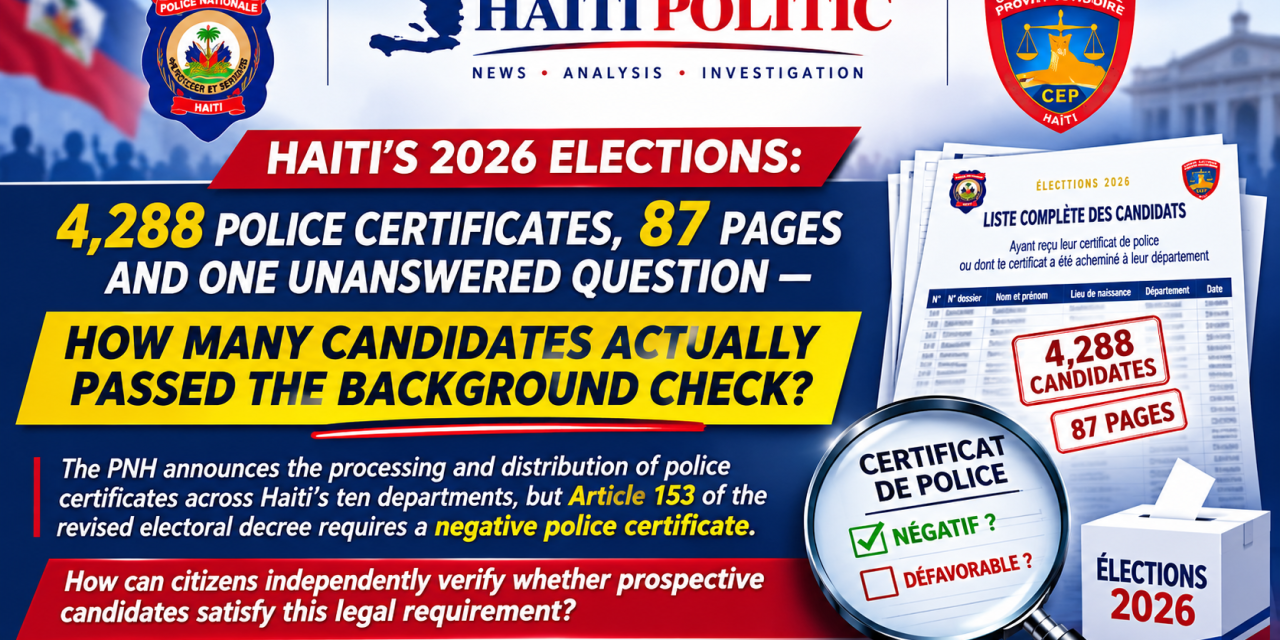
The PNH announces the processing and distribution of police certificates across Haiti’s ten departments, but Article 153 of the revised electoral decree requires a negative police certificate. How can citizens independently verify whether prospective candidates satisfy this legal requirement?
HAITI POLITIC | SPECIAL INVESTIGATION & ELECTORAL LAW ANALYSIS
November 27, 2026
On Friday, November 27, 2026, the Police Nationale d’Haïti (PNH), through its Directorate of Communications, published a significant announcement concerning the preparation of candidates for Haiti’s upcoming elections.
The announcement was accompanied by an 87-page document identifying 4,288 prospective candidates across the country’s ten geographical departments who had received their police certificates or whose certificates had been forwarded to their respective departments.
The publication represents an important administrative development in Haiti’s electoral process.
However, when examined against the revised electoral decree of October 6, 2026, it raises a fundamental question about electoral transparency:
How many of these 4,288 individuals actually received a negative police certificate, as required by Article 153 of the electoral decree?
The PNH has published the names of applicants, their dossier numbers, places of birth, departments and dates.
It has not disclosed whether the certificates satisfy the substantive requirements established by the electoral decree.
The distinction between issuing a certificate and establishing electoral eligibility deserves careful examination.
1. WHAT EXACTLY DID THE PNH ANNOUNCE?
The document published by the PNH carries the following French title:
« Liste complète des candidats ayant reçu leur certificat de police ou dont le certificat a été acheminé à leur département. »
The title translates into English as:
Complete list of candidates who have received their police certificate or whose certificate has been forwarded to their department.
According to the announcement and accompanying documents:
| Information | Published figures |
|---|---|
| Prospective candidates listed | 4,288 |
| Geographical departments | 10 |
| Document length | 87 pages |
| Artibonite candidates | 340 |
| Artibonite share of national total | 7.93% |
| Beginning of dossier registration period | September 10, 2026 |
| End of dossier registration period | November 26, 2026 |
| Publication date | November 27, 2026 |
| Number of negative certificates | Not disclosed |
| Number of certificates containing unfavorable findings | Not disclosed |
| Number of approved electoral candidates | Not established |
The PNH also encouraged applicants whose documents were previously announced as available to collect them at the DCPJ offices in Clercine, Tabarre.
The immediate purpose of the announcement appears to be informing applicants about the progress and distribution of their documents.
However, the announcement does not expressly certify that all 4,288 individuals have satisfied the negative police certificate requirement.
2. THE LEGAL FRAMEWORK: THE ELECTORAL DECREE OF OCTOBER 6, 2026
Haiti’s current electoral framework is principally governed by:
-
The 1987 Constitution, as amended.
-
The electoral decree of June 2, 2026.
-
The modifying decree of July 2, 2026.
-
The revised electoral decree of October 6, 2026, published in Le Moniteur, Special Issue No. 50.
The October 6 revision reorganized several electoral requirements, including the documentation prospective candidates must provide.
Article 153 identifies 22 principal categories of documents required for candidacy, with certain requirements depending on the office sought and the applicant’s previous governmental, professional or financial responsibilities.
The three requirements most directly relevant to the PNH’s announcement are found in paragraphs 6, 7 and 8 of Article 153.
3. ARTICLE 153.6: THE CRIMINAL RECORD CERTIFICATE
Article 153, paragraph 6, requires a certificat de casier judiciaire issued by the registry of the Court of First Instance serving the candidate’s domicile.
The document must be less than six months old and attest that the candidate has not been sentenced to the legally specified categories of criminal punishment.
This requirement concerns judicial records and is distinct from the police certificate issued by the DCPJ.
Among the relevant questions are whether the certificate is authentic, current, associated with the correct individual and consistent with the applicable judicial records.
A judicial certificate should not be confused with a general declaration that a person has never been investigated or accused of wrongdoing.
4. ARTICLE 153.7: THE SWORN DECLARATION
Paragraph 7 requires an attestation sur l’honneur, signed before a notary, affirming the absence of the specified criminal sentences.
This document constitutes a formal declaration by the prospective candidate.
However, notarizing a declaration does not independently establish that every assertion contained in it is factually accurate.
The CEP must therefore have a reliable procedure for evaluating the declaration alongside the other documents submitted by the candidate.
5. ARTICLE 153.8: THE NEGATIVE POLICE CERTIFICATE
This provision is particularly important in light of the November 27 PNH announcement.
Article 153, paragraph 8, expressly requires:
« Un certificat de police négatif délivré par la Direction Centrale de la Police Judiciaire (DCPJ). »
In English:
A negative police certificate issued by the Central Directorate of the Judicial Police.
The operative word is negative.
The electoral decree does not merely require evidence that an applicant requested a certificate, obtained an appointment, received a dossier number or collected a document.
It requires a negative police certificate.
The legal requirement therefore raises a substantive question that cannot be answered simply by publishing a list of processed certificates.
6. THREE DIFFERENT DOCUMENTS SERVING THREE DIFFERENT LEGAL PURPOSES
| Electoral provision | Required document | Issuing authority |
|---|---|---|
| Article 153.6 | Criminal record certificate | Court of First Instance |
| Article 153.7 | Sworn declaration concerning criminal sentences | Candidate, before a notary |
| Article 153.8 | Negative police certificate | DCPJ |
These three documents constitute separate elements of the electoral verification process.
Receiving one does not automatically establish compliance with the other two.
A complete evaluation of a candidate’s legal qualifications therefore requires more than confirming that a police certificate was processed.
7. WHAT DOES THE WORD “NEGATIVE” ACTUALLY MEAN?
In the context of police background verification, a negative finding generally indicates that the relevant search did not identify information that would result in an unfavorable certificate under the applicable criteria.
However, the significance of such a finding depends on the databases consulted, the verification procedures used and the legal standards applied.
The November 27 PNH announcement does not explain:
-
Which police databases were consulted.
-
Whether judicial records from all ten departments were searched.
-
Whether foreign criminal records were considered.
-
Whether international arrest warrants were examined.
-
How individuals with similar names were distinguished.
-
How pending criminal investigations were treated.
-
Whether outstanding Haitian arrest warrants affect certificate issuance.
-
How errors or incomplete records can be corrected.
A negative certificate should not automatically be interpreted as proof that someone has never been accused, investigated, arrested or involved in litigation.
Similarly, a pending investigation or accusation should not automatically be interpreted as proof of criminal guilt.
The DCPJ should explain the precise legal and administrative meaning of its negative certificate within the electoral process.
8. WHAT THE PNH PUBLISHED — AND WHAT REMAINS UNKNOWN
The Artibonite section illustrates the limitations of the published information.
The department accounts for 340 names distributed across seven pages of the national document.
Each entry contains six categories of information.
| Information | Disclosed by the PNH |
|---|---|
| Sequential number | Yes |
| Dossier number | Yes |
| Candidate’s name | Yes |
| Place of birth | Yes |
| Department | Yes |
| Date | Yes |
| Certificate result | No |
| Negative certificate confirmed | No |
| Certificate authentication | No |
| Scope of background verification | No |
| Political affiliation | No |
| Elected office sought | No |
| Final electoral eligibility | No |
The document also does not clearly define the meaning of the date assigned to each entry.
Is it the date the application was registered, the date the background investigation was completed, the date the certificate was issued or the date it was distributed?
These are different administrative events.
Most importantly, the population cannot determine from the published table whether any specific individual has satisfied Article 153.8.
9. THE 4,288 PNH RECORDS VERSUS THE CEP’S 2,423 NATIONAL CANDIDATE REGISTRATIONS
Another important question emerges when the PNH’s announcement is compared with the CEP’s registration statistics.
According to the CEP, the online registration period for presidential and legislative candidates ended on November 15, 2026, with the following figures:
| Office sought | Online registrations |
|---|---|
| President | 33 |
| Senate | 535 |
| Chamber of Deputies | 1,855 |
| Total | 2,423 |
The CEP indicated that the submission of supporting documents would continue through November 30, 2026. Registration for territorial government positions was also continuing through that date.
The PNH subsequently announced 4,288 prospective candidates whose certificates had been received or forwarded.
| Institution | Reported figure |
|---|---|
| PNH/DCPJ certificate list | 4,288 |
| CEP presidential and legislative online registrations | 2,423 |
| Numerical difference | 1,865 |
The difference of 1,865 does not necessarily establish an administrative irregularity.
The two institutions may be counting different populations at different stages of the process. The PNH records may include applicants for local government positions, people who ultimately did not complete their candidacy or other differences in administrative coverage.
However, a reconciliation between the two databases would help the population understand exactly who is being counted.
The PNH and CEP could clarify how many of the 4,288 individuals are presidential, senatorial, legislative or territorial government applicants.
10. DOES APPEARING ON THE PNH LIST MEAN A CANDIDATE IS ELIGIBLE?
No.
The PNH publication concerns one component of the broader electoral process.
At least seven distinct administrative and legal stages must be distinguished.
| Stage | Meaning |
|---|---|
| 1. Police certificate application | An individual requests a certificate |
| 2. DCPJ dossier registration | The application receives an administrative reference |
| 3. Police certificate issuance | The DCPJ produces a document |
| 4. Negative certificate verification | Compliance with Article 153.8 is established |
| 5. Candidate dossier submission | Documents are submitted to the electoral authorities |
| 6. Preliminary eligibility review | The candidate’s qualifications are examined |
| 7. Final eligibility determination | The candidacy is accepted following applicable procedures |
The PNH has not announced that all 4,288 individuals have completed these seven stages.
Nor has it announced that they are all authorized to appear on the electoral ballot.
The list contains prospective candidates at a particular stage of administrative processing.
It is not equivalent to a final electoral candidate list.
11. WHY THE CEP CANNOT RELY EXCLUSIVELY ON THE PNH LIST
Article 191 of Haiti’s Constitution establishes the electoral council’s responsibility for independently organizing and controlling electoral operations.
The DCPJ has responsibility for police verification and the issuance of certificates.
The electoral authorities have responsibility for determining whether candidates meet the applicable electoral requirements.
These institutional responsibilities are complementary.
The CEP should be able to verify each police certificate directly against the DCPJ’s original records rather than relying exclusively on documents submitted by prospective candidates.
Such verification could establish whether:
-
The certificate was genuinely issued by the DCPJ.
-
Its reference number corresponds to the candidate.
-
Its contents have not been altered.
-
It satisfies Article 153.8.
-
Its findings are consistent with other required documentation.
-
Any discrepancy has been resolved through an appropriate review procedure.
A candidate’s name appearing on the PNH list does not substitute for these verification procedures.
12. WHAT ABOUT CANDIDATES WHO HAVE LIVED ABROAD?
Haiti’s electoral process includes individuals who may have lived, studied, worked, invested or conducted business outside the country.
Consequently, the geographical scope of police background verification is a matter of public interest.
| Potential background information | Coverage disclosed in the PNH announcement |
|---|---|
| Haitian police records | Methodology not specified |
| Haitian judicial records | Methodology not specified |
| United States criminal records | Not established |
| Canadian criminal records | Not established |
| Dominican Republic criminal records | Not established |
| European criminal records | Not established |
| International arrest warrants | Not established |
| INTERPOL records | Not established |
| Foreign administrative sanctions | Not established |
The PNH has not explained whether its investigation extends beyond Haitian police databases.
This does not establish that the institution failed to examine international information. It establishes only that the methodology has not been disclosed in the published material.
International sanctions, visa restrictions, criminal convictions and arrest warrants also represent distinct legal categories.
They must be evaluated under the applicable electoral provisions rather than treated as interchangeable grounds for disqualification.
13. CAN THE PUBLIC INDEPENDENTLY VERIFY THE CERTIFICATES?
Based on the November 27 publication, the answer is no.
The public can verify whether a particular name and dossier number appear on the published list.
But this is not the same as independently authenticating the certificate or determining its result.
Three separate levels of verification must be distinguished:
| Verification level | Question | Answered by the PNH list? |
|---|---|---|
| Administrative verification | Does the applicant appear in the published records? | Yes |
| Document authentication | Is the actual certificate genuine? | No |
| Legal compliance | Does the certificate satisfy Article 153.8? | No |
The publication therefore represents a useful administrative disclosure, but an incomplete mechanism for public verification of electoral qualifications.
14. THE RISK OF FRAUDULENT OR INACCURATE DOCUMENTATION
Any electoral process involving thousands of individual documents must have procedures to identify and correct potential irregularities.
These could include forged certificates, altered documents, mismatched identities, inaccurate declarations or administrative errors.
This is not an allegation that any of the 4,288 listed individuals submitted fraudulent documentation.
Rather, it is a reason to establish a uniform authentication system that applies equally to every prospective candidate.
A direct electronic verification mechanism between the CEP and DCPJ could reduce opportunities for document fraud while protecting candidates against erroneous records and mistaken identities.
15. WHAT THE PNH AND CEP COULD PUBLISH WITHOUT VIOLATING CANDIDATES’ PRIVACY
Electoral transparency does not necessarily require the publication of complete police investigation files.
Candidates also have legitimate rights to privacy, due process and the presumption of innocence.
A public compliance database could balance these interests by confirming whether specific legal requirements have been authenticated.
An illustrative candidate record could appear as follows:
| Verification category | Illustrative status |
|---|---|
| Candidate | Candidate A |
| Political organization | Party A |
| Position sought | Senate |
| Department | Artibonite |
| Article 153.6 — Judicial certificate | Authenticated |
| Article 153.7 — Sworn declaration | Received and verified |
| Article 153.8 — Negative police certificate | Requirement satisfied |
| Other applicable documents | Under review |
| Electoral eligibility | Pending |
| Date of last verification | November 27, 2026 |
This is a hypothetical example, not an actual candidate record.
Such a system would allow citizens to evaluate whether candidates satisfy electoral requirements without publishing sensitive police files, fingerprints, confidential investigative information or private identification numbers.
It could also provide a standardized verification procedure that treats all candidates equally.
16. WHAT A SECURE ELECTORAL VERIFICATION SYSTEM COULD LOOK LIKE
Several mechanisms could support greater administrative reliability and public confidence:
| Proposed mechanism | Purpose |
|---|---|
| Secure certificate reference number | Confirm authenticity |
| QR code linked to an official government portal | Prevent document substitution |
| Direct DCPJ-to-CEP verification | Authenticate police certificates |
| Public candidate compliance database | Identify whether requirements are satisfied |
| Standardized verification criteria | Ensure consistent treatment |
| Formal correction procedure | Resolve inaccurate records |
| Electoral challenge procedure | Allow legally authorized objections |
| Independent administrative audit | Evaluate the integrity of the verification process |
These are proposed transparency measures, not existing obligations explicitly established by Article 153.
The electoral decree requires candidates to provide specific documents. Whether and how individual compliance results must be made public is a separate legal and administrative question.
17. FIFTEEN QUESTIONS FOR THE PNH AND DCPJ
The November 27 announcement presents an opportunity for the PNH to provide additional clarification.
-
How many of the 4,288 individuals received a negative police certificate?
-
Does appearing on the published list necessarily mean that the certificate issued was negative?
-
Were any certificates issued containing unfavorable findings?
-
What precise criteria does the DCPJ use to determine whether a police certificate is negative?
-
What police databases were consulted?
-
Were judicial records from all ten geographical departments examined?
-
Were outstanding arrest warrants considered?
-
Does the DCPJ examine relevant foreign criminal convictions?
-
Does the verification process include relevant INTERPOL notices?
-
How are pending criminal investigations treated?
-
Can citizens authenticate certificates using the published dossier numbers?
-
Does the date shown in the table represent registration, issuance or distribution?
-
Does the DCPJ transmit authenticated certificate results directly to the CEP?
-
How many applications remain pending, incomplete or unresolved?
-
What procedure is available to correct an erroneous or potentially fraudulent certificate?
Clarifying these questions would strengthen public understanding of what the PNH’s publication establishes.
18. TEN QUESTIONS FOR THE CONSEIL ÉLECTORAL PROVISOIRE
The CEP must also explain how the police certificate requirement will be incorporated into its broader eligibility review.
-
Will every police certificate be independently authenticated with the DCPJ?
-
How will the CEP verify compliance with Article 153, paragraphs 6, 7 and 8?
-
What happens when a judicial certificate contradicts a sworn declaration or police certificate?
-
How will false declarations or altered documents be investigated?
-
Will the CEP reconcile its candidate registration database with the PNH’s 4,288 records?
-
Will the preliminary candidate list indicate whether applicable documentary requirements have been satisfied?
-
What mechanisms will allow citizens or other legally authorized parties to challenge a candidate’s qualifications?
-
What procedures will protect candidates against false accusations and inaccurate police records?
-
How will foreign criminal records be evaluated under the applicable electoral provisions?
-
Will the CEP publish legally permissible explanations for candidate acceptance or rejection?
These questions concern the implementation of the electoral decree and the transparency of the institutions responsible for its application.
19. ADMINISTRATIVE TRANSPARENCY IS NOT THE SAME AS ELECTORAL TRANSPARENCY
The PNH deserves recognition for making information concerning the processing of police certificates available.
The publication allows applicants to determine whether they appear in the announced records and provides the population with aggregate information about administrative progress.
However, electoral transparency requires a broader framework.
| Administrative transparency | Substantive electoral transparency |
|---|---|
| Number of applications processed | Number satisfying the applicable requirements |
| Publication of names | Authentication of candidate qualifications |
| Publication of dossier numbers | Reliable verification mechanism |
| Distribution of certificates | Confirmation of documentary compliance |
| Administrative processing statistics | Legally supported eligibility decisions |
Publishing names is an important first step.
Establishing the authenticity and legal sufficiency of the documents is the next.
20. WHAT HAS THE INVESTIGATION ESTABLISHED?
Based on the November 27 PNH announcement and the existing electoral framework, Haiti Politic identifies the following findings:
First: The PNH announced that 4,288 prospective candidates had received police certificates or that their certificates had been forwarded to their respective departments.
Second: The accompanying document covers Haiti’s ten geographical departments and contains 87 pages, according to its pagination.
Third: Artibonite accounts for 340 applicants, approximately 7.93% of the announced national total.
Fourth: Article 153.8 of the revised electoral decree specifically requires a negative police certificate issued by the DCPJ.
Fifth: The published tables do not disclose the individual certificate results.
Sixth: The public cannot independently determine from those tables whether a particular applicant satisfies Article 153.8.
Seventh: The criminal record certificate, sworn declaration and negative police certificate are separate documentary requirements.
Eighth: The methodology and geographical scope of the DCPJ’s background verification have not been established through the announcement.
Ninth: The numerical difference between the PNH certificate records and the CEP’s presidential and legislative registration figures requires contextual clarification, not an automatic conclusion of irregularity.
Tenth: Appearing on the PNH list does not constitute final electoral approval.
CONCLUSION: FROM 4,288 NAMES TO VERIFIABLE ELECTORAL QUALIFICATIONS
Haiti’s electoral process requires more than political registration, administrative paperwork and the publication of candidate names.
It requires a credible system for determining whether prospective candidates satisfy the requirements established by the Constitution and the electoral decree.
The November 27 PNH announcement represents progress in communicating the availability of police certificates.
However, Article 153.8 establishes a specific substantive requirement: a negative police certificate.
The distinction matters because citizens cannot assess compliance with that requirement simply by reviewing a list of names and dossier numbers.
The relevant institutions should therefore clarify whether the certificates satisfy the applicable electoral requirement and how their authenticity will be verified.
This can be accomplished without compromising confidential police investigations or violating candidates’ rights.
The same standards should apply to every candidate, regardless of political affiliation, financial resources, governmental experience or international connections.
The fundamental questions remain:
How many of the 4,288 certificates are negative?
How can the public independently verify their authenticity?
How will the CEP confirm compliance with Article 153?
And what safeguards will prevent inaccurate or fraudulent documentation from entering the electoral process?
A police certificate issued is not necessarily proof of a negative finding.
A police certificate received is not necessarily an authenticated electoral qualification.
And a name appearing on a PNH list is not equivalent to an officially approved electoral candidacy.
The credibility of an electoral process depends not only on how many documents are issued, but also on how consistently, accurately and transparently the legal requirements are verified.
HAITI POLITIC
Independent Journalism | Electoral Transparency | Legal Accountability | National Sovereignty
Inform. Analyze. Verify. Demand Accountability.