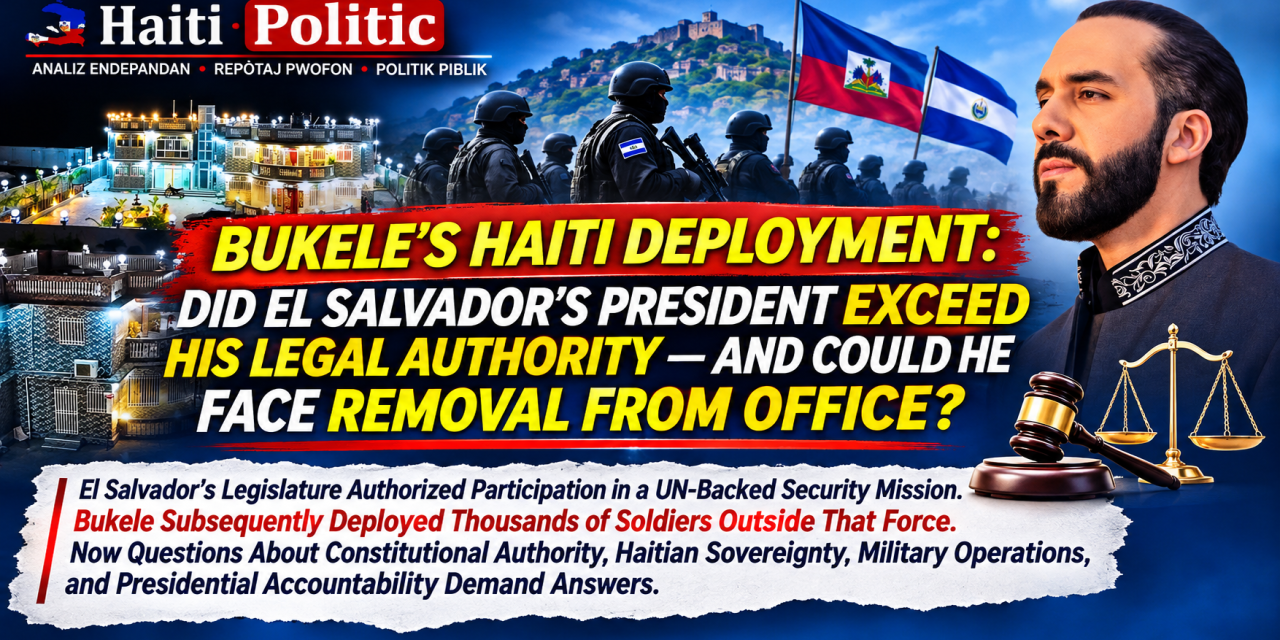
El Salvador’s Legislature Authorized Participation in a UN-Backed Security Mission. Bukele Subsequently Deployed Thousands of Soldiers Outside That Force. Now Questions About Constitutional Authority, Haitian Sovereignty, Military Operations, and Presidential Accountability Demand Answers.
HAITI POLITIC | SPECIAL LEGAL INVESTIGATION
November 10, 2026
International Law | Constitutional Law | Haiti | El Salvador | Military Intervention | Presidential Accountability
THE LEGAL QUESTION BEHIND BUKELE’S MILITARY INTERVENTION IN HAITI
President Nayib Bukele’s expanding military intervention in Haiti has created a constitutional and international legal controversy that extends far beyond the fight against armed gangs.
At the center of the dispute is a fundamental question:
Did El Salvador’s president deploy thousands of soldiers to Haiti under legal authority granted by his country’s legislature, or did he expand the operation beyond the limits of that authorization?
On September 29, 2026, El Salvador’s Legislative Assembly approved a special law authorizing the country’s armed forces to participate in Haiti’s Gang Suppression Force (GSF).
The legislation was approved by 57 votes and established a framework for Salvadoran participation in the international security mission.
However, within weeks, Bukele substantially expanded El Salvador’s military presence in Haiti.
By November 10, Associated Press reporting indicated that at least 2,500 Salvadoran military personnel were operating in the country.
The United Nations subsequently clarified that most of the newly deployed Salvadoran forces were not part of the UN-authorized GSF.
Instead, those troops were operating under a separate arrangement between Haiti and El Salvador.
This distinction creates a potentially significant legal issue.
The Salvadoran legislature authorized participation in a particular international security mission.
But the president subsequently deployed a much larger military force operating outside that mission’s command structure.
Does the original law authorize both deployments?
If not, what additional legal authority permits the independent operation?
And if the president exceeded his constitutional or statutory authority, what legal consequences could follow?
To answer these questions, Haiti Politic examines Salvadoran constitutional law, the September 2026 legislation, international law, and the mechanisms for presidential accountability.
I. WHAT EXACTLY DID EL SALVADOR’S LEGISLATURE AUTHORIZE?
On September 29, 2026, El Salvador’s Legislative Assembly approved the:
Ley Especial Transitoria para la Participación de la Fuerza Armada de El Salvador en la Fuerza de Supresión de Pandillas (GSF) en Haití.
In English:
Special Transitional Law for the Participation of the Armed Forces of El Salvador in the Gang Suppression Force in Haiti.
The law was designed to allow El Salvador to continue participating in international security operations following the transformation of the earlier Multinational Security Support Mission into the GSF.
According to the Legislative Assembly’s official explanation, the law authorizes the deployment of Salvadoran military and civilian personnel, aircraft, equipment, and other resources required for the mission.
The authorization initially covers twelve months beginning October 2, 2026, with provisions for possible extension.
The legislation also establishes obligations concerning compliance with Haitian law, international agreements, and the rules governing the mission.
The critical point is that the law expressly identifies participation in the GSF as its purpose.
It does not expressly describe an unrestricted Salvadoran military campaign conducted independently of that force.
That distinction does not automatically make a separate deployment unlawful.
But it requires the Salvadoran government to identify the legal authority supporting the additional operations.
Source: Legislative Assembly of El Salvador, September 29, 2026.
II. THE DEPLOYMENT THAT CHANGED THE LEGAL QUESTION
In October 2026, four Salvadoran aviation technicians disappeared following an attack in Haiti.
The incident preceded a substantial escalation in Salvadoran military operations.
Bukele deployed additional troops, armored vehicles, and military resources to support operations against Haitian armed gangs.
By early November, reports indicated that more than 2,000 Salvadoran soldiers had arrived.
Associated Press subsequently reported that at least 2,500 Salvadoran personnel were operating in Haiti.
However, UN spokesperson Stéphane Dujarric clarified that the vast majority of the recently deployed Salvadoran military personnel were not part of the GSF.
This was not simply an administrative distinction.
It meant those troops were outside the GSF framework and the associated UN support office’s monitoring arrangements.
Amnesty International publicly highlighted that distinction on November 9, 2026.
The organization called on Haiti and El Salvador to disclose the agreement governing the separate deployment and explain the rules controlling military operations.
Two Different Military Arrangements
The available information indicates two distinct operational frameworks.
First: Salvadoran personnel participating in the GSF.
These personnel operate within the internationally authorized security mission.
Their participation is connected to the framework established by UN Security Council Resolution 2793 and El Salvador’s September 2026 legislation.
Second: Additional Salvadoran personnel operating under a bilateral arrangement.
These troops are reportedly operating outside the GSF command structure under an agreement between Haiti and El Salvador.
Their legal authority must therefore be examined separately.
The fact that both groups are Salvadoran does not automatically mean they operate under the same legal authorization.
A military operation authorized for one mission cannot simply be presumed to authorize every subsequent operation conducted by the same country.
III. WHAT DOES EL SALVADOR’S CONSTITUTION SAY ABOUT PRESIDENTIAL MILITARY POWER?
El Salvador’s Constitution establishes the president’s authority over the armed forces.
But that authority exists within a constitutional system that also assigns powers to the legislature and judiciary.
Three provisions are particularly relevant.
Article 157: The President as Commander-in-Chief
Article 157 establishes the president’s position as commander-in-chief of the armed forces.
This gives the president authority over military leadership and operational command.
However, command authority does not necessarily eliminate statutory limitations on the purposes for which military forces may be deployed.
The distinction is between directing an authorized military operation and possessing independent legal authority to undertake every possible operation.
Article 212: The Constitutional Mission of the Armed Forces
Article 212 defines the armed forces’ principal mission as defending El Salvador’s sovereignty and territorial integrity.
It also establishes the constitutional framework for military participation in certain domestic security functions.
The provision does not expressly grant unlimited authority to conduct military campaigns in foreign countries.
Nevertheless, the absence of such language does not automatically prohibit every overseas deployment.
Foreign military cooperation may be governed by other constitutional powers, legislation, and international agreements.
Article 213: Military Organization and Legal Regulation
Article 213 addresses the organization and functioning of the armed forces within the constitutional and legal framework.
Taken together, these provisions establish presidential military command while leaving important questions about the legal basis for particular deployments.
The president commands the armed forces, but the existence of command authority does not, by itself, answer whether a particular foreign deployment is authorized.
IV. DID BUKELE EXCEED THE SEPTEMBER 2026 LAW?
This is the central issue.
The September 2026 legislation expressly authorizes participation in the GSF.
The United Nations has confirmed that most of Bukele’s additional troops are outside that force.
The two facts create a question about the relationship between legislative authorization and executive action.
A legal challenge could argue that the law was enacted for a specific purpose and cannot automatically be extended to an independent military operation.
Under that interpretation, the government would need to identify another valid source of authority.
However, the Salvadoran government could argue that the president possesses additional constitutional powers concerning foreign relations, military command, and international cooperation.
It could also argue that the bilateral agreement with Haiti supplies an additional legal framework.
Whether those arguments are sufficient depends on the Constitution, the legislation’s precise wording, the bilateral agreement, and any other applicable Salvadoran law.
The available evidence does not establish that a Salvadoran court has ruled the deployment unconstitutional.
Nor does it establish that the Legislative Assembly has formally determined that Bukele exceeded his authority.
Therefore, the legally supportable conclusion is narrower:
The deployment outside the GSF raises a substantial question about whether the president’s actions fall within the September 2026 authorization or require an additional domestic legal basis.
That question remains unresolved.
V. THE SECRETIVE BILATERAL AGREEMENT BETWEEN HAITI AND EL SALVADOR
The existence of a separate agreement between Haiti and El Salvador is one of the most important developments in this investigation.
On November 10, Associated Press reported that Damián Merlo, who works for El Salvador’s government, confirmed that Salvadoran troops were operating under an agreement between the two governments.
However, he did not disclose its precise terms.
He indicated that the arrangement involved either a status-of-forces agreement or a memorandum of understanding.
These are not necessarily equivalent instruments.
A status-of-forces agreement generally addresses the legal position of foreign military personnel operating in another country.
It may regulate matters such as jurisdiction, privileges, responsibilities, and operational arrangements.
A memorandum of understanding may establish broader cooperation without necessarily resolving every legal issue associated with military operations.
The distinction matters because neither label alone establishes the full scope of the authorization.
Five Questions About the Agreement
First, who signed the agreement on behalf of Haiti?
Second, what authority did the Haitian signatory possess to approve the deployment?
Third, does the agreement authorize combat operations, arrests, detention, destruction of property, and the use of lethal force?
Fourth, which country exercises operational command?
Fifth, what legal mechanisms exist for investigating misconduct and compensating civilian victims?
Until the agreement is publicly examined, the answers remain uncertain.
Does Haitian Consent Make the Deployment Legal?
Haiti’s valid consent can provide an important basis for the presence of foreign troops under international law.
However, that consent does not automatically settle questions arising under El Salvador’s domestic law.
A foreign government cannot necessarily expand a Salvadoran president’s constitutional authority simply by signing an agreement with him.
Likewise, even a lawfully authorized foreign military presence does not make every military operation lawful.
There are three separate legal tests: Salvadoran domestic authorization, valid Haitian consent, and compliance with the law governing individual operations.
Each must be examined independently.
VI. THE UNITED NATIONS MANDATE DOES NOT AUTHORIZE UNLIMITED MILITARY OPERATIONS
On September 30, 2025, the UN Security Council adopted Resolution 2793, authorizing the Gang Suppression Force in Haiti.
The resolution established an international framework for operations against armed gangs.
However, the GSF mandate is not an unrestricted authorization for every military activity conducted by participating countries.
It includes requirements concerning cooperation with Haitian authorities and compliance with applicable international law.
The distinction becomes particularly important when troops operate outside the GSF.
A separate bilateral deployment does not automatically inherit every authority granted to the GSF by the Security Council.
Nor does operating outside the GSF automatically establish an unlawful intervention.
The legal basis may instead rest on Haiti’s consent and other applicable international rules.
Nevertheless, the absence of GSF command and monitoring mechanisms raises questions about operational oversight.
Who reviews the use of force?
Who investigates civilian casualties?
Who receives complaints?
And which authorities are responsible when Salvadoran personnel are accused of violating Haitian law?
Amnesty International has called for these issues to be clarified.
VII. THE DESTRUCTION OF A GANG LEADER’S HOUSE: A SEPARATE LEGAL TEST
The controversy intensified following the destruction of a house associated with Wilson Joseph, known as Lanmò San Jou, the leader of the 400 Mawozo gang.
According to Associated Press reporting, Haitian police and Salvadoran soldiers destroyed the property during an operation in early November.
Bukele had previously used social media to request the location of the gang leader’s residence.
The operation did not result in Joseph’s capture.
This incident raises legal questions separate from the authorization to deploy troops.
Is a Gang Leader’s Home Automatically a Military Target?
No.
A person’s alleged involvement in organized crime does not automatically transform every residence associated with that person into a lawful military target.
The applicable legal rules depend on the nature of the operation and whether the situation qualifies as an armed conflict.
If international humanitarian law applies, attacks against civilian objects are prohibited unless the objects qualify as military objectives under the applicable rules.
A residence may lose protection from attack if its use makes it a military objective, but that determination requires evidence.
The attack must also comply with applicable rules concerning proportionality and precautions.
If the operation is governed by law-enforcement standards, the destruction of property must satisfy the relevant requirements of legality, necessity, and proportionality.
What Is Known?
The available reporting establishes that a house associated with Joseph was destroyed.
It does not establish whether the property was being used for military purposes.
It does not provide the complete operational justification.
Nor does it establish whether civilians were present or whether any judicial or military authorization was obtained.
Therefore, the destruction cannot responsibly be declared lawful or unlawful solely from the public reporting.
However, the operation warrants independent scrutiny.
Military force cannot lawfully be used merely as punishment against a person’s property without satisfying the applicable legal requirements.
VIII. COULD BUKELE FACE CRIMINAL RESPONSIBILITY?
El Salvador’s Constitution provides mechanisms for holding senior public officials accountable for criminal conduct.
The relevant provisions include Articles 235, 236, 237, and 244.
Article 235: The Duty to Uphold the Constitution
Article 235 requires public officials to comply with their constitutional responsibilities.
It establishes the principle that government officials exercise public authority subject to constitutional obligations.
Article 236: Criminal Responsibility of the President
Article 236 provides a special procedure for criminal allegations involving the president and other senior officials.
Under this procedure, the Legislative Assembly determines whether there are sufficient grounds for criminal proceedings.
The procedure is commonly associated with the Salvadoran system of antejuicio.
The Assembly’s determination is not itself a criminal conviction.
Rather, it determines whether the case may proceed before the competent judicial authorities.
Article 237: Suspension and Removal
Article 237 establishes important consequences when the competent constitutional body determines that criminal proceedings should proceed.
The official is suspended from exercising official functions.
If the subsequent criminal proceedings result in a conviction, the official is removed from office.
If acquitted, the official may return to office if the relevant term has not expired.
Article 244: Responsibility for Constitutional Violations
Article 244 addresses responsibility for violations of constitutional provisions.
However, constitutional responsibility and criminal responsibility are not necessarily identical.
A government action may be unconstitutional without automatically satisfying the elements of a criminal offense.
That distinction is especially important in the context of presidential removal.
A finding that Bukele exceeded his statutory authority would not, by itself, establish that he committed a crime requiring removal from office.
A criminal proceeding would require identification of an applicable offense and sufficient evidence of personal responsibility.
IX. COULD BUKELE BE IMPEACHED?
El Salvador does not use the identical impeachment system established by the United States Constitution.
The Salvadoran system provides a special procedure through which certain senior officials may face criminal proceedings.
For the president, Article 236 assigns an important role to the Legislative Assembly.
Article 237 provides for suspension when the constitutional threshold for proceeding to trial is met.
A criminal conviction can result in removal from office.
Therefore, presidential accountability is constitutionally possible.
But the legal process requires more than a political accusation.
What Would Have to Be Established?
A case arising from the Haiti deployment would require evidence concerning several matters.
First: The applicable legal authorization.
Investigators would need to determine whether the September 2026 law or another valid legal provision authorized the independent deployment.
Second: The president’s conduct.
The relevant decisions, military orders, and operational instructions would need to be established.
Third: The alleged offense.
Authorities would need to identify a specific criminal offense under Salvadoran law, rather than relying solely on a general allegation that the deployment was unconstitutional.
Fourth: Criminal responsibility.
The evidence would need to satisfy the legal requirements for attributing the alleged offense to the president.
Fifth: Constitutional procedure.
The Legislative Assembly and competent courts would have to follow the procedures established by Articles 236 and 237.
No available evidence establishes that these requirements have been satisfied in relation to Bukele’s Haiti deployment.
The possibility of proceedings should therefore not be confused with an established basis for conviction or removal.
X. COULD HAITIANS SEEK LEGAL ACCOUNTABILITY?
Haitian citizens affected by Salvadoran military operations may have potential legal avenues depending on the circumstances.
These could include remedies under Haitian law, mechanisms established by the bilateral agreement, Salvadoran legal procedures, or applicable international human-rights obligations.
The availability of a particular remedy would depend on jurisdiction, standing, immunity rules, and the nature of the alleged violation.
For example, civilians whose homes are unlawfully destroyed may have claims concerning property damage or other rights violations.
Families affected by unlawful killings or injuries may have grounds to seek investigation and compensation.
However, the existence of a potential claim does not establish that a particular military operation was unlawful.
Nor does every international-law violation automatically create a direct criminal case against a foreign president.
The applicable jurisdiction and legal requirements must be established.
Amnesty International has called on both governments to ensure independent investigations into allegations of human-rights violations and appropriate remedies for victims.
XI. WHO IS FINANCING BUKELE’S MILITARY OPERATIONS?
The financial dimension of the deployment also deserves examination.
El Salvador’s September 2026 legislation contains provisions concerning military procurement.
According to the Legislative Assembly, purchases made by the Ministry of Defense to equip, train, prepare, and deploy personnel for the Haiti mission are exempt from the ordinary Public Procurement Law.
This exemption is legally significant.
It does not eliminate every financial-control obligation.
However, it removes certain purchases from the standard procurement framework.
That creates questions about transparency and public expenditure.
How much has El Salvador spent transporting thousands of troops to Haiti?
Who pays for armored vehicles, aircraft, fuel, ammunition, maintenance, salaries, and medical support?
Does Haiti contribute financially?
Are international partners financing any portion of the operation?
And which institutions audit the spending?
These questions are particularly important because the additional troops reportedly operate outside the GSF framework.
If the procurement exemption was enacted specifically to support participation in the GSF, its application to separate military operations requires legal examination.
The public should be able to distinguish spending authorized for the GSF from expenditures associated with any independent bilateral deployment.
XII. THE POLITICAL AND CONSTITUTIONAL CONSEQUENCES
The controversy surrounding Bukele’s Haiti deployment involves three different forms of accountability.
Domestic Constitutional Accountability
El Salvador’s institutions must determine whether the deployment complies with Salvadoran constitutional and statutory law.
The existence of presidential command authority does not eliminate the need to identify the legal basis for military operations.
International Legal Accountability
Haiti and El Salvador must ensure that the deployment complies with applicable international law.
This includes respect for Haitian sovereignty, protection of civilians, and lawful use of force.
Political Accountability
Both governments must explain the mission’s objectives, duration, costs, and expected results.
Military operations can be legally authorized while still requiring public scrutiny concerning their effectiveness, proportionality, and long-term consequences.
These three forms of accountability should not be confused.
An operation may be politically controversial without being unlawful.
An operation may be legally authorized but poorly managed.
And a deployment may be lawful in principle while particular military actions violate applicable legal standards.
XIII. TEN QUESTIONS PRESIDENT BUKELE AND HAITI’S GOVERNMENT SHOULD ANSWER
1. What specific Salvadoran legal provision authorizes the additional troops operating outside the GSF?
Does the September 2026 legislation cover the separate deployment, or does another law provide authority?
2. Did El Salvador’s Legislative Assembly approve the independent bilateral military operation?
If so, where is the relevant authorization?
3. What does the bilateral agreement between Haiti and El Salvador actually say?
Does it authorize combat operations, detention, destruction of property, and independent military command?
4. Who commands the Salvadoran troops operating outside the GSF?
Which authorities approve military operations and determine their objectives?
5. What legal justification supported the destruction of the house associated with Lanmò San Jou?
Was the property being used for military purposes, and what precautions were taken to protect civilians?
6. What rules govern the use of lethal force?
Are the troops operating under an armed-conflict framework, law-enforcement rules, or different rules depending on the operation?
7. Who investigates alleged misconduct by Salvadoran soldiers?
Can Haitian victims obtain independent investigations and effective remedies?
8. How much is the deployment costing?
Who finances the operation, and what public financial controls apply?
9. What is the mission’s duration and exit strategy?
What conditions must be satisfied before the additional troops withdraw?
10. What constitutional mechanisms would apply if Salvadoran authorities determined that the president exceeded his legal powers?
Would the matter involve constitutional review, criminal proceedings, or other forms of official accountability?
These questions do not presume that the president committed a crime.
They identify the evidence necessary for a meaningful legal assessment.
CONCLUSION: A MILITARY DEPLOYMENT REQUIRES MORE THAN PRESIDENTIAL COMMAND
The available evidence establishes several important facts.
El Salvador’s Legislative Assembly authorized participation in Haiti’s Gang Suppression Force.
President Bukele subsequently expanded the Salvadoran military presence.
The United Nations confirmed that most of the additional troops were outside the GSF framework.
Associated Press reported that the separate deployment operates under a bilateral agreement whose precise terms have not been publicly explained.
And Salvadoran constitutional law establishes procedures through which a president may face criminal proceedings, suspension, and removal following a conviction.
But one essential conclusion remains unresolved.
Did Bukele possess valid Salvadoran legal authority for the separate military deployment?
That question cannot be answered merely by pointing to his position as commander-in-chief.
Nor can it be answered solely by observing that the troops operate outside the GSF.
The legal analysis requires the complete September 2026 law, the bilateral agreement, any additional Salvadoran authorizations, and the constitutional provisions governing presidential and legislative powers.
If the deployment exceeded the president’s lawful authority, the consequences would depend on the nature of the violation.
A constitutional violation would require an appropriate constitutional or legal remedy.
Criminal responsibility would require proof of a specific offense.
Removal from office would require compliance with the constitutional procedures governing presidential accountability.
For Haiti, another question is equally important.
Who authorized foreign soldiers to conduct independent military operations on Haitian territory, and what limits were placed on that authority?
Haiti’s government has a responsibility to explain the agreement, the command structure, and the protections available to civilians.
El Salvador’s government has a responsibility to explain the domestic legal authority under which its soldiers were deployed.
And both governments must ensure that military operations comply with applicable international law.
The fight against armed gangs does not eliminate constitutional obligations.
National security does not eliminate the rule of law.
And international military cooperation does not eliminate the responsibility of governments to account for their decisions.
The central question is not simply whether Bukele can deploy soldiers to Haiti.
It is whether the authority he exercised was lawfully granted, whether the operations remained within its limits, and whether the institutions responsible for oversight can verify compliance.
Until those questions receive documented answers, the legal controversy surrounding El Salvador’s independent military deployment in Haiti remains unresolved.
HAITI DESERVES SECURITY. EL SALVADOR DESERVES CONSTITUTIONAL ACCOUNTABILITY. BOTH COUNTRIES DESERVE THE RULE OF LAW.
HAITI POLITIC | PRIMARY LEGAL SOURCES AND RESEARCH REFERENCES
1. Constitution of the Republic of El Salvador
Relevant provisions: Articles 157, 212, 213, 235, 236, 237, and 244.
Official constitutional text available through the Supreme Court of Justice of El Salvador.
2. Legislative Assembly of El Salvador — September 29, 2026
Asamblea autoriza permanencia de Fuerza Armada en Haití para misión de seguridad.
Official explanation of the special law authorizing participation in the GSF.
3. United Nations Security Council
Resolution 2793 (2025).
Authorization and framework for the Gang Suppression Force in Haiti.
4. Amnesty International — November 9, 2026
Haiti: The governments of Haiti and El Salvador must ensure that the deployment of Salvadoran military personnel respects human rights.
Addresses the deployment outside the GSF and the need for transparency and accountability.
5. Associated Press — November 10, 2026
Haitian leader to visit El Salvador to discuss future of Salvadoran troops’ offensive in Haiti.
Reports on the expanded deployment, bilateral agreement, and destruction of a house associated with the leader of 400 Mawozo.
6. Supreme Court of Justice of El Salvador
Official guidance concerning antejuicio procedures and criminal accountability for senior public officials.
HAITI POLITIC
Independent Political Analysis | Constitutional Law | International Security | Investigative Reporting
Editorial disclosure: This article analyzes publicly reported military deployments and applicable legal frameworks. It does not assert that President Nayib Bukele has been convicted of a crime, formally found to have violated El Salvador’s Constitution, or subjected to impeachment proceedings. The legality of the independent deployment remains a question requiring examination of the relevant legal instruments and competent judicial determinations.
© 2026 Haiti Politic